The History of Tarot: From Renaissance Card Game to Spiritual Tool
By Blair Andrews · Published January 23, 2016 · Updated May 21, 2026
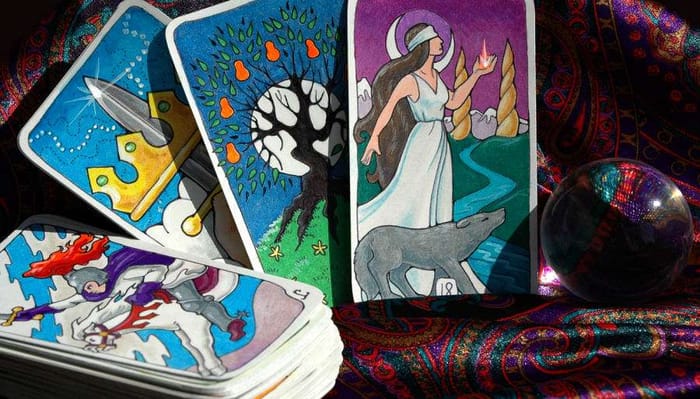
Tarot was a card game for three hundred years before anyone thought it was mystical. That single fact tends to surprise people, but it reshapes everything about how we understand the deck.
The ancient Egyptian origin story, the fortune-telling caravans, the idea that some secret brotherhood encoded forbidden wisdom into 78 cards. None of it holds up. The real history is stranger, messier, and honestly more interesting than any of the myths.
So where did the cards actually come from, how did they become the spiritual tool millions of people use today, and what got lost (or invented) along the way?

Before the Tarot: How Cards Reached Europe
Cards require paper, and paper didn't exist in Europe until the twelfth century. The first European paper mill opened in 1151 in Xativa, Spain, which alone destroys the myth of ancient Egyptian tarot. The Egyptians had papyrus and parchment, neither of which works for cards. Papyrus frays. Parchment crinkles. No paper, no cards.
Paper was invented in China around the second century CE, reached Egypt by 800 CE, and slowly made its way west.
The most important link in the chain is the Mamluk dynasty of Egypt and Syria (1250-1517), which produced a four-suit card deck that almost certainly introduced cards to Europe. Fragments of Mamluk decks survive, some pieces reaching back to the thirteenth century.
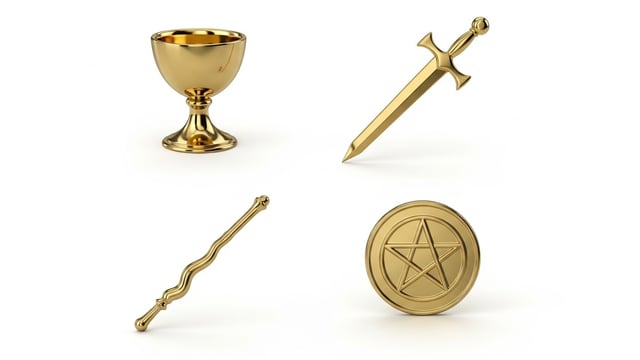
The suits were polo sticks, cups, coins, and scimitars. When these cards crossed the Mediterranean, Europeans transformed the unfamiliar polo sticks into batons, kept cups and coins, and turned scimitars into swords, the origins of the four suits we still use today.
We can track the spread of playing cards across Europe through gambling bans: Bern in 1367, Florence in 1376, Barcelona in 1382. These were ordinary four-suit decks, ancestors of modern playing cards. None of them were tarot.

The Fifth Suit and the Triumphal Procession
Tarot was born in early fifteenth-century northern Italy, probably in the 1420s, when someone added a fifth suit of allegorical figures to the existing four-suit deck.
This fifth suit functioned as permanent trumps in a trick-taking game, a sophisticated ancestor of bridge. The Italian name "trionfi" (triumphs) is the root of our word "trump." The game was entertainment for the aristocracy and nothing more.
But that name - "triumphs" - is the key to what the cards actually depicted. A Renaissance triumphal procession was a real, public event: an allegorical parade moving in strict hierarchy from lowest to highest, with each group "triumphing" over the one before it.
Leonardo da Vinci directed such events in Milan. Love triumphs over the individual. Death triumphs over Love. Fame triumphs over Death, and so on upward toward the divine.
The tarot trumps are a portable version of this public ritual. They encode the same hierarchical movement from the mundane to the cosmic. When you lay out the Major Arcana in order, you're looking at a procession that any fifteenth-century Italian would have recognized on sight.
The oldest substantial surviving cards are hand-painted pieces from fifteen fragmented decks made for the Visconti-Sforza family of Milan around the 1450s.
Painted in tempera on thick cardboard with gold-leaf backgrounds, each with a small hole at the top, they were displayed on walls like miniature paintings rather than shuffled and dealt.
There was no single "original" tarot. Early decks varied wildly. The Visconti-Sforza has no Tower and no Devil.
Another early deck contains all seven classical virtues and six court cards per suit. Three different trump orderings existed across Italian city-states simultaneously.
A Florentine variant called the Minchiate expanded to forty trumps plus the Fool, adding zodiac signs, the four elements, and the four cardinal virtues. This counts as strong evidence against the "hidden wisdom" theory.
Renaissance artists who wanted cosmic symbols in their deck didn't encode them secretly; they just added them. When they wanted zodiac signs, they painted zodiac signs. The standard twenty-two trumps were evidently not understood as a concealed cosmic system by the people who made them.

The Platonic Architecture
Yet the standard trump sequence was not random. Across all known early orderings - Milanese, Ferrarese, Bolognese - the same characters tend to cluster in the same three groups. The first group (roughly cards 1 through 7) deals with worldly conditions: the Magician, the Popess, the Empress, the Emperor, the Pope, the Lovers, the Chariot. The middle group (roughly 8 through 14) introduces moral and cosmic forces: Justice, the Hermit, the Wheel, Fortitude, the Hanged Man, Death, Temperance. The final group (15 through 21) moves into the spiritual and celestial: the Devil, the Tower, the Star, the Moon, the Sun, Judgement, the World.
This threefold division maps precisely onto the three parts of the soul described in Plato's Republic: appetite, will, and reason.
The first seven cards show the appetitive world of human desire and social structure. The middle seven show the willful struggle with moral forces. The final seven show the rational soul's ascent toward cosmic understanding.
Each group carries a classical virtue that purifies its corresponding soul-part: Temperance purifies appetite, Fortitude purifies will, and Justice purifies reason.
The "missing" fourth virtue, Prudence, puzzled occultists for centuries - until you notice that Prudence, the highest virtue (the one that contains the other three, according to medieval philosophy), is the World card itself. The final trump. The virtue that completes all the others.
This isn't occult speculation. It's Renaissance philosophy built into the original structure of the game. The people who designed these cards lived in a culture saturated with Platonic thought.
Around 1530, the name shifted from "carte da trionfi" to "tarocchi," and the cards remained a game - but a game with philosophical bones.
The Marseilles Standard
Tarot reached France around 1507, produced first in Lyons. After Charles VIII's invasion of Milan in 1499 and the French occupation that followed, the Milanese ordering of trumps became the French model.
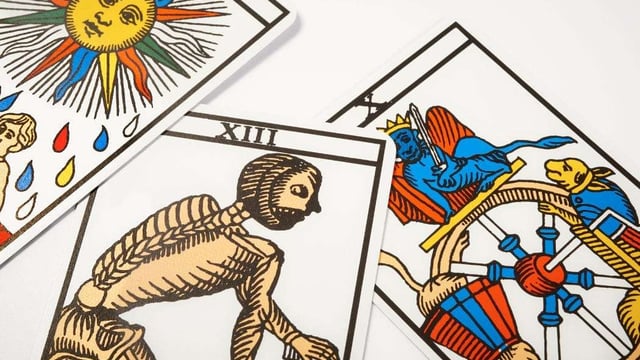
Over the next two centuries, a standardized design emerged (roman numerals on the trumps, consistent suit symbols, a fixed sequence) that became known as the Tarot of Marseilles.
"Marseilles" refers to a style, not specifically to the city. Of roughly one million tarot decks produced in seventeenth-century France, only three survive. But this standardization mattered enormously - for the first time, Western Europe shared a common tarot vocabulary.
The same images, the same order, the same visual language. This was the deck that would land on a table in a Parisian salon one evening in 1781, and redirect the deck's entire trajectory.

The Night Everything Changed
In 1781, a Swiss Protestant pastor and Freemason encountered a tarot deck at a Parisian countess's card party. He had an immediate flash of recognition: these were Egyptian.
He published the claim that same year, inventing a false etymology: "Tar" meaning road, "Rha" meaning king, together "the royal road" in Egyptian. He did no research whatsoever.
The etymology was disproved when the Rosetta Stone was deciphered in 1799. There is no such phrase in Egyptian.
And as we've already seen, the physical impossibility alone is decisive. Ancient Egypt had no paper.
But the damage (or the gift, depending on your perspective) was done. The claim that tarot was ancient Egyptian wisdom embedded in a deck of cards proved irresistible.
It spread through occult circles and into popular culture, where versions of it still circulate today.
What's strange is that this same figure made one genuinely significant structural observation: the number seven runs through the tarot like a spine. There are 77 valued cards (11 times 7), 21 trumps (3 times 7), and 14 cards per suit (2 times 7).
Seven was sacred in Egyptian, Hebrew, Christian, and Pythagorean traditions alike, representing the seven visible planets, the seven-runged cosmic ladder, the seven days of creation. Wrong about the history, but not wrong about the architecture.
He also made changes to the cards themselves that stuck permanently. He turned the Hanged Man right-side-up, claiming the card depicted "Prudence" standing on one foot.
He renamed the Papesse "High Priestess" and the Pope "Hierophant" to strip away Christian imagery. Both renamed versions appear in the most popular modern deck.
A contemporary published alongside him, dividing the 21 trumps into three groups of seven - a threefold structure that is actually sound. More consequentially, he was the first to propose that each of the 22 Major Arcana corresponds to a Hebrew letter.
That idea would become the dominant framework for all subsequent occult interpretation of the tarot. The very terms "Major Arcana" and "Minor Arcana" - the vocabulary everyone now uses - were coined a generation later by a student of the French occultist who built on this foundation.
Divination Before the Myths
There's a wrinkle in this timeline that upends the standard narrative.
The first professional tarot reader had been practicing card divination since the 1760s and published a book on it in 1770 - a full eleven years before the Egyptian myth appeared. And he wasn't the earliest evidence. Ordinary playing cards were being used for fortune-telling as early as 1487, when a German manuscript from Mainz described a card-based divination system. A 1750 document from the University of Bologna records a tarot-specific divination tradition in that city.
Divination with cards was older and more local than the Egyptian myth suggests. It grew from folk practice, not from ancient temples.
Later occultists dismissed the first professional reader unanimously. But here's the irony: the Minor Arcana meanings that most modern readers rely on are almost entirely derived from his system. The very tradition that rejected him quietly absorbed his work. His interpretations survived inside the frameworks of people who claimed he was irrelevant.

Kabbalah Enters the Picture
In the 1850s, a French occultist reinvented himself with a pseudo-Hebrew name and published two volumes that became the foundation of modern Western occultism. His central innovation: correlating the 22 Major Arcana to the 22 Hebrew letters, linking each chapter of his work to a Hebrew letter, a number, and a tarot key.
He created the iconic Chariot with its dark and light sphinxes, drew the famous Baphomet illustration that later shaped the Devil card, and wrote what may be the most quoted sentence in tarot history: "An imprisoned person with no other book than the Tarot, if he knew how to use it, could in a few years acquire universal knowledge."
The historical problems with this framework are real. The letter-to-card assignments are often forced. Kabbalah didn't significantly influence Italian art until after the tarot was already developed. The claim that Kabbalists created the tarot is unsupported by evidence.
But there's a subtler truth underneath: Kabbalah and tarot draw on the same deep structural grammar - the same Pythagorean fascination with number, the same Neoplatonic ladder from matter to spirit.
The ten pip cards echo the ten sephiroth. The 22 Major Arcana match the 22 pathways. These systems rhyme because they grew from the same philosophical soil, not because one produced the other.

Ten Years That Shaped a Century
In 1888, a secret society was founded in London that would last barely a decade, never exceed a few hundred members, and permanently reshape the Western world's relationship with the tarot.
Its foundational tarot document made several decisions that still govern most modern decks: moving the Fool to the first position, switching Justice and Strength to match astrological correspondences, renaming the suits to wands, cups, swords, and pentacles, and connecting each trump to a specific path on the Tree of Life.
The membership list reads like a who's who of early twentieth-century Western esotericism - poets, actors, ceremonial magicians, mystics, and at least one future Nobel laureate. Virtually every widely used English-language tarot deck traces its framework back to this group's influence.

A Big Job for Very Little Cash
In 1909, a deck was published that would become the most recognizable tarot in the world.
The conceptual direction came from a mystic and translator who valued the tarot as a vehicle for contemplation and explicitly stated he hated fortune-telling. Remarkably, he maintained that all correlations between the trumps and the Hebrew alphabet were false - even as he built his system on those correlations.
The artist who brought the deck to life was a woman of extraordinary range - born in Middlesex, raised across London, New York, and Jamaica, trained at Pratt Institute, exhibited at one of New York's most important galleries.
She was known as a storyteller, illustrator, and psychic who would enter light trances while listening to music and draw what she saw.
She created all 78 designs in approximately six months. Her letter to a friend that November: "I've just finished a big job for very little cash!" The conceptual architect described what he wanted; the artist executed intuitively.
He couldn't have overseen every detail in that timeframe, and his later written descriptions sometimes misidentify elements in the cards - describing the Ace of Cups as having four streams when the picture shows five. The art contains meaning he didn't put there.
Her most revolutionary contribution was creating full allegorical scenes for all 56 Minor Arcana cards. No previous deck for wide distribution had done this. Earlier pip cards showed geometric arrangements of suit symbols.
She drew human figures in specific situations, working from photographs of a specific fifteenth-century Italian deck - the Sola-Busca - which had recently arrived at the British Museum. The Sola-Busca was unique in its era: a complete engraved deck featuring warriors rather than allegory, with fully illustrated pip scenes. It was also the first known deck to number the Fool as zero. When you look at the artist's Ten of Wands or Three of Swords, the visual debt to the Sola-Busca is unmistakable.
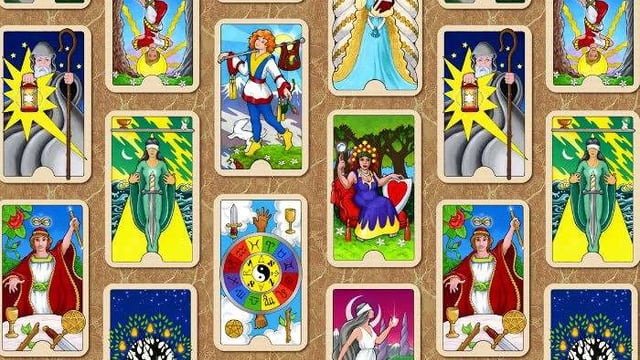
You could look at the Eight of Swords and read something from the image without memorizing a keyword system. This single innovation democratized the tarot. She was paid almost nothing and went largely uncredited for decades.
A second major twentieth-century deck, completed in 1942, moved in the opposite direction - explicitly incorporating dense ceremonial frameworks, renaming several cards, and using projective geometry in the artwork. Most modern "occult" decks trace from this second tradition. Most "psychological" and "intuitive" decks trace from the 1909 deck.
The split is still visible on any shelf of tarot decks today.

The Modern Shift
The mid-twentieth century brought a conceptual revolution. The theory of archetypes - universal symbolic images arising from the collective unconscious - provided a secular vocabulary for taking the tarot seriously without committing to its occult metaphysics.
The cards didn't need to be magical to be meaningful. They worked because they generated metaphor, and human beings naturally find meaning in metaphor. What you see in the image, what it stirs in you - that tells the reader about you.
The 1960s through the 1980s brought a mass-market explosion. Hundreds of new decks appeared. Archetypal psychology, the Hero's Journey, and Eastern contemplative traditions merged with the Western mystical tradition.
By the early 2000s, tarot had largely shed its fortune-telling stigma and repositioned itself as a tool for insight, journaling, and self-reflection.

Where Numbers Meet the Cards
The tarot's structure is numerical to its bones, and the connections to numerology run deeper than most people realize. The pip cards - Ace through Ten in each suit - derive their meanings from the same Pythagorean number philosophy that underlies modern numerology.
As one sixteenth-century philosopher of number wrote, "all things which were first made by the nature of things seem to be formed by the proportion of numbers." The tarot's ten-pip structure encodes this doctrine of emanation directly.
The Pythagorean tetractys (1+2+3+4 = 10) was a model for how reality unfolds from unity into multiplicity. Ten is where the cycle completes and begins again. You'll find the same principle at work in numerological meanings from 1 to 9.
Each number carries a distinct energy across all four suits. One is initiation. Two is reflection. Three is growth. Four is order. Five is adaptation - mind meeting matter. Six is harmony. Seven is triumph and rest. Eight is rhythm. Nine is completion (think of the Hermit's solitary attainment). Ten is full realization and the seed of a new cycle.
What makes this rich is that the same number means something different in the Major and Minor Arcana. In the Majors, five is the inner mediator (the Hierophant), and seven is spiritual victory (the Chariot).
In the Minors, five tends to mean outer-world problems, and seven is the struggle to balance competing energies. The Majors represent inner principles; the Minors represent how those principles play out in lived experience.
The 22 Major Arcana carry a second layer of numerical meaning through their correspondence to the 22 Hebrew letters, each of which has a numerical value. This creates a system where every trump holds both its card number and a letter-number - the very mechanism behind tarot birth card calculations and other tarot-numerology crossovers.
The total of 22 is itself significant: it matches the number of the complete Hebrew alphabet and was considered the number of "the fullness of wisdom."
Seven - the number the original analyst spotted running through the tarot's spine - was called "the vehicle of man's life" in Renaissance number philosophy, because it joins soul (3) to body (4).
The tarot's seven-architecture isn't decorative. It encodes a specific idea about what human life is: a union of the spiritual and the material, played out across every level of the deck's structure.
One twentieth-century teacher of tarot arranged the 21 numbered trumps in a three-by-seven grid and discovered something elegant: Justice (card 11) sits at the mathematical center, and every pair of cards equidistant from Justice sums to 22.
The Wheel inscribed on the Wheel of Fortune card carries the letters T-A-R-O arranged in a circle - which also reads R-O-T-A, the Latin word for wheel. The Wheel of Tarot speaks the Law. This kind of self-referential patterning is what makes the deck feel alive to people who study it closely.
The four suits map across multiple symbolic systems: four elements (fire for wands, water for cups, air for swords, earth for pentacles), four classes of medieval society, four psychological functions.
The tarot and Kabbalah both use this four-and-ten structure not because one copied the other, but because both drew from the same well of Pythagorean and Neoplatonic thought.

What Survived and What Was Invented
The history of tarot holds a productive tension. The cards were invented as a game in fifteenth-century Italy, and nobody used them mystically for at least three hundred years. The Egyptian origin story was fabricated without evidence.
The Kabbalistic connection was imposed after the fact. The myth that Romani travelers brought tarot to Europe is doubly wrong: the cards existed in Italy before the Roma arrived in Western Europe, and the Roma originated in India, not Egypt.
And yet the interpretive systems that occultists built on that history, however inaccurate, produced genuinely useful frameworks.
The Hebrew letter correspondences, the astrological attributions, the Pythagorean number meanings: these create a symbolic architecture that works regardless of whether anyone intended it in the fifteenth century. The Renaissance imagery drew on real symbolic traditions. The numerical structure is elegant. The archetypes resonate.
Three layers of meaning sit on top of each other. The Renaissance intended a game and an allegory - a portable triumphal procession grounded in Platonic philosophy. The occultists added Kabbalah, astrology, and Hebrew letters - correlating the deck with systems its creators never knew.
Psychology contributed archetypes and the idea of projection - the cards as mirror rather than oracle. Most modern readers work with all three layers at once without realizing they come from different centuries.
The tarot didn't need a fabricated ancient pedigree. Its actual history, a Renaissance card game that accumulated layers of meaning over six centuries, is strange enough on its own.
Three hundred years as a game. Two hundred and fifty years as something more. And the conversation between those two identities is still unfolding.

Frequently Asked Questions
Is tarot really from ancient Egypt?
No. This myth was invented in 1781 by a Freemason who encountered tarot cards at a Parisian card party and declared, without any research, that they were Egyptian. He even fabricated an Egyptian etymology ("Tar" + "Rha" = "royal road") that was disproved when hieroglyphs were actually deciphered via the Rosetta Stone.
The physical impossibility seals it: ancient Egyptians had papyrus and parchment, neither of which works for cards. Paper didn't reach Europe until the twelfth century, and tarot wasn't created until the early fifteenth century in northern Italy.
Why does the same tarot number mean different things in different cards?
Numbers carry a core energy, but that energy expresses differently depending on context. In the Major Arcana, numbers represent inner principles: the Hierophant (5) is about inner mediation, and the Chariot (7) is spiritual victory.
In the Minor Arcana, those same numbers play out in everyday life. Fives tend to show up as outer-world problems, and sevens as the struggle to balance competing forces.
The suit adds another layer: a five of wands (fire/passion) looks very different from a five of cups (water/emotion), even though both carry that core five energy of adaptation and challenge. This layered system is part of what connects tarot and numerology so naturally.
Do you need to be psychic to read tarot?
No. The cards work by generating metaphor - images rich enough that your mind naturally finds personal meaning in them. When you look at the Moon card and feel uneasy, or see the Ten of Cups and feel a pull of longing, that response comes from you, not from any supernatural channel.
The mechanism is psychological, and it's available to everyone. Learning the traditional meanings deepens the practice, but the cards are designed to be readable on intuition, especially decks with fully illustrated scenes in the Minor Arcana.
What was the first tarot deck?
There wasn't one single original deck. Tarot emerged in northern Italy in the 1420s, probably in Milan, Ferrara, or Bologna, and early decks varied widely. Some had different numbers of trumps, different figures, different orderings.
The oldest substantial surviving cards are fragments from about fifteen hand-painted decks made for the Visconti-Sforza family of Milan around the 1450s - luxury objects painted in tempera with gold-leaf backgrounds, displayed on walls rather than played with.
The tarot we recognize today took shape gradually over the fifteenth and sixteenth centuries, with the Marseilles design eventually standardizing the format across Western Europe.