The Planets in Astrology: Ten Drives Running Your Life
By Blair Andrews · Published April 27, 2026 · Updated May 10, 2026
They're Not Out There. They're in Here.
Pop astrology introduces the planets as cosmic weather. Mercury goes retrograde and your phone breaks. Saturn shows up and your life falls apart. Jupiter arrives and money appears. The planets do things to you, in this version. You just endure them.
The reality is far more interesting - and far more empowering.
In a birth chart, the planets represent psychological drives - active functions of your own psyche, each with its own agenda, its own style, and its own claim on your energy. The Sun is your drive toward becoming a distinct individual. The Moon is the survival instinct that was running before you had words. Mars is the force that says I exist separately from you and means it.
These aren't forces acting on you from millions of miles away. They're parts of you, operating right now, whether you're aware of them or not.
Your birth chart is a map of these drives - where they're strong, where they're blocked, where they cooperate, where they conflict. Understanding the planets isn't about predicting what will happen to you. It's about recognizing what's already happening inside you.
Think of your personality as a mountain. The visible peaks - the Sun, Moon, Mercury, Venus, Mars, Jupiter, and the four angles of the chart - describe who you are as a distinct individual. Saturn sits at the threshold where the mountain meets the bedrock beneath it. And Uranus, Neptune, and Pluto rise from the shared geological layer where all mountains join, far below the surface. The image explains the entire planetary system better than any list of keywords.
If you're just beginning to explore astrology beyond your Sun sign, our complete astrology guide provides the broader framework for how signs, houses, and planets work together.

The Luminaries: Where Everything Begins
The Sun and Moon aren't technically planets. Astrology calls them luminaries, and they sit at the center of everything else in your chart. Think of them as two opposing forces that drive your entire development.
The Moon pulls you backward, toward safety, toward what's familiar, toward the patterns your earliest caretaker etched into your nervous system before you could speak.
The Sun pushes you forward, toward individuation, toward becoming the specific person only you can be. The tension between these two is the engine.
You need both. The Moon without the Sun is someone who never leaves the harbor. The Sun without the Moon is someone who sails so far from shore they forget why they left.
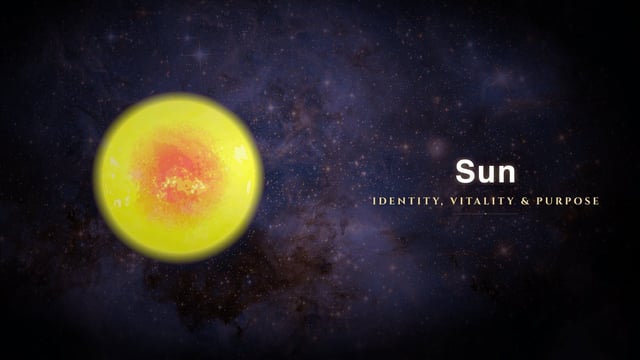
 | The Sun is not your personality. It's your direction. It describes the quality of selfhood you're working toward over a lifetime - the specific style of self-expression that will feel most authentically yours when you stop performing and start inhabiting. Most people don't fully arrive at their Sun sign until their forties or fifties. It's something you grow into, not something you already are. |
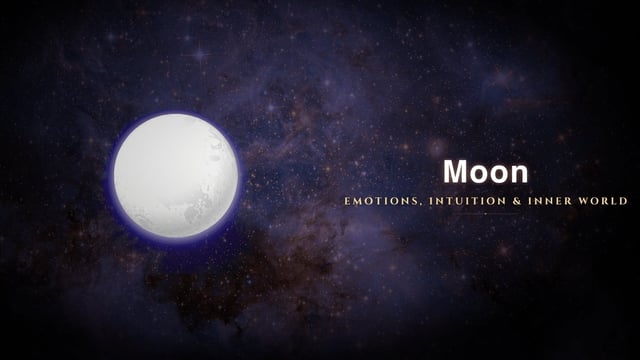
 | The Moon is your survival system. The instinctive, pre-verbal architecture of how you seek safety, how you attach to others, and how the earliest experience of being cared for left its mark on every intimate bond since. It's not "your emotions" in the casual sense. It's the ancient layer that was running before you had words, and it's still running now. Explore how this plays out across all twelve expressions in our guide to the Moon through the signs. |

The Personal Planets: Building a Self
Mercury, Venus, and Mars build the personal self that mediates between the luminaries and the heavier planets. They operate in the immediate, individual realm. Your thinking, your values, your capacity to act.
Pop astrology treats these three as lightweight - Mercury is "communication," Venus is "love," Mars is "aggression." This misses almost everything that matters about them.
Here's what's actually at stake. If the personal self built through Mercury, Venus, and Mars is underdeveloped, the heavier planetary energies don't build you up. They shatter you.
You can't do deep Plutonian work if you've never figured out what you actually like. You can't handle a Neptune transit with grace if you can't think clearly. You can't weather a Saturn return if you have no idea what you're willing to fight for. These three planets aren't preliminary. They're foundational.
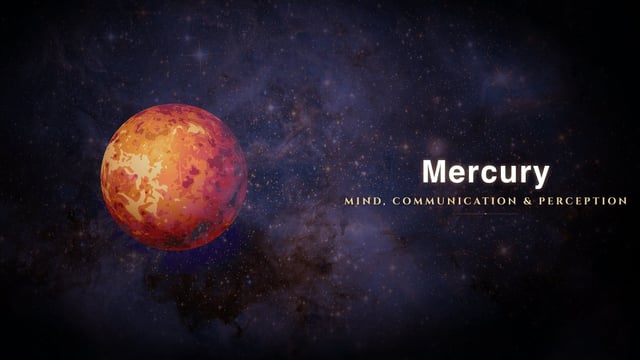
 | Mercury is your perceptual apparatus - what you selectively notice, what you filter out, and how you move between different levels of reality. Communication is a secondary effect. The primary function is constructing the world you then live in through how you perceive it. The same mental machinery can keep you imprisoned in old stories or set you free from them. |
 | Venus is your value system made visible. What you find beautiful, what you desire, what you consider worth existing. Identity is largely a function of what we love, which makes Venus far more central to who you are than a "love planet" label suggests. Where Venus is blocked, self-worth goes with it. Our guide to Venus through the signs explores the twelve ways this desire expresses. |
 | Mars is the assertion of your right to exist as a separate individual. It cuts the cord, draws the boundary, pursues the goal, and defends the self. Without functioning Mars, the Sun has vision but no capacity to act. Venus has desire but no capacity to pursue. A blocked Mars doesn't go quiet. It turns inward as depression, or sideways as the elaborate indirect aggression of someone who has learned to get what they want without ever admitting they wanted it. See how this force operates across all twelve signs in our Mars in the signs guide. |

The Social Planets: Where the Personal Meets the World
Jupiter and Saturn form a pair at the boundary between your individual life and the larger structures you live inside. Jupiter expands; Saturn contracts. But labeling one "good" and the other "bad" - which astrology has been doing for two thousand years - misses what they're actually doing.
Together, they define the outer edge of what your personal ego can handle. Jupiter pushes you to grow beyond your current limits. Saturn tests whether that growth is built on anything real.
The key distinction is this: Jupiter and Saturn transits may hurt, but they belong to the human realm. You can integrate them. You can learn from them. The experiences they produce feel recognizable even when they're hard. The outer planets are different. They introduce something that doesn't originate in your personal psychology and can't be controlled by the ego. That's what separates the social planets from the transpersonal ones - not a scale of importance, but a difference in kind.
 | Jupiter is the function that reaches beyond the self toward meaning, expansion, and faith. It asks what your life is for - the drive to find a philosophy, a belief system, or a sense of growth that makes ordinary existence feel purposeful. Its shadow is inflation - the loss of individual proportion in a cloud of grandiose vision. Too much Jupiter and you can promise the world while delivering nothing. |
 | Saturn is the principle of limit, structure, and reality-testing. It's not the grim reaper. It's the teacher who builds you through genuine difficulty, the alchemical lead that becomes gold only through sustained engagement. Saturn rewards exactly what it demands - show up, do the work, accept the limit, and the limit becomes the foundation for everything else. Saturn also occupies a unique structural position in the chart. It's the last planet visible to the naked eye - the outermost boundary of what ancient astronomers could see. Psychologically, that makes Saturn the threshold between the individual and the collective, between the personal mountain peak and the geological bedrock the outer planets rise from. Everything Saturn-ward and inward belongs to the ego. Everything beyond Saturn belongs to something larger. This is why Saturn transits feel heavy but comprehensible. They test the self. The outer planets do something else entirely. |

The Transpersonal Planets: Forces Bigger Than You
Uranus, Neptune, and Pluto move so slowly that they define generations rather than individuals. Everyone born within a several-year window shares the same outer planet positions.
Remember the mountain image. Your individual personality is the peak - distinct, particular, yours. These three planets operate from the common bedrock all peaks rise from, the shared layer of collective experience far below the surface. That's why their transits feel so different from a Jupiter or Saturn passage. When one of these planets crosses a personal point in your chart, you're being touched by something that doesn't originate in your individual psychology. It comes from deeper.
The ego can't control it, and trying to is like trying to negotiate with weather. The appropriate response isn't resistance. It's conscious participation in something larger than yourself.
 | Uranus is the sky-god who operates through sudden, clarifying disruption. Collective ideas whose time has come, erupting into individual lives in ways the ego didn't plan and can't fully control. The disruption is not a punishment. It's a reorganization. Though it rarely feels that way in the moment. |
 | Neptune governs the depths where individual identity loosens and something larger becomes perceptible. The yearning for dissolution, for unity, for the oceanic feeling of being part of something infinite. This drive can lead to the highest spiritual experience or to the most elaborate self-deception, depending on how much honest ego is available to stay grounded. |
 | Pluto is the slowest and the deepest - the bass rhythm beneath everything else. It heralds the death of structures that have outlived their purpose and the eruption of what was suppressed. Its transits feel fated because they operate from a level far below conscious choice. Pluto is not "transformation" in the comfortable sense. It's what happens when the underground river finally breaks through. |

None of Them Are Simply Good or Bad
Traditional astrology called Mars and Saturn "malefics" and Venus and Jupiter "benefics." Pop astrology inherited this and ran with it, creating a moral universe where some planets are friends and others are enemies. The reality is less comfortable and more interesting.
Every planet has a face that serves growth and a face that creates havoc. Which one you get depends on how conscious you are about that function, not on whether the planet is inherently kind or cruel.
Venus isn't always pleasant - in myth, Aphrodite was competitive, treacherous, capable of destroying lives through desire. Jupiter at its worst is grandiosity and overextension. Mars at its best is the protective force that holds a boundary so love has somewhere safe to land.
The classical tradition actually prescribed specific counterbalances. Renaissance philosophers taught that the Sun, Jupiter, and Venus function as natural antidotes to the heavier planetary energies. When Saturn's weight becomes too much - too much isolation, too much heaviness - you apply Jupiter's warmth and expansiveness. When Mars runs hot - too much conflict, too much aggression - you apply Venus. The three benefics were understood not just as "good planets" but as specific medicines for the three kinds of excess. That is a remarkably practical framework, and it is five hundred years old.
The traditional "benefic/malefic" language was always conditional. A benefic planet in poor condition can fail to deliver its goods. A malefic in strong condition can produce remarkable outcomes. The condition modifies the tendency. Neither the tendency nor the condition tells the whole story alone.
The outer planets are genuinely amoral. Whether someone channels Uranus, Neptune, or Pluto in constructive or destructive ways depends entirely on the consciousness of the person, not on something inherent in the planetary energy.
This is worth sitting with. The planets don't sort into heroes and villains. They sort into drives you're working with consciously and drives you're not.

Retrograde Doesn't Mean Broken
Mercury retrograde did not cause your ex to text you.
Retrograde is a visual phenomenon - the planet appears to move backward from Earth's perspective as relative orbital speeds create an optical illusion. What it means astrologically is that the planet's energy turns inward rather than expressing outward in its usual direct fashion.
People with natal Mercury retrograde, for instance, are not bad communicators. They're reflective ones. They process before they speak. They chew things over. That's a different cognitive style, not a malfunction. People with natal retrograde planets are often more thorough in their inner work precisely because they reflect before expressing.
Traditional astrology treated retrograde as a specific condition affecting whether a planet can deliver its significations in a given chart - not as a collective weather event hitting everyone simultaneously. The "Mercury retrograde survival guide" genre is a modern invention with no basis in traditional practice.
Retrograde planets in a birth chart indicate drives that are more interior, more private, more concerned with inner experience than outward performance. Transiting retrograde periods are suited for revisiting and refining rather than launching new ventures. A planning tool, not a curse.

Why the Sign Matters: Planetary Dignity
Planets function differently depending on which sign they occupy. The traditional language for this is dignity.
A planet in the sign it rules - its domicile - has full access to its own resources. It's operating from home ground, free to express its nature without interference. A planet in its exaltation operates with particular clarity and strength. In detriment or fall, the planet works in conditions that don't naturally suit it.
But detriment and fall are not weaknesses. They describe a harder relationship between the planet's function and the sign's mode, and that friction often produces more interesting results than easy placement.
A Sun in Libra - technically in fall - faces the genuine challenge of defining its own direction in a sign that keeps looking to others for mirrors. That's difficult. It can also produce someone who becomes extraordinarily skilled at the kind of self-knowledge that only comes through sustained encounter with difference. The road is harder. The view from the top can be more earned.
Dignity is a spectrum, not a verdict. It describes the conditions a planet is working with, not whether its outcomes will be good or bad.

Planets and Numbers: A Shared Root
Here's something most modern practitioners have forgotten. The planets and the single-digit numbers come from the same intellectual tradition.
Renaissance cosmology - the same Pythagorean-Neoplatonic system that gave us both astrology and numerology - explicitly assigned each planet a number. The Sun corresponds to 1: unity, the source, the self that illuminates everything else. The Moon corresponds to 2: reflection, receptivity, the first division. Jupiter corresponds to 3: expansion, the fortunate teacher. Mercury corresponds to 5: mediation, the bond between all others. Venus corresponds to 6: generation, harmony, marriage. Saturn corresponds to 7: limit, boundary, time.
When the astrology tradition says the Sun is about individuation and the numerology tradition says the number 1 is about self-reliance, they're drawing on the same root. These aren't two separate systems that happen to overlap. They're two branches of one tree, speaking in different dialects about the same forces.
Working With All Ten
The planets aren't a menu where you pick the ones you like. They're all running, all the time, in everyone. The question isn't whether Mars or Saturn or Neptune is active in your life. It's whether you're working with that drive consciously or whether it's working you from behind the scenes.
Start wherever curiosity pulls you. If relationships are your question, begin with Venus and the Moon. If you're wrestling with purpose, start with the Sun and Jupiter. If something in your life is falling apart in ways that feel larger than personal, you're probably in conversation with Pluto, Neptune, or Uranus.
And if you want to understand where these drives play out in your actual life - which areas they concentrate in, which arenas they activate - that's the work of the twelve houses.
The planets aren't doing anything to you. They never were. They're showing you what's already happening - the drives that have been shaping your choices, your relationships, and your sense of self since before you knew they had names. Seeing them clearly doesn't change what they are. It changes what you can do with them.
Frequently Asked Questions
What is the difference between personal planets and outer planets in a birth chart?
Personal planets (Sun, Moon, Mercury, Venus, Mars) + Jupiter and Saturn describe your individual psychology. Outer planets (Uranus, Neptune, Pluto) move so slowly they define generations - everyone born within a several-year window shares the same positions. Their influence in your chart comes when they cross a personal point - and it feels different because it doesn't originate in personal psychology.
What does it mean when a planet is in retrograde?
Retrograde is an optical illusion from Earth's perspective. Astrologically, it turns the planet's energy inward rather than expressing outward. Natal retrograde planets are more reflective, interior, private - a different cognitive style, not a malfunction.
Which planet in my birth chart is most important?
Sun and Moon are the luminaries at the center of everything. But the most individually significant planet is often your chart ruler (the planet ruling your Rising sign). Beyond that, planets near the Ascendant or Midheaven have their volume turned up.
Is it true that some planets are 'bad' - like Saturn or Mars?
Traditional astrology called Mars and Saturn 'malefics' but this was always conditional - a malefic in strong condition can produce remarkable outcomes. Every planet has a face that serves growth and a face that creates havoc. Venus at its worst is competitive and treacherous (Aphrodite in myth).
What does it mean when a planet is in its 'dignity' or 'detriment'?
Dignity describes the conditions a planet works with in a given sign. In domicile (its ruling sign): full access to its own resources, operating from home ground. In exaltation: particular clarity and strength.