The Tarot Suit of Cups - Emotion, Intuition, and the Inner World
By Blair Andrews · Published May 21, 2025 · Updated May 10, 2026
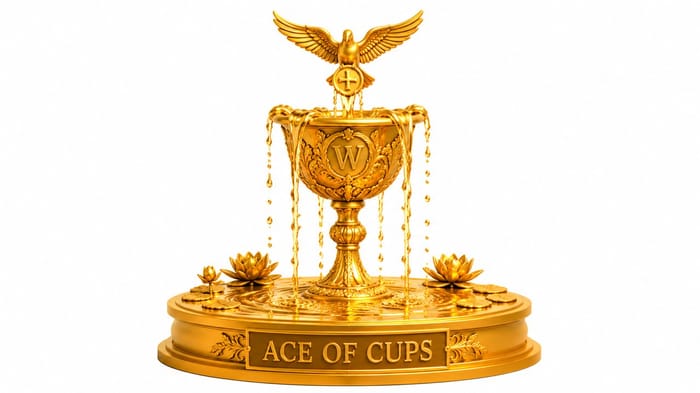
You probably know someone who walks into a room and somehow makes everyone feel calmer. Not because they say the right thing - they might not say much at all. They just have a quality. People lean toward them the way water finds a drain. Open, receptive, quietly present. That quality, turned into fourteen tarot cards, is the Suit of Cups.
Cups don't push. They don't strategize, they don't ignite, and they don't build in the way the physical world understands building. They receive. If you've ever made a decision entirely based on a feeling you couldn't explain, or walked away from something that looked perfect on paper because it felt wrong in your body, the Suit of Cups was running the show.

Water and the Inner Life
Water is the element behind every Cup card, and it helps to be specific about what that means. Not the ocean's dramatic force or the violence of a flood. Water's essential property is simpler than that - it flows into every available space, takes the shape of whatever contains it, and finds every crack. You can't push it into a shape it doesn't want to hold. But it's always moving, always seeking its own level.
In the tarot's symbolic system, water represents the subconscious. That's the part of your mind that processes emotion, stores memory, generates dreams, and knows things before the conscious mind catches up. The blue robe of the High Priestess - pure subconscious power - carries the same water symbolism that runs through every Cup card. When Cups dominate a reading, you're being asked to listen to something that logic alone won't access.
This makes Cups the natural complement to Swords, which represent the conscious, analytical mind. Where Swords cut and discriminate, Cups absorb and feel. Where Wands project energy outward with force, Cups receive it inward with openness. And where Pentacles ask what you're building in the material world, Cups ask what's happening in the world beneath the surface - the emotional currents that determine whether anything you build will actually satisfy you.

The Arc from Open Vessel to Completed Belonging
Read the ten numbered Cups in order and a story emerges. It's the story of the emotional life from its first opening to its fullest expression, with every detour and disappointment along the way.
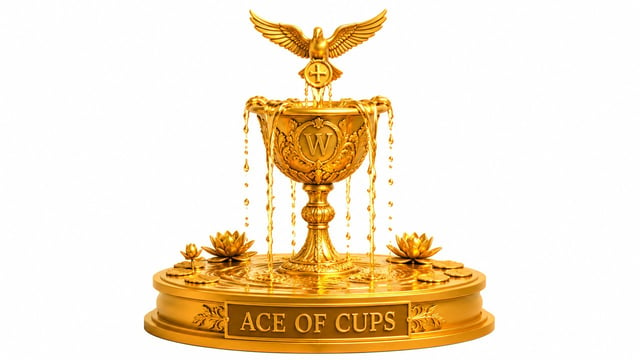
The Ace of Cups is unlike any other Ace in the deck. A dove - the symbol of spirit, of something sacred - descends into a golden cup overflowing with water. This isn't just an emotional beginning. It's the moment when something from above enters the feeling world. A grace note. The start of something you didn't manufacture, that arrived because you were open enough to receive it.
The Two of Cups is where that openness meets another person. Two figures face each other with equal intention, exchanging cups. This is mutual recognition, one soul reflected clearly in another. People often read the Two as a romance card, and it can be, but its deeper meaning is the experience of being truly seen by someone who is also letting themselves be seen. That's rarer than romance and more valuable.
The Three of Cups multiplies the connection. Three women with cups raised, dancing. This is the kind of happiness that only exists in community - joy that wouldn't be the same experienced alone. The Three says some emotional experiences require other people. Not because you're incomplete by yourself, but because certain frequencies only sound right as a chord.
Then the Four of Cups turns inward in a way that costs you something. A figure sits under a tree, staring at three cups on the ground, while a hand from a cloud offers a fourth cup that goes completely unnoticed. Emotional preoccupation. The Four is the card of being so wrapped up in what you already feel - or don't feel - that you miss what's being offered right now. In the minor arcana, fours bring structure and stability, but in Cups that stability can look like emotional stagnation.
The Five of Cups is grief, plainly. A cloaked figure stares at three spilled cups while two remain standing behind them. Everyone notices the loss. Almost nobody - including the figure in the card - notices what's still there. The Five doesn't minimize pain. It just quietly points out that the story isn't over yet.
The Six of Cups reaches backward in time. An older child hands flowers to a younger one. Innocence, nostalgia, the sweetness of the past revisited. But the Six isn't only about memory. It's about how the emotional tone of earlier experiences shapes what you're able to feel now. Sometimes you have to go back before you can go forward.
The Seven of Cups is where the imagination gets loose. Seven cups floating in clouds, each holding something different - a castle, jewels, a wreath, a dragon, a veiled figure. Most of what's being offered isn't real, but the feelings they provoke certainly are. The Seven is the card of fantasy, wishful thinking, and the crucial skill of knowing which possibility is worth pursuing and which is vapor.
The Eight of Cups is one of the most quietly powerful cards in the deck. Eight cups neatly arranged, and a figure walking away under a crescent moon toward higher ground. Nothing is broken. Nothing was taken. The cups are still standing. But the person who stacked them has grown past what they represent. The Eight is the grief of leaving something that still works because your soul has moved beyond it.
The Nine of Cups - often called the wish card - shows a figure seated with arms crossed, nine cups arranged in an arc behind them. Emotional satisfaction achieved. The wish granted. But look at the posture: arms folded, self-contained, a little smug. The Nine's shadow is self-satisfaction that stops receiving. When you've gotten what you wanted, the temptation is to close up. The Nine asks whether your contentment has room for more, or whether you've sealed the cup.
And the Ten of Cups opens everything back up again. A couple with arms raised, children playing, a rainbow of cups overhead. Emotional fullness extended beyond the self into family, community, and lasting connection. The Ten is belonging that was earned - not the starting kind of love but the kind that survived the spills, the fantasies, the quiet departures, and came out complete.

The People Who Carry Water
The four court cards of Cups show emotional intelligence at different stages, and each figure holds their cup in a way that tells you everything about their relationship with feeling.
The Page of Cups stares at a fish that has popped out of a golden cup. Strange? Definitely. But the Page's expression isn't alarm - it's curiosity. Open-hearted, slightly bewildered, willing to engage with something that doesn't make rational sense. Emotional life at this stage is full of surprises, and the Page's gift is the ability to be delighted rather than frightened by the unexpected. In a reading, this figure often points to a creative impulse or emotional message arriving from an unlikely direction.
The Knight of Cups is the only knight in the deck who isn't charging. His horse moves slowly, almost ceremonially, and the cup is extended outward like an offering. Where the Knight of Wands rides toward excitement and the Knight of Swords rides toward certainty, the Knight of Cups rides toward connection. That takes a specific kind of courage - the willingness to approach someone with feeling rather than force, knowing that the offering might not be received.
The Queen of Cups holds a cup she never opens. She gazes at it, but the lid stays sealed. This is the most intuitive figure in the entire tarot, and the sealed cup is central to understanding her. Feeling-intelligence doesn't need to be pried open or analyzed or displayed. It needs to be trusted. The Queen knows what she knows without needing to explain it, and her authority comes from that trust. In readings, she often represents someone whose emotional perception runs deeper than what's being said aloud.
The King of Cups sits on a stone throne in the middle of the ocean. Water churns around him. A fish leaps on one side, a ship rides waves on the other. And the King is perfectly calm. Mastery of water doesn't mean staying dry. It means being in the ocean - fully feeling, fully present to emotional reality - without being swept away. The King is the most complex figure in the suit: artistic, subtle, deeply perceptive, capable of holding tremendous emotional weight. His shadow appears when the mastery becomes too severe, when ruling the emotional realm starts to mean suppressing it.

When Cups Fill a Reading
A spread full of Cups tells you the situation is fundamentally emotional. Whatever practical considerations exist, whatever logical arguments have been laid out, the real action is happening beneath the surface. The answers you need probably won't come from a spreadsheet or a strategy session. They'll come from paying attention to what you actually feel - and being honest about it.
When Cups are absent from a reading, the heart's intelligence is being bypassed. That isn't always a problem. Some situations genuinely call for Swords-level analysis or Wands-level action. But if you notice Cups are missing from a reading about a relationship, or a creative decision, or anything that should involve the inner life, it's worth asking what feelings are being ignored or suppressed.
In timing questions, Cups tend to suggest weeks to months. Water moves at its own pace. And the emotional work that Cup cards point toward - the grief that needs processing, the connection that needs building, the intuition that needs trusting - rarely resolves on someone else's schedule.

Frequently Asked Questions
Are Cup cards always about romantic relationships?
Romance is common territory for Cups, but the suit covers the entire emotional landscape. Grief belongs to Cups. So does creative passion, spiritual receptivity, friendship, the relationship you have with your own inner life, and the intuition that guides decisions your rational mind can't fully explain. The Five of Cups is loss. The Seven of Cups is imagination. The Eight of Cups is outgrowing something you once loved. Narrowing the suit to romance misses most of what it has to say.
What's the difference between the Queen of Cups and the Queen of Swords?
Both queens are perceptive, but they perceive through completely different channels. The Queen of Cups knows things through feeling - her sealed cup represents intuition that doesn't need to be opened or explained, just trusted. The Queen of Swords knows things through clarity - her raised sword represents truth that has been earned through painful experience. The Queen of Cups senses what's true. The Queen of Swords sees it. In a reading, the distinction often matters: are you being asked to trust your gut or sharpen your discernment?
Can Cup cards indicate creative work?
Absolutely. Creativity that comes from an emotional or intuitive place - writing, music, visual art, any work where the process is driven by feeling rather than strategy - often shows up through Cups. The Ace is the initial inspiration, the moment something moves through you that you didn't plan. The Three of Cups can indicate collaborative creative work. The Page of Cups often represents the playful, curious beginning of a creative project. If the creative work is more fire-driven (entrepreneurial, high-energy, performance-based), you're more likely to see Wands.
Why is the Eight of Cups considered a difficult card when nothing bad is actually happening?
Because the kind of loss it represents is the hardest to explain to other people. The Eight of Cups shows a figure walking away from something intact - the cups are still standing, still full. There's no betrayal, no collapse, no dramatic reason to leave. The soul has simply grown past what's there. That quiet grief of outgrowing a relationship, a career, a place, or an identity that still functions perfectly well is one of the most painful emotional experiences precisely because nothing external justifies the departure. The Eight validates the leaving anyway.