The Tarot Suit of Wands - Energy, Will, and Creative Fire
By Blair Andrews · Published May 21, 2025 · Updated May 10, 2026
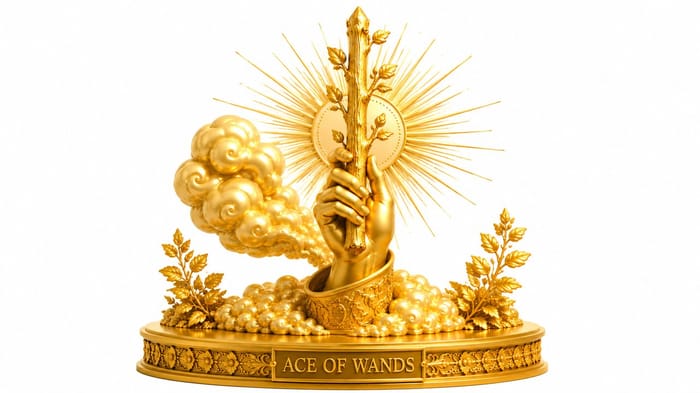
Light a candle and watch what happens. The flame doesn't wait for instructions. It doesn't ask permission. It eats oxygen, bends toward the nearest draft, and if you're not careful, it'll catch the curtain. That restless, consuming quality is what the Suit of Wands brings to a tarot reading. Fourteen cards that track what happens when raw creative force enters your life - and what it costs to keep it burning.
If you've ever started a project at midnight because the idea wouldn't leave you alone, or quit a stable job because something in you needed to move, you already know what Wands feel like. They're the suit of people who'd rather be wrong and in motion than right and standing still.

Fire as an Element - and Why It's Different
Fire is the only classical element that isn't a substance. Water is something you can hold. Earth is something you can stand on. Air surrounds you whether you notice it or not. But fire is a process - it only exists while it's consuming something else. Take away its fuel and it vanishes. Feed it and it grows beyond your control.
That distinction matters for reading Wands. The energy in this suit is never static. It's always either building or dying. A Wand can't just sit on a shelf and remain a Wand the way a Cup can remain a vessel or a Pentacle can remain a coin. The wands in the Rider-Waite deck have green leaves still growing from them - they're alive, still producing, inseparable from the life force running through them.
In traditional tarot structure, Wands correspond to the spiritual plane. Not "spiritual" in the vague, feel-good sense, but the animating principle - the force that precedes form. Before you build something (Pentacles), before you think it through (Swords), before you feel drawn to it (Cups), something has to ignite. That first spark, the will to act, the creative impulse that shows up before the plan does - that belongs to Wands.
There's a useful distinction between Wands and Swords that clears up a lot of confusion in readings. Wands represent inherent force - passion and drive that belong to you, that burn whether you want them to or not. Swords represent invoked force - the power of the mind, deliberately wielded. You pick up a sword. A wand is already on fire in your hand.

The Story the Numbers Tell
The ten numbered Wands cards trace a complete arc from first spark to overload. Reading them in sequence reveals a pattern that shows up constantly in creative and entrepreneurial lives.
The Ace of Wands is pure ignition - a living branch thrust from a cloud, leaves still growing, momentum without a plan. Something arrived with its own energy and it didn't ask whether you were ready. The Two slows down just enough to think. In the Two of Wands, a figure stands on a balcony holding the world in one hand and gripping a wand with the other. The fire hasn't gone anywhere, but now there's a direction forming. The question the Two asks is whether you'll stay on the balcony watching, or actually go.
By the Three of Wands, you went. Ships are on the horizon and you're watching to see if the world responds to what you launched. The Three is the moment after you've committed - the email sent, the business registered, the conversation started - when all you can do is wait. And then the Four of Wands celebrates. A garland strung between four standing wands, people gathering underneath. Fire has built something worth honoring. Not every card needs to be complicated. Sometimes good news is just good news.
The Five of Wands breaks the party. Five people swinging sticks with no coordination, no agreed-upon rules. This is the friction that happens when multiple creative forces collide without a shared direction. It's the committee that can't agree, the band members pulling in five directions, the family argument about what to do with the inheritance. In the minor arcana, fives always mean friction in the outer world, and in Wands that friction tends to be loud.
The Six of Wands resolves it. A figure on horseback, wreathed in laurels, a crowd cheering. Public recognition, victory made visible. But the Six is a transitional card - what you do with the recognition matters more than the recognition itself. The Seven of Wands proves why. One person on high ground, six wands pushing up from below. Success attracted competition. The position is defensible, but the seven asks a hard question: is what you're defending still worth the fight?
Then comes the Eight of Wands - the only card in the Rider-Waite deck with no human figure. Just eight wands in flight, nothing holding them, nothing in their way. Everything is moving at once. Messages, decisions, opportunities, all arriving simultaneously. The Eight doesn't tell you where they're going. It tells you the pace is about to pick up whether you're ready or not.
The Nine of Wands shows what sustained fire does to a person. A bandaged figure leans on the last wand standing, eight more lined up behind like a fence. Exhausted but not extinguished. The nine is resilience earned the hard way - proof that you can take the hit and stay upright. And the Ten of Wands asks the question the whole suit has been building toward: at what point does your own ambition become the thing that's crushing you? A figure carrying all ten wands at once, barely able to see over the top. Every one of those wands started as a good idea. Together, they're a burden.
The arc, when you step back, tells a story almost everyone recognizes. Ignition, direction, launch, celebration, friction, recognition, defense, acceleration, endurance, and finally the reckoning. Are you still the engine, or has the engine started carrying you?

The Court of Fire
The four court cards show fire at different stages of maturity, and each one handles it differently.
The Page of Wands is enthusiasm before focus. A young figure in an empty landscape, holding a wand like it's a map to somewhere interesting. The landscape is empty because the adventure hasn't started yet - everything is still potential. Pages in every suit represent the beginning of learning, and this Page is learning what it feels like to have fire and not yet know where to point it.
The Knight of Wands pointed it - and then charged. Horse rearing, cloak flying, destination unclear. This is probably the most impulsive figure in the entire deck. His speed is both his gift and his problem. He'll get there before anyone else, but "there" might not be where he intended to go. In a reading, the Knight often represents a situation or person moving fast, and the question is whether that speed serves the situation or just feels exciting.
The Queen of Wands is what fire looks like when it becomes warm instead of wild. Sunflower on the throne, black cat at her feet, and the kind of presence that makes everyone in the room feel like they matter. She's magnetic, generative, deeply confident - but her fire draws people in rather than scattering them. The black cat hints at an intuitive edge that the more visible warmth might cause you to underestimate.
And the King of Wands does something none of the other Wands figures do. He doesn't look at his wand. It sits beside him on the throne, not raised, not brandished. He doesn't need to prove anything because the fire is so completely integrated into who he is that displaying it would be beside the point. When you've mastered your element, you don't perform it. You simply are it.

Reading with Wands
A spread dominated by Wands usually means the situation is creative, entrepreneurial, or driven by passion. Something wants to move, and the reading is about figuring out how to direct that energy without getting burned by it. The shadow side of an all-Wands reading is overextension - too many projects, too much drive, the inability to stop even when stopping would be wise.
When Wands are absent from a reading, something is probably waiting for a spark. The plans might be solid. The feelings might be clear. But the will to actually act, to put energy behind intention, hasn't shown up yet. An absent suit is often as telling as a dominant one.
Wands tend to move fast in timing questions - days or weeks rather than months. And they often show up around career moves, creative projects, travel, new ventures, and anything requiring sustained courage.

Frequently Asked Questions
Do Wands always mean career or work?
Not always, though career readings pull Wands frequently because work is where most people direct their creative fire. But Wands can represent any situation where energy, drive, and will are the primary forces at play. A passionate new relationship, a personal transformation, a sudden urge to move across the country - these all carry Wands energy. The key is whether the situation feels like something that's burning to happen rather than something that needs to be thought through or felt through first.
What's the difference between the Knight of Wands and the Knight of Swords?
Speed-wise they look similar, but the fuel is completely different. The Knight of Wands charges because he's driven by passion - he may not know where he's going, but he's excited to get there. The Knight of Swords charges because he's driven by conviction - he knows exactly what he thinks and he's cutting through anything in the way. Wands fire is hot and somewhat chaotic. Swords air is cold and precise. In readings, the Knight of Wands often signals impulsive action motivated by excitement, while the Knight of Swords signals decisive action motivated by certainty.
Can reversed Wands mean burnout?
Frequently, yes. When Wands appear reversed - particularly the Nine or Ten - the fire hasn't gone out, but it may have turned inward. Instead of creative drive flowing outward into the world, the energy gets trapped, producing exhaustion, frustration, or the sense of spinning without traction. A reversed Ace might mean a creative idea that hasn't found its moment yet. A reversed Eight of Wands could signal delays where you expected momentum. The common thread is fire that's present but blocked.
How do Wands interact with the other suits in a spread?
Wands next to Pentacles often indicate creative energy finding practical form - the idea becoming a business, the passion becoming a daily practice. Wands alongside Cups tend to point toward passionate relationships or creative projects fueled by emotional depth. Wands meeting Swords can signal conflict between what you want to do and what you think you should do - the head and the fire arguing over the steering wheel.