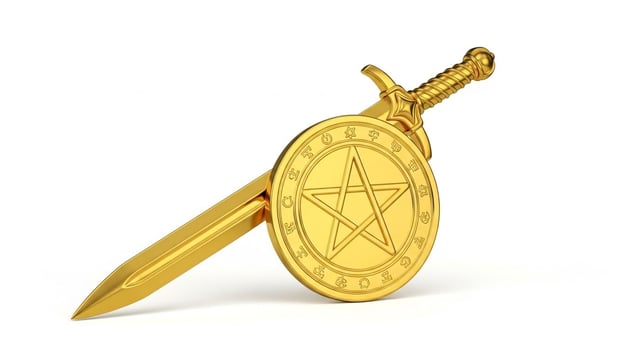
The Tarot Suit of Swords - Mind, Truth, and the Cutting Edge
By Blair Andrews · Published May 21, 2025 · Updated May 10, 2026
You're lying awake at 3 a.m., replaying a conversation from six hours ago. You know exactly what you should have said. You can see every angle of the argument, every flaw in their logic and yours. Sleep won't come because your mind won't stop sharpening its blade.
That's the Suit of Swords. The actual experience of thinking, with all its brilliance and all its cost.

Air: The Invisible Element
Air has no substance of its own. You can't hold it, shape it, or see it. But it carries sound, transmits ideas, and makes speech possible. Every word you've ever spoken traveled through air to reach another person's mind. The Suit of Swords works through this element: invisible, fast, constantly in motion, and capable of cutting through anything it touches.
Swords are the most feared cards in the minor arcana, and the most misunderstood. Flip through the numbered cards and you'll see blindfolded figures, blades through hearts, someone bolt upright in bed with nine swords on the wall behind them. The images look like a warning. And in a narrow sense, they are - but the warning is about what the mind does when it runs unsupervised, not about thinking itself.
A sharp mind is one of the greatest gifts a person can have. The capacity for discrimination, for telling truth from comfortable fiction and seeing what's actually happening instead of what you wish were happening, makes conscious choice possible. In the Major Arcana, the Lovers card is assigned the Hebrew letter Zain, which means "sword." The connection isn't accidental. You cannot choose between two paths if you cannot see the difference between them.
Compare Swords to Wands. Wands carry inherent force: native drive, raw energy that moves because moving is its nature. Swords carry invoked force. The mind claims the power to analyze, discriminate, and act. The English word "clever" connects to "cleave," meaning to cut and separate. Intelligence, at its root, is the ability to make distinctions. That's what every Sword in this suit is doing.
The darkness in this suit comes from a specific imbalance: too much analysis, too little feeling. A mind that never stops cutting eventually turns the blade on itself.

The Arc from Ace to Ten
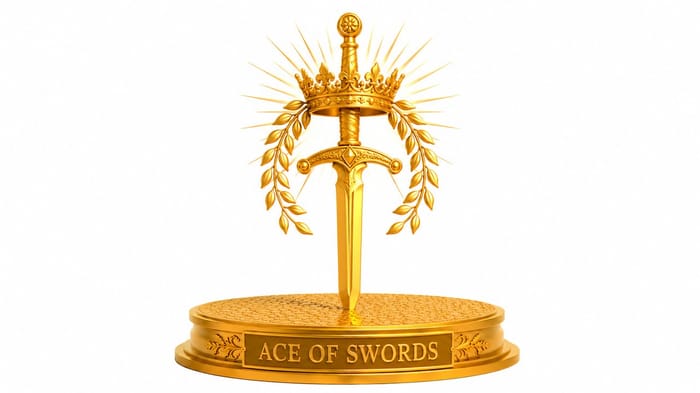
The Ace of Swords is the moment the fog lifts. Pure mental clarity. A single blade piercing a crown above the clouds. You suddenly see what's been obscured. The insight is clean, complete, and arrived without effort. Every Ace is pure potential, and in Swords that potential is the ability to perceive truth without distortion.
But clarity creates a problem. Once you can see clearly, you also see the choices you've been avoiding. The Two of Swords is deliberate avoidance, a blindfolded figure holding two crossed blades, perfectly balanced, refusing to pick one. She knows what she's not looking at. The blindfold is self-imposed. In the number two, force doubles back on itself, and in Swords that means the mind holding two contradictory positions simultaneously because choosing would mean losing something.
The Three of Swords ends the avoidance. Three blades through a heart, rain pouring down. The truth that can no longer be dodged has arrived, and it hurts exactly as much as you feared it would. Three is the number of expression and unfoldment; what unfolds here is a painful recognition. The rain, though, is doing something nobody talks about. Rain cleans.
After the wound, the Four prescribes rest. A figure lies still on a stone slab, three swords on the wall, one beneath. It looks like death. It isn't. Four is structure and stability, and in this suit, stability means the mind requiring stillness before it can function again. Not permanent withdrawal - a pause with a purpose.
The Five of Swords is the victory that costs too much. Five is the number of friction, and here the friction is external: someone won the argument, collected the swords, and now stands smirking while two figures walk away. The battle was won. The relationship may not recover. When the mind prioritizes being right over being connected, this is what follows.
The Six brings movement away from turbulence. A small boat crosses water, six swords standing upright in the hull. You're bringing the sharp things with you - the memories, the lessons, the things you learned the hard way - but the water ahead is calmer. Six is the number of harmony after conflict, and in Swords that harmony is the quiet that comes after you decide to leave a bad situation rather than win it.
The Seven of Swords is the mind operating by indirection. A figure sneaks away with five swords, leaving two behind. The obvious reading is deception, but seven is the number of struggle before balance, and the struggle here is more nuanced than simple theft. Sometimes indirection is strategic. Sometimes it's the only option available when direct confrontation would be destructive. The card asks you to examine your relationship with honesty - where it serves you, and where radical transparency might be its own kind of violence.
The Eight is what happens when the mind that cut through everything now binds itself. A blindfolded, bound figure surrounded by eight planted swords. The bindings are loose. The cage has no floor. Eight is the number of rhythm and evolution, and the evolution being demanded here is recognizing that the prison is mental. The thinking that once liberated you has become the thinking that traps you.
The Nine of Swords is pure mental suffering, the 3 a.m. inventory of everything wrong. Someone sits bolt upright in bed, head in hands, nine swords on the wall. Nine is completion, and what's completed here is the mind's full catalog of anxieties. Every fear, every regret, every worst-case scenario playing on a loop. The figure's blanket shows roses and astrological symbols. Beauty and order are literally covering them, but they can't see any of it because they're staring into the dark.
The Ten of Swords looks like the worst card in the deck. A figure facedown with ten blades in their back. Ten is fullness, force at maximum, and in Swords that means the mental anguish has reached its absolute limit. But look at the horizon. It's golden. Dawn is breaking. When the mind has exhausted every possible fear and the worst has already happened, what remains is the discovery that you're still here. The end of one mental cycle is the beginning of the next, and the next one starts with light.

The Court of Air
The Page of Swords is alert, restless, wind-whipped, sword raised and scanning the landscape for something to analyze. Every Page carries the raw, unrefined energy of their suit, and in Swords that energy is a mind that never stops watching. The Page notices everything - body language, inconsistencies, the gap between what people say and what they mean. The gift is perceptiveness. The challenge is that not every observation needs to be spoken aloud.
The Knight of Swords is the fastest card in the deck. Full gallop, sword forward, clouds tearing apart in his wake. Where the Knight of Cups approaches slowly and the Knight of Pentacles stands still, this Knight has no brakes. He's pure momentum of thought, the flash of intellectual certainty that sweeps away hesitation. Speed is the point and also the problem. He arrives at conclusions the way he arrives at battles: before he's fully assessed what he's riding into.
The Queen of Swords sits alone, facing you directly, sword raised in her right hand, left hand open. That open hand is the detail that tends to redefine the reading. She has known loss - the traditional interpretation ties her to widowhood or grief. But the openness of her left hand isn't softness. It's the earned generosity of someone who processed pain rather than armoring around it. She can hold both the sword and the empty space, and neither one frightens her.
The King of Swords holds his blade perfectly vertical, leaning in no direction. He thinks before speaking. He doesn't add emotional coloring to his judgments or soften uncomfortable truths to make them easier to hear. Of all four Kings, he is probably the least warm and the most fair. The sword points straight up because his mind does the same - no angle, no spin, no agenda beyond clarity.

When Swords Dominate a Reading
A spread full of Swords tells you the mind is working overtime. The situation is intellectual, communicative, or mental in nature: decisions to make, truths to face, ideas that won't stop circling. The advice when Swords crowd a reading is often to balance thinking with feeling. Analysis is necessary, but it has a natural stopping point. If you've been turning the same question over for weeks without resolution, the answer probably won't come from more analysis.
When Swords are absent from a reading, it may suggest a reluctance to look at something honestly. The other suits have their own intelligence (Cups intuit, Pentacles observe, Wands sense), but Swords are the suit of deliberate, conscious examination. Their absence can mean the situation is genuinely emotional or practical rather than mental. But it can also mean someone is choosing not to pick up the blade because they already sense what it would reveal.

The Numbered Cards
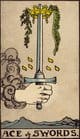
Ace of Swords - A single blade pierces a crown above the clouds. The moment when the fog lifts and you can finally see what's been there all along.
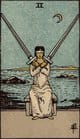
Two of Swords - A blindfolded figure holds two crossed swords, water behind her. She knows exactly what she's avoiding, and the card knows she knows.
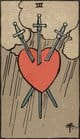
Three of Swords - Three blades through a red heart, rain pouring down. The image everyone dreads pulling. But the rain is doing something nobody talks about.
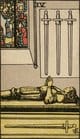
Four of Swords - A figure lies still on a stone slab, three swords on the wall, one beneath. It looks like death. It isn't. The difference matters.
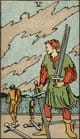
Five of Swords - Three swords collected, two people walking away, and a smirk on the winner's face. What it costs to win like this is the actual reading.
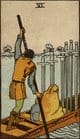
Six of Swords - A small boat crossing water, six swords standing in the hull. You're bringing the sharp things with you - but the water ahead is calmer.
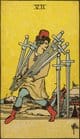
Seven of Swords - A figure sneaks away carrying five swords, leaving two behind. The obvious reading is theft. The less obvious one is more interesting.
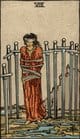
Eight of Swords - A blindfolded, bound figure surrounded by eight planted swords. The bindings are loose. The cage has no floor. Have you noticed?
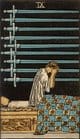
Nine of Swords - Someone bolt upright in bed, head in hands, nine swords on the wall. It's 3 a.m. and your mind won't stop. This card knows what that feels like.
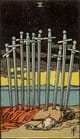
Ten of Swords - A figure facedown with ten swords in their back. Looks like the worst card in the deck. Look at the horizon, though. There's a reason it's golden.
The Court Cards
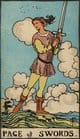
Page of Swords - Wind-whipped hair, sword raised, scanning the landscape like a lookout. Sharp, restless, always watching. What happens when all that energy needs a target?
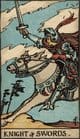
Knight of Swords - Full gallop, sword forward, clouds tearing apart in his wake. The fastest card in the deck. Speed is the point - and also the problem.
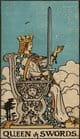
Queen of Swords - She sits alone, sword raised, facing you directly. Her left hand is open - a detail that redefines how to read her.
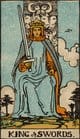
King of Swords - Perfectly upright on his throne, sword held vertical, not angled. He doesn't lean in any direction. The implications are worth sitting with.

Frequently Asked Questions
Is the Suit of Swords always negative?
No, though its reputation makes people think so. The Ace is one of the most powerful cards in the deck: sudden clarity, a breakthrough insight that reorders everything. The Six brings much-needed transition to calmer waters. The Four offers the rest your mind has been begging for. Even the Ten, which looks devastating, carries a golden dawn in its background. Swords are difficult the way honest conversation is difficult: uncomfortable in the moment, and often exactly what was needed.
What's the difference between Swords and Wands in a reading?
Wands are instinct. Swords are intellect. When a Wand shows up, something is moving because it wants to move. There's a creative impulse, a drive, an itch to act. When a Sword shows up, the mind has gotten involved. You're analyzing, planning, deciding, or possibly overthinking. A Wand says "go." A Sword says "think about whether you should go, and if so, which route, and what the consequences might be." Both are necessary. Problems tend to arise when one tries to do the other's work.
What does it mean when Swords keep appearing in every reading I do?
It usually means there's an unresolved mental pattern at work: a decision being postponed, a truth being avoided, or an anxiety loop that hasn't been broken. Swords are persistent because thoughts are persistent. They'll keep showing up until the underlying mental situation gets addressed. The suit isn't punishing you. It's reflecting what your mind is already doing, whether or not you've acknowledged it consciously. Sometimes the simplest response to repeated Swords is to ask yourself what you already know but haven't been willing to say out loud.
How do I read Swords court cards as people versus situations?
Context usually makes it clear. When a Swords court card represents a person, look for someone whose primary mode of engaging with the world is intellectual. A sharp communicator, a quick thinker, someone who leads with their mind rather than their heart or instincts. The Page often points to a younger person (or someone new to a field) who asks uncomfortable questions. The Knight suggests someone moving fast through a situation, possibly too fast. The Queen may represent a person who has been through grief and come out clear-eyed rather than bitter. The King is often someone in a position of authority whose fairness you can trust, even if their warmth is limited.
Explore the other suits: Cups | Wands | Pentacles
The Gilded Tarot Deck by Ciro Marchetti © 2004 Llewellyn Worldwide, Ltd. All rights reserved, used by permission.