Five of Wands Tarot Card Meaning
By Blair Andrews · Published July 14, 2017 · Updated May 10, 2026

When was the last time you were in a room where everyone had a strong opinion and nobody was backing down? The meeting that turned into a debate. The group project where five people wanted to lead. The family dinner where every sibling had a different idea about what to do with the house, and all of them started talking at the same time.
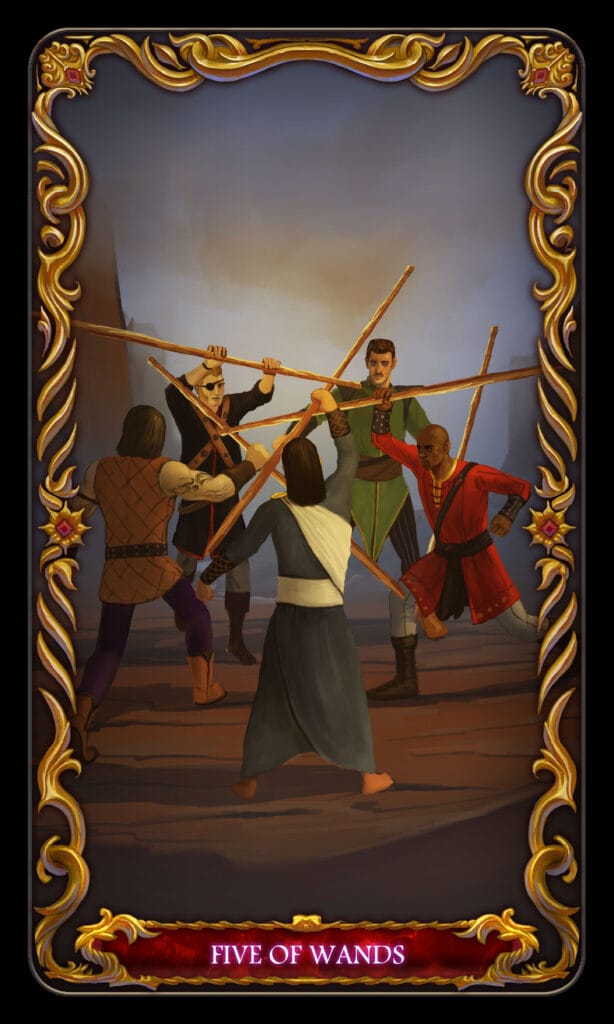
That's the Five of Wands. Five figures swinging sticks at each other, and nobody seems to be winning. But look closer - nobody seems to be losing, either. No blood. No casualties. No one on the ground. This isn't a battle. It's a scrimmage.
If this card showed up for you, the chaos is real, but the danger probably isn't. The friction you're feeling has a purpose, even if it doesn't feel like it yet.

The Card's Essence
Five is the number that disrupts whatever the first four numbers built. One starts. Two plans. Three expands. Four settles into solid ground. Then five arrives and shakes the table.
The older traditions called five the number of adaptation - the midpoint between beginning and completion, where the established order gets challenged by something it didn't expect. In the Major Arcana, five's energy is internal and spiritual. In the Minor Arcana, it shows up as real-world friction. Outer problems. Tangible conflict.
In the Wands suit, that disruption is about passion, ego, and creative drive. Everyone in this card cares about something, and none of them agree on what to do about it. The clash isn't cold or calculated - it's heated. Fire meeting fire.
The important thing to understand about fives in the pip cards is that they always represent outer-world challenges, not internal spiritual tests. When this number shows up in the Minor Arcana, the friction is happening in your job, your relationships, your daily encounters with other people. It's tangible. It's in the room with you.

The Sparring Ground
The esoteric tradition connects five to a kind of mediation - the force that stands between opposites and tries to broker something useful from the tension. The deeper symbolism links it to adaptation, the mental flexibility required to navigate conflict without being consumed by it.
The classical sources describe five as the number of the senses, the body, the physical encounter with reality. In the pip cards, fives are where abstract principles meet the messy, unpredictable world of actual human interaction.
That's exactly what you see in the Five of Wands. No strategy. No plan. Just five people in a field, wands raised, sorting out their differences in real time. The intelligence this card asks for isn't strength - it's flexibility.
One thing the older texts emphasize about five: it stands at the exact midpoint between one and ten. It's the hinge. The pivot. The moment where the first half of the cycle (building) meets the second half (resolving). In the Wands suit, that pivot point feels like a creative fire hitting the real world's friction for the first time and having to adapt or stall.

Upright Meaning
The Five of Wands upright means competition, friction, and the kind of creative chaos that happens when multiple strong people occupy the same space. Everybody's swinging. Nobody's coordinating. The energy is diffuse, scattered, loud.
What distinguishes this card from the more destructive conflict cards - the Five of Swords, for instance - is that nobody here is trying to destroy anyone. The Five of Swords has a winner who walks away smirking while others leave in shame. The Five of Wands has no winner at all. It's more democratic in its chaos.
In practical readings, this shows up during periods of healthy competition. Applying for a position against other strong candidates. Pitching an idea in a room full of ideas. Navigating a workplace where several talented people all want the same project. The fire element means nobody is being passive-aggressive about it - everything is out in the open, wands waving.
The card doesn't ask you to win the scrimmage. It asks you to stay in it. To keep showing up, keep competing, keep caring enough to engage even when the friction is exhausting. The strongest fire in a room full of fires isn't always the biggest. It's the most focused.
It's also worth remembering that fives in the number sequence sit between the settled stability of four and the harmony of six. The disruption is temporary. It exists to shake loose whatever wasn't working in the old structure so something better can form. The friction has a purpose, even when the purpose is invisible in the middle of the scrum.

Reversed Meaning
Reversed, the Five of Wands often signals that the conflict is settling. The worst of the friction is passing. Competing voices are sorting themselves out, and what was chaos is becoming something workable.
But there's a less comfortable reading. Sometimes the reversal means the conflict has gone underground. The wands are still swinging, but behind closed doors now. Passive aggression instead of open competition. People competing while pretending they're not. Tension no one will name.
The upright Five is loud and messy but honest. The reversed Five can be quiet, messy, and dishonest. If you're sensing unspoken tension in a group, this card confirms it.
There's also the avoidance version. You've stepped out of the scrimmage entirely because the discomfort was too much. Sometimes that's wisdom. Sometimes it means you're letting your fire dim because other people's heat makes you uncomfortable. The question is whether the conflict you're avoiding is the kind that would sharpen you or drain you.
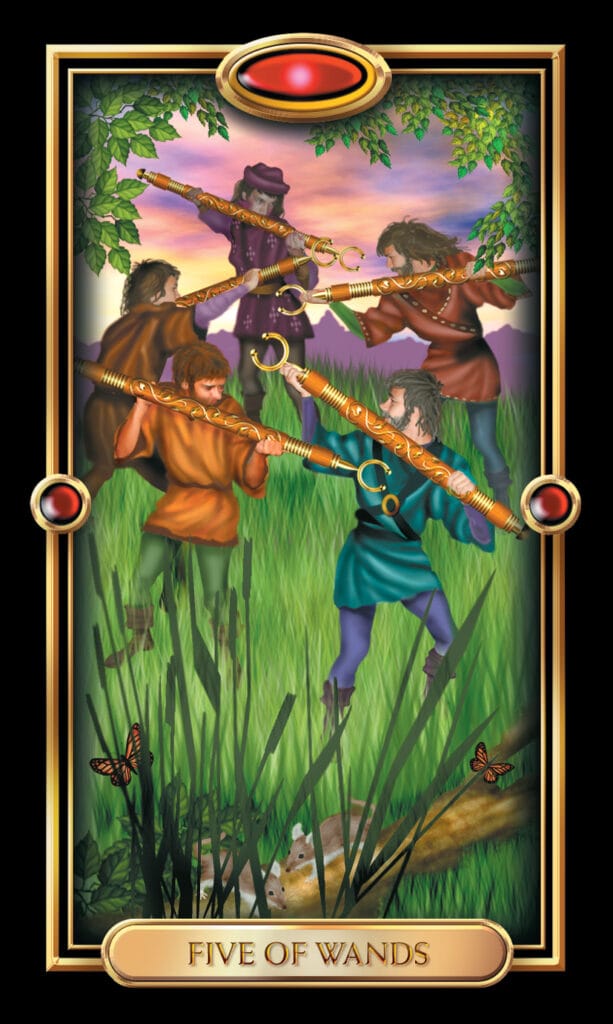
The Gilded Tarot Deck by Ciro Marchetti © 2004 Llewellyn Worldwide, Ltd. All rights reserved, used by permission.

In Love and Relationships
In a love reading, the Five of Wands usually means friction - the kind that comes from two people who both have strong wills and aren't willing to pretend otherwise. Arguments about how to spend the weekend. Disagreements about priorities. The clash of two fires that both refuse to be the one that dims.
For singles, this card sometimes points to a competitive dating scene. Multiple people interested, or the feeling that you're constantly jostling for someone's attention. It's not cruel - it's just crowded. In some cases, it shows up when the person you're interested in is getting attention from multiple directions, and you're one of several fires trying to stand out.
The good news is that the Five of Wands in love rarely signals real danger. The conflict is surface-level, not foundational. These are the arguments that get resolved over dinner, not the ones that end relationships.
Reversed in love, the bickering may be dying down, or it may have gone underground into resentment. Check which one before you assume the peace is real. If one partner has stopped engaging entirely - not because the issue resolved, but because they got tired of fighting - the silence isn't peace. It's avoidance wearing a peace costume.

In Career and Finances
This is a competition card. In career readings, it means you're up against other strong candidates, other strong ideas, other strong egos - and your job is to stand out without burning everyone else down. Office politics. Creative differences in a team. The project pitch that has six contenders and only one gets funding.
Financially, the Five of Wands can mean competing expenses pulling at the same budget. Or it can indicate financial stress caused by too many obligations that all feel urgent at once. The problem isn't usually a lack of resources - it's a lack of coordination about where to direct them. When every bill feels equally important, the budget itself becomes a scrimmage.
Reversed in career, the competitive pressure may be easing. A hiring decision is made. The team reaches consensus. Or the conflict shifts from open debate to quiet maneuvering, which requires a different kind of attention.
If you're self-employed, the Five of Wands in career often means a crowded marketplace. Your offer isn't the only one. Your pitch isn't the only one. The question isn't whether you're good enough - it's whether you can make your fire distinctive enough to stand out in a field where everyone is swinging.

The Numerology Connection
Five is the number of freedom, change, and the refusal to be pinned down. In numerology, people with strong 5 energy in their charts tend to be restless, adaptable, and sometimes allergic to routine. They need friction the way a flint needs a strike - it's how they generate sparks.
The planetary tradition links five to the fastest-moving, most communicative planet. That gives the Five of Wands its speed and its scattered quality - lots of messages firing at once, lots of energy moving in lots of directions.
If 5 shows up prominently in your life path or other positions, the Five of Wands may feel oddly familiar. Not comfortable, exactly, but recognizable. The numbers 1 through 9 guide explains five's personality in depth. In both the tarot and numerology, five's core lesson is the same: the challenge exists to make you more flexible, not to break you.
People with heavy 5 energy in their charts sometimes actively seek out friction because stagnation feels worse to them than conflict. If that sounds like you, the Five of Wands might be less of a warning and more of a confirmation that you're in the kind of environment where you actually thrive - messy, competitive, and full of movement.

Frequently Asked Questions
Is the Five of Wands a bad card?
Uncomfortable, yes. Bad, not really. The Five of Wands is competitive friction - annoying, tiring, sometimes frustrating - but not destructive. Nobody in this card is getting seriously hurt. The chaos is more like a spirited argument than a real fight. Think of it as the heat that forges sharper ideas.
What does the Five of Wands mean in a love reading?
Arguments that are real but not ruinous. Two strong-willed people clashing about how things should go. For singles, it often means a competitive dating landscape or multiple romantic interests creating confusion. The good news: this card's conflicts tend to be surface-level and resolvable.
How is the Five of Wands different from the Five of Swords?
The Five of Swords has a clear winner and clear losers. Someone walks away with the swords while others leave humiliated. The Five of Wands has no winner at all. Everyone is still in the scrimmage. Swords is about domination. Wands is about friction. One leaves scars. The other leaves you tired.
What should I do when the Five of Wands appears?
Stay in the arena. Don't withdraw just because the friction is uncomfortable. Focus your fire instead of scattering it - the person who wins this scrimmage isn't the loudest, but the clearest. Pick the one point you care about most, make it well, and let the rest of the noise sort itself out.