Head Line in Palm Reading: How Your Mind Actually Works
By Blair Andrews · Published April 21, 2026 · Updated July 20, 2026
The head line shows how your mind works, not how smart you are. It runs across the middle of your palm, between the heart line and life line. A straight line points to practical, logical thinking. A curved line points to creative, imaginative thinking.
During the first trimester of human development, something remarkable happens. The hand and the cerebral cortex form simultaneously from the same sheet of embryonic tissue - the ectoderm. The very cells that become your brain also become the ridges, creases, and lines of your palm.
This is not metaphor. It is developmental biology. Your hand is, in a very real and measurable sense, the brain's external map - a living record of how your nervous system organized itself before you ever took a breath.
And nowhere on the palm is this brain-hand connection more visible than in the Head Line.
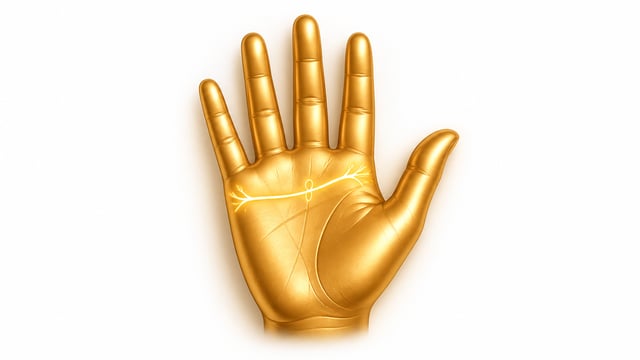
Running horizontally across the center of your palm, the Head Line is the mind's signature. Not your intelligence (palmistry has never been about measuring IQ). What the Head Line reveals is something far more interesting: the architecture of your thinking.
Whether your mind moves in straight lines or spiraling arcs. Whether you process the world through analysis or imagination. Whether your thoughts are sharp and decisive, or deep and wandering, or some restless combination of both.
If the Heart Line tells the story of how you feel, the Head Line tells the story of how you think about what you feel, and everything else. It is the central dividing line of the palm, separating the emotional territory above it from the practical territory below. It is, quite literally, where thinking happens.

Where to Find Your Head Line
Open your dominant hand and hold it in good light. The Head Line runs roughly horizontally across the center of your palm, originating at or near the edge between your thumb and index finger, close to where the Life Line begins - and traveling across the palm toward its outer edge, beneath the little finger.
It is the middle line of the three major horizontal lines. The Heart Line sits above it, closer to the fingers. The Life Line curves below and around the thumb. The Head Line occupies the center, the intellectual midpoint that divides the palm's real estate between the emotional world above and the material world below.
Most people can identify it within seconds. If you see three clear horizontal lines, the middle one is almost certainly your Head Line. In some hands it runs nearly straight across.
In others it curves gracefully downward toward the wrist. Both are perfectly normal, and as you are about to discover, each tells a very different story about the mind behind it.

Straight vs. Curved: Two Ways of Thinking
The single most telling feature of the Head Line is its curvature - or lack of it. This one quality reveals more about how your mind works than almost any other marking on the hand.
A straight Head Line belongs to a practical, methodical thinker. This is the mind that likes facts, evidence, and clear plans. It moves from A to B to C in logical sequence.
People with straight Head Lines tend to be excellent problem-solvers in concrete situations: engineering, finance, law, logistics. They want to know what is true, what is proven, and what can be done about it. There is a clarity to their thinking that others find reassuring, sometimes even commanding.
A curved Head Line belongs to a creative, associative thinker. This mind makes connections between seemingly unrelated ideas. It thinks in images, metaphors, and stories.
Where the straight Head Line asks "What are the facts?" the curved Head Line asks "What else could this mean?" These are the minds behind art, music, innovative design, therapeutic insight, and the kind of lateral thinking that solves problems no amount of logic could crack.
And then there is the deeply curved Head Line - one that dips dramatically downward toward the Mount of Luna near the base of the palm. This marking indicates a powerful imagination, the kind that doesn't just generate ideas but inhabits them.
When this curvature is supported by a strong Life Line and clear Heart Line, it often manifests as artistic brilliance - the painter who sees color differently, the novelist who lives inside their characters, or the musician who hears compositions before they exist.
But when it appears in a hand with other signs of stress - islands, chains, a weak Life Line - this same deep imagination can turn inward, becoming depressive rumination or a tendency to get lost in inner worlds at the expense of the outer one.
Most people fall somewhere between the extremes. A gentle curve is the most common formation, suggesting a mind that can handle both analytical and creative tasks, shifting between spreadsheets and daydreams with reasonable ease.

Where It Begins: The Connection to the Life Line
Look at the starting point of your Head Line, near the thumb-side edge of your palm. Does it begin joined to the Life Line, sharing the same origin? Or does it start separately, with a visible gap between the two?
This detail is one of the most psychologically revealing features in all of palmistry.
Joined at the start. When the Head Line and Life Line share an origin - touching or overlapping before the Head Line separates and moves across the palm, it indicates someone whose early thinking was closely guided by family values, family expectations, and the intellectual framework of their upbringing.
This is the person who absorbed their parents' worldview thoroughly before developing their own. They often describe themselves as "late bloomers" intellectually, not because they lacked intelligence but because they didn't feel permission to think independently until well into adulthood.
In many cases, these individuals live with family or maintain deep family ties into their 30s or beyond.
The length of the attachment matters enormously. A brief overlap, where the lines share just a few millimeters before separating, suggests mild family influence that was outgrown relatively early.
A long, extended attachment running a centimeter or more along the palm suggests a much longer period of intellectual dependence. This is not a judgment. Some of the most thoughtful, wise adults are those who took their time separating from inherited thinking, because they did it thoroughly rather than reactively.
Separated from the start. A clear gap between the origins of the Head Line and Life Line reveals early intellectual independence. This was the child who questioned everything - who asked "why?" not to be difficult, but because they genuinely needed to understand the logic behind rules before following them.
These individuals often struck out on their own early in life, whether physically, intellectually, or both. They trust their own reasoning, sometimes to a fault.
A very wide gap can indicate someone whose independence became impulsiveness - a mind that leaps before looking and acts on its own conclusions without enough input from others. But in most hands, a moderate separation simply means an original thinker who came to their own conclusions early.

The Writer's Fork
Of all the special markings that can appear on the Head Line, the Writer's Fork is perhaps the most sought-after, and the most misunderstood.
Look at the end of your Head Line, where it terminates toward the outer edge of your palm. In some hands, instead of ending in a single point, the line splits into a Y-shaped fork. One prong continues on its original trajectory while the other dips downward into the Mount of Luna, the seat of imagination, intuition, and the subconscious mind.
This is the Writer's Fork. It earns its name because it indicates an exceptional ability to channel imagination directly into intellectual output - to translate inner vision into words, structures, and tangible creations.
The fork creates a bridge between the practical, analytical mind (the main line) and the deep well of imagination (the Luna branch), allowing both to feed into the same stream of thought.
Despite its name, this marking does not belong exclusively to writers.
It appears on the hands of anyone whose work requires channeling imagination into concrete form - screenwriters, yes, but also architects and therapists who intuit what their clients cannot say, inventors who see solutions that do not yet exist, and teachers who find exactly the right metaphor to unlock understanding.
The common thread is the ability to reach into the subconscious and bring something back that others can use.
If you have the Writer's Fork but don't consider yourself creative, you may simply not have found your medium yet. The capacity is there, etched into the structure of your hand.

Depth, Clarity, and What They Mean
Trace your Head Line with the tip of your finger. How does it feel? Is it deeply etched, almost grooved into the palm? Or is it faint, barely visible under certain light? Is it clean and continuous, or does it break into chains, islands, and fragmented sections?
Deep and clear. A deeply etched Head Line indicates intense concentration and a powerful, focused mind. This person has strong opinions formed through genuine thought - not stubbornness but conviction. They can sustain attention on a single problem for hours. When they speak, they have usually already considered the counterarguments.
Faint or lightly marked. A faint Head Line does not mean a weak mind. It suggests mental flexibility and adaptability - a mind that can shift perspectives easily, that doesn't get locked into one way of thinking.
The trade-off is sometimes scattered focus, a tendency to start more things than get finished, and difficulty committing to one intellectual path when so many seem interesting.
Chained or island-marked.
This is where the Head Line becomes diagnostically interesting. Chains (a series of small, overlapping oval formations along the line) have been associated across multiple palmistry traditions with recurring headaches and migraines.
Islands, small enclosed oval shapes within the line, indicate specific periods of mental stress, anxiety, or overwhelm.
If you notice islands or chains on your Head Line, consider the possibility that your nervous system is more sensitive than average, and that your mental health may require more deliberate attention than you've been giving it.
These markings are not permanent sentences. The lines of the palm change as your life changes. People who address chronic stress through meditation, therapy, or lifestyle changes often see chains begin to resolve into clearer lines over the course of months or years.

Length: How Far Your Mind Travels
Long Head Line. A Head Line that extends across the full width of the palm, reaching from the thumb side all the way to the outer edge beneath the little finger - belongs to an exhaustive thinker.
This is someone who follows every idea to its conclusion, who considers all angles, who would rather over-analyze than miss a nuance. They make thorough planners, careful strategists, and sometimes infuriating dinner companions who will not let a topic go until every facet has been examined.
Short Head Line. A shorter Head Line, one that ends around the middle of the palm or before, indicates a quick, decisive mind. This is the person who assesses a situation, makes a decision, and moves. They prefer action over prolonged analysis.
Where the long-Head-Line person writes a ten-page report, the short-Head-Line person writes three bullet points and starts executing. Neither approach is superior. Most organizations desperately need both.
Abrupt ending. A Head Line that stops sharply mid-palm, as if cut off, can indicate someone who makes gut decisions, reaching a conclusion through instinct rather than deliberation, and then acts on it with startling speed. In certain hands, it can also mark a significant event that redirected the entire course of their thinking.

The Quadrangle: Where Thinking Meets Feeling
The space between the Head Line and the Heart Line is called the Quadrangle, and it reveals something fascinating about the relationship between your intellect and your emotions.
Think of the Head Line and Heart Line as two parallel wires, each generating its own field of influence. Where they run close together, their fields overlap - creating more interference between thinking and feeling. Where they run farther apart, each operates more independently.
Narrow Quadrangle. When the Head Line and Heart Line run close together, thinking and feeling are deeply entangled. Decisions are emotionally charged. Beliefs tend to be held with passionate conviction. There may be stronger prejudices - not necessarily negative ones, but strong preferences that are felt as much as reasoned.
The narrow Quadrangle produces loyalty and passion, but also difficulty separating objective analysis from emotional investment.
Wide Quadrangle. When significant space separates the two lines, the intellect and emotions operate more independently. This person can think clearly under emotional pressure.
They can disagree with someone and still love them. They can make hard decisions without being overwhelmed by feelings - though they may sometimes seem emotionally detached to those with narrower Quadrangles.
A balanced Quadrangle - neither too wide nor too narrow - suggests healthy integration between head and heart, the kind of temperament that can feel deeply and think clearly at the same time.

A Line That Divides the Palm in Half
There is a particular formation worth mentioning on its own: a perfectly straight, deeply etched Head Line that runs in an exact horizontal line across the palm, dividing it into two equal halves.
This is not common, and when it appears, it is striking. It indicates a personality dominated by intellect - someone whose mind governs every aspect of their life with iron precision.
These individuals typically possess exceptional memory and formidable powers of concentration. They are often successful in fields that reward systematic control: management, surgery, military strategy, competitive chess.
The shadow side of this formation is a tendency toward rigidity. When intellect overrides all other considerations - empathy, intuition, spontaneity - the result can be a controlling personality who is always right but rarely warm.
If you see this marking on your own hand, it is an invitation to consciously cultivate the qualities that live above and below that dividing line: the emotional depth of the Heart Line's territory, and the grounded vitality of the Life Line's domain.

Rising and Falling Branches
Small lines branching off the Head Line carry their own significance, depending on which direction they travel.
Branches rising upward - toward the Heart Line and the fingers - represent aspirations and ambitions. These are moments where the mind reaches beyond its analytical comfort zone toward the emotional and spiritual realm.
Each upward branch marks a time when intellectual curiosity became something more: a desire, a hope, an aspiration that engaged the heart as well as the mind.
Branches dipping downward - toward the wrist and the mounts at the base of the palm - indicate the mind exploring subconscious territory. Introspection. Deep self-examination. Sometimes worry.
These downward branches appear during periods when you turned inward, when external life quieted and the real activity was happening beneath the surface. In many hands, downward branches cluster around midlife - that period when the question shifts from "What can I achieve?" to "What does it all mean?"

Three Nerve Networks and What They Mean
There is a neurological fact that most palmistry books never mention, but which explains a great deal about how the Head Line functions. The hand is served by three distinct nerve networks: the median nerve, the ulnar nerve, and the radial nerve.
The thumb, index finger, and middle finger - the radial side of the hand - are the most consciously controlled. You use these fingers for deliberate, precise actions: writing, pointing, picking up small objects. The ring finger and little finger - the ulnar side - operate more automatically, more subconsciously.
The Head Line bridges these two zones. It begins in the conscious, deliberate territory of the thumb-and-index side and travels toward the more intuitive, subconscious territory of the outer palm.
In a very real neurological sense, the Head Line traces the path between what you think on purpose and what you know without trying. Its length, curvature, and clarity describe how well these two modes of cognition communicate with each other.
This is why a long, curved Head Line often belongs to someone who is both analytical and intuitive - their mental bridge extends far enough to connect the deliberate and the instinctive. And why a short, straight Head Line may belong to someone who is brilliantly practical but occasionally blind to subtler signals.

The Head Line and Your Numbers
If you study both palmistry and numerology, you will begin to notice patterns that are difficult to dismiss as coincidence. The Head Line is governed by Mercury energy (the planet of communication, intellect, and mental agility) and the Mount of Mercury sits at the outer edge of the palm where many Head Lines terminate.
People with a Life Path 7 - the analysts, the seekers, the deep thinkers of numerology, frequently show deeply etched, long Head Lines. Their hands mirror what their numbers already describe: a mind that goes deep, that needs to understand the underlying structure of things, that is never satisfied with surface answers.
Life Path 3 - the number of creativity, self-expression, and artistic communication, frequently shows the Writer's Fork. The numerical signature of creative expression finds its physical counterpart in the palm marking most associated with channeling imagination into form.
Life Path 1, with its independent, pioneering energy, often shows a Head Line clearly separated from the Life Line at its origin - that early intellectual independence made visible in the hand.
These correlations are not rules. They are patterns - echoes of the same information expressed through different systems. If you are curious about your own, calculate your Life Path number and then look at your Head Line. See what rhymes.

Try This: Reading Your Own Head Line
Take five minutes and examine your Head Line with fresh eyes. Use these steps:
- Check the starting point. Is your Head Line joined to your Life Line, or does it begin separately? If joined, how long is the attachment before the lines diverge? This reveals how much of your early thinking was shaped by family influence versus independent exploration.
- Trace the curvature. Is the line straight, gently curved, or dramatically arched toward the base of your palm? This tells you whether your mind is primarily analytical, primarily imaginative, or - like most people - a blend of both.
- Look for the Writer's Fork. Does the end of your Head Line split into two branches? If one of those branches dips toward the fleshy pad on the outer-lower edge of your palm (the Mount of Luna), you carry the Writer's Fork.
- Assess the depth. Run your fingertip along the line. Is it deeply grooved? Faintly etched? Chained or broken in places? Deep means concentrated focus. Faint means flexible thinking. Chains may correlate with periods of mental stress or headaches.
- Measure the length. Does your Head Line reach across the full palm, or does it stop around the middle? Long lines belong to exhaustive thinkers. Short lines belong to decisive ones.
- Compare both hands. Your non-dominant hand shows the mind you were born with. Your dominant hand shows the mind you have built through experience. Where do they differ? Those differences mark the ways your thinking has evolved through conscious effort and lived experience.
What you find may confirm what you already know about yourself. Or it may illuminate something you have sensed but never quite articulated - a quality of your mind that has always been there, written in the architecture of your hand, waiting for you to read it.