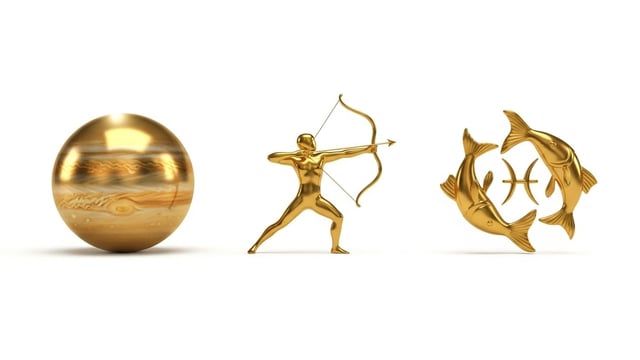
Jupiter: The Promise That Keeps Expanding
By Blair Andrews · Published April 26, 2026

The Pattern Behind the Luck
Every culture that watched the sky noticed the same thing about Jupiter. It was the brightest wandering star, the one that moved with stately calm through the constellations, taking twelve years to complete a single lap.
Where Mars flared and faded, where Mercury darted near the horizon and vanished, Jupiter held steady. Reliable. Generous with its light.
That's where the "lucky planet" reputation comes from. And it's not wrong, exactly. But it's incomplete in a way that matters.
Jupiter in astrology isn't a slot machine that occasionally pays out. It's the part of your psyche that makes meaning. The part that looks at scattered events and finds a story. The part that believes the future holds something worth reaching for, even when the present feels cramped and airless.

What Jupiter Actually Does in Your Chart
Think of Jupiter as your inner philosopher. Where it sits by sign and house describes how you make sense of things, what kind of understanding satisfies you, and where your natural optimism lives.
Jupiter in Sagittarius seeks meaning through exploration. New countries, new ideas, new frameworks for understanding reality. Jupiter in Virgo finds it through precision and usefulness, through getting the details right in service of something practical.
Jupiter in Pisces dissolves the boundary between self and everything else, finding meaning in surrender and mystical connection.
None of these is better. All of them are Jupiter doing its job: expanding the frame so life feels significant rather than random.
The house placement is equally telling. Jupiter in the tenth house finds meaning through public contribution and career achievement. Jupiter in the fourth house finds it at home, in family, in the deep roots of belonging.
Jupiter in the twelfth house finds meaning in solitude, in spiritual practice, in the invisible work that nobody sees but that holds everything together.

The King Who Overthrew His Father
Behind Jupiter sits a myth that changes everything about how you understand this planet. Zeus didn't inherit his throne.
He took it. His father Kronos (Saturn) had been swallowing his own children to prevent them from growing powerful enough to challenge him. Zeus survived because his mother hid him. When he was old enough, he returned, freed his siblings, and overthrew the old order.
This is the Jupiter-Saturn relationship encoded in story form. Saturn says "stay small, stay safe, accept the limits." Jupiter says "there's more than this, and I'm going after it." Every time you push past a fear that's been holding you back, every time you refuse to accept that the ceiling is final, you're living the Jupiter myth.
But the myth also carries a warning. Zeus wasn't a perfect king. He was grandiose, unfaithful, prone to excess. The same expansive energy that liberated the gods also led to boundary-crossing that caused real harm. Jupiter's mythology says: the force that frees you from limitation can also make you believe you're above the rules.

The Greater Benefic, with Conditions
Ancient astrologers called Jupiter the "greater benefic," meaning it was the planet most aligned with good fortune, ease, and abundance. This label has survived into modern astrology largely intact, which is why so many people get excited when they hear Jupiter is transiting their sign.
Here's what the label actually means, though. Jupiter expands whatever it touches. If it touches your career sector, career opportunities expand. But if it touches a part of your chart where difficulty lives, the difficulty also expands. Jupiter transiting your natal Saturn doesn't remove your limitations.
It makes you more intensely aware of where they are. That awareness can be the beginning of growth, but it's not the effortless windfall people expect.
Jupiter is also the planet that governs faith in the broadest sense. This isn't about religion specifically. It's the basic instinct for life that says "yes" instead of "why bother."
When Jupiter is functioning well in a chart, the person has a sense that life is fundamentally worth engaging with. When Jupiter is struggling, that faith gets replaced by cynicism, dogmatism, or the frantic pursuit of experiences that never quite satisfy.
The numerological tradition maps Jupiter to Number 3, which Avery describes as the expression of the first two numbers joined together: fire and water creating "a powerful steam force." His keyword is Pleasant, and the association runs toward the horn of plenty, fruitful harvest, creative abundance.
But the abundance comes through expression, through willingness to move creative energy outward rather than hoarding it.
The 3 generates it through outward expression, through the willingness to move creative energy into the world rather than hoarding it.
Avery notes that the shadow side of 3's generosity is jealousy - a detail that maps directly onto the Jupiter shadow discussed above, the idealization that eventually sours into disappointment when the expansive promise encounters ordinary reality.
The Life Path 3 person and the person with a prominently placed Jupiter in their chart often share the same gift: the capacity to make meaning visible to others. They also share the same developmental task - learning that breadth without depth is just noise.
Case's tarot system assigns the Wheel of Fortune to Jupiter, and this card deepens the "greater benefic" considerably.
The Wheel spins in both directions, and Case notes a descending serpent (light involuting into form), an ascending figure with ears just rising above the horizontal diameter (animal nature beginning to hear intuition), and a Sphinx at the top carrying a sword of discrimination.
Kaph, the Hebrew letter assigned to this card, means "a hand in the act of grasping" - comprehension.
This is Jupiter with real precision: not passive optimism but the active, listening comprehension of which way the cycle is actually turning.
The house Jupiter occupies in your chart tells you where this comprehension operates. Your Life Path number tells you whether Jovian expansion is native to your vibration or something you cultivate through conscious practice.

Where Jupiter Lives by Sign
Jupiter rules Sagittarius and Pisces. In Sagittarius, its home territory, the meaning-making function operates with full directness. These are the people who can't stop exploring, learning, and teaching. They see the big picture instinctively and sometimes struggle with the small details that make the vision actually work.
In Pisces, Jupiter's other home, the expansion is spiritual and boundless. Meaning comes through dissolution rather than conquest. Through the feeling of being connected to something oceanic, something that doesn't respect the boundaries between self and other, between this world and whatever lies beyond it.
Jupiter is exalted in Cancer. This is the philosopher who finds truth in belonging. Wisdom that comes through emotional intelligence, through nurturing, through the radical act of making someone feel at home. Jupiter in Cancer people often create abundance by creating family, whether biological or chosen.
Jupiter falls in Capricorn, where Saturn's pragmatism constrains the expansive impulse. This isn't failure. It's Jupiter forced to prove its optimism in concrete terms. The dreams have to pay rent.
The vision has to survive scrutiny. This can produce remarkably grounded wisdom, but the process of getting there often feels like the faith is being tested to its limit.

When Jupiter Goes Quiet
Jupiter spends about four months of every year in retrograde. If you were born during one of these periods, your philosophical and meaning-making capacities are turned inward. You're a private philosopher. Your worldview develops through interior reflection rather than external exploration.
People with natal Jupiter retrograde often feel alienated from the belief systems around them. The religion they were raised in doesn't quite fit.
The cultural consensus about what constitutes success feels hollow. They're not necessarily rejecting these frameworks, they're just building their own from the inside out, which takes longer and looks less conventional.
The challenge is that the internal richness may never fully externalize. The brilliant inner worldview stays private because translating it into shared language feels like a reduction. There's a loneliness to this placement that doesn't get discussed enough.
The cure is usually finding a few people who speak the same interior language, not forcing the private philosophy into a public framework.

Jupiter in Relationship
Jupiter's gift in relationship is the ability to see your partner as larger than their literal self. To perceive the potential, the story, the mythic quality of who they're becoming. This is the partner who calls out your best self, who believes in what you haven't yet accomplished, who makes you feel like your life has epic scope.
The shadow side of this is idealization. When Jupiter dominates a relationship, you're not seeing a person. You're seeing a projection of meaning, a symbol of everything life could be. The actual human being can't sustain that image indefinitely.
And when the ordinary reality of who they are starts showing through the projection, the disappointment can be devastating. Not because they failed you, but because they were never the myth you needed them to be.
The mature Jupiter in relationship learns to hold both. The partner is a real person with ordinary limitations and a being whose life has genuine significance. The heroic and the mundane coexist in the same body. Learning to love both is one of the harder things Jupiter asks of us.

The Shadow Side of Too Much
Jupiter's shadow isn't subtle. It's excess. Too much confidence. Too much expansion. Too much faith that things will work out without the discipline to make them work out. The myth of Phaeton captures this perfectly: the son of the Sun god who was given the solar chariot and drove it so ambitiously that he nearly burned the earth to cinders.
Dogmatism is the intellectual version of this shadow. The person who has found their meaning-system and stopped questioning it. Who mistakes the map for the territory and defends the map with the ferocity of someone defending their life. Fundamentalism of any kind is Jupiter gone rigid.
There's a subtler shadow too. Jupiter can produce the perpetual student, the eternal seeker, the person who is always beginning the next course or reading the next book or planning the next trip but never fully arriving anywhere. Expansion without integration. Breadth without depth.
The horizon keeps receding because standing still long enough to actually absorb what you've learned feels uncomfortably like Saturn's territory.

Growing Into Your Jupiter
Jupiter matures through its encounter with Saturn. This is the central developmental tension for anyone with strong Jupiter energy. Faith that hasn't been tested by reality is just optimism. Meaning that hasn't survived doubt is just comfort.
The mature Jupiter doesn't ignore limitation. It finds meaning within limitation, and that meaning is far more durable than the untested kind.
The genuine sage in any tradition isn't the one who has never suffered. It's the one who has suffered and still finds life worth engaging with. That's Jupiter after Saturn has done its work. Neither naive nor cynical but something harder to achieve: genuinely wise.
Jupiter's twelve-year cycle offers a built-in developmental rhythm. Every twelve years, Jupiter returns to the sign it occupied at your birth.
These Jupiter returns, around ages 12, 24, 36, 48, and 60, mark moments when the meaning-making function gets a reset. The philosophical framework you've been operating under gets expanded, updated, or replaced entirely.
Pay attention to what happens during these years. New teachers appear. Old beliefs stop working. Opportunities arrive that seem to come from nowhere but actually come from the readiness you've been building. Jupiter returns aren't guaranteed good fortune. They're invitations to grow your understanding of what life is about.
Whether you accept the invitation is still your call.

What Your Jupiter Is Really Asking
Wherever Jupiter sits in your chart, it's asking one question: what do you believe life is for?
Not what you were told it's for. Not what seems practical or achievable. What do you actually believe, in your bones, about why you're here and what makes the whole enterprise worthwhile?
If you can answer that honestly, Jupiter's working. The answer might be grand or it might be humble. It might involve saving the world or it might involve raising children well or it might involve making one beautiful thing before you go.
The scale doesn't matter. What matters is that the answer comes from genuine reflection rather than inherited assumption.
Jupiter doesn't care about the size of your ambitions. It cares about the depth of your faith. And faith, in the Jupiterian sense, isn't belief without evidence. It's the willingness to keep looking for meaning even after the easy answers have stopped working. That willingness is the real luck. Everything else is just weather.