The 3 Main Systems of Tarot Reading, Explained
By Blair Andrews · Published January 16, 2017 · Updated May 8, 2026
Every tarot reader eventually develops a style - a way of approaching the cards that feels natural, almost instinctive. But most people don't realize that their personal style is drawing from one of three distinct traditions, each with its own logic, its own strengths, and its own way of making the cards speak.
Understanding these three systems won't just make you a better reader. It will help you figure out why certain approaches click for you and others feel forced. And once you can name what you're doing, you can start doing it on purpose.
Think of this as a practical map, not an academic survey. These aren't competing schools fighting for dominance. They're three lenses you can pick up, combine, or set aside depending on what a reading needs.

Intuitive Reading: The Card as Mirror
Intuitive reading starts with what you see and what you feel. You look at a card, notice what grabs your attention (a color, a gesture, a detail in the background you've never registered before) and let that impression guide your interpretation. There are no fixed meanings to memorize. The same card can say something completely different in Monday's reading than it said on Friday, because the reading context changed, the question changed, and you changed.
This approach treats each card as a living image rather than a fixed symbol. The Moon card might speak to you about deception in one spread and about creative imagination in the next, depending on which element of the image catches your eye and what the person across the table actually needs to hear.
Intuitive readers tend to work conversationally. They'll describe what they see, ask how it lands, and follow the thread wherever it goes. The reading unfolds like a dialogue between the reader, the card, and the person asking the question. Some readers incorporate meditation, journaling, or free association. Others simply sit with the image and wait for something to surface.
This method shines in personal readings - the kind where someone needs emotional clarity, wants to process a difficult experience, or is trying to understand their own patterns. It's powerful for creative exploration and therapy-adjacent work, where the cards become a vocabulary for things that are hard to say directly.
The limitation is consistency. Two intuitive readers looking at the same spread will often give strikingly different readings, not because one is wrong, but because they're filtering through different personal lenses. That makes intuitive reading difficult to teach in any systematic way. You can teach someone to trust their impressions, but you can't hand them a method that produces reliable results from day one.
If you've ever pulled a card and immediately known what it meant - not from a book, but from something the image stirred in you - you've already done intuitive reading. Most people start here, even if they don't stay.

Traditional Reading: The Architecture of the Deck
Traditional reading is built on structure. Every card has established meanings. Every position in a spread carries specific significance. Reversed cards follow protocols. The reader learns the system, practices the system, and interprets through the system.
This is the backbone of most tarot education, and for good reason. The deck has a genuine architecture that rewards careful study. Seventy-eight cards divide into the Major Arcana (22 cards of spiritual weight and life-defining themes) and the Minor Arcana (56 cards tracking everyday experience across four suits). The suits themselves carry elemental associations: Wands for fire and passion, Cups for water and emotion, Swords for air and thought, Pentacles for earth and material reality. The court cards (Page, Knight, Queen, King) represent people or personality aspects at different stages of maturity.
Within this framework, the numbered cards from Ace to Ten follow a developmental arc. Aces are seeds of pure potential. Twos introduce duality and choice. Threes bring growth. Fours establish stability. Fives disrupt. Sixes restore balance. Sevens test and deepen. Eights bring mastery and momentum. Nines approach completion. Tens are endings that contain the seed of the next beginning.
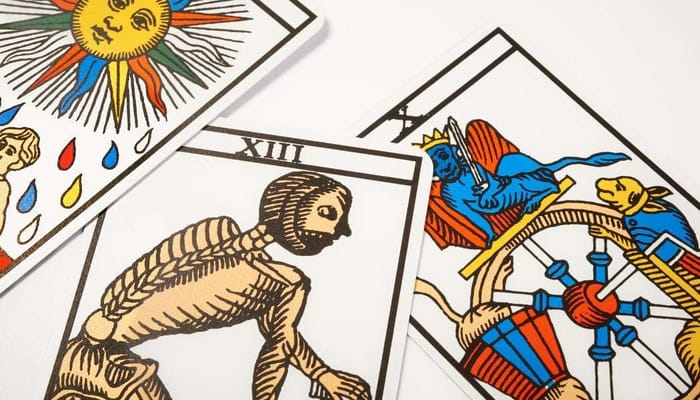
The three major traditional systems - Rider-Waite-Smith, Marseille, and Thoth - each organize these elements differently, but they share the same underlying logic. Learn any one of them thoroughly, and you'll find the other two far more accessible than starting from scratch.
Traditional reading's great strength is consistency. A reader who knows the system can sit down with a stranger and deliver a coherent, useful reading because the framework carries the weight. It's learnable, teachable, and produces results even when your intuition feels flat. It's also the approach with the strongest track record in predictive work - using card combinations and spread positions to map what's likely coming.
The limitation is mechanical repetition. A reader who leans too heavily on memorized meanings can start to sound like a dictionary. The Ten of Swords is always ruin. The Three of Cups is always celebration. The readings become technically accurate but emotionally hollow, missing the personal thread that makes a reading feel like it's actually about you.

Esoteric Reading: The Hidden Architecture
Esoteric reading treats the tarot deck as a map of interconnected symbolic systems. Each card doesn't just have a meaning - it has a position in a web of correspondences that includes Kabbalah, astrology, numerology, alchemy, and the broader Western mystery tradition.
In this framework, every Major Arcana card corresponds to a Hebrew letter, an astrological sign or planet, and a position on the Kabbalistic Tree of Life. The Empress isn't just "abundance" - she's the path of Daleth connecting Chokmah to Binah, associated with Venus, carrying the numerological energy of the number 3. Each layer of correspondence adds depth. Pull three or four of those layers together in a reading, and you're working with a density of meaning that no single keyword can touch.
This is the tradition that grew primarily out of the Golden Dawn in the late nineteenth century, though its roots reach back through centuries of hermetic philosophy. The Golden Dawn's genius was systematization - they took scattered esoteric traditions and wove them into a coherent framework where tarot, astrology, Kabbalah, and ceremonial practice all spoke the same symbolic language.
The numerology-tarot connection is where this site spends most of its time. Every card carries a number, and that number maps to the same energetic principles that govern Life Path numbers, Expression numbers, and every other numerological calculation. The Hermit is card 9, and it carries the same contemplative, completion-oriented energy that the number 9 holds across every system. The Tower is card 16, which reduces to 7 - and beneath the dramatic collapse you find the 7's energy of forced introspection and spiritual seeking. When you read tarot through numerological awareness, patterns emerge across spreads that you'd miss entirely working with keywords alone.
Esoteric reading's strength is extraordinary depth. A single card can open into hours of contemplation when you follow its correspondences across systems. It creates connections between disciplines that enrich each other. Your astrology deepens your tarot, your tarot deepens your numerology, and all three illuminate your Kabbalistic study. For readers drawn to spiritual development, this approach offers something closer to a complete philosophical system than a divination method.
The limitation is the learning curve, which is genuinely steep. Years of study in multiple traditions before the connections start feeling natural rather than forced. And there's a real risk of over-intellectualizing, getting so absorbed in correspondences and cross-references that you lose the living, breathing person sitting across from you. The most elaborate esoteric interpretation in the world falls flat if it doesn't connect to someone's actual life.

Why Most Readers Blend All Three
In practice, very few experienced readers work exclusively within one system. Most develop a blend that draws from all three - and the blend tends to follow a natural arc.
You probably start traditional. You learn the card meanings, memorize some spreads, and build a vocabulary. Then, somewhere along the way, intuition starts to speak louder than the book. You notice that a card is saying something its "official" meaning doesn't capture, and you learn to trust that impression. Later still - maybe months, maybe years - you begin exploring the deeper symbolic layers. You discover that the number on the card connects to an astrological sign, which connects to a Hebrew letter, which illuminates something the intuitive hit was already pointing toward.
The best readings tend to draw from all three at once. Traditional meanings provide the structure. Intuition provides the personal relevance. Esoteric correspondences provide the depth. Think of it like music: traditional reading gives you the scales and chord progressions, intuitive reading gives you improvisation, and esoteric reading gives you music theory. A musician who only knows theory sounds stiff. A musician who only improvises eventually repeats themselves. The ones who've internalized all three can play anything.
If you're just starting out, start with traditional meanings. You need vocabulary before you can improvise, and you need a framework before you can see what lies underneath it. But don't treat any single approach as the final destination. The history of tarot itself is a story of systems layering on top of each other across centuries - and the richest readings come from readers who've absorbed enough of each tradition to move between them fluidly.

Frequently Asked Questions
Which system should a beginner start with?
Traditional reading. Learn the card meanings, practice with established spreads, and build a working vocabulary first. Intuition develops naturally as you spend time with the cards, and esoteric correspondences will make far more sense once you already know what each card does on its own. Most readers who jump straight to Kabbalah or astrology-based reading without a traditional foundation find themselves overwhelmed by abstraction.
Can I mix systems in one reading?
Absolutely - and most experienced readers do exactly that. You might start with traditional positional meanings to anchor the spread, follow an intuitive impression when a particular card image grabs you, and then notice a numerological pattern across the cards that ties the whole reading together. The systems aren't contradictory. They're complementary lenses on the same moment.
Which system is this site based on?
This site leans esoteric, with a particular focus on the tarot-numerology connection. Every card page integrates numerological meanings, Hebrew letter correspondences, and astrological associations alongside the traditional imagery-based interpretation. The idea is that understanding the number behind a card unlocks a layer of meaning that memorization alone can't reach. But we also value intuitive reading and encourage readers to trust their own responses to the images.
Do I need to know Kabbalah to read tarot?
No. Millions of people read tarot effectively using only traditional meanings and intuition. Kabbalistic correspondences add a powerful layer of depth, but they're not required - and the tarot existed as a card game for three centuries before anyone connected it to Kabbalah. If the history interests you and you want to understand why the Major Arcana has exactly 22 cards (matching the 22 Hebrew letters), Kabbalistic study will reward you. But it's a choice, not a prerequisite.