How to Make a Tarot Cheat Sheet: A System for Learning All 78 Cards
By Blair Andrews · Published May 20, 2016 · Updated May 10, 2026

The System Behind the Cards
The hard way to learn tarot is to memorize 78 individual card meanings, one at a time, as if each card were an isolated piece of information with no connection to anything else in the deck. That approach is exhausting, and it produces flat, mechanical readings even when it works.
There is a better way, and it is built into the structure of the deck itself. The tarot is not a collection of 78 random images. It is a system - a grid of intersecting meanings where every card sits at the junction of a suit (which tells you the domain of life involved) and a number (which tells you the stage or quality of the experience). Once you understand the suit meanings and the number meanings, you can derive the core significance of any Minor Arcana card by combining the two.
That is what a real cheat sheet looks like. Not 78 memorized definitions, but a framework that generates meanings on the fly. This page gives you that framework.

The Four Suits: Domains of Experience
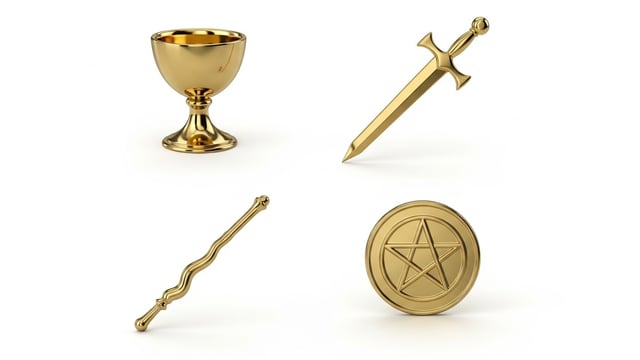
Every suit in the Minor Arcana corresponds to one of the four classical elements, and that element tells you what area of life the card is addressing. This is the first half of the system.
Wands correspond to Fire. Fire is energy, passion, ambition, creativity, and the drive to make things happen. When Wands show up in a reading, the cards are speaking about your will, your motivation, your creative projects, your career ambitions, and your capacity for inspired action. Wands move fast. They are about forward momentum, enthusiasm, and the spark that starts something new. The shadow side of fire is burnout, aggression, impatience, and the tendency to start things without finishing them.
Cups correspond to Water. Water is emotion, intuition, relationships, and the inner world of feeling. Cups address love, friendship, emotional fulfillment, compassion, imagination, and the quality of your connections with other people. When Cups dominate a reading, the cards are telling you that the situation is primarily emotional - that feelings, not logic or ambition or material concerns, are what matter most right now. The shadow side of water is emotional overwhelm, fantasy, avoidance, and drowning in feelings without ever acting on them.
Swords correspond to Air. Air is intellect, communication, conflict, truth, and the sharp edge of the thinking mind. Swords deal with decisions, arguments, mental clarity, honest confrontation, and the pain that comes from seeing things as they actually are rather than as you wish they were. This is the most challenging suit for many readers because so many Sword cards depict difficulty. That difficulty is the unavoidable consequence of thinking clearly in a world that rewards comfortable illusions. The shadow side of air is overthinking, anxiety, cruelty, and using intelligence as a weapon.
Pentacles correspond to Earth. Earth is the material world - money, health, work, home, physical comfort, and the tangible results of your efforts. Pentacles address practical concerns: your finances, your career (the work itself, not the ambition behind it, which is Wands), your body, your physical environment, and the slow, patient process of building something real. The shadow side of earth is greed, materialism, stagnation, and becoming so focused on security that you stop taking any risks at all.

The Number Sequence: Stages of a Story
Each suit tells a story from Ace through Ten, and the numbers follow a consistent arc regardless of which suit they belong to. This is the second half of the system.
Ace: The Beginning. Pure potential. The seed of everything the suit represents, offered to you in its most concentrated form. The Ace of Wands is a burst of creative inspiration. The Ace of Cups is the opening of the heart. The Ace of Swords is a moment of mental clarity. The Ace of Pentacles is a material opportunity. Every Ace says the same thing in its own element's language: something new is starting.
Two: The Choice. Duality enters the picture. What was pure in the Ace now has to reckon with an opposing force, a second option, a fork in the road. Twos are about balance, partnership, and the tension of having to choose. They ask you to weigh options rather than act on impulse.
Three: First Growth. The initial expansion that comes from moving past the Two's decision point. Creativity starts producing visible results. Collaboration begins to bear fruit. The first tangible evidence that the Ace's potential is becoming real. Threes carry an energy of early momentum - you are still at the beginning, but you are no longer standing still.
Four: Stability. Structure consolidates. The energy of the suit finds a stable form - a foundation, a resting point, a defined shape. Fours can feel like relief (the Four of Wands' celebration) or like confinement (the Four of Swords' enforced rest), depending on the suit. The common thread is that something has solidified. Whether that solidity feels like security or stagnation depends on what you need at the time.
Five: Friction. The stability of the Four breaks open. Conflict, loss, competition, or disruption enters the picture. Fives are uncomfortable, but they are also where growth happens. Without the Five's disruption, the Four would become permanent stagnation. Fives are the growing pains of the suit's story - necessary, painful, and ultimately productive.
Six: Harmony. After the Five's upheaval, the Six restores balance - but at a higher level than the Four achieved. Where the Four's stability was rigid, the Six's harmony is dynamic. It integrates the lesson of the Five and finds a new equilibrium. Sixes often carry themes of generosity, reciprocity, and the satisfaction of having worked through difficulty to reach a better place.
Seven: The Inner Struggle. The deepest challenge of the suit. Sevens are complex cards because the struggle they describe is primarily internal. Doubt, temptation, illusion, assessment - the Seven asks you to confront something within yourself that you have been avoiding. These are cards of testing, and the test is about who you are when the path forward is not clear.
Eight: Momentum. The inner work of the Seven translates into outward movement. Eights carry speed, power, and the sense of forces in motion. Sometimes that motion feels liberating (the Eight of Wands' swift progress). Sometimes it feels oppressive (the Eight of Swords' mental imprisonment). But the energy is always kinetic - things are moving, whether you are driving them or being carried by them.
Nine: Near Completion. Almost there. The suit's story is approaching its conclusion, and the Nine carries the emotional weight of the final stretch. Nines can be deeply satisfying (the Nine of Cups' wish fulfilled) or deeply painful (the Nine of Swords' midnight anxiety), but they always signal that you are close to the end of a cycle. The work is nearly done. What remains is integration.
Ten: Fullness. The suit's energy reaches its maximum expression. The story is complete. Tens carry the weight of everything the suit has built from Ace through Nine, and they represent both the culmination and the turning point. The Ten of Pentacles is material abundance fully realized. The Ten of Swords is mental suffering pushed to its absolute limit - which also means it has nowhere left to go but toward healing. Every Ten implies that a new Ace is coming.

The Court Cards: People and Personalities
The court cards - Page, Knight, Queen, and King - operate differently from the numbered cards. Rather than describing situations or events, they most often represent people, personality aspects, or modes of engaging with the suit's element. They follow their own progression.
Page: The Learner. New to the element's energy. Curious, enthusiastic, sometimes naive. The Page of Cups is someone just discovering their emotional depth. The Page of Pentacles is someone beginning to take material responsibility seriously. Pages bring messages, fresh perspectives, and the beginner's openness that more experienced energies sometimes lose. In a reading, a Page often represents a young person, a student, or the part of yourself that is still learning.
Knight: The Active Force. The element's energy in motion - passionate, focused, sometimes reckless. Knights charge forward. They represent the full commitment to pursuing what the suit values. The Knight of Wands is pure creative ambition on horseback. The Knight of Swords is intellectual conviction cutting through everything in its path. Knights get things done, but they can also overdo it. They represent action without the wisdom of experience, which makes them powerful and also dangerous.
Queen: Receptive Mastery. The mature, inward expression of the suit's element. Queens have internalized their element so deeply that it flows from them naturally. The Queen of Cups does not just feel emotions - she understands them, holds space for them, and uses that understanding to nurture others. The Queen of Pentacles does not just manage material resources - she creates environments of comfort and abundance that sustain everyone around her. Queens represent mastery expressed through being rather than doing.
King: Projective Mastery. The mature, outward expression of the suit's element. Kings have mastered their element and now direct it into the world with authority and purpose. The King of Wands leads through vision and charisma. The King of Swords leads through intellectual authority and clear judgment. Where Queens hold and nurture the element's energy, Kings channel and direct it. They represent mastery expressed through doing rather than being.

Combining Suit and Number
The real power of this framework is what happens when you combine both halves. Any Minor Arcana card's core meaning can be derived by asking two questions: what suit is it (what domain of life?) and what number is it (what stage of the story?).
The Five of Cups, for example. Cups means emotion and relationships. Five means friction and disruption. Put them together: emotional disruption. Loss in the realm of feelings. Grief, disappointment, something valued that did not work out. You do not need to have memorized the traditional image of a figure mourning over spilled cups to arrive at that meaning - the system gives it to you directly.
The Eight of Pentacles. Pentacles means material world, practical work. Eight means momentum. Put them together: momentum in practical work. Skill-building, dedicated effort, the steady accumulation of mastery through repetition. The traditional image of an apprentice carving pentacles one after another matches perfectly, but again - you could have arrived at the meaning without ever seeing the image.
This approach does not replace the nuance that comes from studying individual cards in depth, and it does not cover the Major Arcana, which follows its own archetypal logic rather than the suit-and-number grid. But as a foundation for understanding the 56 Minor Arcana cards - and as a tool for those moments in a reading when your mind goes blank and you need something solid to anchor your interpretation - it is genuinely reliable.

Putting It on Paper
The most effective cheat sheet format is a grid. Suits across the top (Wands, Cups, Swords, Pentacles), numbers down the side (Ace through Ten, then Page, Knight, Queen, King). In each cell, write a two-to-four word phrase that captures the intersection of that suit and that number. Fire + Beginning = "Creative spark." Water + Friction = "Emotional loss." Earth + Harmony = "Generous stability."
Keep it brief. The purpose of the cheat sheet is not to replace your intuition but to give it a starting point when you feel stuck. A glance at "Air + Inner Struggle" is enough to remind you that the Seven of Swords is about mental deception and difficult choices - and from there, your intuitive reading of the specific card image in the specific context of the specific reading takes over.
Write it by hand if possible. The physical act of writing engages a different kind of memory than typing does, and the phrases you write will stick in your mind faster than phrases you copy and paste. Carry it with your deck for the first few months of practice, and you will likely find that you stop reaching for it sooner than you expected. The framework internalizes quickly because it makes sense - and things that make sense are easy to remember.
For deeper exploration of the Minor Arcana beyond this framework, the complete Minor Arcana guide covers each card individually with the kind of nuance and context that a cheat sheet intentionally leaves out.

Frequently Asked Questions
Does this system work for the Major Arcana too?
Not directly. The 22 Major Arcana cards do not follow the suit-and-number grid. They represent archetypal energies and major life themes that operate on a different level than the everyday situations described by the Minor Arcana. The Major Arcana has its own internal sequence - the Fool's progression from card 0 through card 21 - but it requires a different kind of study. The suit-and-number framework is specifically designed for the 56 Minor Arcana cards.
What about reversed cards?
Reversals add a layer of meaning that the basic framework does not address. The simplest approach is to think of a reversed card as the same suit-and-number combination but with its energy blocked, internalized, or expressed in its shadow form. The Five of Wands upright is open creative conflict - people competing or clashing energetically. Reversed, it might indicate avoiding necessary confrontation, internal creative frustration, or the resolution of a conflict that was previously active. Reversals are worth studying separately once you are comfortable with the upright framework.
Can I use this framework during actual readings, or is it just for studying?
Both. The framework is designed to be a practical reference tool you can consult during readings, especially in the early months of your practice. There is no rule that says you have to read from pure memory. Professional tarot readers with decades of experience still occasionally consult references for cards that come up in unusual contexts. Using a cheat sheet during a reading is not cheating - it is being thorough.
Why do different tarot books give different meanings for the same card?
Because tarot interpretation has never been monolithic. Different traditions emphasize different aspects of the same symbol, and individual readers develop personal associations through experience. The suit-and-number framework gives you a stable foundation that most traditions agree on. From there, the variations you encounter in different books are not contradictions - they are different angles on the same core meaning. Over time, you will develop your own angle, informed by the books you have read and the readings you have done.