Sing, tend, sing, tend - the lullaby rhythm. 3636 alternates creativity and stewardship twice, and the wisdom lives in the alternation itself rather than in any single brilliant act. The Hermit arrives through patience.
Angel Number 3636 Meaning: The Oscillation Between Making and Choosing
By Blair Andrews · Published April 18, 2026 · Updated May 21, 2026
The numbers inside 3636

3Creativity, expression, communication
6Home, responsibility, the people closest to you
3 + 6 + 3 + 6 = 18 → 9
9: Completion, letting go, a bigger purpose
What 3636 means for you specifically depends on which of the 11 Life Paths you’re on. Your birthday determines that.
Enter your birthday below:

A child is crying. Not from pain - from the ordinary overwhelm of being small and tired and unable to make the world stop spinning for five minutes. Someone leans down and starts to sing. Not a performance. Just a melody, half-remembered, shaped more by warmth than technique. The child's breathing slows. The fists unclench. The song is working.
But the song alone is not enough. After the singing, there are practical things: the blanket tucked, the water glass refilled, the nightlight adjusted so the shadows do not look like animals. Tending. The quiet, physical work of making a small world safe.
And then the child stirs again, and the singing starts over. A different verse this time, because the tending changed the atmosphere - the room is calmer now, the voice can go lower, the melody can wander somewhere it could not have reached before the blanket was tucked.
Sing. Tend. Sing. Tend.
3636 is a lullaby. The expression and the stewardship alternating, each one making the other more itself, until the Moon rises over the nursery and the child who grew up carrying the song becomes the completion.

What the Voice Creates
3 is the number Balliett called "the outward expression of the Christ principle" - the energy that gathers the blossoms that 1 planted and rejoices over the happiness they give. Three is musicians, artists, actors. It is the number that can "interpret and bring forth the silent hidden voices of all things." Agrippa called it perfection itself: an incompounded number, a holy number, a number of perfection, a most powerful number. In the tarot, 3 is the Empress - creation as an act of generosity, the warm, fertile impulse that brings something into the world simply because the world needs it.
When you sing to a child, you are living inside the 3. You are not deliberating. You are not weighing options. You are expressing something - pouring it out because the moment requires it and because the expression itself is a kind of care.
When you sing to a child, you are living inside the 3. You are not deliberating or weighing options. You are expressing something because the moment requires it and because the expression itself is a kind of care.

What the Hands Tend
6 arrives after the singing, and it carries a different weight. Balliett called 6 the Cosmic Mother, the Finisher - "six days shalt thou labor and do all thy work." Not the hard labor of 4, but the completing work, the arranging and tending and making-right. Agrippa found 6 to be "the most perfect in nature, in the whole course of numbers, from one to ten" because its parts add up to itself: 1 + 2 + 3 = 6. Nothing wanting, nothing left over. In the tarot, 6 is the Lovers - the moment of the defining choice, where you stand at a crossroads and both directions are vivid and real.
After the singing, the tending. After creation, stewardship. The 6 does not make new things. It takes what was made and chooses how to hold it. The blanket tucked. The glass refilled. The nightlight turned just so. These are not creative acts in the way the song was creative. They are acts of discernment - of looking at what exists and deciding what it needs to survive the night.
The first 3-6 cycle in this number is the easier one to recognize in your own life. You made something, and then you had to take care of it. You expressed yourself, and the expression opened a question: now what do I do with this? The Empress planted the garden. The Lovers stood at the fork in the path and chose which flowers to water and which to let go wild.

The Second Verse Lands Differently
The second 3 is not the same as the first. Because the tending happened between them.
Come back to the nursery. The first song was instinctive - whatever melody came to mind, whatever words tumbled out. The tending that followed changed the room. The air is calmer. The child is half-asleep instead of wide-awake-screaming. And the second song, the one that starts now, can go to quieter places. It can be more precise. It does not need to compete with crying. It can simply be.
The second 3 in 3636 is creation after a choice has been made. It is leaner, more specific, more honest. The sculptor who committed to one form discovers that the committed chisel finds details the uncommitted one never could. The writer who chose a direction in the second draft suddenly hears the voice of the piece for the first time, because the first draft was where the voice was found and the tending was where the voice was chosen.
And then the second 6 arrives. Another defining choice - but different from the first, because it stands at the end of a creation that was itself shaped by a prior choice. The second Lovers is deeper, more intimate. It is not asking which way should I go? It is asking now that I have sung and tended and sung again - what does this actually mean to me?
The parent singing the second verse is no longer soothing a crisis. They are doing something else entirely: teaching the child what safety sounds like, so the child can carry that sound forward into every dark room they will ever enter.
Whether 3636’s shadow side applies to you — and how strongly — depends on your core numbers. Your birthday reveals the first one.
Enter your birthday below:

The Moon Over the Nursery
Add the digits. 3 + 6 + 3 + 6 = 18.
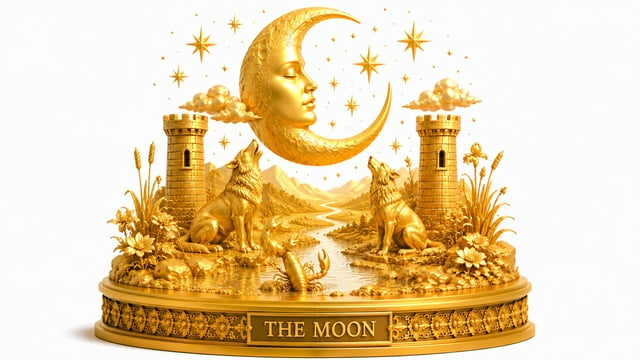
Eighteen is the Moon in the tarot. Borrowed light. A narrow path between two towers. Shapes without edges. Enough light to walk by, not enough to map.
The Moon governs the entire oscillation of 3636 - every verse, every act of tending, every swing between Empress and Lovers. All of it happens under reflected, silver light. You will not see the full picture while you are inside the alternation. You will feel your way through it. The right choice will announce itself not as logic but as a low hum in the body, the way the right note in a lullaby announces itself by the way the child's breathing changes.
This is why the alternation can feel disorienting while you are living it. Create, tend, create, tend - and the whole time, you are working by moonlight. The certainty you want is not available. What you get instead is the quieter kind of knowing that arrives when you stop demanding clarity and start listening to the rhythm.
The Moon rises over the nursery at night. It does not illuminate every corner. But the parent singing in the half-dark knows something the daylight parent does not: that some things can only be made in dim light, when the performer stops performing and the tending becomes instinctive, and the voice drops to the register where lullabies actually live.

The Child Who Grew Up Carrying the Song
Reduce further. 1 + 8 = 9.
Nine is the Hermit - the last single digit, the figure on the mountaintop with a lantern in one hand and nothing else. Balliett called 9 "free expression on all planes," the number composed of three planes of 3, making it fully inspirational. Agrippa dedicated 9 to the nine Muses. It is the number where the paths of life end - not because the road runs out, but because the arc is complete.
The 9 beneath 3636 does not arrive through a single brilliant act. It arrives through the full oscillation - through the patience of singing and tending and singing and tending until the rhythm itself becomes wisdom. A single 3 creates. A single 6 tends. A 36 creates and tends once. But 3636 runs the cycle twice, and in that doubling, the Hermit emerges - not from the creating or the tending alone, but from the alternation between them.
The child who was sung to and tended, sung to and tended, grew up carrying both: the melody and the care, the expression and the stewardship, the voice that creates and the hands that choose. The Hermit on the mountain is that grown child. The lantern he carries is the lullaby he heard so many times that it became part of his breathing, something he could not lose if he tried.
The completion (9) is not the last song. It is the person who was shaped by all of them - every verse, every tucked blanket, every second round of tending that found what the first round missed. The wisdom lives in the rhythm itself, in the willingness to keep alternating between expression and care until the alternation becomes as natural as breathing in and breathing out.
Sing. Tend. Sing. Tend. The Moon over the nursery. The child asleep. The song still going, somewhere, in the bones of the person they became.

Regarding 3636
What does angel number 3636 mean?
3636 is the rhythm of creation and stewardship alternating - like a lullaby where you sing (3), tend (6), sing again (3), and tend again (6). Each round of creation is shaped by the tending that came before it, so the second verse lands differently than the first. The number reduces through 18 (the Moon) to 9 (the Hermit), which means the whole oscillation is leading toward a quiet, complete kind of wisdom that only arrives through repetition, not through a single brilliant moment.
Why does 3636 reduce to 9?
Because 3 + 6 + 3 + 6 = 18, and 1 + 8 = 9. The 18 is the Moon in tarot - borrowed light, intuition, the kind of seeing that happens when you stop demanding clarity. The 9 is the Hermit - the figure at the end of the single-digit cycle who has walked the whole path. In 3636, the Hermit does not arrive through one act of genius. He arrives through the patience of creating and tending and creating and tending until the alternation itself becomes the understanding.
What does 3636 mean for relationships?
In love, 3636 usually describes the rhythm of expressing yourself to someone and then caring for what that expression creates. You say something honest (3), then tend the relationship that the honesty just changed (6). You express yourself again, more precisely this time because the first round of tending taught you something (3), and then you face a deeper choice about what this relationship actually means to you (6). The pattern is not about a single conversation. It is about the ongoing alternation between showing who you are and taking care of what grows from the showing.
What is the shadow side of 3636?
The shadow shows up when one half of the cycle dominates the other. All 3 and no 6 is the person who keeps creating but never stops to tend what they made - the singer who never tucks the blanket, the parent who performs warmth but skips the quiet work of care. All 6 and no 3 is the opposite: someone who tends endlessly but has stopped singing, stopped expressing, become pure stewardship with no voice left. 3636 asks for both, in rhythm, because neither is complete without the other.
How is 3636 different from 36?
36 is one cycle: create, then tend. 3636 doubles it, and the doubling transforms both halves of the rhythm. In the second round, the creation is informed by the tending that came before, and the tending is informed by a more precise creation. The second verse of the lullaby lands differently because the child is calmer now and the singer can go to quieter places. The single cycle of 36 teaches you the basic rhythm. The doubled cycle of 3636 is where the rhythm becomes wisdom.
Curious which numbers are active in your chart right now? Your birthday is the starting point.
Enter your birthday below:
Explore Angel Numbers
| Digit meanings | Angel Number 3, Angel Number 6 |
| Reduces to | Angel Number 9 |
| Mirror | Angel Number 6363 |
| Similar patterns | 3535, 3737, 3434, 3838, 3939, 3232, 4040, 3131 |
Behind Your Angel Number
calculate your full numerology chart·find your life path number·numerology, explained