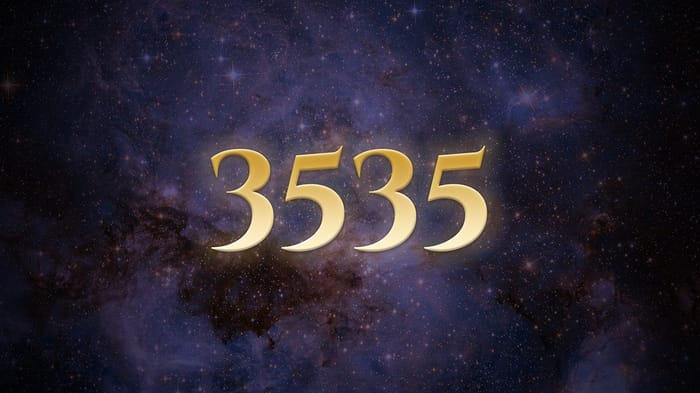
Create it, then govern it - twice - and the Tower clears what was built too rigidly. 3535 alternates Empress and Hierophant through two rounds, and the lightning that strikes on the way to the Chariot removes what the governed-creative rhythm couldn’t flex past.
Angel Number 3535: Create It, Then Govern It. Twice.
By Blair Andrews · Published April 18, 2026 · Updated May 10, 2026
The numbers inside 3535

3Creativity, expression, communication

5Change, freedom, a new direction
3 + 5 + 3 + 5 = 16 → 7
7: Understanding, depth, seeing what others miss
What 3535 means for you specifically depends on which of the 11 Life Paths you’re on. Your birthday determines that.
Enter your birthday below:

Picture a poet on the road. Not a famous poet, just someone with a notebook and good boots and a restlessness that will not let them stay put for long. They stop at a town, rent a room above a bakery, and write a poem about the way the flour dust catches the morning light.
Then they leave. Pack the bag, walk to the next town, sleep in a different room. The leaving feels as necessary as the writing - a different kind of breathing, an exhale after the inhale of making something. At the next stop, they write another poem. Then leave again. Another town. Another poem. Another leaving.
One day - maybe years into this rhythm - the poet spreads all the poems out on a table and reads them in order. And something happens that the writing itself could not have predicted. The poems, laid end to end, form a map. Every verse marks a place. Every leaving marks a distance. The body of work that accumulated poem by poem, stop by stop, turns out to describe an entire geography - a cartography of attention, drawn by someone who did not know they were drawing it.
The realization that the poems are a map: that moment is 3535.

The Expression and the Road
3 is the Empress. Balliett called it "the outward expression of the Christ principle of Trinity" - the number that gathers the blossoms that 1 planted and brings them into the world. Most musicians, artists, and actors vibrate to 3. It is the force that takes what is silent and hidden and gives it a voice. The poet stopping to write: that is the 3. The compulsion to express, to name, to make something where there was nothing.
But Balliett also noted something about 3 that gets overlooked: Without 1 and 2, like a ship without a rudder. Expression alone drifts. It needs direction, needs movement, needs something to carry it forward past the moment of creation.
5 is the Hierophant - and also the road. Agrippa called it the just middle of the universal number and the Seal of the Holy Ghost, the bond that binds all things. Balliett described the 5 person as someone who finds itself in high unexplored country with paths in all directions. 5 is not the wild freedom people claim it is. It is the experience of being at a crossroads with enough knowledge to choose a direction. The poet leaving town: that is the 5. The ability to release what you just made and move toward what you have not made yet.
3-5-3-5. Write a poem. Walk to the next town. Write another poem. Walk to the next town.
Empress-Hierophant-Empress-Hierophant. Express, then move. Express again, then move again. The alternation is the whole pattern, and the pattern runs twice because one round is not enough to see it. You need at least two poems and two departures before the shape of the map starts to emerge.

Why the Poems Become a Map (The Tower at 16)
3 + 5 + 3 + 5 = 16.
Sit with 16 before you reduce it, because the Tower is what turns the pile of poems into a map.
In tarot, the sixteenth card shows a tower struck by lightning, the crown blown off the top, figures falling. Agrippa noted that the Pythagoreans called 16 "the number of felicity" - a strange name for a card about destruction, until you understand what the Tower actually does. It does not punish. It reveals. It strips the cosmetic layer off whatever you built and shows you the structure underneath. What was solid stays standing. What was hollow falls.
For the poet on the road, the Tower is the moment of spreading the poems out on the table and seeing, suddenly, what they actually say. The moment when the individual pieces stop being separate works and become a single document - a record of everywhere you have been and everything you paid attention to. The lightning is the clarity. The falling is the collapse of the illusion that the poems were unrelated, that the traveling was random, that the alternation of writing and moving had no larger shape.
It has a shape. It has been drawing a map this whole time.
The experience can sting. You might realize that some of the poems are about the same wound, written from different towns. You might see a pattern you were not ready to see - a direction you were walking without admitting it, a question you were asking over and over in different words. The Tower does not let you look away. It insists that you read the map honestly, including the parts that show you where you were circling instead of traveling.

Reading the Map - the Sacred Knowing at 7
16 reduces to 1 + 6 = 7.
Balliett called 7 the Finished Number, "a complete temple standing alone." A closed number, like a person carrying a pack on their back - their past - without needing to open it for inspection. Agrippa called it the vehicle of human life and connected it to seven ages, seven planets, seven days, the Sabbath rest. In tarot, 7 is the Chariot: a figure holding the reins of two forces that pull in opposite directions, driving forward through the tension rather than resolving it.
The two forces in 3535 are expression and movement, Empress and Hierophant, the poem and the road. They pull in different directions - creativity wants to stay and deepen, freedom wants to leave and explore. The Chariot does not choose between them. It drives them both.
For the poet, reading the map is the 7. You see the whole route at once. The writing was never separate from the traveling. They were always a single act of attention distributed across time and space. The map is the knowing.
Whether 3535’s shadow side applies to you — and how strongly — depends on your core numbers. Your birthday reveals the first one.
Enter your birthday below:

The Shadow - Poems That Go Nowhere
The shadow of 3535 lives in two places, depending on which half of the alternation you get stuck in.
Stuck in the 3s, you write and write and never leave. The poems pile up, all about the same room, the same view. Balliett warned that 3 without grounding is "like a ship without a rudder" - expression circling the same harbor. The Hierophant's freedom never arrives because you refuse to release what you just made.
Stuck in the 5s, you leave and leave and never write. Balliett described the undeveloped 5 as having "wandering eyes" and "outstanding bills often unpaid" - movement without record. You pass through a hundred towns and none of them mark you, because you never stopped long enough to let a poem form.
Either way, there is no map. The Tower needs material to strike. The Chariot needs two forces to drive. A poet who never travels or a traveler who never writes cannot reach the sacred knowing that emerges when the two activities are finally seen as one.

Where This Meets the Ground
In creative work, 3535 is the artist who moves between projects and realizes, years later, that all the projects were chapters of the same book. The resume looks scattered until you read it as a map.
In career, this is the person who builds something, releases it, builds the next thing, releases that too - and then has the Tower moment of seeing that every venture was preparation for the one they are about to build now.
In relationships, 3535 asks whether you can express yourself fully (3), give the other person room to be who they are (5), express yourself again as you grow (3), and give room again as they grow (5). The Tower moment is usually the fight that reveals the relationship is two people mapping a shared territory they could not have discovered alone.

The Map Keeps Growing
The poet does not stop traveling after reading the map. The Chariot is not a parked car. It is a vehicle in motion, sphinxes pulling, reins in hand.
What changes after the Tower is that you write differently and travel differently. You know, now, that the poems and the journeys are a single practice, and that awareness infuses both halves with something they did not have before - purpose, direction, the knowing that Balliett described as "the power of internal sight."
You still stop. You still write. You still leave. But the map is conscious now. Every new poem is a coordinate placed deliberately. Every departure is a line drawn with intention. 3535 is the poet on the road, and the road is a map, and the map is you, finally reading the story you have been writing with your life.

Frequently Asked Questions About Angel Number 3535
What does angel number 3535 mean?
3535 describes an alternation between expression and movement - write the poem, walk to the next town, write another poem, walk again. The 3s are your creative output (Balliett called 3 the number that brings forth the silent hidden voices of all things), and the 5s are your freedom to release what you made and move toward what you have not made yet. The sequence sums to 16, the Tower, which reveals that your individual creations form a larger map. Then 16 reduces to 7, the Chariot - the sacred knowing that comes from seeing the whole journey at once.
Why does 3535 pass through the Tower (16) before reaching 7?
Because the map cannot be read until the illusion of randomness collapses. When you are in the middle of the alternation - creating, moving, creating, moving - each piece feels separate. The Tower is the lightning-strike moment when you see the pattern connecting them all. It can be uncomfortable, because it might show you that your poems were circling the same question or your travels were tracing the same wound. But without that honesty, the sacred knowing at 7 stays hidden.
What is the difference between 3535 and 5353?
5353 is the mirror - it starts with movement and then expresses. A traveler who arrives at a place and then writes about it, rather than a writer who finishes something and then departs. 5353 gathers experience first, names it second. 3535 names first, moves second. Both reach 7, but the poet-on-the-road energy of 3535 means your creative instinct leads and your freedom follows, while 5353 is freedom leading and expression following.
How does 3535 relate to 3434?
3434 alternates expression with structure - the singer-songwriter who builds a recording studio. 3535 alternates expression with freedom - the poet who hits the road. Both start with the creative impulse (3), but where 3434 immediately builds a container for the creation (4, the Emperor), 3535 releases it and moves on (5, the Hierophant). 3434 reduces to 5 through Temperance (14). 3535 reduces to 7 through the Tower (16). The first teaches you to hold creation and structure in balance. The second teaches you to read the map your creations have been drawing.
Is seeing 3535 a sign to make a change?
It is a sign that you have already been making changes - the 5s are evidence that you know how to move, how to release, how to walk away from what you just created without clutching it. The question 3535 asks is whether you have stopped to read the map yet. Have you spread the poems out on the table? Have you looked at the pattern your creating-and-moving has traced across months or years? The change 3535 is pointing toward is not another departure. It is the recognition of where all the departures have been taking you.
Curious which numbers are active in your chart right now? Your birthday is the starting point.
Enter your birthday below:
Explore Angel Numbers
| Digit meanings | Angel Number 3, Angel Number 5 |
| Reduces to | Angel Number 7 |
| Mirror | Angel Number 5353 |
| Similar patterns | 3434, 3636, 3737, 3232, 3838, 3131, 3939, 3030 |
Behind Your Angel Number
free numerology calculator·life path calculator·what is numerology