Karmic Debt Number 16: When the Tower Falls
By Blair Andrews · Published April 18, 2025 · Updated July 20, 2026

There's no gentle way to introduce this number. Karmic Debt 16 is the most intense of the four karmic debts, and pretending otherwise would waste your time.
But intense is not the same as hopeless. Not even close.

What Karmic Debt 16 Actually Means
Karmic Debt 16 reduces to 7, the number of perfection, inner wisdom, spiritual seeking. The tarot runs on these same numbers, and its card of 7 is The Chariot - the victorious alignment of the higher self driving the personality. Seven is the number of God, the day of rest, the meeting point of heaven (3) and earth (4).
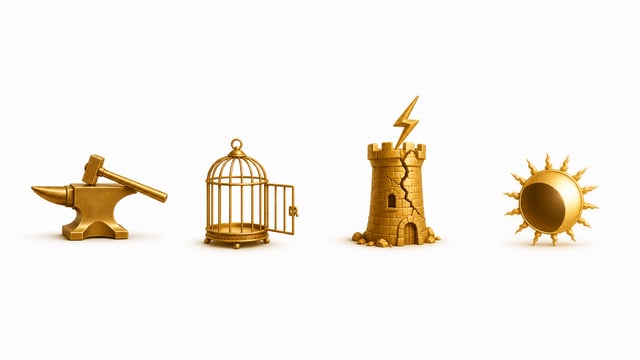
The classical numerologists called 16 "The Catastrophe of Man." In the Tarot, the 16th card is The Tower - a structure struck by lightning, its inhabitants falling, everything they built crumbling around them. It's one of the most feared images in the deck.
It's also one of the most liberating.
The karmic debt behind 16 involves the misuse of love and intimacy in past lives. Specifically, illicit love affairs that hurt innocent people. This wasn't casual heartbreak.
It was the kind of betrayal that damaged someone's ability to trust, that shattered families, that used another person's deepest vulnerability as a plaything. The ego was inflated through romantic conquest at someone else's expense.
Now that ego structure has to come down. Every false thing you've built - every identity constructed on vanity, every relationship maintained through deception, every self-image propped up by other people's admiration - is subject to demolition.
That's the catastrophe. It's also the cure.

The Ego Structure: 1 + 6 = 7
There's a hidden equation in the number 16 that reveals exactly what this debt targets. The 1 is the self. The 6 is love and marriage. Together they produce 7 - Spirit.
The karmic pattern is specifically about the self (1) using love and intimate relationship (6) as an ego vehicle. Not loving another person for who they are - using them to inflate who you are. Building your identity on being desired, admired, or needed by another person. Making someone else's devotion the foundation of your self-worth.
This is the structure the Tower demolishes. Not love itself but the ego structure wrapped around love. If your sense of self is built on someone else's perception of you, the 16 will eventually demolish that. It has to. Because the 7 underneath is seeking something real, and nothing built on borrowed identity is real.
The person who emerges from this demolition doesn't stop loving. They start loving differently. Without needing it to mean something about them. Without using it to feel large. The 7's perfection arrives through the destruction of everything that was pretending to be love but was actually self-inflation.

The Tower as Surgery
Think of it this way. Surgery is frightening. It is necessary. And it is performed on something you'd rather not lose.
But the surgeon removes what's killing you, not what's good. The Tower doesn't destroy what's real - it destroys what's constructed on false foundations.
The relationship that was held together by mutual performance rather than genuine connection. The career built on image rather than substance. The self-concept that depended on other people never seeing behind the curtain.
After every major 16/7 collapse, the question to ask is not "what did I lose?" but "what survived?" Whatever was standing before the Tower fell - whatever held its ground while the false structures crumbled - that's the foundation worth building on. That's the part of you that was real all along.
The surgery hurts. It always hurts. But the thing being removed was the thing preventing the healing. You just couldn't see that yet because you'd mistaken it for yourself.

How 16 Differs From a Straight 7
A plain 7 is oriented toward inner wisdom, spiritual seeking, and philosophical depth. Sevens often live quiet, contemplative lives. They're drawn to understanding the deeper mechanics of existence. There's a natural peace in the number.
A 16/7 wants the same things. The same depth. The same truth. The same perfection. But the path there runs through demolition.
Where a straight 7 might gradually grow into spiritual understanding through study and reflection, the 16/7 gets there through crisis. Through loss. Through having the rug pulled out from under them - sometimes more than once - until they stop standing on rugs that aren't real.
The 7 underneath seeks perfection. The 16 overlay means the path to perfection runs through the destruction of everything false. This is not a punishment. This is the universe performing surgery. The thing being removed is the thing that's preventing your real life from beginning.

The Image Problem
In a culture that rewards self-branding, the 16 faces a particular tension. The more energy you invest in managing how others perceive you, the more the Tower has to demolish.
This applies to the obvious - curated social media presence, strategic self-presentation at work, the carefully maintained image of having it all together. But it also applies to subtler forms of identity management. The persona of being the strong one who never needs help.
The image of the spiritual person who has it all figured out. The identity of the devoted partner who sacrifices everything - when what's really happening is a transaction: I'll perform devotion, and in return, you'll tell me I'm good.
This isn't an argument against all self-presentation. It's an argument for authenticity in the construction. Build from what's real and the Tower has nothing to strike. Build from who you actually are - including the messy, uncertain, imperfect parts - and the lightning passes over. It's the false structures that draw the bolt.
The practice of releasing curated identity is uncomfortable precisely because the identity was built to avoid discomfort. Letting people see the real you - the one behind the management - feels dangerous. But it's far less dangerous than waiting for the Tower to do the revealing for you.

Where 16 Shows Up in Your Chart
The position of the 16 in your numerology chart determines the arena and intensity of the Tower's work.
As a Life Path: Your life will likely include at least one major upheaval that strips away something you thought was essential to who you are. A career. A marriage. A reputation. A self-image you'd spent decades constructing. The experience is devastating while it's happening.
But it creates space for something authentic to emerge. Many people with 16/7 Life Paths report that the worst thing that ever happened to them turned out to be the beginning of their real life. The Tower doesn't end the story. It ends the false version so the real version can start.
As an Expression Number: You have genuine depth and intellectual power, but there's a vulnerability to building your identity on things that can be taken away - status, beauty, other people's perception of you.
The 16 will eventually strip away whatever you're hiding behind, so that your real gifts can emerge. This often plays out in the career sphere, where a dramatic fall precedes a more authentic rise. The fall isn't the end. It's the clearing.
As a Soul Urge: You long for spiritual truth and inner peace, but you may seek it through external validation - being desired, being admired, being needed. The soul lesson is that the perfection the 7 seeks cannot be found in another person's eyes.
It's an inside job. The 16 keeps demolishing external sources of worth until you go inward - not because it's cruel, but because the inward direction is where the treasure actually is.
As a Birthday Number: You were born with unusual charisma and the ability to form deep connections quickly. People feel drawn to you in ways that go beyond ordinary attraction.
But there's a shadow tendency to use that power carelessly - to enjoy being wanted without fully accounting for what being wanted costs the person doing the wanting. The karmic work involves learning to hold other people's hearts with the reverence they deserve.
As a birthday sub-lesson, the Tower dynamic may be less dramatic than as a Life Path, but it still produces a pattern of having false structures stripped away at key moments.

Working With the Debt
The most powerful practice for a 16/7 is radical honesty - proactively. The 16 demolishes deception. All kinds: lying to others, lying to yourself, performing a version of yourself that isn't real.
Every truth you tell voluntarily reduces what the Tower needs to expose forcefully. Think of it as voluntary demolition versus forced demolition. The building comes down either way. But when you take it down yourself, you get to choose where to stand.
Release your attachment to image. Not all at once - that's neither possible nor necessary. But start noticing the places where you're managing perception rather than being honest. Start with the small ones.
Tell someone you don't have it together when you don't. Admit you were wrong before someone proves it. Let yourself be seen without the armor. Each act of authentic self-presentation weakens the false structure that the Tower would otherwise have to destroy.
Treat every relationship as sacred. Given the past-life pattern, this is non-negotiable. No casual cruelty. No using people. No betraying trust for a thrill. The 16 is specifically about the karma of damaged intimacy.
How you treat the people closest to you is where the debt gets paid or compounded. Every act of genuine care - care that costs you something and isn't performed for an audience - repays a piece of the old debt.
When a Tower moment arrives, don't grab at the falling stones. Don't try to rebuild what's crumbling. Let it fall. Stand in the rubble. Stay present. Wait for clarity about what to build next.
The instinct to reconstruct the old structure immediately - to get back to "normal" as fast as possible - is the ego trying to rebuild its hiding place. Resist that instinct. The rubble is uncomfortable, but it's honest. And honest is where the 7 starts its real work.
Develop a genuine spiritual practice. The 7 underneath the 16 is seeking God, truth, deeper meaning. This seeking is not optional for a 16/7 - it is infrastructure. Meditation, contemplation, philosophy, time in nature, meaningful study - these are the foundation of everything else.
The 16/7 without a spiritual practice is a person waiting for the next Tower moment with no framework for understanding why it happened or what it means. The practice doesn't prevent the Tower. But it gives you a way to stand in the rubble without falling apart.

The Perfection Underneath
Here's what's easy to miss about Karmic Debt 16: the number it reduces to is 7. Perfection. Victory. The alignment of the divine and the human.
The catastrophe isn't the destination. It's the doorway.
People who have passed through the Tower - who have been humbled, stripped of pretense, forced into authenticity - often develop a quality that's hard to name but impossible to miss. A groundedness.
A compassion that comes from having been broken and rebuilt. A wisdom that only loss can teach. They've stopped performing. They've stopped needing to be seen a certain way. What's left is just them - and it turns out that's enough.
The 7's perfection was never about being flawless. It was about being real. The 16 just takes a more dramatic route to get there.
The Tower falls so that something true can stand in its place.

Explore Further

What the Classic Sources Say About Karmic Debt 16
Goodwin traces the 16/7 to involvement in unusual or illicit love affairs in a past life, affairs which caused suffering to others. It is the most dramatic of the four debts, associated with the Tower card's energy of sudden collapse and forced rebuilding. The 16/7 carrier built ego structures in past expressions that were based on self-deception or the exploitation of others' affections, and this lifetime demands those structures be demolished so authentic ones can replace them.
The Tower experience is not optional for the 16. Goodwin notes that the collapse typically arrives without warning - a relationship ends, a career implodes, a belief system shatters - and the person must rebuild from the rubble. The lesson is not to avoid building but to build on truth rather than image. The 16's specific challenge is that deception can also come FROM others, not just from the self: the 16 attracts situations where they are deceived precisely because they need to develop the 7's discernment.
The resolution path runs through genuine acceptance of impermanence. The 16 must learn that structures built on truth survive the Tower; structures built on ego do not. The growth is not in avoiding destruction but in building things worth rebuilding.
Wondering where this shows up for you? The Karmic Debt Calculator checks your whole chart for 16 and the other three debts.

Frequently Asked Questions
Why does Karmic Debt 16 involve sudden collapses?
The 16 corresponds to the Tower card in the Tarot - the archetype of structures that must fall because their foundations are false. The collapses are not random punishment; they are corrections. Every time the 16 carrier builds something based on ego, image, or self-deception, the structure becomes increasingly unstable until it falls. The collapses stop when the building starts happening on truth.
Is Karmic Debt 16 the same as Life Path 7?
No. Life Path 7 without the debt pursues wisdom and inner truth freely - the spiritual search is natural and largely voluntary. Karmic Debt 16 forces the search through crisis: you do not choose to go inward, you are driven inward by external collapse. The 16 arrives at the same destination as the 7 (deep understanding, spiritual insight) but the route involves significantly more demolition.
Can Karmic Debt 16 affect romantic relationships specifically?
Yes - Goodwin's name "Illicit Love" points directly at the relational arena. The 16 carrier often experiences love through patterns of idealization and disillusionment: building a partner into something they are not, then being devastated when the real person appears. The debt also attracts deception from partners. The resolution is learning to love people as they actually are rather than as projections of what you need them to be.
What is the positive outcome of resolving Karmic Debt 16?
A depth of spiritual understanding and personal authenticity that is almost impossible to achieve any other way. People who have worked through the 16 carry an authority that comes from genuine rebuilding - they know what is real because they have had everything false stripped away. The resolved 16 becomes one of the most trustworthy and perceptive people in any room.