Karmic Debt Numbers: Understanding the Four Spiritual Debts in Numerology (13, 14, 16, 19)
By Blair Andrews · Published April 18, 2025 · Updated September 23, 2026
About half of all people carry at least one Karmic Debt number in their chart. That is not a fringe statistic from some obscure tradition, and I carry two of the four myself.
If you have one, you are not unusual. You are not cursed. You are working with something that roughly every other person you know is also working with, whether they realize it or not.
What makes a Karmic Debt different from an ordinary number is the starting position. Normally, when a single-digit number appears in your chart, you are free to express it anywhere along its natural range. You might lean toward the positive side, the negative side, or somewhere in the middle. The whole continuum is available to you.
With a Karmic Debt, you do not get that freedom. You start at the difficult end of the number's spectrum - the overexpressed or underexpressed extreme - and you have to work your way toward balance.
The destination is the same healthy expression anyone with that root number can reach. But your starting position is harder, and the early stretch of the road feels steeper than it probably should.
The classical tradition explains this through past-life patterns. You misused or avoided the energy of a particular number before, and now you begin this life already tilted in the direction of that old pattern.
Whether you take the past-life framing literally or treat it as a metaphor for deep psychological tendencies, the practical effect is the same: there is a specific area where things feel disproportionately difficult until you engage with the lesson directly.
Four compound numbers carry this weight: 13, 14, 16, and 19. They appear during the intermediate steps of your numerological calculations - when your birth date or name reduces through one of these numbers on its way to a single digit.
A Life Path of 4 reached through 13 carries a very different energy than a 4 reached through 22 or 31. The final number is the same. The road is not.

How Karmic Debts Appear - and Why Position Matters
Karmic Debts can show up in any of your core chart positions: Life Path, Expression, Soul Urge, Personality, or Birthday. They also appear in timing positions like Pinnacles, Essences, and Personal Year cycles.
Where the debt sits makes a real difference in how you experience it.
On the Life Path, a Karmic Debt colors your entire life direction. It is the most powerful position for any number, and a debt here is unavoidable. It shapes the broad arc of what you are here to work through. On the Expression, the debt affects your natural abilities and how you operate professionally.
It tends to show up in your work life and public role. On the Soul Urge, it operates more quietly, affecting your inner motivations and private emotional life. On the Personality, it influences first impressions and how others perceive you before they know you well.
The Birthday position is the gentlest. If you were born on the 13th, 14th, 16th, or 19th, you carry the corresponding debt, but it acts as a sub-lesson within your Life Path rather than defining the whole thing. Think of it as a particular talent or challenge that modifies your direction rather than setting it.
When a Karmic Debt appears in a timing position - a Pinnacle or Essence period - it does not color your entire life. Instead, it creates an intense window where that debt's specific lessons concentrate. These periods can feel overwhelming while they last, but they pass.
The most challenging scenario is when the same karmic number appears in two major positions simultaneously. I've read charts where both the Life Path and Expression carry the same debt, meaning roughly 70% of the person's core energy is karmic.
These individuals tend to experience the debt's patterns with unusual intensity until they find a way to work with the energy consciously rather than against it.

Karmic Debt Number 13/4: The Debt of Discipline
The 13/4 is probably the most misunderstood of the four debts, mostly because people get distracted by the superstition around the number 13. In numerological terms, 13 has nothing to do with bad luck. It has everything to do with work.
The pattern behind this debt is straightforward: past avoidance of effort. Cutting corners. Expecting results without putting in the time. Letting other people carry the weight. The result in this life is a forced starting position where hard work feels disproportionate to what it produces, especially in the early years.
If you carry a 13/4, you already know what this feels like. You put in more hours than the people around you and seem to get less for it. Shortcuts that work fine for everyone else blow up in your face. The temptation to quit is constant, precisely because the effort-to-reward ratio feels fundamentally unfair.
That unfairness is the point. The debt is recalibrating your relationship with sustained effort itself.
The Two Traps of the 13/4
What most popular descriptions miss is that the 13/4 has two distinct failure modes, not one.
The first is giving up too easily. The frustration of working harder than everyone else for less reward creates a powerful pull toward abandoning projects, relationships, and goals before they have a chance to mature. This is the more obvious trap, and most people with a 13/4 recognize it in themselves.
The second is subtler and often more damaging: rigidity. The intensity of the 13/4 drive can turn genuine discipline into dogmatic stubbornness - one-track thinking, using abilities doggedly in a single direction, refusing to adapt even when the approach clearly is not working.
Some 13/4 people dig in so hard that they build their own prison and mistake it for dedication. The pattern is almost predictable: the person who has worked 60-hour weeks for a decade and can't understand why they feel trapped, when the trap is the rigidity itself, not the workload.
Both traps share a common root: the inability to see the pattern clearly enough to respond to it. The person who quits is reacting to the frustration.
The person who becomes rigid is reacting to the fear of losing what little ground they have gained. Neither is actually engaging with the debt's real demand, which is flexible, sustained effort over time.
The 13/4 by Chart Position
The most surprising placement is the Soul Urge, where the classical tradition describes it as inner laziness: a tendency to avoid the harder work of self-knowledge and spiritual growth even while working punishingly hard externally. The person who never stops moving but never looks inward. On the Life Path, work and effort are central themes from childhood through old age. On the Expression, the challenges concentrate in career, demanding unusual persistence for results that come slowly.
The 13 also carries a fear component that is easy to miss. Underneath the discipline issues, there is often an unnamed anxiety, a fear of being seen as inadequate or of being exposed as someone who cannot keep up. Recognizing that fear, rather than just pushing harder, is often what begins to shift the debt's grip.
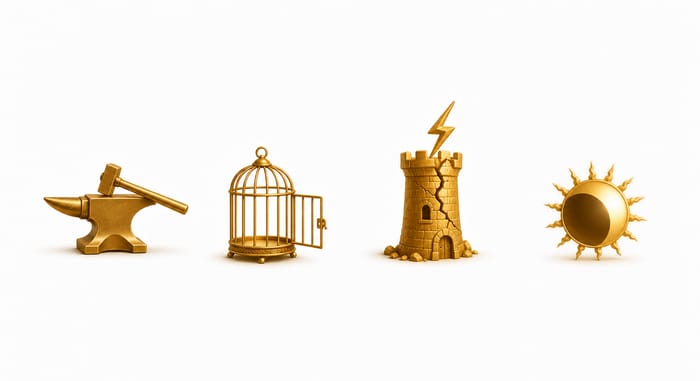
In the tarot, 13 corresponds to the Death card. Not literal death, but the demand for genuine change. The old way of operating has to end so something more honest can take its place. For the 13/4, this means the old relationship with work, whether avoidant or rigidly compulsive, has to die before a healthier one can grow.
Read the full Karmic Debt 13 guide

Karmic Debt Number 14/5: The Debt of Misused Freedom
The 5 energy is already one of the more challenging numbers to master. Its core lesson is learning the full cycle of change: to begin something, nurture it, experience it fully, and then let it go. Most people with strong 5 energy struggle with at least one part of that cycle.
The 14/5 magnifies that struggle dramatically. Specifically, it amplifies the part about letting go. Or more precisely, it makes it nearly impossible to complete any experience fully enough to actually learn from it before the next shiny thing appears.
The past-life pattern behind the 14/5 involves misuse of personal freedom: overindulgence, recklessness, using freedom as an excuse to avoid responsibility. The present-life consequence is a kind of restless chaos. Opportunities and adventures flood in, but the person cannot hold onto any of them long enough to extract genuine value.
What the 14/5 Actually Looks Like
The most visible pattern is excess. This can show up as overindulgence in physical pleasures (food, alcohol, drugs, sex, spending), but it is not limited to those.
Some 14/5 people are perfectly moderate in their appetites but utterly chaotic in their commitments. They start projects, relationships, and plans with enormous enthusiasm, then abandon them the moment the initial excitement fades.
The deeper pattern is forgetfulness. Not ordinary forgetfulness, but a tendency to forget hard-won lessons and repeat the same mistakes as if for the first time. Kevin Quinn Avery calls 14 "The Forgetfulness of Man" - the spirit descends and loses track of what it already knew.
What makes this particularly frustrating is that the 14/5 person can often see the pattern clearly after the fact. They know they keep doing this. I've had more 14/5 readers cry during a reading than any other number, not from sadness but from relief. Hearing someone name the pattern they've been silently watching themselves repeat for years is one of the most powerful moments in a numerology consultation. They just cannot seem to stop in the moment, because the pull of the next experience is so strong.
The 14/5 by Chart Position
The position-specific effects of the 14/5 are worth knowing. On the Life Path, it tends to manifest as loss of the things closest to you: home, family, business, long-term relationships. These losses are not random; they are the consequence of the debt's chaotic energy disrupting whatever you build.
On the Expression, the pattern is disappointment in material and professional matters. Things that should have worked out somehow do not. On the Soul Urge, it shows up in romantic life specifically, as a pattern of broken love affairs.
The resolution requires moderation and self-mastery. Genuine freedom, the kind the 5 is actually about, is not the absence of limits.
It is the ability to direct your own energy consciously rather than being dragged around by impulse. The 14/5 debt asks you to learn this the hard way, by experiencing what happens when freedom has no structure underneath it.
In the tarot, 14 corresponds to Temperance - the card of balance, patience, and the deliberate mixing of opposing forces. It is a striking counterpoint to the debt's chaotic energy: the medicine is depicted right there in the card's image.
Read the full Karmic Debt 14 guide

Karmic Debt Number 16/7: The Debt of Ego
I would call the 16/7 the most intense of the four Karmic Debts, and it is the one that sits behind my own Expression number. It is also the one that sounds the most frightening when you first read about it, which is unfortunate, because the frightening framing often prevents people from seeing what the debt is actually offering.
The pattern behind the 16/7 involves ego, specifically the misuse of love and connection for selfish purposes in a previous cycle. The classical tradition describes past-life situations where personal vanity or self-centeredness caused real harm to others, particularly in intimate relationships.
The present-life consequence is recurring disruption. Things you build get knocked down. Relationships you depend on fracture. Structures you trusted (career, home, social position) collapse in ways that feel sudden and sometimes catastrophic.
The Tower card in the tarot, which corresponds to the number 16, shows this dramatically: a tower struck by lightning, its crown blown off, figures falling through the air.
Impermanence as the Teacher
Here is where the most thorough modern treatments of the 16/7 diverge from the popular descriptions. Most websites focus on the destruction and stop there. But the destruction is not the lesson. It is the setup for the lesson.
The real teaching of the 16/7 is impermanence. Everything in life is temporary. The ego's insistence on permanence, on locking things down, on making relationships and achievements and identities stay, is what creates the suffering.
The 16/7 forces you to confront this truth not through philosophy but through lived experience, over and over, until you stop fighting it.
I worked with a woman whose Life Path and Expression were both 16/7, the vast majority of her core chart shaped by this single debt. Her life was a succession of broken romances and job changes that felt relentless and cruel.
The turning point came not when the pattern stopped, but when she stopped resisting it. She began accepting that impermanence was her basic structure and started enjoying things as they came rather than spending all her energy fearing their loss.
That shift, from fighting impermanence to accepting it, is the 16/7 resolution in miniature.
The 16/7 by Chart Position
The 16/7 hits hardest where you're most attached. On the Soul Urge, that means marriage and intimate partnership: broken marriages, divorces, the repeated fracturing of the connections that matter most. On the Life Path, the losses spread wider, across social position, home, business, and relationships. On the Expression, the disruption concentrates in material and professional life.
The spiritual medicine for the 16/7 is specific: gratitude and faith. Gratitude for what is present right now, without clinging to it. Faith that the process of loss and rebuilding is moving you toward something more authentic, even when it does not feel that way.
The number it reduces to, 7, is the number of introspection, spiritual depth, and inner understanding. The ego collapses that the 16 produces are clearing the way for exactly those qualities.
The 7 is the destination the whole painful process is aimed at. Many people who have worked through a 16/7 debt describe eventually reaching a depth of self-knowledge and inner peace that they probably would not have found any other way.
A historical note worth mentioning: Agrippa, writing in the 1530s, called 16 "the number of felicity." The modern karmic interpretation did not develop until the twentieth century.
That contrast does not invalidate either reading. It is a useful reminder that the same number can hold both difficulty and genuine happiness - often in sequence.
Read the full Karmic Debt 16 guide

Karmic Debt Number 19/1: The Debt of Selfishness
The 19/1 contains a paradox that sits right at its center, and understanding this paradox is the key to understanding the debt itself.
The 1 energy is about independence. The 19/1 debt demands that you learn independence. But the path to getting there is selflessness. You have to subordinate your own needs, genuinely and not performatively, in order to develop the very independence the number is pushing you toward.
If that sounds contradictory, that is because it is. And living inside the contradiction is exactly what makes the 19/1 one of the more psychologically demanding debts to carry.
The past-life pattern involves misuse of power and authority. Using personal influence, talent, or position for selfish ends without regard for how it affected others. The present-life consequence is a forced recalibration. You must learn to lead and stand alone, but every time you try to do it the old way, through self-interest, it backfires.
The Two-Direction Trap
The 19/1 is unusual among the four debts because it creates a trap that pulls in two opposite directions simultaneously.
One direction is excessive self-concern. The person becomes so focused on their own needs, ambitions, and problems that they cannot see anyone else's reality. This is the more obvious version of the debt's shadow, and it tends to produce isolation and resistance from others.
The other direction is excessive dependence. The person swings to the opposite extreme and waits for others to solve their problems, provide direction, or validate their choices. This looks like humility but is actually another form of avoiding the debt's real demand, which is genuine, earned independence.
Both extremes keep the person stuck. The path forward requires threading between them: caring about others enough to be genuinely selfless, while also developing enough self-direction to stand on your own.
A reader put it to me once in a way I've never forgotten: "A part of me still screams that this is not fair. I have had so much to overcome and I have done a lot of it, and still I have to put others first." That frustration is the 19/1 experience in a single sentence.
The 19/1 by Chart Position
On the Life Path, the 19/1 manifests as wasted energy and time resulting in loss - the sense of having to start over repeatedly, as if previous accomplishments do not carry forward. On the Expression, it creates periods of loss and hard times in professional and material life.
On the Soul Urge, the classical tradition describes a distinctive consequence: the exposure of secret thoughts. Inner motivations that the person would prefer to keep private have a way of becoming visible, demanding honesty about what is really driving them.
In the tarot, 19 corresponds to the Sun card - one of the most positive cards in the entire deck. This creates a meaningful tension with the debt itself. The Sun represents success, clarity, liberation, and joy.
These qualities are genuinely available to the 19/1 person, but only after the selfishness pattern has been honestly addressed. The positive outcome is embedded in the number. It is not something you have to reach beyond yourself to find.
Read the full Karmic Debt 19 guide

Karmic Debt vs. Karmic Lesson vs. Modified Karmic Lesson
These three concepts get confused constantly, so it is worth being precise about what each one actually is.
A Karmic Debt (13, 14, 16, or 19) appears as a compound number in the calculation pathway of a core chart element. It forces you to start at the negative extreme of that number's continuum. It is concentrated, intense, and directly tied to the position where it appears. Debts carry more weight than lessons.
A Karmic Lesson is a number from 1 through 9 that is completely absent from your birth name. When you map every letter in your name to its numerical value and a number does not appear at all, that missing number represents an undeveloped capacity.
A missing number is a capacity your name didn't encode. Not a flaw, a gap. The situations that demand it will keep showing up until you build the muscle from scratch.
A Modified Karmic Lesson is a subtler category that most sources skip entirely. It occurs when a number is missing from your name but happens to be one of your core chart elements - your Life Path, Expression, or another major number.
The situations that demand that capacity still show up in your life, but because the number is one of your core elements, you have more inherent ability to handle them. It is the difference between being asked to build something without any tools and being asked to build something with a tool you are still learning to use.
A person can carry both Karmic Debts and Karmic Lessons at the same time. They operate through different mechanisms and do not necessarily interact.
The debts tend to be more acute - concentrated challenges that demand immediate engagement. The lessons are more diffuse - recurring situations that keep nudging you toward developing a missing capacity.

How Karmic Debts Change with Age
One of the most practically useful observations from experienced practitioners is that Karmic Debts follow a roughly age-dependent arc.
Before age 20, the negative energy of the debt is usually expressed strongly. This is the period when the forced starting position is most visible.
Young people with Karmic Debts often feel like something is fundamentally unfair about their circumstances, and they are not wrong - they are starting at a disadvantage that their peers without the debt do not share.
Between 20 and 40, the obstacles are actively being overcome. The balance begins to tip. This is often the hardest and most productive period, because the person is now conscious enough to see the pattern but still working through the heaviest part of it. The effort-to-result ratio starts to improve, but slowly.
After 40, there is a strong possibility of proceeding primarily with the positive potential of the root number. The debt has not disappeared - it is still part of the chart. But the person has moved far enough along the continuum that the number's healthy expression becomes the default rather than the exception.
This arc is not a guarantee. Some people engage with their debts early and move through the pattern faster. Others avoid the lesson for decades and find the negative energy still running strong into later life. The arc depends on conscious engagement, not just the passage of time.
But if you are in your twenties or thirties and a Karmic Debt feels overwhelming, this age-dependent pattern is genuinely encouraging. The most intense period does not last forever.
This arc plays out with remarkable consistency. The people who engage with their debt consciously - who name it and stop fighting the pattern - tend to move through the heaviest phase faster than those who spend years insisting nothing is wrong.
To check your own chart, run the Karmic Debt Calculator - it scans every core number for 13, 14, 16, and 19.

Frequently Asked Questions
Can I have more than one Karmic Debt?
Yes. About half of all people have at least one. Roughly 10% have two. More than two is rare but possible. Having multiple debts does not mean you are more karmically burdened than everyone else - it means the lessons encoded in those numbers are particularly central to your growth in this life.
Each debt operates according to where it appears in your chart, and they do not compound into a single intensified effect. They are separate patterns that need separate attention.
Is 13 really an unlucky number?
The superstitious reputation of 13 has nothing to do with its meaning in numerology. As a Karmic Debt, 13 demands hard work and discipline, which can certainly feel like bad luck when you are watching everyone around you get results with half the effort.
But it is actually one of the more straightforward debts to work through. The demand is clear: apply yourself consistently, do not cut corners, and accept that the results will come more slowly at first.
The classical tradition actually notes that 13 tends to be fortunate in matters of love and relationships - the difficulty concentrates specifically around effort and discipline.
Does a Karmic Debt on my Birthday matter as much as one on my Life Path?
No. The Birthday position accounts for roughly 10% of your core chart influence. A Karmic Debt there acts as a sub-lesson that modifies your Life Path rather than defining it.
If you were born on the 14th, for example, you carry the 14/5 debt as a specific challenge within your broader life direction - but it does not have the same weight as a 14/5 Life Path, which colors everything.
The strongest positions for any Karmic Debt are the Life Path and Expression. The Soul Urge and Personality are intermediate. The Birthday is the gentlest.
Can I resolve a Karmic Debt completely, or is it permanent?
The number in your chart does not change. But your relationship to it can shift so fundamentally that the debt's negative patterns essentially stop running your life. Resolution is not a single moment of breakthrough - it is a gradual movement along the number's continuum from the forced starting position toward healthy, balanced expression.
Many practitioners describe clients who have clearly moved through a debt's lesson: the number is still there in the chart, but its difficult qualities have matured into genuine strengths.
The discipline that was once grinding for the 13/4 becomes reliable competence. The chaos of the 14/5 becomes genuine adaptability. The ego collapses of the 16/7 become spiritual depth. The selfishness of the 19/1 becomes authentic leadership.