Every time you calculate a Life Path number, you are using a system that one woman built.
Every time a numerology site tells you that 7 is the seeker, that 3 is the expressive one, that 11 is a master number too elevated to reduce - those are her categories. Her language. Her framework, assembled in Atlantic City at the turn of the twentieth century from a lifetime of studying Pythagoras, the Bible, and the vibrational properties of sound and color.
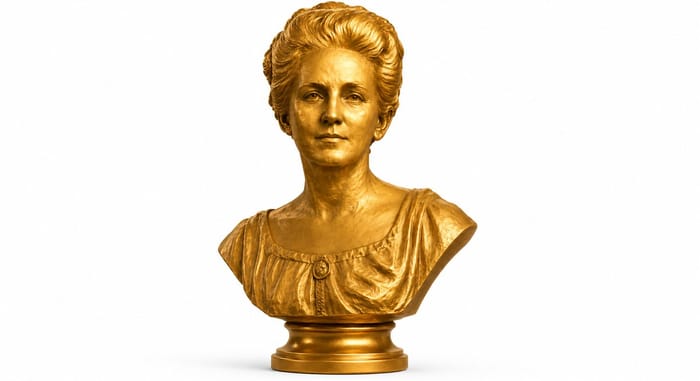
Her name was Mrs. L. Dow Balliett. Born Sarah Joanna Dennis in 1847. She died in 1929 at the age of 82. In the years between, she invented the practice that the rest of us now call numerology.
Not the philosophy. The philosophy is five thousand years old. Pythagoras articulated its core principle - that all is number - in the sixth century BCE, and the conviction that numbers carry qualitative meaning runs through Sumerian temples, Egyptian mystery schools, Hebrew gematria, and Chinese divination long before that. The philosophical lineage is ancient and cross-cultural and real.
What Balliett did was translate that philosophy into a working system. A method anyone could learn. A chart that maps letters to numbers. A way to analyze a name and a birth date and extract from them something that practitioners have been verifying against lived experience for over a century.
She is, by any honest accounting, the most important figure in modern numerology. And almost nobody knows her name.

The Lineage Before Her
Balliett did not invent the idea that numbers carry meaning. She inherited a lineage that runs back twenty-five centuries, through a specific chain of thinkers who each preserved and extended the tradition before passing it forward. Understanding who came before her is what separates serious numerology from the version that pretends the whole thing was discovered last Tuesday.
Pythagoras (c. 570–495 BCE)
The origin. Pythagoras established the doctrine that would underpin everything: all is number. Not as metaphor - as literal cosmology. The elements of numbers were the elements of everything, and the whole universe was a proportion. His school at Croton treated numbers as living forces, “almost human in their capacity for mutual influence,” with “attractions, repulsions, families, friends.” They could be generous or miserly, active or passive, procreators or progeny.
Pythagoras discovered that musical harmony - something experienced subjectively - could be expressed as simple ratios of whole numbers. If beauty itself obeyed mathematical law, perhaps everything did. He extended the insight to the cosmos and proposed the Music of the Spheres: an ever-present harmony produced by the planets as they move through heaven. He alone was said to be pure enough to hear it.
The Pythagoreans revered the number 10 as the mother of all numbers and swore their most solemn oaths by the Tetractys - ten dots in a triangle (1+2+3+4). The Monad and the Dyad. The ten Laws of Opposites. The conviction that each number from 1 through 9 carries a distinct qualitative character. Everything Balliett later built rests on this foundation.
Plato (c. 428–348 BCE)
Plato’s Academy in Athens was modeled directly on the Pythagorean school. His theory of Forms - the idea that the physical world is a shadow of a higher world of ideal patterns - is Pythagorean philosophy in philosophical dress. Numbers as archetypes, as the patterns that material reality imperfectly reflects, is Platonic language for the Pythagorean conviction that number is primary.
Plato did not develop a number system. What he did was transmit. The Neoplatonic chain that followed him - Plotinus, Porphyry, Iamblichus, Proclus - systematized Pythagorean-Platonic number philosophy into the comprehensive metaphysical framework that would survive the fall of Rome and reach the Renaissance intact.
Nicomachus of Gerasa (c. 60–120 CE)
A neo-Pythagorean from Judaea whose Arithmetical Introduction became the standard text on number philosophy for the entire medieval period. Nicomachus synthesized Pythagorean number theory with Judeo-Christian theological framing - a critical move that allowed the tradition to survive the Christianization of the Roman world. His work is the bridge text that Boethius would later translate and transmit to the medieval West.
Boethius (c. 477–524 CE)
Boethius translated Nicomachus into Latin and expanded it into De Institutione Arithmetica, which became a standard university textbook for centuries. His critical contribution was Christianizing the Pythagorean framework - positioning number philosophy as consistent with the theology of a God who “ordered all things in measure, and number, and weight” (Wisdom 11:21).
This is the move that kept the tradition alive through the Middle Ages. Pythagorean arithmetic became part of the Quadrivium - the four mathematical sciences taught at every medieval university. Every educated European mind for a thousand years encountered number philosophy through Boethius. Agrippa cites him directly.
Marsilio Ficino (1433–1499)
Head of the Florentine Platonic Academy under Medici patronage, Ficino revived Pythagorean-Platonic thought during the Renaissance. His Three Books on Life (1489) went through nearly thirty editions and introduced a concept that would prove critical for the lineage: spiritus - a mediating force between the World-Soul and the physical body through which cosmic vibrations reach the individual.
Ficino mapped planetary forces to musical qualities (Saturn’s voices “slow, deep, harsh, and plaintive”; Jupiter’s “deep, earnest, sweet, and joyful”) and insisted that music could heal because it operates on the same vibrational medium that connects the cosmos to the human soul. He systematized the seven-year life cycles (7, 14, 21, 28, 35, 42, 49…) that would later appear in numerology’s Period Cycles.
The connection to Balliett is direct. Her entire vibration framework - the insistence that number, color, and sound are different expressions of the same underlying force - is Ficinian philosophy translated into practical English-language terms.
Pico della Mirandola (1463–1494)
Pico’s 900 Theses (1486) performed the synthesis that made Agrippa possible. He was the first major Western thinker to argue that Jewish Kabbalistic number mysticism - gematria, the Sephiroth, the Hebrew letter-number correspondences - was not merely compatible with Christian theology but actually confirmed it. This “Christian Kabbalism” opened the door for Agrippa to combine Pythagorean, Platonic, and Kabbalistic number traditions into a single system.
Heinrich Cornelius Agrippa (1486–1535)
Agrippa’s Three Books of Occult Philosophy (1533) is the great synthesis - the most comprehensive pre-modern statement of what each number means and how numbers operate across every level of reality. A scholar of the Renaissance called it “the high-water mark of Renaissance arithmology.”
Agrippa’s specific contribution was the Scale System: every number resonates simultaneously in the divine world (God’s names), the intellectual world (angels), the celestial world (planets), the natural world (elements), and the human world (body and soul). He mapped each number to its planetary ruler, its musical function, its Kabbalistic correspondence, and its qualitative character - producing the most detailed catalog of number meanings the Western tradition had ever assembled.
His number descriptions became the classical authority that Balliett drew from three centuries later. When Agrippa called 7 “most full of all efficacy” and “neither generated nor generates,” Balliett translated this into her own vocabulary: “the Finished Number, a complete temple standing alone.” When he called 6 “the most perfect number in nature,” she named it “the Cosmic Mother, the Finisher.” The specific number meanings that modern numerology treats as canonical can be traced through Balliett to Agrippa, through Agrippa to the Neoplatonists, and through the Neoplatonists to Pythagoras himself.
The Underground River (17th–19th Centuries)
After Agrippa, the tradition went underground. The scientific revolution separated quantitative mathematics from qualitative number philosophy. But the qualitative stream never stopped flowing. The Freemasons, the Rosicrucians, and other esoteric orders preserved Pythagorean and Kabbalistic number symbolism through the Enlightenment. In the nineteenth century, Éliphas Lévi (1810–1875) connected the Kabbalah, the tarot, and number philosophy in a synthesis that fed directly into the broader occult revival - the intellectual environment in which Balliett came to maturity.
What no one in this entire chain had done - not Pythagoras, not Agrippa, not the Freemasons - was build a practical system for analyzing individual names and birth dates in English. The philosophy was there. The number meanings were there. The conviction that letters carry numerical force was there. What was missing was the working method.
That is what Balliett built.

Atlantic City, 1908
By 1905, when her first book on number vibration appeared, Balliett had already spent decades studying. She was not a casual enthusiast. She was a systematic thinker who had absorbed Pythagorean philosophy, Platonic metaphysics, and biblical symbolism and was looking for the thread that connected them.
The thread she found was vibration.
Her core insight - the philosophical foundation of everything she built - was that all things in the universe vibrate at distinct rates, and those rates can be expressed as numbers. The rate determines the quality of the force. A vibration at one frequency produces color. At another, it produces sound. At another, it produces the particular character we recognize when we say that someone “feels like a 7” or “carries 3 energy.”
She put it plainly: “Moving at a certain rate vibration causes color; at another rate it causes sound. Through vibration comes motion, through motion comes color, through color comes tone.”
This was not mysticism dressed as science or science dressed as mysticism. It was a framework that took the ancient Pythagorean conviction - that numbers are the elements of everything - and gave it a mechanism. Vibration was how numbers became qualities. Vibration was why the letter A carried a different force than the letter E, why a person born on the 7th moved through the world differently than a person born on the 3rd.
By 1911 she was principal of the School of Psychology and Physical Culture in Atlantic City, New Jersey. She lectured through the New Age Thought Church and School, where she became friends with Julia Seton Sears, M.D. - a friendship that would have enormous consequences for the practice.

The System She Built
What Balliett constructed, book by book across two decades, was not a single idea but an entire architecture. The pieces she put in place are still the load-bearing walls of every numerology chart calculated today.
The Pythagorean Letter-to-Number Chart
The principle that letters carry numerical values is ancient. Hebrew gematria and Greek isopsephy had been assigning numbers to letters for thousands of years. But those systems were built for Hebrew and Greek. Balliett took the underlying principle and adapted it specifically to the English alphabet, creating the sequential assignment (A=1 through I=9, J=1 through R=9, S=1 through Z=8) that every modern Pythagorean numerology calculator uses.
She called it the Pythagorean chart in honor of the philosophical lineage. The label has stuck. But the English-language implementation is hers.
The Birth Number and the Name Number
Balliett established the foundational distinction that structures every modern reading. The birth number - what we now call the Life Path - shows the work chosen for this incarnation. The name number shows the consciousness level the soul has already reached.
Her language was direct: “The digit of birth path shows what part in the great chorus of life they come to take. It cannot be changed. It must be met. It can be made harmonious or its opposite.”
That single formulation - that the birth path is fixed but its expression is not - is the reason modern numerology treats the Life Path as the most important number in the chart while insisting that free will shapes how it plays out. The nuance was built in from the beginning.
The Soul Urge
Balliett discovered that the vowels of a name carry a distinct significance. “The vowels of a name show its spiritual structure - the desire of the soul reaches out in this way.” The consonants show the outer character. Together they make the full name number. But the vowels, isolated, reveal the hidden interior - what the person truly yearns for underneath the public self.
She did not call it the Soul Urge. That terminology came later. But the concept - that vowels encode the soul’s desire - is entirely hers.
Master Numbers
Balliett established as a hard rule that 11 and 22 are never reduced to single digits. Her reasoning was theological in its force: “We never add 11 to make a digit. No man has a right to interfere with God’s messenger.”
She called these “free vibrations” - numbers that had broken out of the ordinary structure and carried elevated potential. The entire master number doctrine in modern numerology traces to this ruling.
Color and Sound Correspondences
Each number, in Balliett’s system, has both a color and a musical note. She worked these correspondences out with characteristic rigor, calculating the numerical value of color words themselves to confirm the match. The system runs from 1 (flame, the note C) through 9 (red and brown, the note D), with 11 and 22 carrying full octaves rather than single tones.
She explicitly distinguished her system from Kabbalistic numerology, describing her approach as more grounded because it is “built upon exactly the same foundation” as the musical scale. The vibration framework was not metaphor for Balliett. It was physics as she understood it - the same force that produces audible tone also produces the qualities we recognize in human character.

The Numbers in Her Language
Balliett’s descriptions of the nine digits became the canonical vocabulary of the field. When you read that 1 is “the leader” or 6 is “the nurturer,” you are hearing translations of her original formulations. Here is what she actually wrote:
1 - “The adept and creator.” Independent, comprehensive. “Mingles with the world but is never really one of them.” Element of Air.
2 - “Mother Nature. The Seer.” The peacemaker, the pivot between spirit and matter. “Waters and nourishes the seed others plant.”
3 - “The outward expression of the Christ principle of Trinity.” The Gleaner. “Can interpret and bring forth the silent hidden voices of all things.” Without 1 and 2, “like a ship without a rudder.”
4 - “The rank and file of the world. The Cube.” Works entirely on the intellectual plane. “Does not believe in inspiration; depends entirely on intellect.”
5 - “The Sage. A limited master.” Begins the new cycle of mind. “Finds itself in high unexplored country with paths in all directions.”
6 - “The Cosmic Mother. The Finisher.” The one who arranges the temple for others to use. “A cosmic mother means a man or woman - is not related to sex.”
7 - “The Finished Number. A complete temple standing alone.” Sacred. A reservoir without outlet. “A closed number - like a person carrying a pack on their back.”
8 - “The Mystic. The beginning of the higher cycle. Resurrection.” Light and Darkness. The aura extends twice as far as a 4’s.
9 - “The Master of Law. Free expression on all planes.” “Honors are laid at his feet.” Expresses the feelings of every phase of humanity.
11 - “The fire-vibration. The Royal Priesthood. Psychic Master.” “Giants of strength upon all planes, yet at times correspondingly weak.” Iron vibrates 11.
22 - “The Master.” The greatest philanthropists of all the numbers. “Joins the material and spiritual.” Water vibrates 22.
These are not the simplified personality sketches you find on most numerology websites. They are the originals - denser, stranger, more theologically grounded, and more psychologically precise than most of what has been written since.

The Three Trinities
Balliett organized the single digits into a structural hierarchy that reveals how she understood the entire system.
The First Trinity (1-2-3) is the creative and intellectual foundation. “No. 1 creates, No. 2 collects, and No. 3 expresses, making a chain strong and beautiful.” These three numbers produce the basic cycle of origination, reception, and communication.
The Middle Numbers (4-5-6-7) are what she called “limited” - earth-bound, cube-based, working on the physical and intellectual planes. They are the practical numbers, the ones that build and seek and love and understand within the constraints of material existence.
The Higher Trinity (8-9-11/22) are “free vibrations.” They have broken out of the cube structure and access universal forces directly. “These high vibrating numbers no longer go through the world blindly, being buffeted on all sides, but they consciously work with Nature, and try to help out the Divine Plan.”
She believed a Third Trinity existed but had not yet been revealed - numbers belonging to a stage of human evolution that had not yet arrived.

The Soul’s Choice
One of Balliett’s most distinctive doctrines - and one that separates her system from fortune-telling or personality typing - is her insistence that the soul chooses its birth.
“Our highest part chose the path in life by which we entered the world. The individualized spirit, called the Soul of Man, knew what experiences it needed when it took upon itself the mystical substance called the body, in order to perfect itself in the Christ life, and chose the vibration which would draw to itself the experiences needful for his greatest spiritual growth.”
And then the sentence that serves as the quiet foundation of the entire practice: “No one is out of place.”
This is not determinism. The birth path can “be made harmonious or its opposite.” Free will operates fully. But the terrain was chosen, and the choosing was purposeful. You are not an accident of timing. Your numbers are not random. The soul selected this particular vibration because this particular lesson was needed.
Whether you hold this literally or as a useful metaphor for approaching your own chart, it changes the quality of the reading. A Life Path is not a label applied from outside. It is a curriculum the deepest part of you signed up for.

Her Works
Balliett published at least six books on number vibration between 1905 and 1925. All are now in the public domain.
The Philosophy of Numbers: Their Tone and Colors (1908) - The foundational text. Establishes the vibration framework, the letter-number chart, and the basic number meanings.
Nature’s Symphony: Lessons in Number Vibration (1911) - Extends the system to color therapy, harmony in dress, and the Music of the Spheres.
How to Attain Success Through the Strength of Vibration (1917) - The most encyclopedic work. Covers name analysis, business compatibility, daily vibrations, body correspondences, gems, minerals, flowers, trees, and guardian angels.
The Day of Wisdom According to Number Vibration (1917) - Covers trinities, the Spiritual Birthday, masters and healers, reincarnation, and money.
The Balliett Philosophy of Number Vibration in Questions and Answers (1918) - A comprehensive Q&A textbook summarizing the entire system.
These books are not easy reading by modern standards. The prose is Victorian. The theological assumptions are of their era. But the structural insights - the architecture of the system itself - remain the foundation that every subsequent numerologist has built upon, whether they know it or not.

The Music of the Spheres
There is a story about Balliett that connects her to the oldest thread in the Pythagorean tradition.
Pythagoras himself was said to be the only human pure enough to hear the Music of the Spheres - the harmony produced by the planets and stars as they move through heaven. It was the sound of the universe’s mathematical structure made audible, and hearing it was considered the highest attainment a human being could reach.
Balliett reported hearing it. While traveling overnight by train, she described “faint, glorious music that arose from the depths of earth and sea, silvery, watery, fiery, and the unity of the whole so blended that it filled me with awe.”
Whether you take this as literal perception or as a metaphor for the kind of understanding that years of deep study can open, it places her within the lineage she drew from. She was not merely writing about vibration. She was, by her own account, hearing it.

The Lineage After Her
Balliett’s friend Julia Seton Sears coined the word “Numerology” around 1912, giving the ancient practice a modern name. But it was Seton’s daughter who would carry the system forward.
Dr. Juno Jordan studied with Balliett directly, beginning at the age of fourteen. She absorbed the system at its source. As an adult, she founded the California Institute of Numerical Research, which operated for twenty-five years, conducting systematic studies of how numbers correspond to personality, life events, and human potential.
Through the Institute’s work, Jordan formalized several tools that Balliett had sketched but not fully developed: the Pinnacle numbers, the Challenge numbers, the Planes of Expression, the Table of Events. These gave the chart the layered architecture it carries today.
Jordan died in 1984, two months before her hundredth birthday. The historian Ruth Drayer, who conducted original research with the Atlantic County Historical Society, called Balliett and Jordan “the Mothers of Numerology.”
The lineage runs: Balliett (1908) → Julia Seton Sears (coined “Numerology,” c. 1912) → Dr. Juno Jordan (formalized the chart architecture). Three women, across roughly fifty years, building the practice the rest of us inherited.

Why She Matters Now
Most numerology content online is third-hand at best. Someone read someone who read someone who once skimmed Balliett. The descriptions get flatter with each generation. The theological depth drops away. The structural precision softens into personality typing. By the time a number meaning reaches a typical website, it has been photocopied so many times that the original is unrecognizable.
Going back to Balliett is like going back to the source code. Her descriptions are not simpler than the modern ones. They are more complex, more grounded in a coherent philosophical framework, and more psychologically honest. When she calls 7 “a complete temple standing alone” or describes 4 as the number that “does not believe in inspiration; depends entirely on intellect,” she is not flattering anyone. She is describing vibrational realities as she understood them, with the precision of someone who had spent decades studying the system before writing a word of it down.
Her work is the reason the practice exists. Every Life Path calculation, every Expression number, every Soul Urge reading, every Personal Year forecast descends from the architecture she assembled in Atlantic City across the two decades that followed.
She deserves to be known by name.

Frequently Asked Questions
Who was L. Dow Balliett?
Mrs. L. Dow Balliett (born Sarah Joanna Dennis, 1847–1929) was the founder of modern Western numerology. Working from Atlantic City, New Jersey, she spent decades synthesizing Pythagorean philosophy, biblical symbolism, and vibration theory into the practical system that virtually all Western numerology uses today. Her first book on number vibration, How to Attain Success Through the Strength of Vibration, carries a 1905 copyright.
What did Balliett actually invent?
She created the English-language Pythagorean letter-to-number chart, established the distinction between the birth number (Life Path) and the name number, discovered that vowels encode the soul’s desire (the ancestor of the Soul Urge), ruled that 11 and 22 are master numbers that must never be reduced, and developed the color and musical-note correspondences for each digit. The structural framework of every modern numerology chart traces to her work.
Are her books still available?
Yes. All five of her major works are in the public domain, as copyright has long since lapsed. They have been reprinted by Kessinger Publishing and can be found through libraries and online booksellers. The prose style is Victorian, but the structural insights remain the foundation of the practice.
What is the connection between Balliett and Pythagorean numerology?
Balliett built her system on Pythagorean philosophical principles - the conviction that numbers are qualitative forces, not just quantities, and that the universe’s structure can be understood through mathematical relationships. She called her letter-number chart “Pythagorean” to honor this lineage. The philosophical framework is ancient. The specific English-language implementation is hers.
How does Balliett relate to Dr. Juno Jordan?
Dr. Juno Jordan studied directly with Balliett beginning at age fourteen. She later founded the California Institute of Numerical Research and formalized several tools Balliett had sketched: the Pinnacle numbers, Challenge numbers, Planes of Expression, and Table of Events. Together, Balliett and Jordan are considered the “Mothers of Numerology” - the two women most responsible for the practice in its current form.