Third Challenge Number 2 - The Lifelong Lesson of Sensitivity and Cooperation
By Blair Andrews · Published April 24, 2025 · Updated May 10, 2026
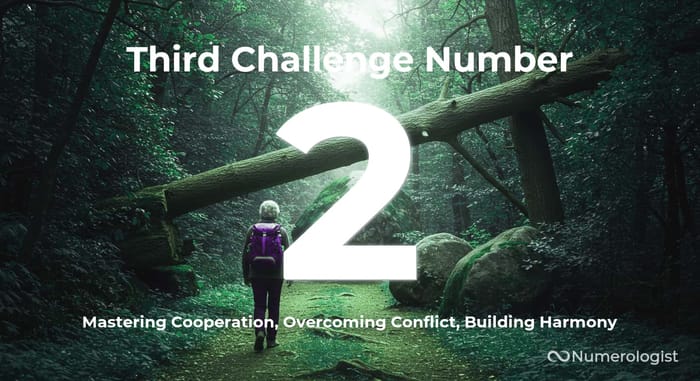
A Third Challenge of 2 places your deepest, most enduring life lesson squarely in the territory of relationships, sensitivity, and the art of working with others. This is not a challenge that shows up for a few years and moves on. It is woven into the fabric of your entire life, influencing how you relate to people, how you handle your own emotional depth, and whether you can find genuine balance between giving and receiving.
The Third Challenge - sometimes called the Main Challenge - spans your whole lifetime. It is the deepest undercurrent of personal growth, running beneath the more specific lessons of your First and Second Challenges. When that lifelong number is 2, cooperation and sensitivity become the territory you are continuously learning to navigate.
Two is the line between two points - the first connection, the first relationship. In the Tarot, it corresponds to the High Priestess, who sits between two pillars in receptive wisdom, reflecting rather than projecting. When 2 appears as a lifelong challenge, the qualities it represents - patience, diplomacy, cooperation, emotional awareness - are precisely the ones you are here to develop through direct experience and sometimes through difficulty.

The Two Poles of the 2 Challenge
The core tension tends to show up in one of two patterns. Either you are overly sensitive - absorbing other people's emotions, taking things personally, feeling wounded by slights that others shrug off - or you have built walls against your own sensitivity, becoming outwardly tough while inwardly fragile. Many people swing between these poles for years before finding a sustainable middle ground.
The oversensitive pattern is often the more visible one. You absorb the moods and needs of everyone around you. Criticism devastates you. Conflict makes you physically ill. Your own needs disappear behind the urgency of managing everyone else's feelings. The undersensitive pattern is the defense against this: walls go up, cooperation is refused, and the emotional intelligence that could be your greatest asset gets sealed away where no one - including you - can reach it.
Cooperation is another area where this challenge makes itself felt. You may find it genuinely difficult to work with others as equals. Either you defer too much, becoming subservient and resentful, or you resist cooperation entirely because it feels like a threat to your autonomy. The lesson is not to become a pushover or a team player on command. It is to develop the capacity for genuine partnership - where you contribute fully without losing yourself.

Sensitivity as a Capacity Under Development
What makes this challenge distinctive: the sensitivity that causes you trouble is also your greatest potential asset. People with a 2 Main Challenge often have an extraordinary capacity for empathy, intuition, and emotional intelligence. The problem is rarely the feeling itself. It is that you have not yet learned how to manage what you feel.
Think of the 2 energy as a cup - receptive, open, designed to hold. When that cup has no bottom, everything pours straight through, leaving you depleted. When the walls are too thick, nothing gets in at all. The work of this challenge is building a container that can hold your sensitivity without being overwhelmed by it. That container takes a lifetime to build because life keeps presenting new situations that test its structural integrity.
The High Priestess reflects the sun's light without becoming the sun. She receives without being consumed. She remembers - memory being one of 2's core attributes - the history of every exchange, every give and take. This is the mastery the challenge is pointing toward: the ability to be deeply receptive without dissolving your own boundaries in the process. The difference between empathy and enmeshment. Between understanding someone else's pain and losing yourself inside it.

How It Evolves Across a Lifetime
In childhood and early adulthood, the 2 Main Challenge often manifests as emotional turbulence in relationships. You might be the child who cries easily, who picks up on tension in a room, who knows when something is wrong before anyone says a word. You might be the peacemaker, the mediator, the one who smooths things over - often at the cost of your own feelings going unspoken.
In your twenties and thirties, the challenge typically intensifies around romantic partnerships. This is where the dynamics of cooperation and codependence play out most intensely. You may choose partners who dominate, because their certainty provides a structure you can lean against. You may lose your own preferences and opinions inside a relationship. You may avoid commitment altogether, sensing that your tendency to merge would cost you your identity.
By midlife, if you have been learning from your experiences, you start to develop a more refined sense of when to engage and when to step back, when to assert and when to yield. The sensitivity that once felt like a liability begins to function as genuine intuition. You can read a room with unusual accuracy. You can sense what people need before they articulate it. The challenge has not disappeared, but your relationship with it has matured.
In your later years, this challenge can produce a rare quality of emotional wisdom - the kind that comes from having navigated decades of complex human dynamics. You understand people not from a textbook but from the inside, because you have spent a lifetime feeling your way through the landscape of human connection.

The Diplomacy Dimension
Diplomacy is the practical face of the 2 Challenge. Can you navigate conflict without either caving in or escalating? Can you see both sides of a disagreement without losing your own position? Can you communicate difficult truths with enough tact that they can actually be heard?
These are skills, and like all skills, they develop through practice. People with a 2 Main Challenge often become remarkably skilled mediators and peacemakers over time - not because it came naturally, but because life kept putting them in situations where mediation was necessary. The esoteric tradition notes that tact - the ability to say what needs to be said in a way that can be received - is the highest expression of 2 energy. When it is underdeveloped, you either say nothing (avoiding conflict) or say too much (because the pressure of held-back words becomes unbearable). Learning to speak honestly and gently at the same time is part of the lifelong curriculum.

Patience as a Recurring Lesson
Another dimension of the 2 Challenge involves patience and timing. Two energy is receptive, not assertive. It watches, waits, listens. If you are naturally impatient - wanting to force outcomes, push through obstacles, make things happen on your schedule - this challenge will repeatedly put you in situations where patience is the only viable path.
This can be maddening, especially in a culture that rewards initiative and speed. But the 2 Challenge teaches something valuable: that some of the most important things in life cannot be rushed. Relationships deepen on their own timeline. Trust builds gradually. Understanding comes through listening, not through demanding answers. And the person who has learned this - truly learned it, through decades of practice - brings something irreplaceable to every relationship and every team they are part of.

Working With This Challenge
The practice that serves this challenge best is simple to describe and difficult to execute: learn to sit with your feelings without acting on them immediately. When you are hurt, pause before reacting. When you are overwhelmed, create space before making decisions. When someone else's emotions are flooding your system, learn to distinguish between what is yours and what is theirs. This single skill - the pause between feeling and response - is the foundation of everything this challenge is trying to teach you.
Develop something that is entirely your own. A skill, a creative practice, a domain where your identity does not depend on anyone else's response. This becomes the anchor that keeps you from dissolving into other people's needs - the inner ground you can stand on when the relational waters get turbulent.
And notice the difference between keeping peace and making peace. Keeping peace means suppressing conflict so the surface stays smooth. Making peace means engaging with disagreement honestly and working through it to genuine resolution. The 2 Main Challenge, across a lifetime, is asking for the latter - even though the former is always more comfortable.

What This Challenge Builds
People who engage the 2 Main Challenge honestly across decades develop a quality of relational intelligence that is both rare and deeply valuable. The sensitivity that once felt like a burden becomes perceptiveness. The tendency to absorb others' emotions becomes the ability to understand what people actually need. The bicycle of balance stays upright - not because the road is smooth, but because the rider has learned to keep adjusting.
The moon's reflection is not weakness. It is a different kind of power: the power to illuminate what the sun's direct glare cannot reveal. And the person who has spent a lifetime learning to hold that power with clear boundaries and genuine compassion brings something to the world that cannot be learned from books. Only from the long, sometimes painful, always instructive work of being in relationship with other human beings.

Explore Further
- First Challenge Number 2
- Second Challenge Number 2
- Third Pinnacle Number 2
- Challenge Numbers: Complete Guide
- Challenge Numbers Calculator
- Number 2 Meaning

What the Tradition Says About Challenge Number 2 as the Main Challenge
Goodwin's 2 energy governs cooperation - the entire domain of relating to others with sensitivity, tact, and appropriate boundaries. As a Main Challenge, it makes the quality of relationship the central thread of an entire lifetime. The growth direction Goodwin describes - from over-sensitivity that paralyzes to sensitivity that serves - is not a journey with a destination but a lifelong practice of calibration.
Drayer's characterization of the 2 Challenge as teaching "the most important challenges of our times" carries particular weight as a lifelong designation. She notes that the 2 energy teaches "flowing, sensitive, intuitive, tender, gentle" qualities - all of which require the kind of sustained practice that a lifetime of application makes possible. The person who carries the Third Challenge of 2 across a lifetime develops an unusual depth of relational intelligence: the capacity to read situations and people with accuracy, to negotiate differences without imposing, and to hold space for harmony without sacrificing honesty.
Drayer's caution about the 2's tendency to say "I don't know," "I don't care," and "It doesn't matter" when all three statements are false - as a form of conflict avoidance rather than genuine neutrality - describes the lifelong shadow pattern this challenge asks to be moved through. The Main Challenge of 2 is resolved not once and finally, but continuously, in each relationship context where the choice arises between genuine presence and managed withdrawal.

Frequently Asked Questions
- What does Challenge Number 2 mean in the third position?
- In the third position, Challenge Number 2 is the Main Challenge - the lifelong lesson of developing genuine relational skill, appropriate sensitivity, and the courage to be both present and honest in your relationships. The quality of cooperation and relating runs as a central thread through every phase of your life.
- How do I calculate my Challenge Numbers?
- Subtract reduced birth digits: First = |month digit − day digit|, Second = |day digit − year digit|, Third (Main) = |First − Second|. Always use the absolute value - there are no negative challenge numbers.
- What does mastery of the Third Challenge of 2 look like in practice?
- Drayer points toward the future expression of 2 energy as the peacemaker, arbitrator, negotiator - someone who has developed the rare ability to hold space for multiple perspectives simultaneously without losing themselves in the process. The person who has genuinely engaged the Main Challenge of 2 across a lifetime typically becomes someone others bring their difficult situations to, trusting that they will be heard without being managed.