Second Challenge Number 2: Mastering Partnership and Diplomacy
By Blair Andrews · Published April 24, 2025 · Updated July 20, 2026
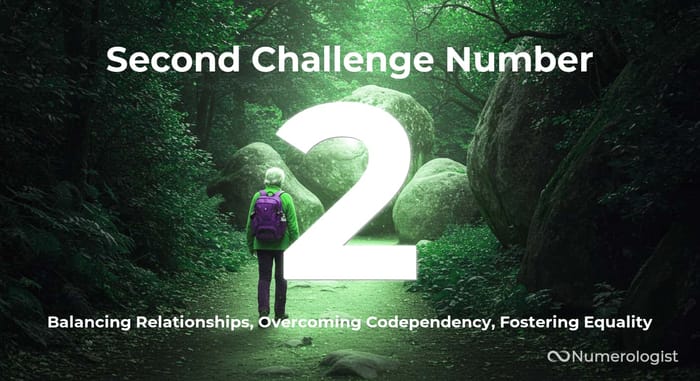
A Second Challenge of 2 puts cooperation, sensitivity, and partnership at the center of your most productive adult years. That phase runs roughly from your mid-thirties through your late forties or early fifties.
These are the years when professional collaborations, marriage dynamics, business partnerships, and community relationships carry the greatest weight.
A 2 Challenge in this phase makes working with others the defining growth area of your prime. The test is to cooperate without losing yourself or submitting entirely.
The High Priestess is 2's Tarot correspondence. She sits between two pillars, reflecting light without generating her own. The moon reflects the sun. The line connects two points.
These images all point to one truth: 2 is about relationship. It is the space between, the give and receive, the art of two separate things choosing to move together.

Why This Challenge Intensifies at Midlife
Cooperation challenges during youth are mostly personal: friendships, family dynamics, early romantic relationships. The Second Challenge of 2 operates in a larger and more complex arena. Now the partnerships are professional as well as personal.
The diplomacy required is strategic, not just emotional. Getting cooperation wrong can now mean failed business ventures, damaged careers, and family breakdown - not just hurt feelings.
That is what makes the Second Challenge of 2 so demanding. You cannot opt out of collaboration during your productive years. In youth, you might have avoided it.
Your career likely requires teamwork. Your marriage or partnership requires daily negotiation. Being a parent, colleague, neighbor, and community member demands the same skill: cooperation without collapsing into codependence.

Common Manifestations
The Second Challenge of 2 shows up in adult life through several recognizable patterns:
In the workplace: You may struggle with team dynamics. Some people absorb too much of the emotional labor: sensing every tension, mediating every conflict, taking on work that should be shared. Others withdraw from collaboration because the sensitivity feels unmanageable.
Decision by committee might frustrate you, yet deciding alone may feel equally uncomfortable.
The balance between your ideas and others' input remains elusive.
In marriage or partnership: The codependence pattern from youthful relationships does not automatically resolve with age. At midlife, it can deepen. You may have spent years accommodating a partner's needs at the expense of your own. The accumulated resentment may surface during the Second Challenge years.
Or the pattern may reverse. After years of over-giving, you swing toward emotional withdrawal. The distance feels like self-preservation, but it damages the partnership.
In family dynamics: As children grow and aging parents need more attention, the demands for cooperation multiply. The 2 Challenge at this stage can make you the family member everyone leans on, to your detriment. Or it makes you the one who struggles to show up relationally, even when showing up is clearly needed.

The Mature Expression of 2
Balance, the esoteric tradition reminds us, is a dynamic act, like riding a bicycle. You must keep moving to stay upright.
The metaphor fits the Second Challenge of 2 at midlife, because adult cooperation is never static. The demands shift constantly. A marriage that was balanced last year may need recalibration this year.
A work partnership that functioned well needs new terms as circumstances change.
The mature expression of 2 is not a permanent state of harmonious cooperation. It is the ability to continually adjust. You notice when you are giving too much and pull back. You notice when you are withholding and lean in. You hold your own center while remaining genuinely responsive to others.
This is the High Priestess's real teaching. She reflects light without losing her own nature. She receives without being consumed. Memory is one of 2's key attributes. She remembers the history of the relationship and the pattern of give and take. She uses that memory to navigate what comes next.

Working With This Challenge
Name your needs out loud. The Second Challenge of 2 often involves a deeply ingrained habit of prioritizing others' needs while treating your own as optional. In professional settings, learn to state your requirements clearly. In personal relationships, say "I need this" without framing it as a negotiation.
Learn the difference between keeping peace and making peace. Keeping peace means suppressing conflict. Making peace means addressing it honestly and working through it. The Second Challenge of 2 demands the latter, even though the former is far more comfortable.
Develop comfort with healthy conflict. Not all disagreement is a threat. The most productive professional partnerships and the strongest marriages include regular, respectful disagreement. If your instinct is to smooth over every tension, practice letting it exist. Allow it to stay long enough to be resolved rather than papered over.
Evaluate your partnerships honestly. The midlife years are an appropriate time to ask hard questions. Are my partnerships balanced? Am I giving more than I receive, or receiving more than I give? Is this collaboration serving both parties, or has it become a one-way flow? These are 2 Challenge questions. Answering them honestly is part of the work.

What Emerges
People who work through the Second Challenge of 2 during their productive years often become remarkably skilled at collaboration.
They understand from direct, sometimes painful experience what genuine partnership requires. It takes clear boundaries, honest communication, mutual respect, and the willingness to keep adjusting as circumstances change.
The sensitivity that once felt like a liability has become perceptiveness. The tendency to absorb others' emotions has become the ability to read a room with uncanny accuracy. The bicycle stays upright, not because the road is smooth. The rider has learned to balance in motion.
The High Priestess's teaching has been internalized. You reflect light without losing your own nature. You receive without being consumed. You cooperate without self-erasing.
And the partnerships you build from this foundation - professional, personal, familial - carry genuine mutuality. That quality can only come from someone who learned the hard way what it costs to give too much and receive too little.

Explore Further
- First Challenge Number 2
- Third Challenge Number 2
- Second Pinnacle Number 2
- Challenge Numbers Calculator
- Challenge Numbers: Complete Guide
- Number 2 Meaning

What the Tradition Says About Challenge Number 2 at Midlife
Goodwin's 2 energy governs cooperation: the capacity to relate to others with genuine sensitivity and appropriate boundaries. As a Second Challenge, it brings the cooperation question into the heart of the productive middle years. By then, relationships have had time to calcify into patterns.
By midlife, the person with a Second Challenge of 2 has typically developed habitual ways of managing conflict. Many of those habits involve avoidance rather than resolution.
Drayer described the 2 Challenge as teaching "the most important challenges of our times." That claim carries extra weight in this context. She frames the distinction precisely. The 1 Challenge is about getting clear on what you want. The 2 Challenge is about letting go of it when it is not for the highest good of all.
At midlife, the stakes in relationships and professional life are higher. This letting-go requires more than it did in youth. The Second Challenge of 2 asks for genuine negotiation skill, not just the appearance of harmony.
Goodwin's growth direction for 2 energy runs from over-sensitivity that paralyzes to sensitivity that serves. That arc is what the Second Challenge presses on during this phase.
In youth, this person learned to absorb others' emotions as their own and to keep peace at personal cost. Now they are asked to relate differently: present, boundaried, genuinely cooperative rather than merely compliant. This is harder work at forty than at twenty. The patterns are older and more entrenched.

Frequently Asked Questions
- What does Challenge Number 2 mean in the second position?
- In the second position, Challenge Number 2 makes the deeper work of cooperation, boundary-setting, and authentic relating central to your productive midlife years. Patterns formed in youth are brought forward for revision: keeping peace at personal cost, absorbing others' emotions, avoiding direct confrontation.
- How do I calculate my Challenge Numbers?
- Challenge Numbers use absolute subtraction: First = |birth month digit − birth day digit|, Second = |birth day digit − birth year digit|, Third = |First − Second|. Reduce each birth component to a single digit before performing the subtractions.
- What does the Second Challenge of 2 ask of someone in a long-term partnership?
- It asks for the courage to be honest rather than merely harmonious. Say what is actually true about the relationship, instead of maintaining an accommodation that has stopped serving either person. Drayer notes that saying this will hurt them, so I won't say it is a form of manipulation. The 2 Challenge asks for tact in delivery but honesty in content.