First Challenge Number 2: Learning the Art of Cooperation
By Blair Andrews · Published April 24, 2025 · Updated July 20, 2026
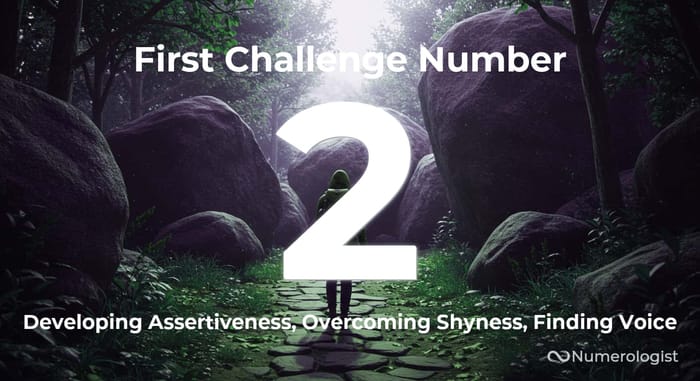
If your First Challenge is 2, the central lesson of your youth revolves around learning how to be with other people without losing yourself in the process. This is the challenge of cooperation, sensitivity, and partnership, and it is far more complex than it sounds.
In the Pythagorean tradition the number 2 is the moon reflecting the sun's light, the line that connects two points - and the tarot, which numbers its cards the same way, makes it the High Priestess. It represents receptivity, memory, the ability to see both sides, and the delicate act of balance. Balance is dynamic, not static, like riding a bicycle. You must keep moving to stay upright.
When 2 appears as your First Challenge rather than as a natural strength, it means these qualities did not come easily during your formative years. Instead, your early life was shaped by the struggle to develop them, often painfully, often at the cost of your own emotional wellbeing.

The Two Faces of the 2 Challenge
The First Challenge of 2 typically manifests in one of two directions during youth, and many people swing between both.
Oversensitivity and absorption. You absorb the emotions, opinions, and moods of everyone around you like a sponge. Criticism devastates you. Conflict makes you physically ill. You bend yourself into shapes trying to keep everyone happy, and when you cannot, you feel it as personal failure. The world feels too loud, too harsh, too demanding of a skin you have not yet grown thick enough to wear. Your own needs disappear behind the urgency of managing everyone else's feelings.
Overcorrection into walls. Because sensitivity hurts, you build defenses. You become guarded, reluctant to cooperate, distrustful of partnership. You tell yourself you do not need anyone - not because it is true, but because needing people has caused too much pain. This version looks like toughness on the outside but is actually fragility wearing armor. The sensitivity is still there underneath. You have just sealed it away where no one (including you) can reach it easily.
Neither extreme represents the mature expression of 2. The challenge asks you to find the dynamic middle: receptive without being porous, cooperative without being codependent, sensitive without being shattered by every emotional breeze.

Why This Challenge Runs Deep
The High Priestess sits between two pillars, dark and light, known and unknown. She reflects the sun's light without becoming the sun. This is the mastery that your challenge is guiding you toward: the ability to receive, to reflect, to understand deeply, without dissolving your own boundaries in the process.
The esoteric tradition is clear about what makes the 2 Challenge so difficult in youth. Sensitivity is a capacity to be developed, not a flaw to be corrected. The same nervous system that makes you feel too much is the one that, once properly calibrated, allows you to perceive what others miss entirely. The child who reads every tension in a room is developing a skill that will become genuine emotional intelligence, but only if they learn to hold that information without being overwhelmed by it.
This is the core distinction the challenge is teaching: the difference between empathy and enmeshment. Empathy means understanding what someone else feels while maintaining a clear sense of your own identity. Enmeshment means your emotional state becomes indistinguishable from theirs - when they hurt, you hurt; when they are angry, you feel responsible; when they are happy, only then can you relax.

Childhood Patterns
Children with a First Challenge of 2 often grow up in environments where the emotional dynamics between people are intense or unstable. Perhaps your parents' relationship was turbulent, and you learned early to read the room - to sense when tension was building and to try to smooth things over. Perhaps you were the family peacemaker before you were old enough to understand what that role cost you.
In school, this challenge frequently appears as difficulty with social navigation. You may have been the child who took every slight personally, who cried easily, who could not understand why other children seemed to move through social interactions with a casualness that felt impossible to you. Or you may have been the one who withdrew - quiet, watchful, participating only when it felt safe.
Friendships may have felt disproportionately intense. Where other children could argue on the playground and make up by lunch, you carried the weight of disagreements for days. The loss of a friendship could feel catastrophic, not because you were dramatic, but because you experienced connection at a depth that made its disruption genuinely painful.
The esoteric tradition notes that the 2 energy is fundamentally about tact - the ability to say what needs to be said in a way that can actually be heard. Children with this challenge often struggle with exactly this distinction. They either say nothing (to avoid disrupting the peace) or say too much (because the pressure of held-back words becomes unbearable). Learning to speak honestly and gently at the same time is part of the lifelong curriculum.

How This Challenge Develops Through Early Adulthood
As you move into your twenties, the First Challenge of 2 often becomes most visible in romantic relationships. This is where the dynamics of cooperation and codependence play out most intensely. You may choose partners who dominate, because their certainty provides a structure you can lean against. You may lose your own preferences, opinions, and goals inside a relationship, emerging from a breakup unsure of who you are without that person. You may avoid commitment altogether, sensing that your tendency to merge with a partner will cost you your identity.
In career settings, the 2 Challenge can manifest as difficulty with assertiveness. You defer to others in meetings, absorb more than your share of workload to avoid conflict, and struggle to advocate for your own advancement because it feels uncomfortably aggressive. The irony is that these cooperative instincts are genuinely valuable in the workplace - but only when they include the ability to cooperate with yourself, to advocate for your own needs as part of the partnership rather than subordinating them entirely.
You may also become the constant mediator in friend groups, work teams, and family dynamics - useful to everyone, fulfilled by no one. The 2 Challenge teaches that being needed is not the same as being valued, and that genuine cooperation includes contributing your perspective, not just facilitating everyone else's.

The Path Through
Working through the First Challenge of 2 requires developing specific capacities, not just adopting a new attitude.
Learn to sit with discomfort. When someone near you is upset, practice being present without trying to fix it. Their feelings are theirs. Your compassion is yours. These are separate things. The habit of immediately trying to smooth over every tension is the 2 Challenge at its most unresolved.
Practice stating preferences. Start with small, low-stakes situations. What do you want for dinner? Which movie appeals to you? Where do you want to go? The habit of deferring erodes slowly when you begin voicing your own desires consistently. The goal is not to become demanding - it is to become present in your own life.
Notice the difference between peace and avoidance. Real peace includes the ability to navigate conflict constructively. If your "peace" depends on never rocking the boat, it is avoidance wearing a pleasant mask. True diplomacy - the highest expression of 2 - involves engaging with disagreement honestly, not pretending it does not exist.
Develop something that is entirely your own. A skill, a practice, a creative outlet that is not about anyone else, something that reminds you who you are when no one else is in the room. This becomes the anchor that keeps you from dissolving into other people's needs.

What This Challenge Builds
People who work through the First Challenge of 2 during their youth often develop into extraordinarily perceptive, diplomatic, and emotionally intelligent adults. The sensitivity that once felt like a liability becomes their greatest asset, but only because they learned to hold it with clear boundaries.
The moon's reflection is not weakness. It is a different kind of power: the power to illuminate what the sun's direct glare cannot reveal. The person who has wrestled with the 2 Challenge and found their center within it brings a quality of understanding to their relationships that cannot be taught from the outside. It can only be earned through the long, sometimes painful process of learning where you end and where others begin.
By the time you enter your Second Challenge phase, the cooperative capacity you developed is no longer fragile. You can work with others, listen deeply, and create genuine harmony - not because you are afraid of discord, but because you have learned how to hold both your own truth and someone else's at the same time.

Explore Further
- Second Challenge Number 2
- Third Challenge Number 2
- First Pinnacle Number 2
- Challenge Numbers: Complete Guide
- Challenge Numbers Calculator
- Number 2 Meaning

What the Tradition Says About Challenge Number 2
Goodwin places the 2 energy in the realm of cooperation - relating to others with sensitivity and tact without losing oneself in the process. As a challenge, it marks an area where the negative extreme is active: either over-sensitivity that paralyzes, or a failure to cooperate and engage. The growth direction Goodwin describes is from paralysis to service - using awareness of others to create genuine harmony rather than to avoid all possible conflict.
Drayer's characterization of the 2 Challenge is precise: Handle things tactfully. Develop skills of arbitrator and negotiator. She adds that while the 1 Challenge is about getting clear on what you want, the 2 Challenge is about letting go of it when it is not for the highest good of all. During the First Challenge years - youth and early adulthood - this plays out as a slow, often painful learning curve around boundaries: where do you end and others begin? The 2 energy teaches "flowing, sensitive, intuitive, tender, gentle" qualities, but only if the person learns to distinguish between genuine sensitivity and conflict avoidance masquerading as harmony.
As a First Challenge, this often produces a child or young adult who keeps peace at enormous personal cost - saying "I don't know" or "it doesn't matter" when they very much do know and very much do care. Avery notes that the 2 challenge requires learning to cooperate, take direction, and gain humility - while also learning not to lean so heavily on others that the self disappears entirely. Both the self-effacing and the over-dependent expressions are forms of the same unmet challenge.

Frequently Asked Questions
- What does Challenge Number 2 mean in the first position?
- In the first position, Challenge Number 2 means that learning to cooperate, set boundaries, and handle relationships with sensitivity was the defining growth area of your youth and early adulthood. The lesson involves moving from either excessive people-pleasing or emotional reactivity toward genuine, grounded cooperation.
- How do I calculate my Challenge Numbers?
- Subtract the smaller from the larger: First Challenge = |birth month digit − birth day digit|, Second Challenge = |birth day digit − birth year digit|, Third (Main) Challenge = |First − Second|. Always use absolute differences - there are no negative challenge numbers.
- How does the First Challenge of 2 typically show up in relationships during the teen and young adult years?
- It typically shows up as a deep discomfort with conflict - saying yes when you mean no, absorbing others' emotions as your own, and building resentment quietly rather than expressing it directly. Drayer notes that this challenge teaches the hardest lesson of all: that tact and honesty are not enemies, and that real cooperation requires the courage to say what is actually true.