What the Numbers Actually Mean
By Blair Andrews · Published April 18, 2025 · Updated July 19, 2026
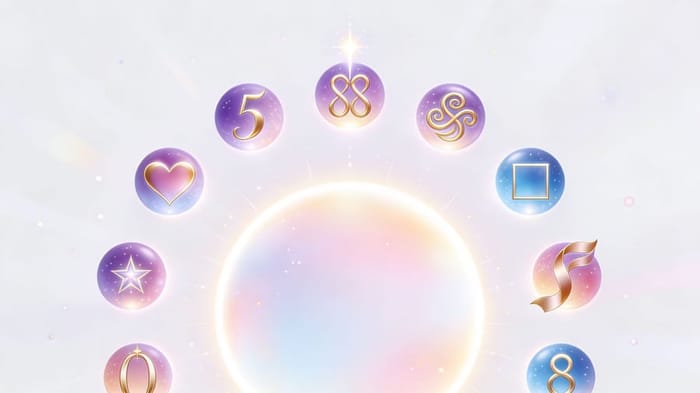
Every number in numerology, 1 through 9, describes a range of behavior rather than a fixed personality type. Your birthday does not slot you into a category. It points to the stretch of that range where your real strengths, blind spots, and growth are found.
Each number from 1 through 9 represents something more interesting than that. It represents a mode of consciousness, a distinct way of experiencing, processing, and expressing life. Think of each one as a lens. Same world, nine fundamentally different ways of seeing it.
Number Meanings at a Glance
| Number | Core meaning |
|---|---|
| 1 | Individuation - the passage from dependence to independence, then using it beyond yourself. |
| 2 | Relation - sensitivity that makes a natural diplomat, without erasing yourself. |
| 3 | Expression - creative warmth and joy, with focus as the real work. |
| 4 | Limitation - finding meaning and freedom within structure. |
| 5 | Constructive freedom - mind over matter, freedom with self-direction. |
| 6 | Responsibility - deep giving that matures into discriminating love. |
| 7 | Understanding - the inward pull toward real knowledge. |
| 8 | Stewardship - managing great inner force; money is a byproduct, never the point. |
| 9 | Completion - giving to all humanity without keeping score. |
| 11, 22, 33 | Master Numbers - higher octaves with amplified potential and responsibility. |
Each row links to a full guide. To see which number leads your own chart, calculate your Life Path below.
And here is the part most numerology sources leave out: every number is a continuum, not a fixed point.
Each one stretches from an extreme of overexpression to an extreme of underexpression, with the healthiest version sitting somewhere near the center. Most people express the positive potential most of the time. But the full range is always there, pulling in both directions.
If you are new to numerology, the complete numerology guide covers the foundations. If you already know your Life Path number, this page will show you what it actually means - and why some of the popular descriptions have it wrong.

Why Numbers Have Meaning at All
The idea that numbers carry qualitative meaning - not just quantitative value, is not a modern invention. It is among the oldest documented intellectual traditions in the world.
For the ancient Pythagorean school, numbers were understood as living forces. They were seen as dynamic and active, almost human in their capacity for mutual influence. Each number had attractions, repulsions, families, and friends. The independence of One, the duality of Two, the completion of Three. These qualities were understood as inherent to the number's nature, the same way heat is inherent to fire. This was not metaphor. It was the foundation of an entire philosophy of reality.
That tradition did not die with the ancient world. In the sixteenth century, the German scholar Heinrich Cornelius Agrippa produced the most comprehensive single framework connecting each number to its correspondences across divine, celestial, elemental, and human levels simultaneously, what he called the "Scale" system. His core principle was direct: numbers are the principal pattern in the mind of the Creator, and they work upon the soul the way sound works upon the ear. Not as symbols of something. As forces in themselves.
The modern Western system took shape in 1908, when Mrs. L. Dow Balliett established the calculation framework still used today. Her approach was built on what she called the Law of Vibration: the principle that everything in the universe vibrates at a distinct rate, expressed mathematically as a number. The number's quality is simply the character of that rate. Moving at one rate, vibration produces color. At another rate, it produces sound. The same principle underlying musical harmony (that mathematical ratios produce audible beauty) underlies why each number carries a distinct meaning.
This matters because it tells you something important about where you stand when you read about your numbers. You are not reading someone's opinions. You are reading the modern expression of a tradition that stretches back over two thousand years, refined by every generation that carried it forward.
When I first started studying numerology, the best advice I received was to forget about Life Path numbers, Expression numbers, and chart positions for a while, and just live with the nine single digits. Get to know what 4 actually feels like before you try to interpret a Life Path 4. Understand the difference between 5's freedom and 9's release before you calculate anyone's chart. The numbers are the alphabet. If you don't know the letters deeply, the words won't mean much.
That foundation reshaped my entire practice. Once the nine numbers were genuinely internalised - not memorised from a list, but felt, every calculation I encountered afterwards made immediate sense. The chart positions just told me where to apply what I already understood.
I'd recommend the same approach to anyone reading this page. Take your time with each number below before moving on.
- Blair Andrews

Two Families of Numbers
Before getting into the individual numbers, it helps to notice the two families they naturally divide into.
 | Odd numbers (1, 3, 5, 7, 9) deal with the individual alone. They are oriented toward intangible qualities: creative expression, abstract ideals, personal experience, inner life. They resist conformity. They expand beyond existing form. |
 | Even numbers (2, 4, 6, 8) involve the individual's relationship to the group. They are oriented toward structure, tangible results, and practical engagement with the external world. They prefer workable patterns and tend toward social integration. |
Neither family is better. The goal is always balance between both.
When you know which family a number belongs to, you already know something about its temperament before you read a single word of the detailed description.
The older tradition framed the same division in elemental terms. Odd numbers partake of fire, air, and earth, the expansive, upward-moving elements. Even numbers belong to water: cohesion, form, things that take the shape of their container. The language is different. The observation is the same.
There is also a trinity structure within the families worth knowing. The first three numbers - 1, 2, 3 - form the creative triad: initiative, collection, expression. Everything begins here. The higher numbers (8, 9, and the master numbers) form the universal triad: body, soul, and spirit operating at a level that has broken through limitation into something much larger than the self.
And cutting across the odd-even divide entirely, the nine numbers also sort themselves into three natural groupings based on orientation. The people-oriented numbers (2, 6, and 9) all involve how we relate to others, from cooperation to love to universal giving. The self-focused numbers, 1, 4, and 8, all represent different aspects of individual will, from independence to discipline to material mastery. The expressive numbers, 3, 5, and 7, each deal with an inner quality that then reaches outward: joy, freedom, and understanding.
These are not competing frameworks. They describe the same architecture from different angles. And they explain why some numbers feel like natural allies while others create friction you can feel immediately.

The Three Families Within the Nine
There is a deeper structure inside the nine single digits that most popular numerology never mentions. Three vertical triads run through them, and once you see them, the entire system stops looking like nine separate categories and starts looking like a coherent architecture.
3-6-9: The Love Triad
Three is joy and creative expression - the love of life itself. Six is the love of family, community, and home. Nine is the love of all humanity. Each one expands the previous one's circle. The 3 loves what it creates. The 6 loves those close to it. The 9 loves with no circle at all.
There is a mathematical elegance here too. Three is the first truly complete figure - the triangle, the first shape that encloses space. Six is considered the most perfect single-digit number, because its factors add up to itself: 1 + 2 + 3 = 6. And Nine completes the entire single-digit cycle. These are not accidents. The love triad carries the architecture of completion at every level.
1-4-7: The Seeking Triad
One seeks independence and self-expression. Four seeks order and the meaning of limitation. Seven seeks understanding - the analytical and spiritual truth beneath appearances. All three are inward-turning at their core. The 1 turns inward to find the self. The 4 turns inward to find structure and purpose in work. The 7 turns inward to find knowledge.
All three can become isolated if that inward turn goes too far. But the isolation feels different in each case - the 1 becomes lonely at the front, the 4 becomes trapped inside walls of its own making, and the 7 becomes lost in its own analysis.
2-5-8: The Engagement Triad
Two is the first relationship - the awareness that others exist. Five is the experience of life in full, with all its changes, freedoms, and risks. Eight is the management of force and material consequence. All three deal with how we engage with the world beyond the self, in increasing scale and complexity.
The 2 engages through sensitivity. The 5 engages through direct experience. The 8 engages through power. Same outward orientation, three entirely different methods.
These triads explain why some numbers feel like natural companions and others feel like productive tension. A 3 and a 9 understand each other almost intuitively - same family, different scope. A 1 and an 8 create a more interesting dynamic because one seeks independence while the other seeks material power, and those two drives do not always cooperate easily.
When you know a number's triad, you know its family. And when you know its family, the territory is already partly mapped before you read the individual number's page.

The Numbers 1 Through 9
The nine single-digit numbers form a sequence with its own internal logic. Each one grows naturally out of the number before it.
Independence leads to cooperation, which produces creative expression, which must be grounded in reality, and so on. But each number is also the opposite of its neighbor - and that productive friction is what drives growth.
Number 1 - Individuation
 | The 1 is not about being a natural-born leader. It is about the difficult passage from dependence toward independence, and then learning to use that independence for something beyond yourself. Early life for a 1 often feels marked by the uncomfortable need to prove oneself, sometimes from a position of subservience. |
The psychological core is learning to stand alone without pushing others away. The mature 1 inspires rather than dominates.
When overexpressed, the 1 becomes a bully who cannot see anyone else's reality. When underexpressed, it collapses into passivity and abdicates its capacity for self-direction entirely.
Number 2 - Relation
 | The 2 is exquisitely sensitive. It reads the moods in a room, the unspoken tensions, the emotional undercurrents that everyone else misses. This sensitivity is both the gift and the burden. It makes 2s natural diplomats and mediators, but it also leaves them vulnerable to being overwhelmed or erased by the very harmony they work so hard to maintain. |
The growth direction for 2 is not becoming less sensitive. It is learning to use that awareness in service of genuine harmony rather than just avoiding conflict. A 2 who cooperates to the point of self-erasure has lost the plot entirely.
Number 3 - Expression
 | Three is perhaps the most inherently enjoyable of all nine numbers. The creative warmth, the expressiveness, the natural ease with words and people. But that lightness is also the challenge. The creative fire that makes 3s so warm and inspiring can scatter in a dozen directions at once, leaving a trail of unfinished projects and diluted talents. |
The real work of the 3 is focus. Learning to bring the creative gift to completion rather than simply inhabiting the spark. When a 3 avoids depth, all that brilliance stays on the surface - charming but ultimately unfulfilling, even to the 3 themselves.
Number 4 - Limitation
 | The 4 carries the weight of the world - sometimes willingly, sometimes not. Its lesson is the difficult law of limitation: everyone operates within constraints of environment, body, and circumstance. Rather than fighting those limits, the 4 is invited to find meaning and even freedom within structure. |
The key insight, when it arrives, is that discipline does not confine. It liberates.
But there is a trap here worth naming: many of the limitations the 4 experiences are self-imposed. The 4 can build its own prison and mistake it for the world. The growth direction is from resentment of restrictions to genuine mastery within structure.
Number 5 - Constructive Freedom
 | The 5 carries a reputation as the freedom-and-adventure number, the wild child, the wanderer. The original meaning is different, and the difference matters. |
Five is actually about mind over matter.
In the esoteric tradition, the five-pointed star with its single point upward represents consciousness ruling the physical elements, spirit directing instinct, not the reverse. The 5 is the mediator, the balance point, the inner teacher who can observe all the elements and combine them wisely.
The keyword that carries the real weight is constructive freedom. Freedom without self-direction leads to chaos, and the 5 knows this better than any other number.
When the pentagram inverts, when the elements rule the mind rather than the other way around, the 5 becomes scattered, impulsive, and overindulgent. The real task is defining your own parameters in order to master your surroundings.
Number 6 - Responsibility
 | The 6 feels deeply. Often almost unbearably so. It carries responsibility not just for its own life but for the lives of those around it, and others recognize this and bring their burdens accordingly. Sixes do not need to learn how to give. They already give. |
The challenge is learning to distinguish which responsibilities are genuinely theirs and which are being accepted by default.
A 6 who has not learned this distinction can become enslaved by its own generosity - so giving and so endlessly present for others that nothing remains for itself. The growth is from indiscriminate giving to discriminating love.
Number 7 - Understanding
 | The 7 gets called the loner of numerology, and that framing misses the point almost completely. The 7 is not retreating from the world out of fear or social dysfunction. I've lost count of the Sevens who've told me some version of "I thought there was something wrong with me until I read this." There isn't. The frequency is just different. It is driven by something deeper - a pull toward understanding that operates on a genuinely different frequency from most of the people around it. |
The introversion some 7s display is not avoidance. It is the inward gravity of a number that subjects everything to analysis in search of real knowledge.
This produces genuine wisdom, but the same perfectionism that serves truth can become a wall that keeps connection out. The lesson is not becoming more social. It is developing enough faith and inner peace that the aloneness becomes chosen solitude rather than painful isolation.
Number 8 - Stewardship
 | The 8 is usually summed up as money, power, and material success. That description is so incomplete it borders on misleading. |
The real meaning of the 8 is spiritual energy management. Look at the number's shape: the lemniscate (infinity symbol) standing upright.
It represents the ebb and flow of enormous inner force, the challenge of balancing conscious and subconscious, the rhythm between giving and receiving. Material success may be a byproduct when the 8 manages its energy well. It is never the point.
The 8 carries tremendous power and the full challenge of learning to direct it sustainably. When balanced, the 8 appears charismatic and strong.
When out of balance, the same power produces dramatic swings, wasted force, and cycles of excess and collapse. The highest expression of 8 is stewardship - and at the deepest level, the insight that material freedom might ultimately mean relying very little on money at all.
Number 9 - Completion
 | Nine is the number of completion. It has absorbed all the lessons of 1 through 8 - the independence, the cooperation, the creativity, the discipline, the freedom, the responsibility, the analysis, the stewardship. And now it turns outward toward humanity as a whole. |
The 9's satisfaction comes from giving for its own sake, without expectation of return. This sounds simple. In practice, it is extraordinarily difficult.
The shadow of 9 is resentful obligation - performing selflessness while secretly keeping score, or wielding the appearance of giving as a form of control. The growth direction is toward giving freely and receiving gracefully, finding deep satisfaction in both.
Read the complete guide to Numbers 1 Through 9

Master Numbers: 11/2 and 22/4
Master Numbers are not simply more powerful versions of their single-digit counterparts.
They represent a qualitatively different level of potential - higher spiritual octaves that come with a specific cost: persistent nervous tension, present whether or not the higher power is being actively used.
The structural fact that most popular numerology ignores is that master numbers operate on two levels simultaneously.
An 11/2 person can work at the 11 level or the 2 level; the slash is not decorative. A person with a plain 2 cannot access the 11. Children with master numbers almost always operate at the reduced level. Even mature adults may only touch the higher expression occasionally.
 | 11/2 is the number of illumination and inspiration. The 11 is called to develop intuition and become a channel - not through force, but through example. Picture two 1s standing side by side: cause mirroring effect, inner reflecting outer, the peacemaker who hears both sides before speaking. At the 2 level, the 11 expresses as sensitivity, cooperation, and diplomacy. |
 | 22/4 is the Master Builder. Where the 11 dreams at scale, the 22 builds at scale - projects that benefit humanity in tangible, lasting ways. The practical challenge is translating a vast inner perspective into language and action that ordinary people can follow. At the 4 level, the 22 expresses as hard work, discipline, and attention to detail. |
 | Some traditions also recognize 33/6 as a master number, while others work strictly with 11 and 22. What all traditions agree on is that master numbers carry amplified responsibility alongside amplified potential. They are not prizes. They are assignments. |
Read the complete Master Numbers guide

Karmic Debt Numbers: 13, 14, 16, 19
Karmic Debt Numbers are not omens and they are not punishments. They are indicators of specific patterns - set in motion in previous cycles, that must be worked through consciously in this one.
Without a Karmic Debt, a person is free to express anywhere on a number's continuum. With one, they tend to start at the negative extreme and must work their way toward positive expression. About half of all people carry at least one, a figure consistent across thousands of charts in my own practice.
 | 13/4 is the debt of laziness. Past avoidance of work creates a present life of unusually heavy labor and often self-created limitation. The pattern to watch for is obstinacy and rigid thinking that converts real discipline into dogmatic stubbornness. |
 | 14/5 is the debt of misused freedom. Past overindulgence creates a present life of erratic behavior, excessive appetites, and difficulty completing the full cycle of any experience. The 14/5 intensifies every challenge the 5 already faces with change and self-direction. |
 | 16/7 is the debt of irresponsibility in love. It creates recurring impermanence - broken relationships, repeated disruptions, a persistent sense that the ground keeps shifting. This is often the most intense Karmic Debt in practice. The work is to stop fighting the disruption and begin accepting it as a teacher. |
 | 19/1 is the debt of selfishness. It creates a paradox: the person must learn independence through selflessness. The trap is either dependence (waiting for others to solve the 19/1's problems) or excessive self-concern that isolates. The path forward requires subordinating personal needs just enough to discover that leadership does not actually require running over people. |
The strength of any Karmic Debt depends on where it appears in your chart. Strongest on the Life Path or Expression; less powerful on the Soul Urge; weakest on the Birthday. If you are not sure what your numbers are, the free calculators will show you in about thirty seconds.
Read the complete Karmic Debt Numbers guide

How the Numbers Connect
The nine numbers are not nine separate boxes. They form a single story - the arc of consciousness from undifferentiated One through the complete wisdom of Nine.
One asserts: I am. Two discovers: you are. Three responds: we can create something together. Four confronts: but creation has limits. Five breaks through: freedom is possible within those limits. Six accepts: and with freedom comes responsibility. Seven asks: but what does it all mean, underneath? Eight applies that understanding to the material world. Nine completes the cycle and turns everything outward toward humanity as a whole.
Then the cycle begins again, on a new level.
The traditional description of the Nine captures this perfectly. It has traveled from beginning through association, to expression. It has suffered the toils of work, enjoyed the expansion of freedom, accepted and loved, meditated and enriched the spirit, directed and achieved. And now, in Nine, it has the all-encompassing knowledge that only comes from having walked the entire path.
This is why higher numbers are not better than lower numbers. They are more advanced iterations of principles already present in the earlier numbers. The same lessons, worked at greater depth. A 9 is not luckier than a 1. It simply covers more territory and faces greater difficulty reaching the end.
Which is exactly why the numbers are not labels. Your Life Path number is not a box you have been sorted into.
It is the particular stretch of this continuum where your most important work happens. Understanding what that number actually means - not the simplified version, but the real one - is where the value of numerology begins. That's what this entire site is built to give you.