The creative voice couldn’t emerge in isolation - it needed the partner’s presence to draw it out. 423 says the Emperor builds, the High Priestess arrives, and the Empress finds her voice through that combination: some expressions only become possible through relationship.
Angel Number 423: The Foundation That Found a Voice Through Partnership
By Blair Andrews · Published May 11, 2026 · Updated May 21, 2026
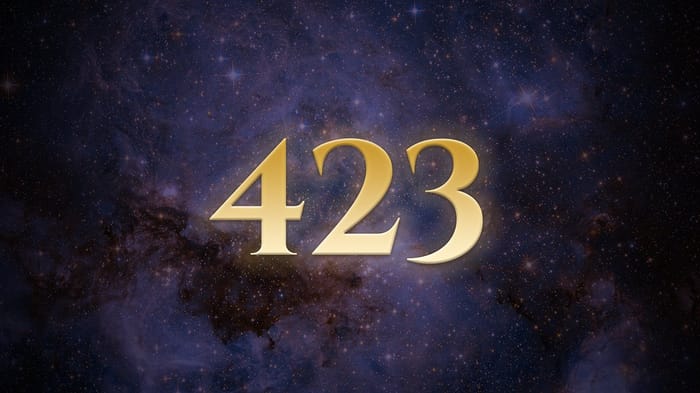
The numbers inside 423
4Stability, foundation, building something solid

2Partnership, patience, trust

3Creativity, expression, communication
4 + 2 + 3 = 9
9: Completion, letting go, a bigger purpose
What 423 means for you specifically depends on which of the 11 Life Paths you’re on. Your birthday determines that.
Enter your birthday below:

A kiln is not much to look at. Brick stacked on brick, lined with refractory clay, a chimney to pull the draft. It sits in the corner of the studio like a squat, patient animal. It produces nothing on its own.
If you walked past one that had never been fired, you would see a well-made box and think: someone built this carefully. And you would be right. And you would also be looking at something that had not yet become what it was for.
The kiln only becomes a kiln the first time someone loads it.
That loading is the whole story of 423. The structure that was built first - built solid, built right - and then discovered what it was built to hold.

The Builder Who Goes First
The sequence opens with 4. The Emperor. The cube. The Pythagoreans called the Tetractis the "perpetual fountain of nature" and swore oaths by it - not because four was flashy, but because four was the ground everything else stood on.
Balliett described 4 with a line that cuts right to the bone: Builds the buildings of which No. 1 is the architect. The 4 does not dream the dream. The 4 takes the dream and makes it load-bearing. Pours the foundation. Squares the corners.
And here is what is quietly devastating about opening with 4: the builder often does not know what the building is for. They know it should be solid, the walls plumb, the foundation deeper than anyone thinks necessary.
But the purpose - the thing the structure will eventually contain - that part is not yet clear. The builder builds anyway, because that is what builders do.
If you carry 423 energy, you know this feeling. You have built things - habits, skills practiced until they became second nature, a reputation assembled one reliable day at a time - and somewhere in all that construction, you have wondered: what is this for? The structure holds.
But it feels like a kiln that has never been loaded.

The Hands That Arrive
2 is the second digit, and 2 reframes the entire structure without changing a single wall.
The High Priestess. The moon. Balliett called 2 Mother Nature - waters and nourishes the seeds others plant; often reaps the harvest. The 2 does not build. The 2 receives. The 2 is the other person in the room, the one who sees what you made and understands something about it that you missed.
In the kiln, 2 is the pair of hands that arrive carrying wet clay. Hands that did not build the kiln and do not need to understand its engineering. Hands that simply know this structure can hold heat, that the walls are thick enough, that the draft will pull correctly.
The hands trust the kiln before the kiln trusts itself.
This is the partnership moment in 423, and it looks different from what most people expect. It is not two people building something together from scratch. It is one person who already built something sturdy being joined by someone who knows what to put inside it.
You may have already met your 2. The collaborator who showed you what your skills were actually good for. The friend who said, casually, over dinner: "You know what you should do with that?" And something clicked.
Or you may still be waiting. The kiln is built. The 2 has not arrived yet, but the structure is already shaped to receive them.

What Comes Out of the Fire
3 closes the visible sequence. The Empress. Expression. Creation that is visible and alive.
Balliett described 3 as the outward expression of 1 and 2 - the place where the spark and the nourishing meet and produce something the world can see. Without the grounding of what came before, 3 drifts.
But with a solid 4 beneath and a receptive 2 beside, it becomes the glazed piece pulled from the kiln. The thing that could not have existed without the container, the hands, and the heat.
This is the part of 423 that surprises people. The creation does not come first. The infrastructure came first. The partnership came second. And the expression came last, because it could only come last.
If you have been feeling like your careful, structured life should have produced something visible by now, 423 is telling you the sequence is not broken. It is correct.

The Firing That Cannot Be Undone
Add the digits. 4 + 2 + 3 = 9. The Hermit. The sage standing at the top of the mountain with a lantern, not because he is searching for something, but because the search is finished.
Nine is the end of the first cycle. Agrippa dedicated it to the Muses - nine daughters of memory presiding over every form of human expression. Balliett called it "free expression on all planes. The Soul of things." Nine does not strive for honors the way eight does. Nine has them laid at its feet.
But 9 carries a specific, physical truth that matters here: ceramic, once fired, cannot return to clay. You can shatter it, grind it to dust, but you cannot make it soft and shapeable again. The kiln did not just heat the clay. It changed what the clay was.
This is the root energy of 423. Whatever expression comes out of the fire will be permanent - not in the sense that nothing will ever change, but in the sense that you will not be able to go back to who you were before the firing.
It is as quiet as pulling a finished bowl from a cooled kiln and knowing, without anyone telling you, that this is what the kiln was for.
Whether 423’s shadow side applies to you — and how strongly — depends on your core numbers. Your birthday reveals the first one.
Enter your birthday below:

The Kiln That Never Gets Loaded
The trap 423 sets for itself is the most beautiful kiln in the studio that has never once been fired.
The structure is immaculate. The routines are airtight. The skills are sharp. Everything is in place. And nothing is happening. The kiln sits in the corner, perfectly built, perfectly maintained, perfectly empty.
The shadow of 423 is the builder who fell so in love with building that they forgot it was supposed to be in service of something else. A life so organized, so structurally sound, that there is no room left for the mess of actual creation.
No room for the wet clay, the uncertain glaze, the possibility that the piece might crack in the firing.
It shows up as the person who keeps preparing. One more certification. One more year of saving. One more round of research before starting. The foundation gets deeper and deeper, and the thing it was supposed to support never arrives, because the building has become the entire project.
It also shows up as the person who found the partner and then refused to let them load the kiln.
"I will do it myself." "The system is delicate." The 2 arrived and was kept at arm's length - not out of malice, but out of the 4's constitutional terror that someone else's hands might compromise what took so long to build.
If you recognize yourself here: the kiln was not built to be admired. It was built to be used. Using it means accepting that the glaze will run in unexpected directions, and the piece that comes out may not look like what you imagined when you were laying bricks.
The structure did not fail you - it did exactly what it was made to do.

What the Builder Learns Last
Most people think creative work starts with inspiration. Idea first, then blueprint, then building. 423 reverses that order completely.
You built the structure first - maybe without fully understanding why - and the vision arrived later, carried in by someone else's hands. The creation was not the seed. It was the fruit, and the fruit only grew because the tree was already rooted and strong enough to bear the weight.
This can feel disorienting if you compare yourself to people who seem to start with passion and build outward from there. You started with competence. With the quiet work of making things that hold. And now you are discovering what all that holding was in service of.
The Hermit's lantern at the root of this number is not searching for the path. It is illuminating the path you already walked, showing you that every step made sense. Even the ones that felt like they were going nowhere. Especially those.

The Temperature Rises
Think about what a kiln actually does. You load it carefully. Close the door. Start the fire low. The first hours are about driving off moisture so the clay does not crack from thermal shock. You cannot rush this part.
Then the temperature climbs. The minerals begin to vitrify - to fuse, to seal. The glaze melts and flows. What was dull becomes luminous. What was fragile becomes durable. What was clay becomes ceramic.
And then you wait. You let the kiln cool at its own pace. You do not open the door early. You trust the structure you built, the hands that loaded it, and the fire to do what fire does.
You are somewhere in this process right now. You may be stacking bricks. You may be meeting the person whose hands will load the kiln. You may be in the firing, feeling the heat climb. Or you may be in the cooling, sitting with something that has already changed and is simply becoming solid.
Wherever you are, the message is the same. The structure came first because it had to. What it was built to hold is arriving on its own schedule. And the thing that emerges will be permanent - nothing fragile or temporary about it. Fired all the way through.

Frequently Asked Questions
What does angel number 423 mean?
423 is about building the container before you know what it will hold. The 4 creates structure, the 2 brings a partner who knows what to place inside it, and the 3 is the creative expression that emerges. It reduces to 9 - completion. Whatever this process produces is permanent.
You built something sturdy, someone showed you what it was for, and the result is changing you in ways that cannot be reversed.
Why do I keep seeing 423 everywhere?
Because a structure in your life - something you built through discipline and unglamorous effort - is about to find its purpose. Or it already has, and you are just starting to recognize it. Pay attention to who is arriving and what they are carrying. They may be the hands that load your kiln.
Does 423 mean I need to wait for someone else before I can create?
The answer is more nuanced than that. The 2 is not always a romantic partner or business collaborator. It can be an audience, a client, a community - anyone whose presence reveals a purpose for what you built. Your creation was never meant to come from isolation.
It comes from the meeting between your structure and someone else's need.
What is the shadow side of 423?
The kiln that never gets fired. The person who keeps perfecting the foundation, optimizing the systems, preparing endlessly - but never puts anything inside and turns up the heat. If you have been "getting ready" for a long time without starting, 423 is asking what you are actually afraid of. The structure is sound.
Load it.
Is 423 a sign of completion or a sign of beginning?
Both. The 9 at the root says a cycle is completing - the long period of building without knowing why is ending. But the expression that emerges is itself a beginning. The finished piece does not sit on a shelf.
It holds water, holds flowers, holds someone's morning coffee. 423 marks the shift from construction to inhabitation.
Curious which numbers are active in your chart right now? Your birthday is the starting point.
Enter your birthday below:
Explore Angel Numbers
| Digit meanings | Angel Number 4, Angel Number 2, Angel Number 3 |
| Reduces to | Angel Number 9 |
| Numbers that share your vibration | 585, 828, 900, and 990 all reduce to Life Path 9. |
Behind Your Angel Number
numerology chart calculator·life path number calculator·numerology guide