Angel Number 155: The Justice of Too Many Open Doors
By Blair Andrews · Published March 13, 2023 · Updated May 21, 2026
The numbers inside 155


1 + 5 + 5 = 11
11: Heightened awareness, sensing what others miss
More liberations than you can govern - the scales are asking which ones stay. 155 lands on Justice because doubled freedom after a beginning demands honest weighing. Not every open door can stay open.
What 155 means for you specifically depends on which of the 11 Life Paths you’re on. Your birthday determines that.
Enter your birthday below:

Too much freedom becomes its own kind of problem eventually.
The opposite of confinement, the opposite of oppression, and yet a problem all the same. A steady accumulation of open doors - options, latitudes, permissions - until the sheer number of them begins to generate a weight the person carrying them did not expect.
The younger self would not have understood this. The younger self was still working to pry open the first few doors. The struggle, at that stage, was to become less bound. To claim the freedoms one had not yet been granted.
The assumption, largely unspoken, was that freedom was a destination. Reach it, and the problem of what to do with your life would resolve itself.
It does not resolve itself. And for a certain kind of person, in a certain season, freedom begins, quietly, to reveal its other face.
The number attached to this particular arrival is 155.

The Beginning, Placed First
Look at the number itself before anything is added.
A 1 stands at the front. Two 5s follow.
The one, in the older symbolic traditions, is the monad, the concentrated point of consciousness that precedes every act. It is the seed. The starting position. The moment before motion, when all directions are still possible.
The Magician of the tarot standing at his table, one hand raised, one hand lowered, the four elements arrayed in front of him. The stance before choosing. Fully ready.
Place this figure at the head of a composite, and the composite is telling you something specific. Whatever it describes began somewhere. There is an origin point. A fresh start that the rest of the number is unfolding from.
This matters, because 155 is often the number of a life that was, once, genuinely renewed. The person carrying it typically had a beginning. A real one.
Not a cosmetic adjustment but an actual break in continuity, after which the life that followed was not the life that came before. A new career. A new city. A recovery. A relationship that reorganized the self. A creative turn that changed what the hands could make.
That beginning is the 1. It is still there in the number. It has not been erased by what came after. The fresh start remains part of the composition.
But the composition does not stop at the 1.

The Liberation That Followed
Behind the 1 sit two fives.
The 5, in the older traditions, is not the number most recent writing makes it out to be. It is not thrill-seeking or restlessness or the permission slip for impulse. That reading is almost exactly inverted from what the symbol has always meant.
The 5 is the pentagram, the five-pointed star, one point above, four points below. The top point is spirit. The four below are the classical elements.
The arrangement is a diagram of governance. Consciousness standing above the physical and directing it, rather than being dragged around by it. The Hierophant of the tarot - the inner teacher who has bridged visible and invisible worlds enough times to walk in both without stumbling.
This is what the 5 actually is. The doubled 5 is offering liberation. And liberation is heavier than license - it asks more of you. The particular freedom that belongs to a person who has learned their own nature well enough that outer circumstance cannot own them.
Now consider the 5 doubled. Two pentagrams, side by side, tracing a life that was not only liberated once, but liberated again, and then again. One set of constraints shed, and then another. One ceiling lifted, and then the next.
This is the shape of 155 in a human life.
A person who began something new (the 1), and in the course of that beginning accumulated, steadily, a widening set of freedoms. Financial latitude, perhaps. Geographic latitude. Professional latitude, the ability to say yes to this and no to that in a way that was not available ten years ago. Creative latitude. Relational latitude.
The quiet latitudes of reputation and experience, which open more doors than younger people realize.
Each freedom, on its own, was hard-won and precious. The person did not accumulate them casually. Each represents some season of labor, some risk accepted, some version of themselves outgrown. The freedoms are real.
The problem is that there are now several of them. And they are all, simultaneously, open.

The Weight the Composite Produces
Here is where 155 begins to reveal why its arithmetic lands where it does.
When one 5 is present, the person has a liberation to steward. A single freedom, however significant, can be held in one hand. The governance it requires is substantial but contained. Spirit above the elements is a full-time attention, but it is a single attention.
When the 5 is doubled, the attention has to divide. Two liberations do not simply sit quietly side by side. Each one asks for the same vigilance the single 5 required.
Each one needs its pentagram oriented upright. And because the person is one person, with one inner life, the question of which freedom gets the governance on any given day stops being abstract.
A person with a free schedule and a free income and a free creative practice and free relationships and free geography cannot exercise all of these freedoms at full capacity at the same time. The mathematics of a day will not allow it. Something will be chosen. Other things, by the very choosing, will not be chosen.
This is not a complaint. It is simply the physics of a life that has, successfully, accumulated its freedoms.
And it is exactly the position from which 155 asks its question.

Halfway Through
What does angel number 155 mean?
155 is the number of a life that successfully accumulated its freedoms and is now discovering that too many open doors can feel more like fog than flight. The 1 is the fresh start that generated the freedoms.
The doubled 5 is liberation upon liberation. And 1 + 5 + 5 = 11, the master number of Justice - the scales asking you to weigh which freedoms you can actually govern well.
Why do I keep seeing 155?
You’re probably in a season where you have more options, latitude, and freedom than you’ve ever had, and it’s starting to feel less like expansion and more like diffusion. Days end and you’re not sure what you actually did. 155 shows up when the honest management of your freedoms has become the real work, not the earning of them.
What does 155 mean for relationships?
In love, 155 often shows up when you have the freedom to go in multiple directions and the real question is which connection gets your full presence. It’s not about choosing between a good partner and a bad one. It’s about recognizing that spreading your attention across too many possibilities means none of them get the devotion they deserve.
Is 155 telling me to give something up?
The weighing inside 155 has a quality the article calls “rueful,” a quiet recognition that some of the doors you spent years earning are better left resting for now. Closing a door isn’t reversing your earlier work. It’s maturing it. So the doors you keep can be walked through fully, with real presence and real governance.
Learn more: Browse our complete angel numbers guide

The Arithmetic
Add the digits. One plus five plus five.
The expected outcome of a three-digit composite is a single digit. The composite should reduce, cleanly, and settle into a meaning the tradition can assign.
155 does not settle.
One plus five plus five concentrates into eleven, and eleven holds. The master numbers preserve their doubled charge rather than diluting it into a single digit.
The weight does not lighten. Whatever the composition was carrying, it keeps carrying. There is no shortcut back to a single digit.
The arithmetic has pointed at something the system cannot simplify away.
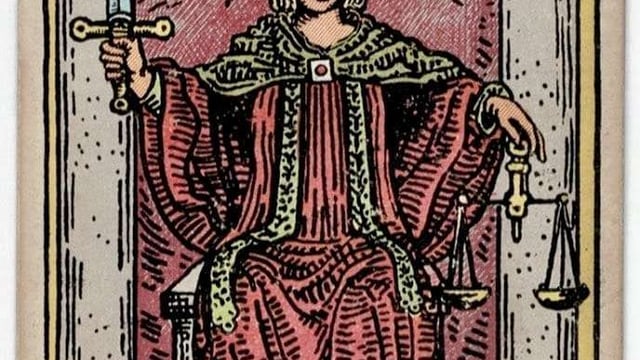
Eleven is the Justice card in the tarot. A seated figure holding a sword in one hand and a set of scales in the other. The sword is for discernment - the clean cut between what matters and what does not.
The scales are for weighing - the patient, unhurried work of measuring one thing against another until the truth of their relative weight reveals itself.
Eleven is not anxiety. It is not heightened nervous sensitivity. It is not the meeting of mirrored souls. Those readings are recent and they misread the tradition. The older meaning is unambiguous: eleven is the apparatus of weighing, placed in the hands of a person now qualified to use it.
The question is what eleven is weighing, in this particular composite.

What the Scales Are For, This Time
Most weighings in a life are between a yes and a no. Between a good and a bad. Between a thing worth keeping and a thing worth releasing. Those weighings are difficult, but their structure is clear. One side of the scale is supposed to tip.
The weighing inside 155 is not that. Inside 155, both sides of the scale hold things the person values. Each freedom on the t
Whether 155’s shadow side applies to you — and how strongly — depends on your core numbers. Your birthday reveals the first one.
Enter your birthday below:
The scales are not being asked to distinguish between good and bad. They are being asked to distinguish, among several goods, which ones can actually be governed well by a single mortal life.
This is a harder weighing. It is also the specific weighing 155 was built for.
The person carrying this number has reached a position where they have too many open doors, and the question is not which doors are the wrong doors. All of them are, in some defensible sense, right doors.
The question is which of them can realistically receive the attention a door requires if it is going to remain open without becoming a draft through the whole house.
A door left unattended does not stay neutral. It admits weather. It admits whatever passes by. The freedoms in a life are the same. Unattended freedom does not remain freedom. It becomes diffusion.
The person with too many open doors does not experience expanded liberty. They experience, over time, a slow hollowing, a sense of being pulled in several directions at once, without being fully present in any of them.
This is the condition 155 has named. And it is the condition that requires the scales.

Why the Liberated Person Becomes the Judge
There is a particular logic to why this weighing falls specifically to the person in whom 1 and doubled 5 are both present.
A person without the initial 1 has not begun anything. They have not made the move that generated the freedoms in the first place. For them, the scales have no weights to measure. The liberations are still aspirational. The weighing can only happen later, if it happens at all.
A person with 1 but only a single 5 has one freedom to steward. They have the governance of the pentagram - spirit over the elements - and the single attention this requires. The weighing is vigilant but contained. One door. One watch. No contest between comparable goods.
It is specifically the person who has 1 and the doubled 5 who faces the weighing 155 describes. They have begun. They have, in the course of their beginning, accumulated more than one liberation. And they have reached the point at which those liberations can no longer all be honored equally.
They do not arrive at this position as a failure. They arrive at it as a consequence of success. The life they built worked. It generated options.
The options multiplied. Now the options exceed the hours, and someone has to decide which ones keep their open status and which ones, quietly, are returned to being merely possible rather than actively available.
That someone is the person carrying the 11. The arithmetic has ensured it. Once both 5s are present behind the 1, the composite resolves to the scales, and the scales resolve to the hands of the person who summed the number by living it.

The Difference From the Governance of a Single Five
It is worth saying plainly what is different, here, from what the single 5 asks.
The single 5 asks the person to govern their desires. To keep the pentagram upright. To exercise constructive freedom rather than the inverted, destructive kind that popular readings have confused with the number's meaning.
This is the classical task of the Hierophant, the inner teacher who has learned to place spirit above matter in the service of a coherent life.
The single 5 does not typically require the scales. One governance, faithfully maintained, does not produce a composite weight that needs measuring. The pentagram itself is the instrument.
In 155, the governance task is the same at the level of each individual freedom. But there are two of them. And a person cannot, in the physics of a day, serve two full governances at the same attention the single pentagram required.
So a second instrument enters. The scales. The weighing of one governance against another.
The patient discernment of which freedom, in this season, deserves the primary hand - and which one is being asked to rest quietly in the background, still real, still accessible in principle, but no longer demanding the active vigilance the single pentagram would require.
This is what the 11 inside 155 is asking. What looks like abandonment from the outside is, from the inside, the mature management of freedom.
Discover more: Calculate your Life Path Number

What This Looks Like in a Life
A person moving through 155 is often someone who has, by this point, gathered a particular kind of inventory.
They have, in principle, the freedom to pursue several directions at once. They have enough independence that no single structure owns them.
They have enough resources (financial, relational, creative, temporal) that no single claim fully constrains them. They have, in short, become the kind of person whose younger self would have considered them liberated beyond imagination.
And yet they notice, often with some surprise, that this liberation is beginning to feel less like flight and more like fog. The multiplicity of their options has dispersed, rather than concentrated, their attention.
The days end and they are not sure what they actually did. Several directions were partially honored. None was fully honored. The inner pentagram, which had been reliably upright when there was only one set of elements to govern, is now rotating among several sets of elements, and the rotation is becoming its own form of depletion.
They are not unhappy, exactly. They are diffuse. And they are beginning to feel, somewhere below conscious thought, that something is being asked of them that was not being asked ten years ago.
What is being asked is the weighing.

What the Weighing Asks Them to Consider
The specific question the scales of 155 pose is not which freedoms do you deserve? That question is closed. The freedoms are already present. They were earned in the decades behind the number.
The question is narrower, and harder.
Which of these freedoms, honestly, can you govern well?
In the daily, weekly, seasonal sense, the practical one, not the philosophical one. Which of the open doors can you stand at and actually tend? Which deserve the upright pentagram - the presence of spirit above the elements?
Which, if you are honest with yourself, have been open long enough that you are ready to admit you will never walk through them, and keeping them open is simply admitting a draft into the rest of the house?
This is a question about finitude. It is the recognition that a mortal life cannot fully govern an unbounded number of liberations, and that the attempt to do so produces, in the end, the opposite of what freedom was supposed to produce. Instead of a person concentrated enough to act, a person diffused enough to drift.
155 asks the person to become the Justice of their own latitude. To weigh, patiently, which freedoms are living freedoms and which have quietly become theoretical.
To close, with reverence rather than resentment, the doors that are not going to be walked through, so that the remaining doors can be walked through as the pentagram always intended: with spirit above the elements, fully present, fully governed, fully free in the way the 5 actually means.

The Particular Quality of This Eleven
The 11 inside 155 has a specific texture worth naming, because it is not identical to the other master-eleven paths.
The scales that arrive through construction and inner victory carry a sober weight - the judgment of someone who has built and whose judgment has been trained on what holds.
The scales that arrive through freedom and love carry tenderness, because the weighing is between things the person cares for. The scales that arrive through completion and receptivity carry hospitality, oriented toward whoever comes through the door asking for counsel.
The 11 inside 155 is none of those exactly. It is rueful. Not bitter - rueful. The specific quality of a person who has, with some chagrin, recognized that the very freedoms they spent decades acquiring have now become more than any single mortal can fully steward. The scales do not condemn this recognition. They simply wait for it.
There is a small grief inside this weighing. Each door that closes was once a door that mattered. Each liberation not chosen was, in an earlier season, something the person fought to claim. Closing some of them is not the reversal of the earlier work.
It is the maturation of it. But the ruefulness is real. It is what this particular version of Justice sounds like. A person sitting with the scales and saying, quietly, I could keep this one open, and I am choosing not to, because the ones I am keeping need me more.
That quiet sentence is the whole work of the number.

The Closing Image
Picture a person standing in a wide, sunlit corridor.
Along one wall of the corridor are several doors. Each one is open. Each one leads somewhere real - a life they could live, a direction they could walk, a freedom they have already, in some earlier year, succeeded in earning for themselves.
The person is holding one open door in each hand. Physically, actually, their hands are on two doors, keeping them from swinging shut. A third door is being held open by their foot.
A fourth is being held by the weight of a book they have leaned against the jamb. A fifth, further down the corridor, is beginning to drift closed on its own, because no one is there to keep it open.
The person is not in distress. They are simply reaching the limit of what a body can hold. And in the middle of the corridor, at a small table, a figure is seated with a pair of scales. She does not speak. She does not have to. She is waiting for the person to walk to her and hand her one of the doors.
Just one. Maybe two. The doors that, in this season, have become more than the person can actually steward without losing the ability to be fully present at any of them.
The figure at the table is not closing doors as punishment. She is closing them as governance. So that the remaining doors, the ones the person will keep open, can actually be walked through, standing upright, with spirit above the elements, in the way the pentagram has always asked its carrier to move.
The beginning is still there. The 1 at the front of the number has not been erased. The liberations behind it, earned across seasons, are real and will remain real. But the arithmetic of 155 has arrived at the scales, and the scales have a question that does not answer itself.
Which of these freedoms deserves your governance? And which, though you earned them, are you now willing to let rest, so that the ones you keep can be honored fully?
The person walks to the table. They hand the figure a door. The door closes gently, without violence, without drama. It is not gone. It is simply no longer demanding the attention it was demanding before.
The corridor, with fewer doors open, becomes, strangely, brighter.
The person turns back toward the doors they have chosen to keep. Their hands, no longer overfull, are now free to tend what remains. The pentagram rights itself. Spirit settles, once again, above the elements it is here to govern.
This is the quiet closing of the number 155. The honest management of freedom, which looks nothing like its loss. The Justice of discernment among liberations, all of them real, not all of them able to be lived at once.
The scales were handed to the one who could weigh this. The one who had begun, and who had been liberated, and who had been liberated again. The composite has produced, by its own arithmetic, the person most qualified to decide which of the doors the hands can actually hold.
They weigh with care. They choose with reverence. And when they close the doors they are closing, they do so not as a defeat of freedom but as its mature continuation - the 5, now finally free enough to be present, because the 5 has stopped trying to be everywhere.
Curious which numbers are active in your chart right now? Your birthday is the starting point.
Enter your birthday below:
Explore Angel Numbers
| Digit meanings | Angel Number 1, Angel Number 5 |
| Reduces to | Angel Number 11 |
| Mirror | Angel Number 551 |
Behind Your Angel Number
free numerology calculator·life path calculator·what is numerology