Angel Number 1181 Meaning: The Third Thread, While the First Two Are Still Humming
By Blair Andrews · Published October 31, 2023
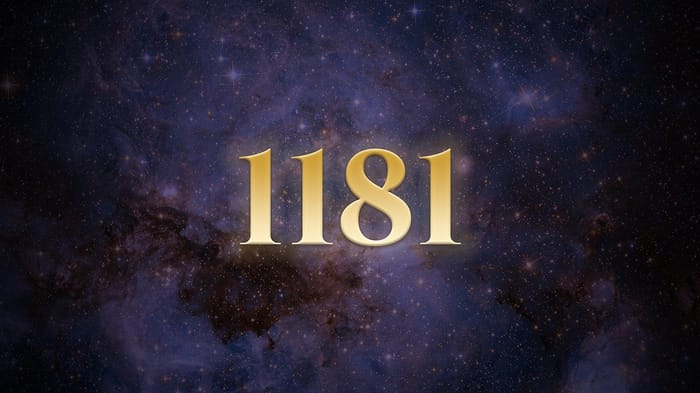
The numbers inside 1181

1 + 1 + 8 + 1 = 11
11: Heightened awareness, sensing what others miss
Can the established rhythm hold a third note? 1181 asks whether your practiced pattern has room to expand - Justice’s scales are weighing whether the new thread strengthens the pulse or fractures it.
What 1181 means for you specifically depends on which of the 11 Life Paths you’re on. Your birthday determines that.
Enter your birthday below:

The kitchen, end of an unremarkable Tuesday.
They have two practices already underway. Neither is new. The first has been part of their life for a long enough stretch that it no longer requires the little internal speech that used to accompany it.
The second joined the week a couple of years after the first, and by now the two have settled into a kind of conversation with each other - one breathing in where the other breathes out, one catching the attention the other has just released.
And tonight, standing at the counter, a third thing has begun to form.
Not a wish. Not an idea they saw someone else doing. A real pull, small but unmistakable, asking whether it might also become a practice. Asking it softly. Asking it in the specific tone that the first two once used, back when they were still only threads.
This is where 1181 lives. Not at the striking of the first match, not at the moment a single practice finds its tempo, but at the doorway between a working rhythm and a third thing quietly asking to come in.

The shape of the number
Look at 1181 before doing any arithmetic.
Two ones at the front. Then an eight. Then one more one, standing at the end by itself.
Each piece of that sequence is a whole situation.
The doubled beginning, those two opening ones, is a life that has already founded more than a single pattern. The person has started, and then started again, and both of the starts took. Neither was abandoned. Both became part of the actual life rather than the life the person meant to live.
The eight in the middle is the pulse that forms once a practice has been going long enough. The lemniscate turned on its side. Energy moving through its two halves without requiring daily willpower to keep moving. Between the first two practices, a rhythm has established itself.
And then, after the rhythm, another one arrives.
A new beginning. Positioned not at the start of the number, where beginnings usually appear, but at the end - after the rhythm is already playing. A third start, showing up while the first two are still humming.
That placement is the whole story of 1181. A beginning that is not the opening beat. A beginning that arrives mid-stride.

Not the same as 118, and not the same as 1118
It's worth pausing briefly on what this is not.
It is not 118, which describes a doubled start finding its rhythm and completing a full turn of the wheel. 118 is about the close of a first cycle, the calluses that form, the new beginning that arrives already seasoned.
It is not 1118, which describes three foundings before the rhythm ever gets to announce which of them the life has actually chosen. That is a more crowded situation, weighed under different pressure.
1181 is its own arithmetic. Two beginnings, then a working rhythm, then a third beginning arriving after the rhythm has already formed. The first two are not candidates anymore - they are the practice the person's days are actually made of. The third one is the fresh thread. It is genuinely new. It is genuinely asking.
What is in question is not whether the third thread is real. It is. What is in question is whether the rhythm can hold it.
You might also enjoy: Browse our complete angel numbers guide

The third thread and its particular kind of pull
There is a specific texture to the kind of beginning 1181 describes.
It is not the grand new direction that asks for everything to be dropped. Those are easier to recognize, in a way, easier to accept or refuse. The third thread does not demand that the first two be set aside. It simply enters the room and asks, politely, whether it might also be practiced.
It might be a creative project that has been gathering in the mind for months without the person quite noticing. It might be a relationship beginning - not a disruption to an existing one, but a new friendship, a new mentorship, a new direction in someone's care for their community.
It might be a study the person keeps returning to, an instrument they have begun to pick up more often than is explained by curiosity alone, a small business that has quietly begun to shape itself around conversations they did not know they were having.
Whatever the specific form, the quality is the same. It is forming. It is not yet a practice. It is asking to become one.
And the question it brings with it is not a question about itself. It is a question about the rhythm.

The rhythm that has already formed
The first two practices, by the time 1181 begins showing up, are usually quite established.
Often quiet, rarely spectacular. Often invisible from the outside. But real, the kind of practices that have shaped the week for long enough that the week would look strange without them. The first is likely the older of the two and carries the deeper groove.
The second entered later and found its place in the hours the first had not taken. Together, they form a pulse. One carries the morning energy, the other carries the evening. One claims certain seasons, the other holds the intervals.
The person carrying 1181 is often not fully aware of how finely tuned that pulse is until the third thread arrives.
Because the moment something new tries to enter the week, the existing rhythm becomes visible. The places where it has no slack. The hours that are already spoken for. The energy that is already circulating through the lemniscate of the first two practices and has no obvious surplus to lend.
This is not a failure of the rhythm. It is what a working rhythm looks like. A pulse that has been going long enough to sustain itself does not have arbitrary empty pockets. It uses what it has. That is why it works.
But it does mean that the arrival of a third thread cannot be treated as if the week still had empty space in it. The week does not. The week has a pulse. And the pulse is about to be asked whether it can carry a third note without losing the rhythm that made it musical in the first place.
Whether 1181’s shadow side applies to you — and how strongly — depends on your core numbers. Your birthday reveals the first one.
Enter your birthday below:

The scales arrive
Add the digits of 1181. 1 + 1 + 8 + 1 = 11.
Eleven is Justice in the classical tarot - the seated figure with scales in one hand and a sword in the other. The scales for weighing the actual weight of things. The sword for the clean discernment that follows honest measurement.
The scales of 1181 arrive at a very particular moment. They do not arrive at the founding of the first practice, or the founding of the second, or the finding of the rhythm between them. They arrive in the doorway between the working pulse and the new thread.
They are not weighing whether the third thread is worthy. That is not the question. The scales of eleven are not moral scales in this sense. They are descriptive scales. They are measuring something narrower and more useful.
They are weighing whether the rhythm can hold the third thread, and if it can, what the rhythm will have to become to hold it.
This is a harder assessment than it sounds, because the honest answer is almost never a clean yes or a clean no. A rhythm that has been going for years has real carrying capacity, and a thread that has genuinely begun to form carries its own energy with it. It is not asking to be fed from the existing pulse.
It has its own pulse in miniature. But two pulses and one new thread do not automatically integrate. They have to find each other. Sometimes the rhythm has to change to let the third thread in. Sometimes one of the first two has to compress slightly, or change tempo, or move to a different hour.
And sometimes the honest reading of the scales is that the third thread, real as it is, is not going to become a practice in this season. It is going to remain a thread a while longer. Perhaps years. Perhaps until one of the first two has completed its season and left space the way finished practices leave space.
Dive deeper: Calculate your Life Path Number

What the sword is for
The sword in the Justice card is not an execution instrument. It is a discernment instrument. It cuts the honest line between what a situation actually is and what a person would prefer it to be.
In 1181, the sword does its work on the shape the third thread will take.
It might weave in. The rhythm might be generous enough, or the third thread light enough, or the alignment between them natural enough, that the pulse simply expands to include it. This is the easiest of the honest outcomes, and it is rarer than it seems.
It might enter as a smaller version of itself. Not the full practice the person imagines it becoming, but a modest daily or weekly contact - enough to keep the thread alive without asking the existing rhythm to restructure. A sketch in the notebook rather than a painting.
A page of the novel rather than the chapter. A phone call rather than the full mentorship arrangement. The thread gets to continue forming, and the rhythm gets to continue playing, and time is allowed to do the work that only time can do.
It might be named, clearly, as a thread for now. Something beyond a practice. The timing isn't right yet. A real thing, kept in view, honored by the person's attention, but not asked to carry the weight of a founded pattern in a life that is already running two. Threads are not failures.
They are seeds that may become practices later, in a different season, when the rhythm has reorganized around whatever the next turn of the life brings.
The sword of 1181 is not there to reject the third thread. It is there to prevent the sloppy integration that would happen if the person simply let it in without weighing.
Sloppy integration is how rhythms break. The third thread crowds the first or the second, one of them loses its grooved place in the week, the pulse that sustained the person begins to stutter, and within a season all three are suffering.
The scales exist to prevent that. The sword exists to cut the line that lets the third thread be real without costing the rhythm its music.

Why the number arrives mid-stride
1181 almost always arrives while the person is already moving.
In the kitchen, on a Tuesday. In the middle of a regular week. In the middle of an ordinary Tuesday, between the first practice and the second, with the hum of both of them still audible and the third thread quietly announcing itself in the background.
This is the particular honesty of the number. It does not ask the person to pause everything and deliberate. It asks them to notice, even while moving, that something is forming, and to pick up the scales without dropping the rhythm that is already playing.
That is the small discipline at the center of 1181. The person does not stop walking. They continue the first practice. They continue the second. They let the third thread keep forming in the background, observed but not yet grabbed.
And somewhere between the two practices they have already founded, they pick up the scales and hold them - briefly, honestly, while the rhythm continues.
The scales do their work in motion. That is part of what makes them master-number scales rather than beginner scales. They do not require the life to stop in order to be read. They are made for practitioners who already know how to move.

A quiet closing image
Picture the person again, later in the same evening.
They are standing in a doorway between two rooms. In one room, the first practice is gently playing - a lamp on a desk, the particular quiet that a long-running discipline gives off.
In the other room, the second practice is playing too, its own tone, its own rhythm, meeting the first through the hallway. Between them, the pulse the two have formed is clearly audible.
The person is holding the third thread in one hand.
It is small. It is real. It is warm. It is still in the early stage of asking to become a practice, not yet insisting.
In the other hand, without quite noticing, they have picked up the scales.
They stand there for a while. They do not hurry. They do not refuse the thread, and they do not yet weave it in. They let the scales settle. The rhythm continues playing through both rooms around them. The third thread stays warm in their hand.
After a time, the indicator on the scales settles, not dramatically, not with ceremony, just with the quiet certainty that honest weighing gives.
The rhythm can hold one more note, or it cannot. The third thread will become a practice now, or a smaller version of itself, or a thread held in view for a season or two while the pulse of the first two continues its music undisturbed.
Whichever answer the scales give, the person has done the work the number was asking for. They have weighed without stopping. They have honored the third thread without sacrificing the rhythm. They have let the master number do what it exists to do - measure, in motion, whether a life that is already singing has the room to add one more voice.
The scales settle. The rhythm continues. The third thread, in one hand or woven in, is accounted for.
The practitioner lowers the scales and returns to the pulse.

Curious which numbers are active in your chart right now? Your birthday is the starting point.
Enter your birthday below:
Explore Angel Numbers
| Digit meanings | Angel Number 1, Angel Number 8 |
| Reduces to | Angel Number 11 |
| Mirror | Angel Number 1811 |
Behind Your Angel Number
numerology chart calculator·life path number calculator·numerology guide