Third Challenge Number 6 - The Lifelong Lesson of Responsibility and Balance
By Blair Andrews · Published April 24, 2025 · Updated May 10, 2026
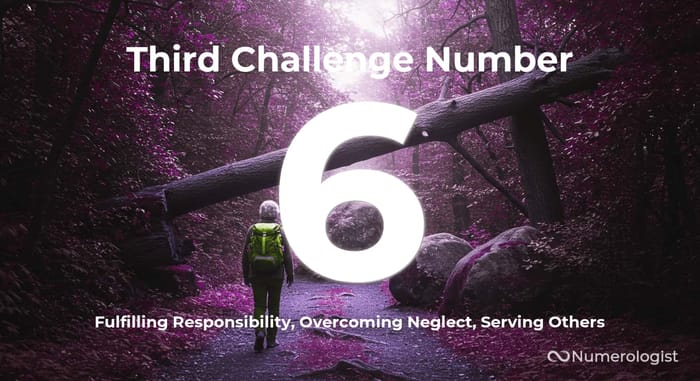
When your Third Challenge is 6, the lesson you will wrestle with across your entire life centers on responsibility - how much to take on, how much to let go of, and how to serve others without losing yourself in the process. This is the challenge of the caretaker who must learn that care includes caring for themselves.
The Third Challenge - sometimes called the Main Challenge - spans your entire lifetime. Unlike the other challenges, it never concludes. It is the deepest undercurrent of personal growth, the thread running beneath all other lessons. When that lifelong number is 6, your relationship with duty, service, and love becomes the territory where your most persistent growth happens.
Six is the hexagram, the symbol of harmony and beauty. In the Tarot, it is the Lovers - but not in the romantic sense most people assume. The image shows a young person standing between two paths, with a higher force ready to intervene if they choose wrongly. When 6 appears as your lifelong challenge, that choice between selfless service and self-preservation becomes the recurring question of your existence. The esoteric tradition puts it plainly: you are learning to be a server, not a servant.

The Responsibility Trap
People with a 6 Main Challenge usually do not lack a sense of responsibility - they have too much of it, or they have a complicated relationship with it that swings between extremes. You may take on everyone else's problems as your own, carrying burdens that were never yours to carry. Or you may resist responsibility so forcefully that you create chaos in the lives of people who depend on you.
The first pattern is more common. Six energy is naturally oriented toward service, and when it sits in the challenge position, service can become compulsive.
You might be the person who can't say no - to a favor, to an obligation, to a family member's crisis, to a colleague's request for help. Each individual yes seems reasonable, but collectively they add up to a life lived entirely for others, with nothing left for yourself.
The esoteric tradition associates 6 with the lily - the six-petaled flower of divine desire, as opposed to the five-petaled rose of human desire.
People with prominent 6 energy are reaching for something higher than personal satisfaction. They genuinely want to serve. The challenge is that this beautiful impulse, when unchecked, leads to depletion, resentment, and eventually burnout.

Family and Domestic Life
The 6 Challenge is deeply connected to home and family dynamics. Your family of origin may be where this challenge first takes root - perhaps you were parentified as a child, taking care of younger siblings or even your own parents.
Perhaps the household required constant adjustment and peacemaking, and you became the designated smoother of rough edges.
In your own adult family life, similar patterns tend to repeat. You may become the one everyone turns to, the hub that holds everything together. When that's a conscious choice made from a full cup, it can be deeply fulfilling.
When it's an unconscious compulsion driven by the belief that everything will fall apart without you, it becomes the challenge at its most acute.
The lesson here is not to stop being responsible or caring. It is to examine the motivation behind the caregiving. Are you helping because it's genuinely needed and you freely choose to, or are you helping because you do not know who you are if you are not needed?

The Perfectionism Connection
Six energy has a strong relationship with idealism and perfectionism. The Lovers card in the Tarot points to the tension between the ideal and the real, and when 6 is your lifelong challenge, you may hold yourself and others to impossible standards.
The home must look a certain way. The family must function a certain way. Relationships must meet a particular ideal.
This perfectionism creates suffering - both for you and for the people around you. The partner who never quite measures up. The children who feel the weight of unspoken expectations.
The self-criticism when reality doesn't match the vision. One of the deepest lessons of the 6 Challenge is learning to love what is, rather than constantly measuring it against what should be.

How It Evolves
In youth, this challenge often shows up as an early and intense sense of obligation. You may have been the "responsible one" long before responsibility should have been on your radar. By adolescence, you might already feel torn between duty and personal desire.
Young adulthood typically amplifies the challenge through partnerships and early family life. The commitments multiply - spouse, children, career, extended family, community - and the 6 Challenge keeps asking: How much is yours to carry? The answer you give in your twenties and thirties often determines the shape of your midlife experience.
Midlife with a 6 Challenge frequently involves a crisis of over-responsibility. The caretaker reaches a breaking point. The person who has been holding everything together discovers that they're falling apart inside.
This is actually a productive moment, though it rarely feels like it. It's the point where the challenge demands that you extend to yourself the same care you've been giving everyone else.
In later years, the well-worked 6 Challenge produces someone who serves from wisdom rather than compulsion. You still care deeply. You still show up for people.
But you've learned the difference between responsibility that nourishes and responsibility that depletes. You've discovered that taking care of yourself isn't selfish - it's the foundation that makes genuine service sustainable.

Working With This Challenge
Learn to distinguish between requests and obligations. Not everything that's asked of you is yours to do. Practice the pause between someone's need and your response. In that pause, ask yourself honestly: Is this mine? Do I have the capacity for this right now? What will it cost me?
Practice receiving. If giving is your default, receiving may feel profoundly uncomfortable. Let someone else cook the meal, handle the crisis, offer the comfort. This isn't lazy. It's balance - and balance is what the 6 Challenge is ultimately teaching.
And examine your relationship with perfection. The home doesn't have to be flawless. The relationship doesn't have to be ideal. The family doesn't have to look a certain way. Six energy at its highest expression reaches past perfection toward beauty - and beauty, unlike perfection, includes imperfection. The cracked pot that lets the light through. The messy kitchen where real meals are cooked with love. That is the harmony this challenge is pointing you toward.

What This Challenge Builds
People who engage the 6 Main Challenge honestly across decades develop a remarkable capacity for creating genuine harmony in their environments and relationships. Because they learned the hard way what happens when responsibility is avoided or when service becomes self-destruction, they tend to carry a deep, earned wisdom about the proper place of duty in a meaningful life.
The lily's six petals represent divine desire - the desire not just for what you want, but for what is beautiful, true, and right. When this challenge has been met, that desire becomes a genuine guiding force rather than a source of perfectionist anxiety. You learn to serve with your whole heart while keeping that heart intact. And that capacity - sustainable, boundaried, genuinely loving service - is one of the most valuable things any human being can offer.

Explore Further
- First Challenge Number 6
- Second Challenge Number 6
- Third Pinnacle Number 6
- Challenge Numbers Calculator
- Challenge Numbers: Complete Guide
- Number 6 Meaning

What the Tradition Says About Challenge Number 6 as the Main Challenge
Goodwin describes the 6 energy as balance, responsibility, and love - the lifelong work of learning which responsibilities are genuinely yours, and how to give care without losing oneself in the giving. As a Main Challenge, this means the tension between care for others and care for oneself remains a central thread of the entire life. Goodwin's growth direction - from indiscriminate giving to discriminating love - describes a transformation that unfolds across decades, not weeks.
Drayer's treatment of the 6 Challenge touches the deepest level of this lesson as a lifelong designation: "Become your own best friend. Do all the things for yourself that you do for others." She adds her most pointed observation: if you feel like a martyr, you are probably agreeing to things you do not want to do. For the person with a Third Challenge of 6, the martyr pattern is not a phase of youth but a recurring option that presents itself across the entire lifespan - and the work is developing the self-awareness, the courage, and the self-regard to consistently choose otherwise.
Goodwin's key insight about the near-universal first expression of 6 energy - overuse, becoming enslaved through excessive giving - points toward what the lifetime of engagement with this Main Challenge is building toward: the discriminating love that knows not just how to give, but what to give, to whom, in what measure, and when to say no. This is not a lesson learned once. It is a skill refined continuously across a lifetime of relationship.

Frequently Asked Questions
- What does Challenge Number 6 mean in the third position?
- In the third position, Challenge Number 6 is the Main Challenge - the lifelong lesson of developing genuine, balanced, discriminating love for others and for yourself. The question of how to give without self-abandonment runs as a central thread through every life phase, presenting itself in new forms across family, professional, and personal contexts.
- How do I calculate my Challenge Numbers?
- Subtract reduced birth components: First = |month digit − day digit|, Second = |day digit − year digit|, Third (Main) = |First − Second|. The Third Challenge equals zero when the First and Second Challenges are the same number.
- What does genuine mastery of the Third Challenge of 6 look like?
- Drayer describes the future expression of 6 energy as someone who comprehends that a loving relationship with oneself creates more to share - who is their own best friend, loyal and tender to themselves first, and who brings beauty not by doing love as a performance but by being love as a reality. This takes most of a lifetime of conscious engagement to embody.