Second Challenge Number 6: Balancing Obligation and Self in the Middle Years
By Blair Andrews · Published April 24, 2025 · Updated July 20, 2026
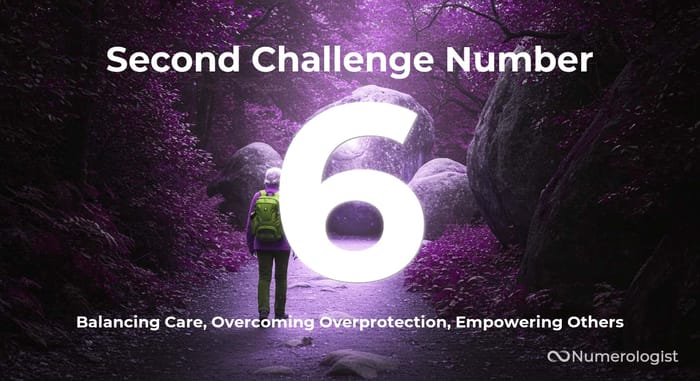
The Second Challenge of 6 places the question of responsibility - its weight, its boundaries, and its proper place in a meaningful life - at the center of your most demanding adult years.
This challenge spans roughly your mid-thirties through your late forties or early fifties, precisely the period when family obligations, career duties, community roles, and the care of aging parents tend to converge with maximum intensity.
The tarot is built on the same numbers numerology reads, and its card 6 - the Lovers - together with the hexagram and the lily with its six petals of divine desire, all ask you to figure out how to serve without being consumed.
If there is a single word that captures the Second Challenge of 6, it is "adjustment." Not perfection, not self-sacrifice, not the relentless pursuit of an ideal, but the ongoing, practical, sometimes exhausting work of adjusting to what is real while holding onto what matters.

Why 6 Is Particularly Demanding as a Second Challenge
The productive middle years are when most people face the peak concentration of human obligation. You may simultaneously be responsible for children who need guidance and emotional presence, a career that demands consistent output and leadership, a marriage that requires attention to remain vital, aging parents whose needs are increasing, a household that must be managed and funded, and community roles that expect your participation. All of it, running at once.
The 6 Challenge does not create these obligations - they exist for most adults. What it does is make the relationship to these obligations the central growth area of your life. You are not just managing responsibilities during these years. You are learning something fundamental about what it means to carry them wisely - to serve without self-destruction, to give without depletion, to love without losing yourself in the process.

The Three Patterns of the Second Challenge of 6
The Martyr Pattern. You take on everything. You are the one who holds the family together, who picks up slack at work, who volunteers when no one else will, who sacrifices sleep, health, and personal time because people depend on you.
Your identity becomes so intertwined with service that you cannot distinguish between who you are and what you do for others.
When someone suggests you are overdoing it, you dismiss the observation - because if you stop, who will keep everything running?
This pattern is the shadow side of 6 at its most dangerous. It leads to burnout, resentment, health crises, and the bitter discovery that the people you sacrificed everything for did not actually need - or want - you to sacrifice everything.
The Perfectionist Pattern. Your home must be perfect. Your children must be perfect. Your marriage must look perfect. Your work must meet an impossibly high standard.
You spend enormous energy controlling details, correcting others, and maintaining an image of harmony that bears little resemblance to your inner experience. The gap between the life you present and the life you live grows wider with each passing year.
This pattern stems from the 6's deep desire for things to be right - a beautiful impulse that becomes toxic when "right" is defined as "flawless."
The Avoidance Pattern. Overwhelmed by the weight of obligation, you retreat. Responsibilities that clearly belong to you are neglected or delegated. Relationships that need your engagement receive your absence.
You may physically present but emotionally checked out, present at dinner but not truly there, fulfilling the minimum requirements of your roles without genuine investment.
This pattern is often a reaction to the martyr or perfectionist pattern - having experienced the cost of over-engagement, you swing to the opposite extreme.

What the 6 Is Actually Asking
In the Tarot image of The Lovers, the Spirit of Justice hovers above the young man's choice, ready to guide but not to compel. This detail is crucial for the Second Challenge of 6.
The choice is yours: not between vice and virtue in some abstract moral sense, but between the daily, practical options of how to distribute your finite energy among competing legitimate needs.
The 6 asks you to serve consciously rather than perfectly - to make deliberate choices about where your energy goes, to accept that you cannot do everything, and to make peace with the adjustments that real life requires.
The prophets and messiahs who resonate with the 6 vibration chose their service. They did not try to solve every problem or heal every person. They served with purpose and boundaries. The Second Challenge of 6 is asking you to do the same, in the very human context of family, career, and community life.

The Guilt Problem
Guilt is the constant companion of the unresolved Second Challenge of 6. When you serve, you feel guilty about what you are neglecting. When you rest, you feel guilty about not serving. When you set a boundary, you feel guilty about the disappointment it causes. When you have no boundaries, you feel guilty about your own resentment.
This guilt cycle is not a sign that you are failing. It is a sign that the 6 Challenge is active and demanding your attention. The resolution of this guilt comes not from finding the perfect balance (which does not exist) but from accepting that imperfect service, offered with genuine love and honest boundaries, is enough. Not ideal. Enough.

Working With the Second Challenge of 6
Distinguish between responsibility and over-responsibility. Some obligations are genuinely yours. Others have been assumed because no one else volunteered or because your identity has become attached to being indispensable. The Second Challenge of 6 asks you to be honest about which is which.
Let go of the ideal. The perfect family, the perfect home, the perfect work-life balance - none of these exist. Pursuing them is a form of avoidance dressed as diligence. The 6's keyword is "adjustments," and adjustments, by definition, involve working with what is imperfect.
Include yourself in the equation. You are not separate from the people you serve. Your needs, your health, your joy, your rest - these are not optional extras. They are necessary inputs to sustainable service. A depleted parent, partner, or professional serves no one well.
Practice saying no with love. The 6 Challenge does not require you to say no coldly or aggressively. It requires you to say no honestly - and to trust that the people who truly love you can handle your boundaries.

What Balanced Responsibility Creates
People who work through the Second Challenge of 6 during their productive years develop something deeply valuable: the capacity for genuine, sustainable service.
Not the frantic over-giving of the martyr, not the controlled perfection of the idealist, but the warm, honest, boundaried engagement of someone who has learned to love and serve from fullness rather than depletion.
The lily's six petals - divine desire - no longer represent an impossible standard. They represent the genuine longing for things to be good: good relationships, a good home, good work, a good life. Not perfect. Good. And in the acceptance of that distinction lies the resolution of the 6 Challenge.

Explore Further
- First Challenge Number 6
- Third Challenge Number 6
- Second Pinnacle Number 6
- Challenge Numbers Calculator
- Challenge Numbers: Complete Guide
- Number 6 Meaning

What the Tradition Says About Challenge Number 6 at Midlife
Goodwin's 6 energy centers on balance, responsibility, and love - specifically the challenge of learning which responsibilities are genuinely yours and which you have absorbed from others' expectations. As a Second Challenge, this question arrives with full weight during the productive middle years, when family obligations, professional responsibilities, and community roles are often all demanding simultaneously. Goodwin's growth direction - from indiscriminate giving to discriminating love - describes the work that this phase asks for.
Drayer's rendering of the 6 Challenge is precisely suited to midlife: "Become your own best friend. Do all the things for yourself that you do for others. If you feel like a martyr, you are probably agreeing to things you do not want to do." The second position places this challenge at the peak of the caretaking years - when children may be young, parents may be aging, and professional demands are at their highest. The person with a Second Challenge of 6 is typically managing an enormous amount of responsibility, much of it genuinely chosen. The question this challenge asks is: is any of it unchosen? And if so, what would honesty about that cost?
Goodwin's key insight about doubled 6 energy applies as a diagnostic here: overuse of 6 energy - giving so freely that you become enslaved - is the nearly universal first expression. The solution path involves developing the positive 3 energy: trading the heavy, martyr's approach to responsibility for the lighter joy of living. The Second Challenge of 6 does not ask you to stop being caring. It asks you to bring some of that care home.

Frequently Asked Questions
- What does Challenge Number 6 mean in the second position?
- In the second position, Challenge Number 6 means that the question of how you give your care - and whether any of that care is directed toward yourself - becomes central during your productive midlife years. This challenge is specific to the peak caretaking phase of adult life, when the demands on a 6 energy are greatest and the risk of self-abandonment through over-service is highest.
- How do I calculate my Challenge Numbers?
- Challenge Numbers are found through subtraction: First = |birth month digit − birth day digit|, Second = |birth day digit − birth year digit|, Third = |First − Second|. Reduce each birth date component to a single digit before subtracting.
- How does a Second Challenge of 6 often show up in long-term family or professional relationships?
- It typically shows up as a slowly building resentment that the person cannot quite account for - they are doing everything right, by any external measure, yet feel increasingly depleted. Goodwin identifies this as the signature of indiscriminate giving: taking on responsibilities without the discernment to determine which are genuinely yours, until the weight becomes unsustainable.