Third Challenge Number 4 - The Lifelong Lesson of Discipline and Structure
By Blair Andrews · Published April 24, 2025 · Updated May 10, 2026
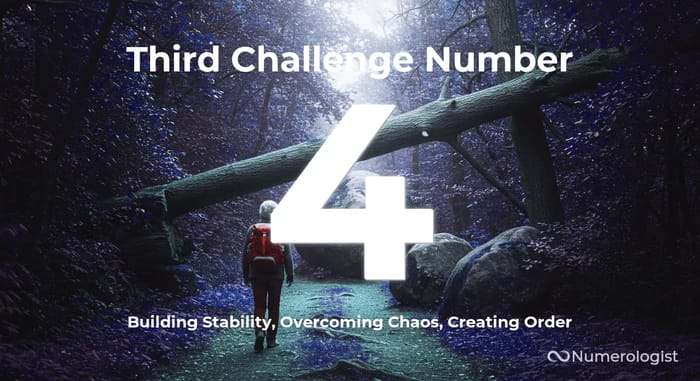
A Third Challenge of 4 means your most persistent, lifelong area of growth involves discipline, structure, and the willingness to do hard, practical work. The lesson never fully resolves. It is the foundation you are being asked to build, brick by brick, across every decade of your life.
The Third Challenge - sometimes called the Main Challenge - spans your entire lifetime. It is not a period that ends. It is the deepest undercurrent running beneath everything else. When that lifelong number is 4, your relationship with work, structure, and practical reality becomes the territory where your most persistent growth happens.
Four is the square - solid, grounded, earthbound. In the Tarot, it is the Emperor: authority built through effort, order imposed on chaos. In the Pythagorean tradition, 4 represents the physical plane - the four elements, the four directions, the body and its needs. It is the number of manifestation: the point where ideas stop being theoretical and must become real through effort. When this energy appears as a challenge, it means that relationship with the practical world probably does not come easy.

The Two Faces of the 4 Challenge
This challenge typically expresses itself through one of two opposing patterns, though many people experience both at different points in life.
Avoidance of structure. You resist routine, chafe against limitations, struggle with follow-through. Starting projects feels exciting; finishing them feels like drudgery. You might have brilliant ideas that never materialize because you cannot sustain the disciplined effort required to bring them into physical form. Bills go unpaid, plans go unfinished, and your life has a quality of chaos that others find perplexing given your obvious intelligence.
Over-rigidity. You cling to structure so tightly that it becomes a prison rather than a foundation. Every detail must be perfect. Every rule must be followed. You work yourself to exhaustion, not because the work requires it, but because you cannot allow yourself to stop. The structure that is supposed to support your life ends up consuming it.
The real lesson lies between these extremes: learning to build structures that serve life rather than replacing it. The esoteric tradition is explicit about this: the feelings of limitation that accompany the 4 Challenge are often self-imposed. The prison is your relationship with structure, not the structure itself. And that relationship is exactly what this challenge is asking you to rework across a lifetime.

What Building Actually Means
Four energy is fundamentally about manifestation - taking something from the realm of ideas and making it real in the physical world. The Emperor does not dream. He builds. When this is your lifelong challenge, you are learning how to be an effective builder, and that requires a specific set of qualities: patience, persistence, attention to detail, and the willingness to work even when the work is not glamorous.
But building does not mean constructing walls. The deeper teaching of the 4 energy is that the best things you will ever build will have gaps in them - and that is where the life gets in. The structures you build need to be solid enough to stand, but flexible enough to breathe. A house with no windows is a tomb. The challenge is learning to create order without creating suffocation. The tradition offers a useful reminder here: "You are a human being, not a human doing."

The Relationship With Work
If you have a 4 Main Challenge, your relationship with work is likely complicated in ways that go beyond simple laziness or workaholism. There may be a deep ambivalence about effort itself - a part of you that knows hard work is necessary and another part that resists it at a fundamental level.
This sometimes traces back to early experiences with work and responsibility. Perhaps you were burdened with too much responsibility too young, and work now feels like an imposition rather than a choice. Perhaps you were never taught how to work methodically, and the gap in your practical skills creates anxiety. Whatever the origin, the challenge keeps bringing you back to the same territory: Can you do the work? Not the exciting work, not the inspired work, but the daily, unglamorous, brick-by-brick work that turns potential into reality?
Because this is the Main Challenge, this question does not just appear in one area of life. It appears in your career, your finances, your health habits, your home maintenance, your relationships - anywhere that sustained, practical effort is required. Each decade presents the question in a new context, and each context requires a new answer.

How It Evolves Across a Lifetime
In early life, the 4 Challenge often shows up as struggles with organization and follow-through. The child whose room is always a disaster, who loses homework, who cannot keep track of time - that is often a 4 Challenge at work. Or conversely, the child who becomes obsessively neat and orderly, organizing everything as a way to manage a chaotic inner world.
Young adulthood brings the challenge into sharper focus through career and finances. Building a career requires sustained effort, and building financial stability requires discipline with money. People with this challenge may cycle through jobs, never staying long enough to build anything lasting, or they may lock themselves into soul-crushing positions because security feels more important than satisfaction.
The midlife passage is often where this challenge produces its most significant growth. By this point, you have seen the consequences of both avoidance and rigidity. You have enough life experience to understand that discipline is not punishment - it is the foundation that makes everything else possible. The builder who has learned this lesson starts creating structures that genuinely serve: a career with real stability, a home that functions well, relationships built on reliability and trust.
In later life, the gift of a well-worked 4 Challenge is groundedness. You become the person others can depend on - not because you perform dependability, but because you have spent a lifetime learning what it actually means to show up, do the work, and follow through. The Emperor energy that once felt foreign has become part of your operating system. And the structures you create from that foundation tend to last, precisely because they were built by someone who knows what it costs to build at all.

Working With This Challenge
If structure is your weakness, start with something small and sustainable. One consistent habit. One project seen through to completion. The goal is not to become a perfectly disciplined person overnight. It is to build the muscle of follow-through gradually, the same way the 4 builds everything: one brick at a time.
If over-rigidity is your pattern, the work is different: practice allowing imperfection. Leave one thing unfinished. Take a day off without justifying it. Let the plan change. The structure you are building with your life needs doors and windows, not just walls.
And in both cases, pay attention to how you relate to limitation itself. Four energy involves confronting the limits of the physical world - limits of time, energy, resources, ability. The challenge is not to transcend those limits. It is to work within them productively and, eventually, to find a kind of freedom in the discipline itself. The master builder does not resent the properties of stone. They work with those properties to create something that stands.

Explore Further
- First Challenge Number 4
- Second Challenge Number 4
- Third Pinnacle Number 4
- Challenge Numbers Calculator
- Challenge Numbers: Complete Guide
- Number 4 Meaning

What the Tradition Says About Challenge Number 4 as the Main Challenge
Goodwin describes the 4 energy as limitation, order, and service - the lifelong work of learning to function within structure with discipline and genuine purpose. As a Main Challenge, it means that the relationship with limitation remains a central thread of the entire life. The question of whether the structures you inhabit are serving growth or constraining it does not get resolved once and filed away; it returns in new forms across every decade.
Drayer's framing of the 4 Challenge - life teaching you how to live in a box - becomes, as a lifelong designation, an invitation to become genuinely skilled at constructing useful boxes rather than either suffocating in them or refusing to enter them. Her comparison of 4 energy to a drumbeat is apt for the Main Challenge: the reliability, the steadiness, the unbroken rhythm that everyone else counts on - these are not incidental qualities for the person with a Third Challenge of 4. They are the curriculum.
Goodwin's growth direction for 4 energy - from resentment of restrictions to finding freedom within structure - describes a transformation that takes most of a lifetime to complete. The Third Challenge of 4 at its highest expression produces what Drayer calls flexibility alongside steadiness: someone who has learned that the box is only as confining as the relationship one has with it, and that genuine discipline creates the conditions for everything else to flourish.

Frequently Asked Questions
- What does Challenge Number 4 mean in the third position?
- In the third position, Challenge Number 4 is the Main Challenge - the lifelong lesson of developing a genuine, flexible, and purposeful relationship with structure, discipline, and limitation. The question of how to build something solid without becoming rigid in it runs as a central thread through every phase of your life.
- How do I calculate my Challenge Numbers?
- Subtract the smaller from the larger of the reduced birth digits: First = |month digit − day digit|, Second = |day digit − year digit|, Third (Main) = |First − Second|. Reduce each birth component to a single digit first.
- What does engagement with the Third Challenge of 4 produce in later life?
- Drayer notes that the future expression of 4 energy involves understanding that strength includes the ability to roll with the punch - bringing both form and flexibility. People who genuinely engage the Main Challenge of 4 often become the steady, dependable, and adaptable center of whatever communities or families they inhabit: the person who can be counted on without being rigid about it.