Second Challenge Number 4: Building With Discipline at Midlife
By Blair Andrews · Published April 24, 2025 · Updated July 20, 2026
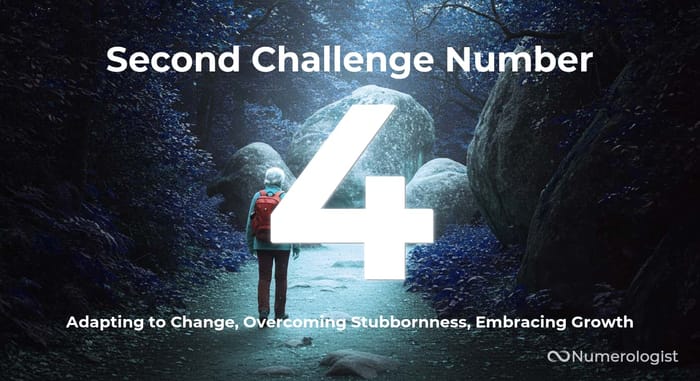
A Second Challenge of 4 brings the lessons of discipline, structure, and sustained effort into the heart of your most productive years. The tarot runs on the same numbers as numerology, and four's card is the Emperor, whose energy - order, boundaries, the unglamorous work of building brick by brick - becomes your central growth area during approximately your mid-thirties through your late forties or early fifties.
These are the years when careers either solidify or stagnate, when financial foundations are either laid or neglected, when the structures you build (or fail to build) determine much of what your later years will look like.
Having a 4 Challenge during this phase is both difficult and potentially transformative. Difficult because the demands of midlife do not pause while you learn discipline.
Transformative because the structures you build under this challenge, once built, tend to be exceptionally solid - precisely because they were constructed by someone who had to fight for every brick.

The Midlife Context
The Second Challenge operates in a fundamentally different arena than the First. During youth, the 4 Challenge might mean unfinished homework and messy bedrooms.
During the productive middle years, it means unfinished projects with real deadlines, financial habits that have compounding consequences, and career trajectories that require sustained, organized effort over years.
This is the phase of life where the Emperor is not optional. Whether you are running a department, building a business, raising children, managing a household budget, or maintaining your health - all of it requires the square's stability, the four walls that create a container for everything else.

How the Second Challenge of 4 Manifests
Career stagnation through lack of follow-through. You may have brilliant ideas, genuine talent, and clear ambition, but the disciplined, day-after-day execution required to turn potential into achievement keeps eluding you.
Colleagues who are less talented but more consistent advance past you. Projects that should have been completed months ago remain 80 percent done.
Your reputation becomes one of promise without delivery.
Financial instability in the critical building years. The thirties and forties are when most people establish their long-term financial foundation.
The 4 Challenge during this period can create patterns of disorganized spending, neglected savings, ignored tax obligations, and a general unwillingness to engage with the tedious details of financial management.
The consequences of these patterns compound over time in ways that become increasingly difficult to reverse.
Workaholism as overcorrection. The opposite extreme is equally tied to the 4 Challenge. Sensing that discipline does not come naturally, you may try to compensate by working constantly - not strategically, but compulsively.
The difference is important: disciplined work is focused and efficient. Workaholic work is anxious and scattered, driven by the fear that if you stop for a moment, everything will collapse.
This overcorrection exhausts you without producing the solid results that genuine 4 energy creates.
Household and health neglect. The 4 governs the physical plane - the body, the home, the tangible structures of daily life. The Second Challenge of 4 can manifest as a deteriorating home environment, deferred maintenance (both of property and of health), and a general reluctance to attend to the physical foundations that support everything else.

The Deeper Teaching at Midlife
The Emperor does not build for the sake of building. He builds because structures create the conditions for life to flourish. The castle is not a prison but a home. The city walls are not restrictions; they are protection.
And the garden that grows within those walls grows precisely because someone did the unglamorous work of preparing the soil, building the irrigation, and pulling the weeds.
At midlife, this teaching takes on urgent practical meaning. The structures you build now - financial, professional, physical, relational - are the ones that will either support or fail you in the decades to come.
The Second Challenge of 4 is life's way of insisting that you take this building process seriously, even if every instinct tells you to improvise, shortcut, or defer.
There's a reason the tradition keeps coming back to imperfection. The goal is not perfect structure. It is functional, honest, good-enough structure - the kind that holds without being rigid, that contains without suffocating. Perfectionism is as much a trap as laziness when it comes to the 4 Challenge.

Working With This Challenge
Audit your foundations honestly. Look at your career, finances, health, and home environment with clear eyes. Where are the structures solid? Where are they missing entirely? Where have you been improvising when building was needed? This honest assessment is the starting point for real change.
Build one system at a time. The temptation is to try to organize everything simultaneously, which is itself a form of avoidance dressed up as ambition. Choose the foundation that is most urgently needed and focus there first. A budget. A health routine. A project management system. One brick, then another.
Value consistency over intensity. The 4 does not reward heroic bursts of effort followed by long periods of neglect. It rewards showing up, day after day, doing the steady work. This is particularly difficult for people whose natural energy runs in peaks and valleys, but it is precisely what the challenge is developing.
Reframe maintenance as mastery. One of the 4 Challenge's gifts is the eventual recognition that maintaining what you have built is as important as building it in the first place. The daily routines, the regular check-ins, the unglamorous acts of upkeep - these are not distractions from the real work. They are the real work.

What Disciplined Building Creates
People who work through the Second Challenge of 4 during their productive years often enter their later decades with a solidity that surprises even themselves. The career that almost stagnated has been rebuilt on a genuine foundation.
The finances that were once chaotic have been organized into something sustainable. The health that was neglected has been reclaimed through consistent attention.
The Emperor energy that once felt foreign has become a reliable inner resource. You know how to build, how to maintain, how to endure - not because these came naturally, but because life insisted you learn them during the years when the stakes were highest.
And the structures you built under that insistence tend to last, precisely because they were built with the care and attention that only a hard-won lesson can produce.

Explore Further
- First Challenge Number 4
- Third Challenge Number 4
- Second Pinnacle Number 4
- Challenge Numbers Calculator
- Challenge Numbers: Complete Guide
- Number 4 Meaning

What the Tradition Says About Challenge Number 4 at Midlife
Goodwin describes the 4 energy as limitation, order, and service - the mastery of structure and disciplined effort. As a Second Challenge, it raises the question of whether the structures of your adult life are genuinely serving you and others, or whether you have built constraints that masquerade as foundations. The overbalanced 4 at midlife is often recognizable: rigidity, resistance to adaptation, obsession with system to the exclusion of flexibility. Goodwin's growth direction - from resentment of restrictions to finding freedom within structure - describes work that is ongoing during the productive middle years.
Drayer's description of the 4 Challenge as life teaching you how to live in a box takes on specific resonance at midlife. By this phase, most people are well inside their boxes - careers with defined trajectories, homes with mortgages, relationships with established patterns. The Second Challenge of 4 asks whether those boxes are the right size, built from the right materials, and oriented in a useful direction. It does not ask you to abandon them. It asks for honest evaluation and, where necessary, renovation.
Her comparative warning is useful: do not get so caught up in organization that you lose flexibility - but equally, do not avoid the work that genuine structure requires. At midlife, both extremes carry consequences. The person who has rigidly over-organized finds themselves unable to respond when life requires adaptation. The person who has avoided structure finds themselves without the foundations that the second half of life will need. The Second Challenge of 4 asks for the center: disciplined, functional, and capable of adjustment.

Frequently Asked Questions
- What does Challenge Number 4 mean in the second position?
- In the second position, Challenge Number 4 means that the quality of the structures you have built during adulthood - professional, financial, domestic - comes under examination during your productive midlife years. This challenge asks whether your foundations are genuinely serving your life or have become constraints that need to be revised.
- How do I calculate my Challenge Numbers?
- Challenge Numbers are calculated by subtracting reduced birth digits: First = |month digit − day digit|, Second = |day digit − year digit|, Third = |First − Second|. Use single-digit reduced values for each birth component throughout.
- What is the key difference between a healthy relationship with structure and an overbalanced Second Challenge of 4?
- Drayer's distinction is practical: the healthy 4 builds foundations that serve as platforms for growth; the overbalanced 4 builds systems that restrict it - treating rules as ends rather than means, and interpreting any departure from established procedures as a threat. The Second Challenge of 4 is resolved when structure becomes a tool you use consciously rather than a prison you defend unconsciously.