THE Most Powerful Number in the Universe (That Elevates Your Creation of Reality!)
By Blair Andrews · Published January 29, 2016 · Updated May 10, 2026
Ask anyone to name the most powerful number in numerology, and you will probably hear 11 or 22 - the master numbers, the ones that carry the most obvious weight and mystique. Some might argue for 7, the seeker, or 8, the great manifestor. Almost nobody would say zero.
And that is exactly the point.
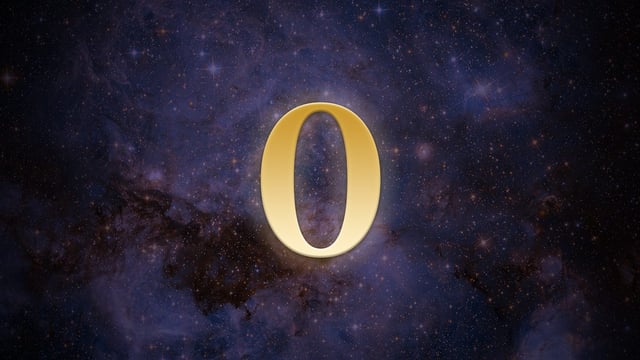
Zero is the most powerful number in the universe precisely because it refuses to announce itself. It carries no quantity, no obvious identity, no place in the counting sequence. It is the number that is not a number - and that paradox is the key to everything it can do.

The Number That Had to Be Discovered Twice
Zero did not arrive the way other numbers did. The digits 1 through 9 emerged naturally from the human need to count things - sheep, days, seasons, children. But zero was an accident.
Ancient mathematicians stumbled upon it when they realized they needed some kind of marker to distinguish 1 from 10 from 100. In its earliest form, zero was just a placeholder, a little wedge-shaped mark in Babylonian clay tablets or a dot in Mayan manuscripts indicating an empty position in a number.
Nobody understood, at first, what they had found. It took centuries for anyone to grasp that this humble placeholder was actually the most revolutionary concept in the history of mathematics. And when that realization did begin to dawn, it was met not with celebration but with outright panic.

Why the Greeks Tried to Kill It
The Greek mathematical tradition was built on a beautiful but fragile premise: that numbers describe real structures in the universe, and that these structures are fundamentally rational and geometric. Every number had a shape. One was the point. Two was the line. Three was the triangle. Four was the square. The entire cosmos could be mapped through ratio and proportion, and this mapping was not just useful but sacred.
Zero demolished all of it. If zero existed as a real number, then the void existed. Infinity existed. Numbers without shapes existed.
The tidy geometric universe that Pythagoras and his followers had constructed would crack open, and all the chaos they had spent their lives trying to contain would come pouring through.
When Hippasus of Metapontum tried to reveal the existence of irrational numbers - a direct consequence of taking zero seriously - the Pythagorean brotherhood drowned him at sea. That is how frightened they were. Not of the man, but of the idea. The mere concept of zero threatened the entire intellectual and spiritual framework they had built their lives around.
The Western theological tradition was equally hostile. Church authorities saw a void as an affront to God. The divine must be something, they reasoned, so a number that represented nothing was either meaningless or heretical. For centuries, this alliance between Greek logic and Church doctrine kept zero locked out of European thought almost entirely.

The East Knew Better
Half a world away, the story could not have been more different. The contemplative traditions of the East (Buddhism, Hinduism, Taoism) had been building their spiritual practices around the void long before anyone attached a symbol to it. In these traditions, emptiness was not a threat. It was the ground of being. The fertile darkness from which all light emerges. The silence that gives birth to sound.
When Eastern mathematicians encountered the concept of zero, they did not recoil. They recognized it immediately as the mathematical expression of something their meditators had been experiencing for thousands of years. They gave it a symbol, integrated it into their number systems, and began exploring its properties with genuine excitement.
From India the concept traveled to the Islamic world, where brilliant mathematicians refined it further, and eventually - slowly, reluctantly - it made its way into Europe. By the time it arrived, it was so obviously essential to basic arithmetic that even its most determined opponents could no longer deny it.

The Mayan Glyph: A Face Covered by a Hand
Of all the ancient representations of zero, the Mayan glyph may be the most profound. Where other cultures used dots or circles, the Mayans chose a face with its features hidden behind a hand. This was not decorative. It was theological. The Mayans understood that zero is a presence, not an absence - but a presence so vast and so complete that it can never be fully seen. You can approach the mystery. You can feel its power. But you will never look it directly in the face, because it contains everything, including the parts of reality you do not yet have the capacity to perceive.
That image is worth sitting with. A face that is there but hidden. A power that is real but veiled. A number that contains all other numbers without being any of them.

What Zero Means in a Reading
In a numerological reading, zero is the doorway. Everything possible is contained here, but nothing has started yet. It is the moment between exhale and inhale, the space between chapters, the blank page that holds every story you could write.
When zero shows up in your chart or your awareness - through angel numbers like 000, through dates that reduce to zero-heavy expressions, through the zeros that quietly amplify other digits - it is pointing you back to the source. Back to the place where you have not yet decided, not yet committed, not yet limited yourself to a single path.
The zero is the sum total of life and death. Every number from 1 through 9 describes a specific quality, a particular vibration, a distinct way of moving through the world. Zero holds all of those qualities simultaneously, without choosing between them. When the number 1 emerges from zero, it brings focus, direction, and individuality - but it also leaves behind everything it did not choose. Zero never has to leave anything behind because it never narrows.
This is why zero amplifies whatever it touches. The difference between 1 and 10 is not just a matter of magnitude. The zero in 10 opens up the energy of 1 to a wider field of possibility. The same is true for 20, 30, 40 - every time zero appears alongside another digit, it is whispering: there is more here than you think.

The Shape That Contains All Shapes
Look at the physical form of zero: the circle, the oval, the ring. Now consider how many fundamental structures in nature and human design echo this shape.
The eye. The wheel. The lens. The orbit of a planet. The ring of a tree trunk. The mouth as it opens to speak. The cell before it divides. Even the shape of your own skull, the container that holds your mind and all its dreams.
Every one of these forms relates back to zero. The circle is the only shape with no corners, no endpoints, no beginning and no end. It is simultaneously the simplest geometric form and the most complete one.
Ancient traditions across the world understood this instinctively, which is why the circle appears as a sacred symbol in virtually every culture: the mandala, the medicine wheel, the ouroboros, the halo.
When you begin to see zero's fingerprints on the physical world, it becomes very difficult to think of it as "just a number" again. That's not what it is. It is the pattern underneath all patterns, the structure that makes structure possible.

Working with Zero in Daily Life
You do not need to be a mathematician or a mystic to develop a relationship with this number. The simplest way to start is to notice the moments in your day that carry zero's quality - the pauses, the open spaces, the instants where you have not yet decided what comes next.
Most of us rush through these moments because they feel unproductive. We fill silence with noise, fill open time with plans, fill uncertainty with worry. But those empty-seeming spaces are where zero lives, and they are far more powerful than we give them credit for.
The zero point field meditation is one practical way to engage with this energy directly - a simple three-step process of softening your perception, sitting in open possibility, and allowing intention to arise naturally from that spaciousness. But even without a formal practice, simply pausing to acknowledge the zero-moments in your day can begin to shift something. When you stop resisting the void and start recognizing it as the source of all creation, the entire landscape of your life looks different.
The Greeks feared zero because it meant their neat, rational universe was not the whole story. The Church feared it because it suggested that the divine could exist in emptiness as well as in form. The Mayans honored it with a veiled face because they understood that the deepest power is the one you can never fully see. And the Eastern sages welcomed it as the ground of everything - the place where meditation begins and where, ultimately, all things return.
Every one of those responses was correct in its own way. Zero really is that vast, that contradictory, that impossible to contain in a single interpretation. And perhaps that is the most powerful thing about it: it will always be bigger than any box you try to put it in.

Frequently Asked Questions
Is zero actually considered a number in numerology?
Zero occupies a unique position. It is not a core number like 1 through 9, and it is not a master number like 11 or 22. It functions more as the field from which all numbers emerge. You will not find zero as a life path or expression number, but it profoundly influences any number it appears alongside - amplifying, expanding, and adding a dimension of infinite potential to that number's energy.
Why do so many angel number sequences include zero?
When zero appears in repeating sequences like 000, 101, or 1010, it is emphasizing connection to source energy and spiritual potential. The zero acts as a magnifier for the other digits in the sequence. A pattern like 101 carries the fresh-start energy of 1, but the zero between the ones opens that energy to a much broader range of possibility than 11 alone would carry.
How does zero relate to the concept of karma in numerology?
Zero sits outside the karmic system because karma operates through the numbered vibrations of 1 through 9, each representing specific lessons and patterns. Zero is the clean slate that exists before any karmic pattern has been established. Some practitioners view encounters with zero energy as invitations to step outside accumulated patterns entirely - to reset rather than resolve, to start from a place of pure openness rather than working through a specific lesson.