Zero is the space everything else exists inside. Not a number you’ll ever calculate to in a reading - it’s the field that makes every other number possible.
Angel Number 0: The Origin Before the Origin
By Blair Andrews · Published May 25, 2023 · Updated May 21, 2026
What 0 means for you specifically depends on which of the 11 Life Paths you’re on. Your birthday determines that.
Enter your birthday below:

Before the first line, there was the blank page.
Every geometry you have ever seen begins the same way. A point appears. Then a line extends from it. Then a plane unfolds from the line. But before the point - before anything was drawn - there was the surface that made drawing possible. The white field. The unmarked space. The thing you cannot see because it is the thing you are seeing on.
Zero is the page itself - it was never the point, never the first mark.
You cannot draw it. You can only draw on it. You cannot count it. You can only count because of it. It has no shape of its own, and yet look at how we write it - a circle, a perfect closed curve, a line that returns to its own beginning without ever stopping. No corners. No endpoints. No place where the stroke breaks. The shape is not a symbol for nothing. It is a portrait of everything before it separates into parts.
This matters because most people encounter zero as an absence. An empty account. A scoreless game. A placeholder sitting quietly between digits, doing what they assume is nothing.
Zero is actually doing the most radical thing any number can do. It is holding open the space in which all the other numbers exist.

What Zero Actually Does
Try a small experiment with arithmetic.
Add zero to any number. 7 + 0 = 7. 143 + 0 = 143. The number stays exactly what it was. Zero touches it and leaves it completely unchanged. No other number does this. Every other number, when it arrives, alters what was there. Only zero can be present without disturbing anything.
Now multiply. 7 × 0 = 0. 143 × 0 = 0. Everything returns to zero. Every number, no matter how large, no matter how complex, when multiplied by zero, goes back to the source. Back to the blank page.
And then there is the operation that breaks arithmetic entirely. Divide by zero, and the answer is undefined. The answer is not wrong - it is undefined. The rules themselves stop working. The system that governs every other calculation reaches zero and has nothing to say.
These are not abstract tricks. They describe something real about what zero is. It is the thing that holds every other thing without changing it. The thing that every other thing returns to when stripped bare. And the thing that, when you try to split it open and look inside, breaks the tools you brought.
Agrippa, writing in 1510, described the number one this way: "Nothing is before one, nothing is after one, and beyond it is nothing." He was talking about unity - the first principle, the Creator, the source. But that "nothing" he kept naming? That nothing is zero. The field one stands in. The silence one speaks into. The absence that makes presence possible.

The Number That Didn't Exist
For most of human history, zero had no symbol.
The Greeks - who built their entire civilization on geometry and proportion - never gave absence a name. The Romans, whose numeral system ran the Western world for a thousand years, had no zero. You can write MMXXVI for 2026, but try writing "nothing" in Roman numerals. You cannot. The system has no way to say it.
This was not an oversight. It was a philosophical position. To the Greek mathematical tradition, a number was a count of things. You could have three apples or seven soldiers or a hundred stadia. But you could not have zero apples, because that was not a quantity - it was the absence of one. Naming the absence felt like naming a shadow and calling it a person.
It took Indian mathematicians to see it differently.
In 628 CE, the astronomer and mathematician Brahmagupta wrote the Brahmasphutasiddhanta - and in it, for the first time in recorded history, zero was treated as a number in its own right. It was a number - with rules for how it behaved when you added it, subtracted it, multiplied by it.
The Sanskrit word was shunya. It is usually translated as "emptiness," but that translation misses something. In the Buddhist and Hindu philosophical traditions shunya was part of, emptiness was not the same as absence. It was the ground state. The condition from which form arises and to which form returns. Shunya described a void where nothing had differentiated yet - fullness waiting to take shape, rather than absence.
The moment zero had a symbol, everything changed. Mathematics gained positional notation - the ability to distinguish 1 from 10 from 100 from 1,000 using the same digit in different positions, separated by zeros. That single invention made algebra possible. It made calculus possible. It made every calculation you have ever done on a phone possible. Before Brahmagupta, mathematics could count and measure. After Brahmagupta, mathematics could describe the motion of planets, the curve of a bridge, the rate of change of anything.
All because someone decided that absence deserved a name.

The Fool at the Edge
In the tarot, zero belongs to the Fool.
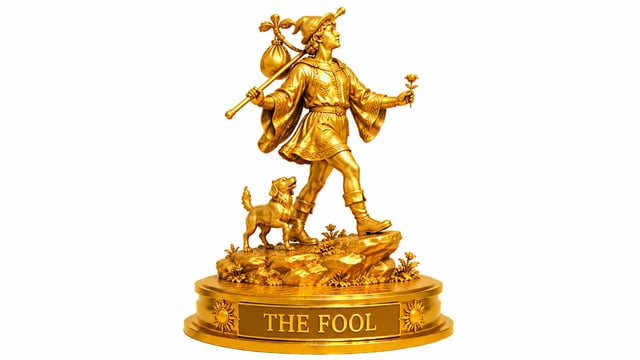
This is the card people misunderstand more than any other. The Fool is pre-experience, and wildly misread as foolish. One foot lifted, standing at the edge of a cliff, about to step into the whole journey of the major arcana - all twenty-one remaining cards, from Magician to World - without knowing any of them yet.
The Fool carries almost nothing. A small bag. A flower. A dog at the heels. No armor, no scrolls, no accumulated wisdom. And the spareness reads as freedom from having chosen, rather than poverty.
Every other card in the major arcana is a stage. The Magician has picked up tools. The High Priestess has acquired inner knowing. The Emperor has built a throne. Each card gains something - and in gaining it, narrows the field. Once you are the Emperor, you are no longer the Magician. Once you are the Hermit, you have left the Lovers behind.
The Fool is the only card that could become any of them. Zero is the only number that contains every other number without being any of them.
It is not a comfortable position to hold. Standing at the edge with all roads open and none taken - there is exhilaration in that, yes. But there is also vertigo. The Fool's shadow is not naivety. It is paralysis dressed as possibility. It is the person who keeps every option open for so long that none of them ever gets lived.

Outside the System
Something peculiar happens with zero in numerology.
You cannot arrive at it.
Every life path calculation reduces your birth date to a single digit or a master number - 1 through 9, 11, 22. Every expression number reduces your name the same way. Every soul urge, every birthday number, every personal year. The system produces 1 through 9 and the master numbers. It never produces zero.
Zero exists outside the system of personal numbers entirely.
L. Dow Balliett, who built the foundations of modern Western numerology in the early 1900s, started her number system at 1. The Creator. Unity. The binding chain. From 1 she moved through the full journey - 2 as the collector, 3 as the expresser, up through 9 and into the master numbers 11 and 22. Zero never appears in her framework because zero is not a vibration in the way the other numbers are. It is the condition that makes vibration possible.
Think of it this way. In Balliett's system, every number is a note in what she called "the Music of the Spheres" - each one vibrating at its own rate, producing its own color, its own tone, its own meaning. The numbers are the notes. Zero is not a note. Zero is the silence that the notes require in order to be heard. It is the rest in the composition, the space between words that lets meaning arrive, the pause that gives everything around it room to exist.
You do not calculate your zero. You carry it already. Everyone does. It is the part of you that existed before your personality, before your life path, before your name was chosen. The awareness that is aware, underneath all the things it happens to be aware of.
Whether 0’s shadow side applies to you — and how strongly — depends on your core numbers. Your birthday reveals the first one.
Enter your birthday below:

The Amplifier
When zero does appear alongside other numbers, it does not compete with them. It deepens them.
Place a zero after any digit. 1 becomes 10. 3 becomes 30. 7 becomes 70. The essential nature of the number stays the same, but its reach expands by an order of magnitude. This is not metaphor - it is exactly what positional notation does. The 1 in 10 is the same 1 as in 1. Zero did not add anything to it. Zero gave it a wider field to operate in.
This is the key to understanding zero in any angel number combination. When zero appears alongside 1, it is not mixing its energy with 1. It is amplifying 1. Opening the lens wider. Pulling the camera back so you can see more of what was already there.
A number with zero behind it carries the weight of potential that has not been capped. The walls have not closed in yet. The ceiling has not come down. Whatever the number means, zero says: and more. And wider. And deeper than you thought.
This is also why sequences of zeros - 00, 000, 0000 - feel so strange when they show up. There is nothing to amplify. It is amplification amplifying itself. Potential reflecting in its own mirror. The page becoming more page-like, if that makes any sense. It is the universe reminding you of what you are before you are anything in particular.

The Shadow of Infinite Openness
Zero's shadow is worth naming clearly because it is the most seductive shadow of all.
Zero's shadow is the spiritual bypass of infinite potential.
It is the person who meditates for years but never makes a decision. Who reads every spiritual book but never puts one into practice. Who keeps all paths open, all options on the table, all commitments safely at arm's length - because choosing one thing means closing the door on everything else, and everything else feels like the more spiritual option.
It is the person who has made a religion out of remaining unformed. Who calls it openness but feels like avoidance. Who calls it surrender but looks like stalling. The blank page is sacred, yes. But at some point, someone has to pick up the pen.
The Fool standing at the cliff edge is beautiful. The Fool who has been standing at the cliff edge for forty years, refusing to step forward because every direction is equally possible, has turned the gift into a prison.
Zero does not want this for you. Zero wants to be the ground you launch from, not the comfortable void you disappear into. The blank page exists so that something can be written on it. The silence exists so that music can emerge from it. If you are seeing zero - especially seeing it repeatedly - the message is not "remain empty." The message is: you are standing in the place where everything begins. So begin.

What It Feels Like When Zero Arrives
Zero showing up in your life is not like other numbers. Other numbers feel like advice. Zero feels like a reset.
It tends to arrive at the big turning points - the kind where the ground shifts under your feet and you realize that who you were last month or last year is no longer quite who you are now. The relationship that defined you just ended, or the career you built yourself around just changed, or some deep internal shift happened while you weren't looking and now the old structures feel like they belong to a different person.
That disorienting feeling - the "I don't know who I am right now" feeling - is zero, not a crisis. It is the blank page that appears when one chapter ends and the next has not yet started. It is uncomfortable in the exact way that silence is uncomfortable to people who are used to constant noise.
But the discomfort is not the point. The point is what the silence makes room for.
When zero shows up, it is not asking you to do anything. It is reminding you of what you are before you do. Before the roles, before the patterns, before the labels and the life path descriptions - there is something underneath. Something unformed and whole and impossibly full. Something that has been here since before you had a name for it.
Zero lives inside every number the way silence lives inside every sound - the space that makes music possible, rather than its opposite.

Frequently Asked Questions About Angel Number 0
What does angel number 0 mean?
Angel number 0 represents pure potential - the source point before anything takes shape. It is not absence or emptiness in the way we usually use those words. It is the field where all possibilities exist before any single one has been chosen. When 0 shows up, it usually signals a reset or a return to your most fundamental self, underneath the roles and patterns you have built up over time.
Is 0 a real angel number, or just a placeholder?
Zero is often dismissed as "just nothing," but it is arguably the most powerful single digit you can encounter. It is the only number that, added to anything, changes nothing - and the only number that, multiplied by anything, returns everything to itself. Those are not the properties of a placeholder. Those are the properties of something that operates at a completely different level than the numbers around it. In angel number tradition, 0 carries the energy of the divine source - the circle, the infinite, the origin.
Why does 0 amplify other numbers?
When zero appears after a digit, it expands that digit's reach by an order of magnitude - 3 becomes 30, 7 becomes 70. It does this without adding its own qualities. Zero does not compete with the number beside it. It deepens it. Widens the lens. If you are seeing a number with zeros in it, the zeros are saying: whatever this number means, it means it more. The potential has not been capped yet.
What should I do when I keep seeing 0?
The honest answer is: probably nothing, at first. Zero is not a call to action the way most angel numbers are. It is a call to awareness. To noticing where you are before you decide where to go. If you are seeing zero at a time of transition - between jobs, between relationships, between identities - the message is that the blank space you are standing in is not a problem to solve. It is a starting point. The most useful thing you can do is stop trying to fill it immediately and let yourself feel what wants to emerge from it.
Does 0 have a life path or personal number meaning?
No. Zero cannot be reached through any standard numerology reduction - no birth date or name calculation produces it. It exists outside the system of personal numbers entirely. This is not a flaw. Zero is the field the other numbers play in. You do not need to calculate it because you already carry it. It is the awareness underneath your personality, the self beneath the self.
What is the connection between 0 and the Fool in tarot?
The Fool is card zero of the major arcana - the only unnumbered or zero-numbered card in the deck. The Fool stands at the beginning of the journey, before any of the other twenty-one stages have been entered. No accumulated wisdom, no chosen path, no fixed identity. Just pure readiness. This is exactly what zero represents in numerology: the state before differentiation, the moment before the first choice narrows the field. The Fool is not foolish. The Fool simply has not chosen yet - and in that not-yet-choosing, everything remains possible.
Related: Explore every angel number in our complete directory

Curious which numbers are active in your chart right now? Your birthday is the starting point.
Enter your birthday below:
Explore Angel Numbers
Behind Your Angel Number
calculate your full numerology chart·find your life path number·numerology, explained