Personality Number 6: The Nurturing Protector
By Blair Andrews · Published April 24, 2025 · Updated May 10, 2026
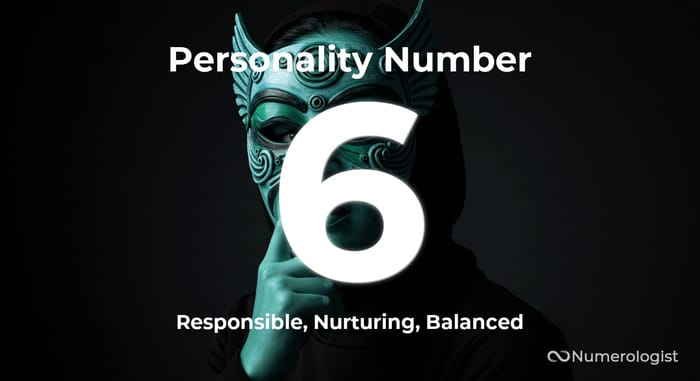
Six is the only single digit whose parts add up to itself. One plus two plus three equals six. Mathematicians call this a "perfect number," and everything it contains, when gathered together, recreates the whole. That mathematical fact shapes everything about how this personality number operates in the world.
When someone carries a 6 in their personality position, they project a quality of completeness that others can feel before a single word is spoken. People sense that here is someone whose pieces fit together, whose presence somehow makes the room itself feel more arranged, more harmonious. It's a subtle thing, not flashy, not loud, but remarkably consistent.
The personality number represents the outer impression you create, the first thing people perceive when they encounter you. Think of it as the entrance hall to your deeper nature. Your Soul Urge Number 6 drives what you genuinely long for inside. Your Expression Number 6 describes your full range of talents. But the personality number? That's the filtered version, what gets through to others before they know you well enough to see the rest.
You just named it yourself: your Personality 6 is the entrance hall — the warm, put-together first impression people meet before they ever reach the real you.
But what's behind that door is the rest of your core numbers. Your Soul Urge is what you quietly long for, your Expression is the talents you actually carry, your Life Path is the direction your whole life is built around — and together they decide how this 6 warmth shows up for you, not for 6s in general.
Enter your birth date to start the free reading. It pulls your Life Path number right away, then your name fills in the rest of "Your Soul's Secret Code."
If you're not sure whether 6 is actually your personality number, you can verify with the Personality Number Calculator - it's calculated from the consonants in your full birth name.

The Warmth That Draws People In
People with a 6 personality can walk into a room full of strangers and within minutes someone is telling them something they wouldn't normally share. It happens with remarkable regularity. There's something about the 6's outer energy that signals safety - a composed warmth that says, without words, "You can bring that here."
This isn't the same as being approachable in the way a 3 personality is approachable. The 3 draws people in through lightness and social ease. The 6 draws people in through substance. Others sense that this person can hold weight - emotional weight, practical weight, the full burden of a problem that needs solving. They tend to look comfortable in a grounded way. Their clothing often runs toward soft colors, quality fabrics, things that feel good rather than things that demand attention.
Venus governs this number, which partly explains the aesthetic sense that usually accompanies it. But it's Venus in her role as harmonizer, not merely as beauty-maker. The 6 personality projects an energy of "things in their right place." Their homes often reflect this - not necessarily immaculate but arranged with a kind of intuitive rightness that visitors notice and relax into.
People naturally bring their problems to someone projecting 6 energy. They may not even realize they're doing it. A coworker starts venting about a difficult situation. A neighbor shows up asking advice. A friend calls at an odd hour because something feels wrong and they didn't know who else would actually listen. This happens because the 6 personality broadcasts a signal of responsible care that others pick up on - often unconsciously.

The 98 Percent Problem
When someone carries strong 6 energy, particularly in multiple positions of their chart, most will start their adult life giving too much. The overbalance isn't the exception. It's practically the default.
This matters enormously for understanding the 6 personality. The warm, responsible, "I can hold this for you" energy that others find so attractive becomes, without conscious management, a trap. The 6 personality begins saying yes to every request. They become the person who always organizes the gathering, always remembers the birthday, always picks up the emotional slack that others leave lying around.
And because they're good at it - because the 6 genuinely possesses the capacity for this kind of care - nobody questions whether it's sustainable.
The outside world sees someone who seems to thrive on service. What they don't see is the slow accumulation of resentment, the growing sense of being unseen, the exhaustion that builds behind that composed and capable surface.
The overbalanced 6 personality becomes a drudge. A doormat. Someone who has confused being needed with being loved. They give and give until there's nothing left, and then they give some more, because stopping would mean confronting the terrifying question of whether people would still want them around if they weren't useful.
The underbalanced expression looks different but comes from the same root. Here the 6 personality has pulled back so far from the pain of overgiving that they've become aloof, emotionally unavailable, seemingly unloving. They project coldness not because they lack feeling - the 6 almost always possesses extremely deep feeling, but because they've learned that feeling leads to giving, and giving led to being drained dry.
Neither extreme serves them. The work of the 6 personality is finding the center - generous without being depleted; responsible without being enslaved.

A Hidden Longing Beneath the Composed Surface
There's an old observation in the numerological tradition that six "lies in the heart of the free eleven, but its colors are not truly free." I've turned this over for years and I think what it points to is something most 6 personalities carry quietly: a deep, often unacknowledged longing for a kind of freedom they don't let themselves pursue.
The 6 personality looks so settled. So comfortable in the role of caretaker, harmonizer, the one who makes sure everyone else is okay. But underneath that composed surface, there's often a part of them that wants to throw off every responsibility and just go. Travel. Create something purely for themselves. Say no to everyone for a week and see what happens.
This longing doesn't usually get expressed directly. It comes out sideways - in the 6 who meticulously plans a vacation and then can't stop organizing everyone else's good time. In the 6 who picks up a creative hobby and immediately turns it into a service ("I'll make quilts for the charity auction"). In the quiet restlessness that surfaces in midlife when the children are grown or the business is running smoothly and suddenly the 6 wonders: what do I actually want?
Understanding this hidden dimension of the 6 personality is crucial because it prevents the common mistake of reading this number as purely domestic or purely oriented toward others. The 6 contains within it the mathematical perfection of all its parts summing to itself - which means all its needs are already present within it. Including the need for something that belongs to the self alone.

Career as Temple Arranger
There's a beautiful old description of 6 energy as "arranging the temple for others to use." That captures something essential about how the 6 personality operates in professional settings. They're rarely the ones standing at the podium. They're the ones who made sure the podium was in the right place, the lighting was warm enough, the audience felt welcomed, and the speaker had water.
This doesn't mean the 6 personality avoids leadership. Far from it. But their leadership style tends toward creating conditions rather than commanding outcomes. They're the manager who somehow makes the team function better without anyone quite being able to point to what changed. They're the designer who creates spaces that make people feel something. They're the teacher whose classroom has an atmosphere students remember decades later.
Professional domains where the 6 personality often thrives:
Counseling and therapy, where the natural "safe harbor" energy serves a genuine function. Interior design and architecture, where the instinct for harmonious arrangement becomes tangible. Healthcare, particularly nursing, where sustained care over time matters more than dramatic intervention. Education, especially with younger children who need the stability the 6 naturally projects. Hospitality, where creating an experience of welcome is the entire point.
The challenge in career for the 6 personality is boundaries. They tend to become the person everyone relies on, which can mean they get stuck in roles beneath their capability because the team "needs them there." The 6 who learns to say "I've arranged this temple beautifully, and now someone else can tend it while I build another" - that's the 6 who actually fulfills the number's potential rather than becoming its servant.
The prophetic quality sometimes attributed to this number also shows up professionally. The 6 personality often has a far-sighted quality - they can see where things are heading before others catch up. This makes them valuable in planning roles, in organizational development, in any context where someone needs to anticipate what a group will need six months from now.

The Tyrant Inversion
The ancient magical tradition assigns each number a planetary magic square - a grid of numbers whose rows, columns, and diagonals all sum to the same value. The 6 belongs to the Sun. A 6x6 grid. And the tradition notes, with characteristic bluntness, that under a fortunate Sun this number "equals man to kings," but under an unfortunate Sun, it "makes a tyrant."
This is the shadow that most popular descriptions of the 6 personality entirely miss. The same energy that creates a warm, responsible, harmonious presence can - when distorted - become controlling, rigid, and suffocating. The 6 who knows best. The 6 who won't let anyone else do things differently. The 6 whose "care" has become a cage.
It usually begins innocently enough. The 6 personality genuinely does see how things could be better arranged. They notice the inefficiency, the disharmony, the thing that's out of place. And because their natural orientation is toward fixing - toward making things right - they step in. Again and again. Until "helping" becomes "managing," becomes "controlling," becomes something nobody asked for and nobody can escape.
The tyrannical 6 is particularly insidious because it wears the mask of love. "I'm only doing this because I care about you." "I just want what's best for the family." "If you'd just let me handle it, everything would be fine."
The care is genuine, which is what makes it so hard to resist or to name. But care without respect for another person's autonomy isn't actually care. It's control with a pleasant face.
Recognizing this shadow in oneself is the 6 personality's most important growth edge. The perfection they project - that mathematical completeness where all parts sum to the whole - can become a standard they impose on everyone around them. When "I want things to be harmonious" becomes "things must be harmonious according to my definition" - that's the tyrant emerging.
The antidote isn't to stop caring. It's to develop what might be called discriminating love - love that distinguishes between what is genuinely needed and what the 6 wants to fix because fixing things makes them feel valuable.

So the real question for a 6 isn't whether you care — it's which kind of caring you default to: the discriminating kind that asks "is this actually mine to carry?", or the kind that fixes everything because being needed is how you feel valuable. The martyr trap you're about to read lives in exactly that gap.
Which way you lean isn't decided by your Personality 6 alone. The direction your life is built around, and what you secretly want underneath the caretaking — those come from your Life Path, your Soul Urge, your Expression. They're what tip you toward giving from fullness, or giving until you're empty.
Put in your birth date and the free reading shows your Life Path first, then walks through the rest of your core numbers and how they shape this 6 in your own life.
Relationships and the Martyr Trap
In intimate relationships, the 6 personality faces a specific and recurring pattern. It goes something like this: they attract a partner partly through that warm, capable, "I can hold this" energy. The partner relaxes into being held. The 6 takes on more and more of the emotional and practical labor.
The partner lets them - because who wouldn't? And slowly, the relationship develops an imbalance that the 6 simultaneously resents and perpetuates.
The martyr trap is the 6's most common relationship pitfall. They give until they're empty, then feel resentful that nobody is giving back with equal intensity. But they never actually asked for what they needed. They never said "this is too much." They just kept shouldering it because that's what felt like love - and because stopping felt like a kind of failure.
Partners of 6 personalities sometimes describe feeling smothered. Not unloved (the love is usually obvious and genuine) but overwhelmed by the 6's need to make everything right, to fix every problem, to tend every wound whether or not the wound wanted tending. The 6's partner may start hiding their struggles not because the 6 wouldn't care but because they know the 6 will immediately try to solve what they just needed to vent about.
What healthy 6 relationship energy actually looks like: the capacity to witness someone's difficulty without immediately intervening. The ability to say "I see this is hard for you" without following it with "here's what you should do." The willingness to let a partner struggle productively - to trust that not every discomfort requires rescue.
The 6 personality also tends to partner well with certain numbers and struggle with others. The 2 often creates a deeply harmonious pairing - both value peace and cooperation, and the 2's gentleness doesn't trigger the 6's fixing instinct. The 7, by contrast, often creates friction. The 7's need for solitude and intellectual independence can feel like rejection to the 6, while the 6's warmth can feel intrusive to the 7. These aren't impossible combinations - nothing in numerology is doomed, but they require more conscious navigation.
For the 6 personality in relationship, the growth edge is learning that love and service are not synonyms. You can love someone deeply without doing everything for them. In fact, sometimes the most loving thing is to do nothing - to let them find their own way while you stand nearby, available but not insistent.

What Discriminating Love Looks Like
The mature 6 personality - the one who has worked through the overgiving pattern and emerged on the other side - projects something qualitatively different from the younger version. Where the younger 6 broadcasts "bring me your problems," the mature 6 broadcasts something more like "I see you clearly and I trust your capacity."
This shift transforms how others experience them. People still feel safe around the mature 6, but they also feel respected. They sense that this person won't try to fix them, won't rush in with solutions, won't make them into a project. They'll be witnessed. They'll be held - but held loosely, like something precious that also needs room to breathe.
Discriminating love means the 6 personality learns to ask a question before acting: "Is this mine to carry?" Sometimes the answer is yes - there are genuine responsibilities, genuine moments when the 6's gift for harmonious arrangement is exactly what's needed. But sometimes the answer is no. Someone else's discomfort is not automatically the 6's problem to solve. Someone else's chaos is not automatically the 6's temple to arrange.
The composed surface that others admire - that quality of everything being in its right place - becomes authentic rather than performative when the 6 has done this inner work. Before the work, the composure is often a mask over exhaustion. After it, the composure reflects genuine inner peace - the peace of someone who has learned their own limits and honors them.
This is where the Life Path 6 journey intersects with the personality in interesting ways. If someone carries 6 in both positions, the lesson is intensified - they're both projecting this energy outward AND walking a life path centered on the same themes of responsibility and love. The key question becomes whether they'll learn the lesson of balance early or late, easily or through crisis.
The 6 personality who develops discriminating love often becomes genuinely prophetic in the way the old traditions describe. Their far-sightedness, the ability to see where things are heading, becomes more reliable once they're no longer clouded by the need to be needed. They can see others more clearly when they're no longer looking through the lens of "how can I help?" and instead looking through the lens of "what is actually true here?"
The mathematical perfection of six - all parts summing to the whole - becomes, in this mature expression, a kind of model for what love can be. Complete within itself. Offering from fullness rather than from need. Present without grasping.
The composed surface stays. But underneath it, something has started reaching toward wholeness that does not depend on anyone else's need.

Frequently Asked Questions
Does a 6 personality number mean I'm destined to work in caregiving professions?
Not at all. The 6 personality shapes how people perceive you - warm, responsible, someone who creates harmony - but it doesn't dictate your career path. You might channel that temple-arranger energy into architecture, event planning, executive leadership, or even entrepreneurship. What tends to remain consistent is that whatever you do, people experience your presence as stabilizing. The key is choosing work that genuinely fulfills you rather than defaulting to caregiving just because others expect it from you.
How does a 6 personality interact with a more independent soul urge like a 1 or 5?
This combination is more common than you might think, and it often creates that hidden longing I described - the tension between what you project outward (warmth, availability, responsibility) and what you genuinely crave inside (independence, freedom, adventure). The work isn't to resolve the tension by choosing one over the other. It's to honor both. You may need to build deliberate freedom into a life that otherwise fills up with other people's needs. Give yourself permission to be both the harmonizer others see and the independent spirit you feel yourself to be.
Can the 6 personality's shadow show up in friendships, not just romantic relationships?
Absolutely - and it often shows up in friendships even more clearly because there's less cultural narrative around boundaries in friendship. The 6 personality may become the friend who always organizes, always remembers, always shows up - and then feels deeply hurt when that effort isn't reciprocated equally. They may also become the friend who offers unsolicited advice so frequently that others start sharing less. Watching for the "am I helping or am I managing?" distinction is just as important in friendship as in romance.
What happens when a 6 personality number combines with a 6 life path?
This double emphasis intensifies everything - the warmth, the responsibility, and the overgiving tendency, and the potential for both the martyr and tyrant expressions. With this combination, the life lesson and the outer presentation are perfectly aligned, which means there's no hiding from the work. People with this pairing often hit their growth crisis - the moment when they realize overgiving isn't sustainable - earlier and more dramatically than those who carry 6 in only one position. The good news is that when they find their balance, it tends to be deeply stable. They've earned their composure through genuine inner work rather than surface arrangement.

Explore Further
If you carry a 6 personality, understanding how it interacts with your other core numbers gives you a much fuller picture. Start with your Soul Urge Number 6 page if your inner drive shares this vibration, or explore the Expression Number 6 to see how your full name energy operates. The Personality Number Calculator can confirm your number and show you exactly which consonants contribute to it. And for the broader life themes that context your personality, the Life Path 6 guide covers the full journey of learning balanced responsibility and love.