Personality Number 2: The Gentle Diplomat
By Blair Andrews · Published April 24, 2025 · Updated July 20, 2026
There's a particular kind of exhaustion that comes from holding everyone else's emotional weather. You walk into a room and you feel everything: the tension between two colleagues who won't look at each other, the quiet sadness your friend is carrying under her smile, the undercurrent of anxiety at the dinner table that nobody has named yet. And somehow, without anyone asking, you become the person responsible for smoothing all of it.
If you carry a Personality Number 2, that's the first thing the world encounters about you. Not your ambitions, not your intellect, not your private fire. The world meets your sensitivity first. And while that sensitivity is genuinely extraordinary (a kind of perceptual gift most people will never develop) it can also feel like an unpaid job you never applied for.
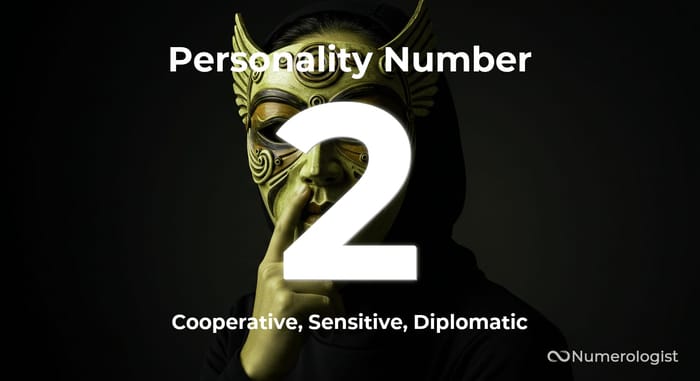
Your Personality Number comes from the consonants of your full birth name. It describes the outer layer, the version of you that strangers encounter before they learn anything about what drives you underneath. For the 2, that outer layer is built from receptivity, warmth, and an almost musical attunement to other people's states. It's real. It's valuable. And it often costs you more than anyone around you realizes.
So that's the outer layer — the receptive, warm version of you the world meets first. But it's only the entrance hall, and on its own it can't tell you why it costs you so much.
Your Personality 2 is one of four core numbers, and the others fill in the rest: the direction your life is actually organized around, the talents you carry, and what you secretly want underneath all that accommodation.
Pop in your birth date to start your free reading. It pulls your first number right away, then your name fills in the rest of Your Soul's Secret Code.

Why Does Everyone Bring Their Problems to You?
Within thirty seconds of meeting you, most people feel heard. That's not an exaggeration. There's something in your energy that signals safety, a quiet permission that says "you can put that down here." People sense that you see more than you say. They sense that you won't judge. And so they talk. They confide. They bring the thing they haven't told anyone else yet and set it at your feet.
This isn't random and it isn't imagined. The 2 Personality functions as a kind of emotional tuning fork. You resonate with what's happening in the room before anyone has spoken a word about it. In the older traditions, this number was associated with the Moon, not generating its own light but reflecting everything around it with extraordinary fidelity. Gold was its color. Reception was its mode.
The problem isn't that you do this. The problem is that it happens automatically, without your consent, and often without recognition. You become the listener, the holder, the one who absorbs the room's emotional surplus. And because you do it so naturally (because it doesn't look like effort from the outside) people assume it costs you nothing.
It costs you plenty.

What Do People Actually See When They Meet You?
First impressions of the 2 Personality tend to cluster around a few consistent themes: warmth, approachability, elegance, a kind of natural grace in social situations. You probably don't dominate conversations. You probably don't enter a room with fanfare. What you do is create a particular quality of space around yourself, something that feels like a clearing in a forest. People step into it and exhale.
The older sources describe this quality as diplomatic, which is accurate but incomplete. Diplomacy implies strategy. What you do often feels less strategic and more instinctive; you sense the gap between two people and you step into it like water filling a channel. You find common ground the way some people find rhythm in music: without having to think about it.
There's a refinement to how you present yourself as well. Not necessarily expensive tastes or formal manners, but a sensitivity to aesthetics: to tone, to timing, to the texture of an interaction. You tend to notice when something is off before anyone else does. A conversation that's gone slightly wrong. A joke that landed harder than intended. A person who's pretending to be fine.
These register for you instantly, and your outer manner adjusts to compensate. This is genuinely rare. Most people move through social spaces like they're walking through fog - aware of the general terrain but missing the details. You catch the details. And people feel that, even when they can't name what it is about you that puts them at ease.

Is the Diplomacy a Cover for Something Else?
Here's where things get interesting. The cooperative exterior that others meet first is real, but it's also partial. The Personality Number is sometimes called the entrance hall to a house. People see it immediately. They form impressions based on it. But the house itself (your deeper motivations, your private hungers, your actual complexity) lives further in.
Your Soul Urge Number reveals what's driving you underneath that diplomatic surface. And the gap between the two can be quietly dramatic.
If your Soul Urge carries fire (a 1, an 8, a 5) there's something privately ambitious or restless inside that your cooperative exterior never reveals. You want more than you show. You may want to lead, to build, to break free entirely. But the outer presentation keeps projecting warmth and accommodation. People are genuinely surprised when you finally assert yourself, because the diplomatic surface gave no warning. The interior was ready for months.
If your Soul Urge also carries 2 energy, the alignment goes deep. Your cooperative nature isn't a front - it runs all the way down. But even here there's a risk: when both the outer and inner self say "you first," nobody advocates for your needs at all. The harmony becomes so complete that it loops into a kind of self-erasure.
Understanding this gap is one of the most useful things your full chart can show you. The 2 Personality is never the whole story. It's the beginning of the story - the chapter people read before they earn access to the rest.

Where Does This Patience Actually Come From?
People underestimate you. Consistently. Reliably. Almost universally. They see the agreeableness and assume it means a lack of strength. They see the accommodation and assume it means a lack of conviction. They see the diplomacy and assume it means you don't actually care who wins.
These assumptions are often spectacularly wrong.
The older practitioners described the 2's patience as "enormous inner strength that people underestimate because the surface appears so agreeable." That word - enormous - was chosen deliberately. The ability to hold two opposing perspectives without collapsing into either one, to sit with tension that makes other people uncomfortable, to wait for the right moment rather than forcing the wrong one - these are advanced capacities. They look passive from the outside. From the inside, they require extraordinary discipline.
Think about what it actually takes to listen - truly listen - to someone who is wrong. To hold space for a perspective you disagree with, without shutting down, without performing agreement, without losing your own position. That's what you do naturally. And it's the reason you often end up mediating situations that people with louder numbers would simply dominate or flee.
The strength isn't despite the sensitivity. The strength comes through the sensitivity. You perceive more, which means you understand more, which means you can navigate situations that overwhelm people who are operating with less information.
The 2's perception isn't a vulnerability. It's an advantage that happens to be uncomfortable.

That advantage hiding behind the agreeable surface isn't vague — it has a definite shape, and your other core numbers are what give it one.
Your Soul Urge says what's actually driving you under the diplomacy. Your Life Path says the direction it's all bending toward. Your Expression says the talents you're working with. The Personality 2 is the doorway; those are the rooms behind it.
Enter your birth date and the free reading walks you through your full Your Soul's Secret Code — where this stops being general and starts being about you.
How Do Relationships Work When You Feel Everything?
In intimate relationships, the 2 Personality often establishes a pattern early: you become the emotional anchor. The listener. The one who notices when something is off and creates space for it to be named. Partners tend to feel deeply seen by you - and that quality is genuinely magnetic. People want to be around someone who makes them feel visible.
The risk shows up slowly. Because you attune so naturally to what others need, you may stop checking in with what you need. The relationship develops an imbalance. Not dramatic, not abusive, just quietly tilted. You give attention. You receive less. You absorb mood. You process alone. Over time, the accumulation can become significant.
The shadow in your relationship patterns probably isn't aggression. It's accumulated resentment from years of saying yes when the interior meant no. The exterior stays warm. The interior keeps a quiet record. And one day the record becomes too lopsided to sustain, and your partner is blindsided by a frustration they never saw building because you never let it show.
What works better: partners who ask. Not partners who assume your agreeableness means everything is fine, but partners who notice when you've gone quiet and say "what do you actually want here?" That question - asked with genuine curiosity rather than impatience - is probably the most loving thing someone can offer you. Because it interrupts the pattern before it calcifies.
The most reliable partnerships for 2 energy tend to involve people who match your emotional depth without depending on it entirely. Someone who can hold space for you the way you hold space for everyone else. That reciprocity might feel unfamiliar at first. Stay with it anyway.

What Kind of Work Environment Lets You Thrive?
You're the person everyone wants on their team but nobody thinks to promote. That sentence probably landed with some recognition. The 2 Personality gravitates naturally toward collaborative environments, places where the ability to bridge perspectives and hold groups together is needed daily.
The problem is that these contributions are often invisible on performance metrics. Nobody tracks "prevented three interpersonal disasters this quarter" on a spreadsheet. Your professional strength isn't leadership in the traditional sense; it's the capacity to make leadership possible for others. You create the conditions under which good decisions happen. You translate between people who can't hear each other. You notice the team member who's struggling before their manager does. These are ecological functions. They keep the whole system healthy.
The career challenge is advocacy. The first time you say "I want this" instead of "whatever the team needs" will probably feel like breaking a rule. Like you're being selfish or aggressive or taking something from someone else. You're not. You're finally participating fully in a system that has been benefiting from your contributions without compensating them.
Fields that tend to resonate with the 2 Personality: mediation, counseling, human resources, collaborative arts, diplomacy, teaching, healing professions, partnership-based business. Not because you can't thrive elsewhere, but because these environments actually see and reward the skills you bring naturally.
In environments that only reward individual achievement and visible dominance, your contributions may go unrecognized no matter how essential they are. The career often finds you rather than the reverse. You don't climb. You get pulled upward - slowly, almost accidentally - by people who recognize that your ability to hold complexity without breaking is exactly what their organization needs. Trust the process, but also learn to name your value out loud. Both matter.

What Happens When the 2 Personality Meets Its Soul Urge?
The Personality Number is sometimes described as a chariot - the vehicle others see moving through the world. Your Soul Urge is the one holding the reins. When these two are aligned, you move through life with a kind of integrated grace. When they're mismatched, the vehicle keeps going one direction while the driver wants another.
A 2 Personality with a 1 Soul Urge is privately ambitious behind a cooperative facade. The world sees gentleness; the interior wants to win. This person needs to learn that asserting themselves isn't a betrayal of their diplomatic nature - it's the completion of it. Real diplomacy requires having a position of your own.
A 2 Personality with a 5 Soul Urge is quietly restless. The outer warmth and stability conceal an interior that craves change, movement, and variety. This person may stay in situations long past their expiration date because the exterior keeps projecting contentment. Learning to honor the inner restlessness - without guilt - is the work.
A 2 Personality with a 7 Soul Urge pairs the social antenna with a deeply private, analytical interior. People feel comfortable approaching you, but your inner life requires solitude that your outer manner never signals. You may need to explicitly create boundaries that your personality doesn't naturally project.
A 2 Personality with a 9 Soul Urge combines personal warmth with humanitarian vision. The sensitivity extends beyond individual relationships into broader compassion. This combination often produces people who quietly change their communities - not through force, but through sustained, patient attention to what others need.
Whatever the combination, the 2 Personality remains the doorway. What lives behind it determines the full architecture of who you are. If you haven't calculated your Soul Urge yet, that's the next piece of the picture worth exploring.

How Do You Stop the Sensitivity from Draining You?
There's a continuum at work with every Personality Number, and knowing where you fall on it matters more than knowing the number itself.
At the overbalanced end, the 2 becomes so sensitive and accommodating that the self disappears entirely. You become pure mirror, reflecting everyone else's needs back at them with nothing of your own left visible. The perceptiveness that makes you extraordinary becomes the perceptiveness that erases you. People don't just lean on you; they lean through you, as if you weren't solid enough to stop them.
At the underbalanced end, something different happens. The warmth goes cold. The diplomacy becomes avoidance wearing a pleasant face. You withdraw when pressed. The receptivity that defined your first impression vanishes the moment someone asks for something real. People who relied on your presence feel suddenly abandoned, and they don't understand what changed.
The center - the balanced expression - is neither of these. At center, you're a genuine mediator. Someone who holds space for both sides without losing their own ground. You listen deeply and then say what needs saying, even when it's uncomfortable. You can absorb the room's emotional complexity without being consumed by it. That's real diplomacy - not the avoidance of conflict, but the capacity to move through it with grace.
Practical things that tend to help: regular solitude (not isolation but chosen silence), physical practices that ground you back in your own body, relationships where you're held rather than always holding, creative expression that gives the accumulated emotional material somewhere to go.
The sensitivity doesn't need to be fixed. It needs to be managed the way any powerful capacity needs management - with intention, with boundaries, with rest.

What Keeps the 2 Personality Growing?
The developmental arc of the 2 Personality tends to move through distinct phases. In the early years (teens through late twenties) the cooperative exterior can tip toward avoidance. You keep the peace by disappearing. You yield not because you've weighed both sides but because confrontation feels unbearable. This isn't diplomacy yet. It's survival strategy, and it works well enough to persist for a long time.
Somewhere in the middle years, if things go well, the diplomatic nature matures into genuine mediation. You're no longer smoothing things over out of fear. You're smoothing things over because you can actually perceive the solution that both parties are missing.
The sensitivity becomes a tool rather than just a condition. The difference is enormous, and people around you tend to notice the shift even if they can't articulate what changed.
In later years, the 2 Personality often becomes the person others seek out for a particular kind of wisdom. Not the flashy, declarative kind. The quiet kind. The kind that says precisely the right thing at precisely the right moment because you've spent decades listening before speaking. There's a reason the older traditions associated this number with seers and prophets - people who perceive truth and then clothe it in language others can receive.
The highest expression of the 2 isn't someone who keeps the peace at all costs. It's someone who understands that true harmony sometimes requires honest friction. That the most loving thing you can do is sometimes to say the uncomfortable truth rather than the comfortable lie. When you learn to bring your own voice into the spaces you so beautifully hold for others, the diplomacy deepens. The connections get more real. And that steady, reassuring presence becomes something genuinely powerful rather than merely pleasant.
Your Life Path describes the broader journey. Your Expression Number describes your full potential. But the Personality Number describes where all of that meets the world: the first point of contact, the opening frequency. For the 2, that frequency is gold. Receptive. Warm. Quietly perceptive in ways that most people will never fully appreciate.
Gold reflects. It doesn't generate its own light. But without it, nothing in the room is visible.

Frequently Asked Questions
Can a Personality Number 2 be a leader?
Absolutely - though the leadership often looks different from what corporate culture traditionally rewards. The 2 Personality leads through influence, mediation, and the ability to build genuine consensus. Some of the most effective leaders in collaborative environments carry this number. Their teams trust them because the leadership doesn't feel like dominance - it feels like partnership. The key is finding or creating environments that recognize this style as the asset it genuinely is.
How does Personality Number 2 differ from having a 2 Life Path?
Your Life Path 2 is your core life lesson - the curriculum you're working through across your entire lifetime. Your Personality Number 2 is specifically about the outer presentation others encounter first. Someone can have a fiery Life Path 1 with a 2 Personality - meaning they're privately driven toward independence while outwardly projecting cooperation. The numbers work together but describe different layers of the same person.
Does Personality Number 2 mean I'm too sensitive?
Sensitivity isn't a flaw to be corrected. It's a capacity to be managed. The 2 Personality's attunement to others is genuinely rare and genuinely useful. The question isn't how to become less sensitive but how to create conditions where your sensitivity serves you as well as it serves everyone around you. Boundaries, rest, chosen solitude, and relationships where you receive as much as you give - these aren't limitations on your nature. They're what allows your nature to function sustainably over a lifetime.
What happens when Personality Number 2 appears with a master number Soul Urge?
When the 2 Personality pairs with an 11 or 22 Soul Urge, the combination is particularly interesting. The outer warmth and approachability give people easy access to someone whose inner life operates at an unusually high frequency. The 2 exterior makes the master number energy approachable rather than intimidating. It's a combination that often shows up in counselors, teachers, and healers, people whose depth is made accessible by their manner. The nervous tension that master numbers carry may not be visible through the 2's composed exterior, which means you'll need to be deliberate about acknowledging your own stress rather than just absorbing everyone else's.