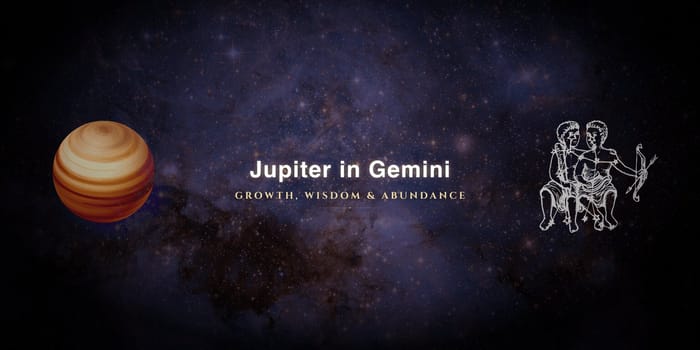
Jupiter in Gemini: The Mind That Sees Connections Everywhere
By Blair Andrews · Published May 2, 2026 · Updated May 10, 2026
Picture someone at a dinner party who has just connected quantum physics to a Sufi poem to their grandmother's recipe for borscht - and somehow it all makes sense. Everyone at the table is leaning in. Nobody is entirely sure where the conversation is going, including the person talking. But the ride is worth it.
Jupiter in Gemini lives in that space between ideas, in the electricity that sparks when two unrelated things suddenly illuminate each other. Meaning, for this placement, is not a destination. It is the act of connecting itself.

Jupiter in Detriment - and Why That Matters Less Than You Think
The traditional view says Jupiter is in detriment in Gemini. The logic goes: Jupiter wants depth and Gemini wants breadth. Jupiter seeks the big picture and Gemini is fascinated by every small one. So the meaning-seeking function is supposedly weakened here, scattered across too many interests to ever settle into genuine wisdom.
The tradition is not wrong, exactly. But it misses something important. Gemini's version of wisdom looks different from the kind Jupiter produces in Sagittarius or Pisces. It is horizontal rather than vertical.
Instead of one deep well, you get a vast network of shallow streams that, taken together, irrigate an enormous territory. The person who has read a little about everything and can synthesize across fields is doing something genuinely valuable - something specialists often cannot do.
Your faith grows when you discover that everything connects to everything else. That a pattern in biology echoes a pattern in music which mirrors a pattern in ancient mythology. These connections are not decorative. For you, they are evidence of an underlying order that most people are too focused to notice.

The Perpetual Student
You probably own more books than you have finished. Courses started with genuine excitement trail off once the novelty fades. Browser tabs multiply like rabbits. Your search history looks like a detective board from a conspiracy thriller - wildly various on the surface, held together by a logic only you can see.
This gets misread as lack of discipline. It is actually a different kind of discipline - the discipline of following curiosity wherever it leads, trusting that the pattern will eventually emerge from the accumulated fragments.
Some of the most original thinkers in history worked this way: collecting widely, connecting laterally, seeing what others missed because they were too deep in their own specialization to look sideways.
The challenge is real, though. You can spend a lifetime being interesting without ever being deep. The dinner party is always brilliant. The book never gets written. The insight that could change someone's life stays scattered across forty notebooks and three different note-taking apps, never assembled into something whole.

The Shadow: When Everything Connects, Nothing Commits
Jupiter in Gemini's shadow is relativism taken to its logical extreme. You can see every side of every question so clearly that committing to any single perspective feels like intellectual dishonesty. Why would you limit yourself to one belief when you can hold twelve simultaneously?
The problem is that some questions in life demand a stand. Moral questions. Relationship questions. Questions about what you are actually going to do with your one life.
Perpetual openness can become a sophisticated form of avoidance, using the mind's agility to sidestep the situations that require you to plant a flag and say, "this is where I stand."
You may also notice a pattern of talking about growth instead of growing. Jupiter in Gemini can discuss transformation with extraordinary eloquence while the actual inner work remains undone. The conversation about the thing replaces the thing itself.

Where This Placement Grows
Growth arrives when you discover that some questions actually do have answers - or at least, answers good enough to live by. When the pleasure of seeing every side deepens into the willingness to choose one. When breadth of knowledge begins to serve something beyond its own accumulation.
The mature version of this placement often shows up as a remarkable communicator - someone who can translate complex ideas into language anyone can understand, who builds bridges between fields, who makes learning feel like play.
Teachers, writers, journalists, translators, podcasters, cultural connectors. The gift is making knowledge move. Not hoarding it. Passing it along in a way that multiplies its value.
The Jupiter return - every twelve years or so - tends to mark inflection points in this development. The first return, around age twelve, often coincides with a discovery of how much there is to know.
The second, near twenty-four, may bring the first real crisis of commitment: you have sampled everything, and now someone or something is asking you to specialize.
By the third return, around thirty-six, the best versions of this placement have found a way to honor both the breadth and the depth - usually by choosing a subject wide enough to contain their curiosity without scattering it.

The Mind as Meeting Place
There is something worth noticing about how Jupiter in Gemini processes new information. You do not just learn things - you introduce them to each other. Every new fact, book, conversation, or experience enters a busy room where it immediately starts mingling with everything already there.
A piece of neuroscience meets a childhood memory meets a cooking technique meets a philosophical argument, and something new emerges from the collision that none of the original pieces contained on their own.
This synthesizing ability is genuinely valuable, and it tends to be underestimated - partly by the world, which rewards specialists, and partly by you, because the synthesis happens so naturally that you may not recognize it as a skill. It is.
The person who can connect quantum physics to a Sufi poem to their grandmother's recipe is not being scatterbrained. They are doing something that most single-discipline thinkers cannot do, and the insights that emerge from that connective process can be genuinely original.

In Relationships
Conversation is the bloodstream of your partnerships. Without intellectual stimulation, a relationship loses oxygen for you, no matter how emotionally secure or physically satisfying it might be. You need a partner you can talk to about anything - and who can surprise you with a perspective you had not considered.
The risk is that you seek novelty in people the way you seek it in ideas. New relationships are thrilling because every person is a new world of perspectives to explore. Long-term partnerships can feel like rereading a book you have already finished - comfortable, maybe, but where is the discovery?
The work of sustaining intimacy with this Jupiter involves recognizing that the person you have been with for years still contains surprises, if you are willing to ask different questions.
Partners who work well here tend to be curious in their own right - people with their own intellectual lives, their own reading stacks, their own questions to pursue. The relationship becomes a conversation that neither person wants to end.
There is something else worth naming about intimacy with this placement. You tend to process emotions through language.
Talking about a feeling is how you come to understand it, and a partner who can sit with you while you think out loud - without needing to fix anything, without getting impatient with the circuitous route your processing takes - is offering you something more valuable than they may realize.
The conversation is not avoiding the feeling. The conversation is how the feeling becomes real for you.

A Layer Worth Noticing
Jupiter's number in the classical tradition is 3 - creative expression, the teacher, the voice that turns raw experience into something sharable. Mercury, ruler of Gemini, carries the 5 - restlessness, adaptability, the hunger for variety and direct sensory engagement.
Together, 3 and 5 produce maximum mental range: the meaning-seeking impulse (3) turbocharged by the restless curiosity (5) of a sign that genuinely believes every idea is worth exploring.
The philosopher who believes meaning lives in the connections between things, not in any single conclusion. If you carry a Life Path 3, this placement doubles your natural broadcasting energy - the urge to learn, synthesize, and share runs deep in both systems.
The watch-point is relativism: you may discuss meaning endlessly without ever landing anywhere long enough for it to take root. If you want to explore what number 3 in numerology reveals about this energy, it adds another layer to what the chart is already telling you.

Frequently Asked Questions
What does Jupiter in Gemini mean?
Jupiter in Gemini is traditionally in detriment, but the label undersells what this placement does. Wisdom here is horizontal rather than vertical - a vast network of streams that irrigates enormous territory rather than one deep well. Faith grows through discovering that everything connects to everything else, and those connections are evidence of an underlying order that most people are too focused to notice.
How does Jupiter in Gemini affect relationships?
Conversation is the bloodstream of partnerships - without intellectual stimulation, a relationship loses oxygen regardless of emotional security or physical satisfaction. The risk is seeking novelty in people the way novelty is sought in ideas, where new relationships feel like unread books. The growth work is recognizing that long-term partners still contain surprises if different questions are asked.
What stops Jupiter in Gemini from reaching its full potential?
The dinner party is always brilliant but the book never gets written. The shadow is relativism taken to its logical extreme, where committing to any single perspective feels like intellectual dishonesty. Talking about growth replaces growing; the conversation about the thing replaces the thing itself. The breakthrough arrives when discovering that some questions do have answers good enough to live by.