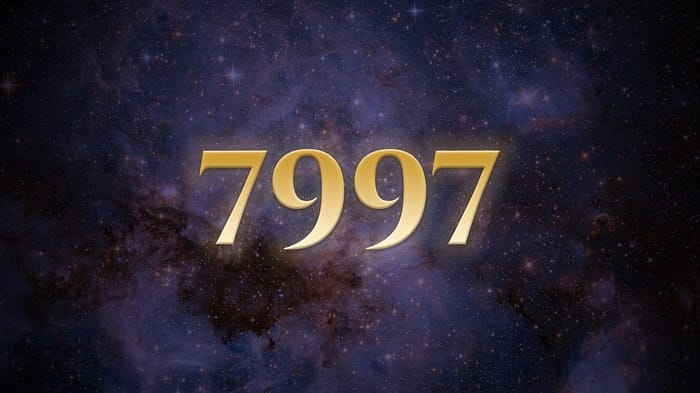
Two full cycles run in the valley between two peaks of sacred knowing. 7997 is an ABBA palindrome with doubled completion nested between two victories - the mountain, the double valley, the second mountain - and the freedom exists after both cycles are genuinely finished.
Angel Number 7997: The Victory That Finished What It Started
By Blair Andrews · Published April 18, 2026 · Updated May 21, 2026
The numbers inside 7997
7Understanding, depth, seeing what others miss
9Completion, letting go, a bigger purpose
7 + 9 + 9 + 7 = 32 → 5
5: Change, freedom, a new direction
What 7997 means for you specifically depends on which of the 11 Life Paths you’re on. Your birthday determines that.
Enter your birthday below:

Imagine two mountains with a valley between them.
You climbed the first peak. Scrambled up through whatever resistance was in the way, reached a vantage point, and saw everything laid out below you. The career, the relationship, the decision you finally made after years of circling it. You arrived at a place of real knowing.
You could see the whole terrain from up there.
And then, instead of planting a flag and staying, you walked back down.
Down into the valley. Into the low place between the peaks where the sky narrows and the light changes and everything you thought you understood from above has to be felt at ground level. Something finished in that valley. Something else finished too.
Two full cycles ran their course in the quiet, without any audience, without any summit view to comfort you.
And now the second mountain is in front of you. The path goes up again. Your legs remember how to climb. But the person starting this ascent is someone the first mountain would barely recognize.
That valley is the whole story of 7997.

The Mirror in the Numbers
7-9-9-7. Read it backward and you get the same thing. A palindrome. Two peaks of sacred knowing on the outside, two completed cycles nestled between them, and the whole structure reading identically in either direction.
The Pythagoreans had a word for 7 that most people never hear. They called it the vehicle of human life, the number of virginity, because it stands alone in the first ten. It cannot be divided into equal parts or doubled to produce another number within the decade.
Agrippa devoted more space to 7 than to any other number in his three books of occult philosophy, calling it "of various and manifold power" and "most full of all efficacy."
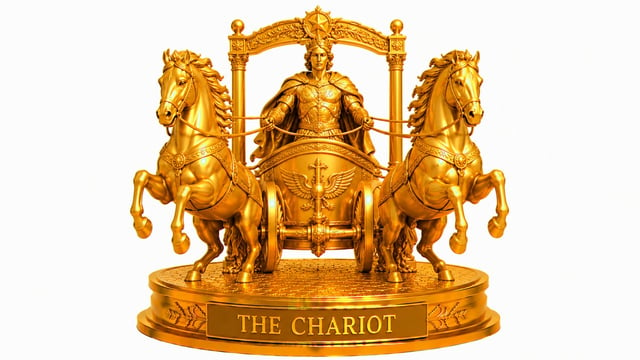
In the tarot, 7 is the Chariot, two sphinxes pulling in opposite directions, held together by someone who learned to move through contradiction rather than wait for it to resolve.
And 9 is the end of the first cycle. The completed arc. Agrippa dedicated nine to the Muses and linked it to the nine celestial spheres, because 9 is where the entire first order of numbers reaches its furthest extension before returning to unity through 10.
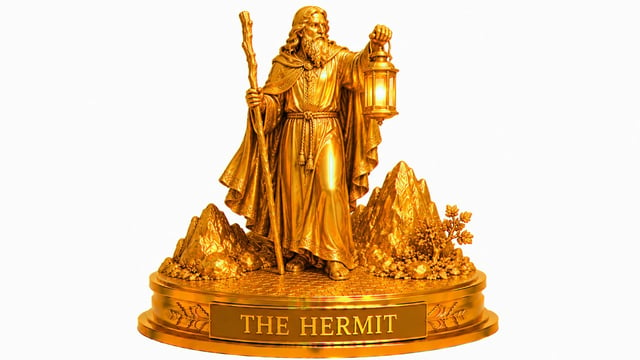
In the tarot, 9 is the Hermit, the one who stands at the summit with a lantern raised, lighting the way for whoever follows because the journey is genuinely done.
So the architecture of 7997 is a frame of sacred knowing (7, 7) enclosing a doubled completion (9, 9). The victories hold the boundary. The finishing happens inside the safety they provide.
Compare this with 9977, where the Hermit completes twice before the Chariot ever appears. 9977 is the sage who re-entered the arena. 7997 is the charioteer who stopped mid-campaign, walked down into the valley, completed what needed completing, and then climbed again.

Coming Down from the First Mountain
The opening 7 is the victory that created conditions. Something in your life required you to hold opposing forces together - ambition and responsibility, desire and discipline, the person you were and the person you were becoming - and you held them. You drove forward. You arrived somewhere real.
But arriving somewhere real is when the ground beneath you starts to speak.
This is the part most people do not expect. You win the thing, secure the position, make the move - and then discover that the territory you won into contains unfinished business. Old arcs that had been waiting, sometimes for years, for conditions stable enough to finally close.
The victory did not create the unfinished business. The victory created the safety for it to surface.
So you come down from the mountain. Into the valley where the doubled 9 lives.
The first completion is the one you expected. The chapter you knew, somewhere in the back of your mind, was going to surface once you had enough ground beneath your feet. Maybe a relationship pattern that outlived the relationship. Maybe a grief you had been outrunning since before the first climb started.
The arc runs its full course and closes, the way a river reaches the sea - without drama, without ceremony, just done.
The second completion surprises you. It is deeper, older, something you did not know was running until the first completion cleared enough space for you to notice it. An identity you had been carrying that no longer fits.
A way of understanding yourself that the first mountain's victory had already disproved, except you had not caught up to the evidence yet. This one closes more quietly than the first, with the particular weight of something that has been waiting a very long time.
Two completions inside a victory can feel like a setback. You were on the mountain. You had the view. And then you spent what might have been months or years in a valley, finishing things, while the wind and the summit were somewhere above you, out of reach.
But the victory was never about the view. The victory was about creating the conditions where those two old cycles could finally reach their end.

The Valley Path Toward Freedom
7 + 9 + 9 + 7 = 32. And 3 + 2 = 5.
Five is the Hierophant. The inner teacher. The one who bridges the gap between doctrine and direct experience because they have walked through both. Five is also freedom.
Balliett called 5 the Sage and said it "begins the new cycle of mind" - finding itself in "high unexplored country with paths in all directions." Agrippa placed 5 at the exact midpoint of the universal number (ten), calling it the number of mediation and the seal of the Holy Ghost, "a bond that binds all things."
Draw the pentagram. Spirit presides at the apex, governing the four elements below. The star upright. Five points - and the fifth point is the one that gives the other four their meaning.
Now look at what produced this Hierophant in 7997.
Two victories provided the knowledge of alignment, the understanding of what it costs to hold opposing forces together and keep moving. Two completions provided the knowledge of patience, the understanding of what it means to stay with something all the way to its natural end without forcing it or abandoning it.
And from both - from driving and finishing, from the Chariot's momentum and the Hermit's lantern, from the mountain and the valley - the Hierophant crystallized. The governance was forged, not studied. You had to win before you could finish. You had to finish before you could win again.
The freedom at the center of 5 is not the freedom of having no obligations. It is the freedom of someone who has operated at every tempo and knows which one the moment requires.
Whether 7997’s shadow side applies to you — and how strongly — depends on your core numbers. Your birthday reveals the first one.
Enter your birthday below:

The Shadow Side of the Palindrome
A palindrome's shadow is the temptation to believe that reading the same forward and backward means nothing actually changed.
The person who climbed the first mountain, walked through the valley, and is now facing the second mountain can sometimes look at the symmetry and think: I am back where I started. The second 7 looks like the first 7. The reins are familiar. The climb feels like repetition.
It is not repetition. The first 7 was the victory of someone who had never completed anything at valley depth. The second 7 is the victory of someone who descended willingly, stayed until two full arcs finished, and then chose to climb again. Those are profoundly different victories, even though the number is the same.
The shadow is also the temptation to stay in the valley. The completions were hard, patient, interior work. They changed you in ways that are difficult to articulate but easy to feel. You are steadier now. Less reactive. And there is a real seductiveness to that steadiness, a voice that says: why climb again?
Why not stay in the quiet place where the finishing happened?
Because the palindrome does not end in the middle. It ends with 7. The structure of the number itself insists on the second ascent. The valley was the passage, not the destination.

Why the Valley Makes the Teacher
Most people learn to do one or the other. The Chariot people drive forward - they win, arrive, conquer, and move on to the next victory without staying long enough to complete anything.
The Hermit people complete - they walk every mile, close every chapter, light every lantern, but they rarely drive hard enough to win anything that changes the landscape.
7997 is the number of someone who did both. Won, descended, finished twice, and climbed again. That combination produces something that neither winning nor finishing creates on its own.
It produces someone who knows the whole road. The exhilarating parts where the chariot is moving and the wind is in your face. The quiet parts where the lantern is lit and the summit is visible only as a memory. The valley parts where neither speed nor stillness matters and you simply have to walk.
People have probably started coming to you. For your understanding. The doubled completion gave you a kind of knowledge that others can feel even when you have not spoken it aloud. You finished what most people leave unfinished - twice - and that shows in how you carry yourself.
The Hierophant is emerging because the arithmetic of your experience produced one. Victory, completion, completion, victory. The teacher who traveled every stretch of the road, the fast parts and the slow parts, the peaks and the valley floor.

The Second Mountain
If 7997 is appearing, the valley is behind you. Or very nearly behind you. The two completions have done their work, and you are standing at the foot of the second peak with a different body and a different mind than the person who summited the first.
The reins are familiar. The sphinxes still pull in opposing directions. But your grip has a quality it did not have before. The finishing taught your hands something the winning never could. You know the cost of driving without completing. You know the cost of completing without driving.
And you know - because you lived it, in the valley, in the quiet between the two mountains - that the freedom the Hierophant carries is not the absence of those opposing pulls. It is the earned capacity to hold them both and walk the path that runs between the peaks.
That path through the valley is what 7997 has always been about. You had to come down from the first mountain to cross it. And the crossing made you someone the first mountain could never have made on its own.

Frequently Asked Questions About Angel Number 7997
What does angel number 7997 mean?
7997 is a palindrome - two peaks of sacred knowing (7, 7) enclosing two completed cycles (9, 9). It describes someone who achieved a real victory, then descended into the difficult interior work of finishing two old arcs, and is now ready to climb again.
The whole sequence reduces to 5, the Hierophant, which means the journey through both winning and finishing has produced a specific kind of inner authority and freedom.
Why does 7997 reduce to 5?
7 + 9 + 9 + 7 = 32, and 3 + 2 = 5. Five is the midpoint of the first decade of numbers, the Hierophant in tarot, and what Agrippa called the seal of the Holy Ghost.
In 7997, the 5 represents the freedom earned by someone who has operated at every tempo - sprint and stillness, victory and patience - and come out the other side knowing which one any given moment requires.
What is the difference between 7997 and 9977?
The order determines the entire journey.
9977 starts with the completions and ends with the victories - the sage who re-entered the arena. 7997 starts with a victory, descends into two completions, and then rises to a second victory. 7997 is the charioteer who stopped mid-campaign to finish what needed finishing, and then resumed the campaign as a different person.
Is 7997 a lucky number?
7 has been called "lucky" for centuries, and two of them bookending a number feels doubly so.
But Agrippa's description of 7 was never about luck - it was about efficacy, the vehicle of human life, the number "most full of all" power. 7997's promise is more specific than luck: it says the hard work of completing old cycles inside the safety of an earlier victory has produced genuine readiness for the next ascent.
What should I do when I see 7997?
Recognize that the valley is behind you. The patient interior work - those two arcs that ran their full course - has changed you in ways you can feel even if you cannot fully name them. The second mountain is ahead, and your hands know the reins differently now.
Trust the steadiness that the completions built in you, and start the climb.

Curious which numbers are active in your chart right now? Your birthday is the starting point.
Enter your birthday below:
Explore Angel Numbers
| Digit meanings | Angel Number 7, Angel Number 9 |
| Reduces to | Angel Number 5 |
| Similar patterns | 8008, 7887, 8118, 8228, 7667, 8338, 7557, 8448 |
Behind Your Angel Number
numerology chart calculator·life path number calculator·numerology guide