Angel Number 772: The Two Who Won Together
By Blair Andrews · Published June 29, 2023 · Updated April 30, 2026
The numbers inside 772


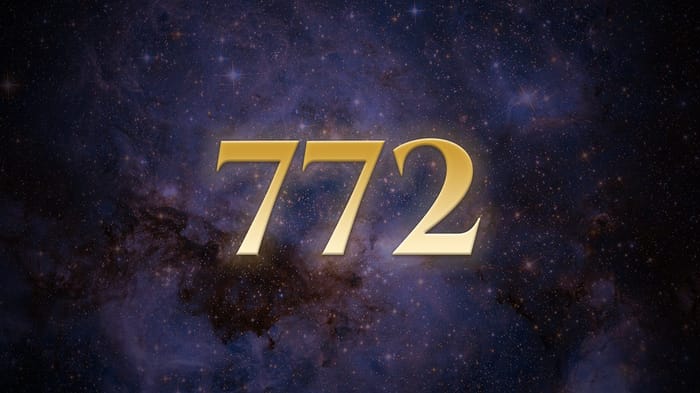
7 + 7 + 2 = 16 → 7
7: Understanding, depth, seeing what others miss
The Tower separates what fused - each victory stands on its own, and the partnership stands on its own. 772 says the language matches reality after the lightning: “I built this, she built that, we built this third thing.”
What 772 means for you specifically depends on which of the 11 Life Paths you’re on. Your birthday determines that.
Enter your birthday below:

Here is the first strange thing about 772. It is a number that ends where it began.
Add the digits. 7 + 7 + 2 = 16. Reduce that. 1 + 6 = 7. The sequence starts at seven, winds through the two sevens and the partnership, passes through sixteen, and lands on seven again.
A round trip. A circuit that returns the traveller to the starting point - except the traveller is no longer who they were when they set out.
That by itself would be worth slowing down for. A self-returning number is unusual. But that is not the part of 772 that matters most. The part that matters is where the two is sitting.
Look at the sequence. The two sevens come first. Then the two arrives last. The victories are already in place before the partnership enters.
The number is not describing two people who came together and won. It is describing two people who had already won - separately, in full - before they were ever a pair.
That order of operations is the whole key to 772.

The Two That Arrives Last
It's easy to treat the two in 772 as a supporting detail. A little partnership energy sprinkled on top of the big 7-7 victory headline. That reading misses what the number is actually doing.
The two is not a detail. The two is the site of the whole event. Everything interesting in 772 happens because the partnership showed up after the victories were already real. And over time, the partnership quietly became the frame that held them.
This is how it usually unfolds. Two people meet, each already accomplished, each already aligned, each already driving their own chariot competently. They recognise each other.
A real partnership forms. And because the partnership is genuinely good. Because it amplifies both of them. Something gradually happens that nobody notices at first.
The two wins start being told as one story.
The bundling starts with everyone else, not with them. The couple who built the thing. The duo behind the project. The team. The wins get bundled. The brand of us forms around the work. And because it flatters both parties and sells well and feels warm, nobody interrupts the bundling.
Then, somewhere along the way, the bundling stops being external. They start telling it that way themselves.

The Sixteen in the Middle
Between the opening sevens and the closing seven sits the bridge. 7 + 7 + 2 = 16. Every 772 experience is routed through the Tower.
The Tower does not strike relationships. The Tower strikes false structures. That distinction is load-bearing here. The partnership in a 772 is not the false structure. The partnership is often the most real thing in the picture.
The real partnership stays standing. What falls is something more specific. The performance of the partnership, the merged-brand identity that grew up around two genuinely separate victories and started getting told as one.
The lightning here is strangely surgical. It does not break the relationship. It does not rewrite the history. It just separates two things that had quietly fused: the truth of the partnership, and the story of the winning duo.
The story is what falls. The partnership remains.
What that looks like in practice is very particular. Something - a project, an invitation, a moment - asks for one of the two victories to be claimed cleanly.
Named by one person. Owned as theirs. And the old reflex kicks in, the we reflex, the our reflex, the habitual bundling.
And suddenly it feels wrong. It feels like something is being misrepresented. Not because the partnership isn't real, but because the single win is also real and has been getting hidden inside the duo-story for so long that claiming it feels almost illegal.
That pressure is the Tower arriving. What has to come down is not the partnership. It is the habit of never separating the two achievements from each other.

Why the Partnership Survives
Read most Tower-adjacent numbers and the structure that falls deserves to fall. Built on sand. Built on avoidance. Built on someone else's blueprint. 772 breaks that pattern, and the break is worth noticing.
The partnership in a 772 was not built on sand. The two victories are not imaginary. The alignment between the two people is real, often rare, often the best thing either of them has been part of. None of that is what the lightning is after.
What the lightning is after is subtler and worth naming precisely. When two genuine victories get consistently narrated as one shared story, the individual victories begin to feel like they don't exist on their own.
The person inside the partnership starts to doubt that their win would stand up if pulled out of the us. The partnership stops being an addition and starts being the thing that validates each individual seven.
That is the structure that cannot hold. Not the partnership itself, but the quiet assumption that the victory requires the pairing to count.
16 is the correction. The two wins get pried apart from the winning duo packaging just long enough for each person to see, cleanly and without the flattering wrapper, that their victory was always theirs.
Was theirs before the partnership. Remains theirs after the Tower passes. Does not require the other name beside it to be real.
And the partnership - the real one, not the brand - survives the separation just fine. Often it comes out stronger, because it stops being asked to do work it was never meant to do.
A partnership is not supposed to be the birth certificate for each partner's achievements. It is supposed to be the thing two already-real people do together.
Whether 772’s shadow side applies to you — and how strongly — depends on your core numbers. Your birthday reveals the first one.
Enter your birthday below:

The Seven on the Far Side
Now look at where the sequence lands. 772 reduces through 16 to 7. The number returns to its starting tone.
That second seven, the one at the end, is not the same as the first sevens. The first sevens were the victories in their packaged form - real, but currently wrapped in the duo-narrative.
The final seven is the victory unwrapped. The alignment that does not need a brand around it. The charioteer who does not need a co-driver in the frame in order to say with a straight face: yes, I drove this.
This is the hidden gift of a self-returning number. The reader ends where they began - same note, same number - but the relationship to it has changed completely.
The seven at the start was a seven that needed to be told as part of a pair. The seven at the end is a seven that can stand by itself and also be in partnership, without the two things being confused.
That is what the Tower does in 772. It does not strip victory. It does not strip partnership. It strips the merger of victory and partnership into a single inseparable brand, so each can be what it actually is.

How It Tends to Show
When 772 has been present for a while, a specific kind of conversation starts happening. Someone asks one of the two to talk about their work in the first person.
Just one I. No we. And there is a flicker of hesitation. A reflex to reach for the partner's name. A strange little resistance to claiming the thing cleanly.
The Tower is pointing at exactly that resistance. The Tower is pointing at the reflex, not the partner.
None of this requires the partnership to end. Most 772 transits do not end the partnership. What they end is the fusion. After the transit, the two people are still together, still aligned, still genuinely a pair.
They just speak about their wins differently. I built this. She built that. We built this third thing. The language finally matches the reality.
The 77 piece of 772 is worth a closer look on its own, because the two sevens have their own logic separate from what the two does to them. And the single-digit 7 that the whole sequence reduces to is the underlying tone that makes the self-return possible at all.

The Two Who Happen to Have Won
Pay attention to this part: the closing picture.
Two sevens remain. Both victories are intact. Neither gets taken away.
The partnership remains. The real one - the chosen alignment between two people who recognise each other - survives the transit and usually strengthens.
What falls is the middle thing that was never quite real. The winning duo as a single entity. The merged-brand identity that had quietly taken the place of two distinct victories and one chosen partnership.
After the Tower, the picture is simpler and more honest. Two people who each won something of their own. Who happened to find each other. Who happen to be, also, a partnership that works. Three separate true things instead of one blended story.
The whole number routes toward exactly this. Not a breakup. Not a merger. A clarification. Two victors standing beside each other with their trophies held in their own hands - and then, once the hands are full, choosing to walk together anyway.
Curious which numbers are active in your chart right now? Your birthday is the starting point.
Enter your birthday below:
Explore Angel Numbers
| Digit meanings | Angel Number 2, Angel Number 7 |
| Reduces to | Angel Number 7 |
| Mirror | Angel Number 277 |
Behind Your Angel Number
calculate your full numerology chart·find your life path number·numerology, explained