Angel Number 56: The Number of the One Who Loves and Is Free
By Blair Andrews · Published April 5, 2023 · Updated May 21, 2026
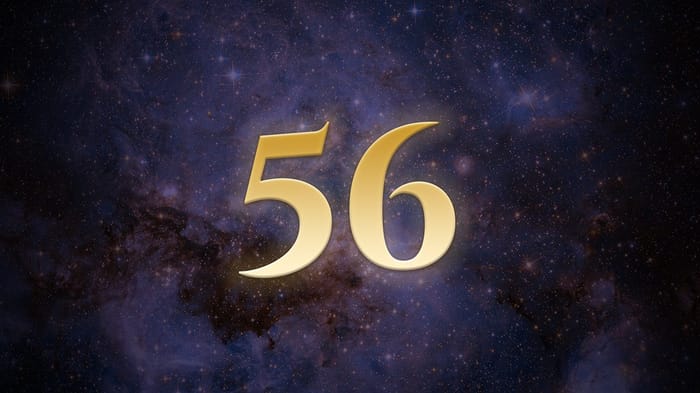
The numbers inside 56

5 + 6 = 11
11: Heightened awareness, sensing what others miss
56 holds liberation and love at full strength simultaneously - neither one shrinks, and the weighing never stops. The master number at the root means both the Hierophant and the Lovers demand their full volume, and Justice is the constant act of balancing them.
What 56 means for you specifically depends on which of the 11 Life Paths you’re on. Your birthday determines that.
Enter your birthday below:

Consider a pair of words that do not belong in the same sentence, and yet in certain lives cannot be separated.
Liberation. Love.
Liberation moves outward. It wants the open road, the unclosed door, the sky without a ceiling. Its instinct is to leave. Not in cruelty - in necessity. A thing that cannot leave is not free.
Love moves inward. It wants the small room with the lit window, the hand already familiar in the dark. Its instinct is to stay. Not in fear - in devotion. A thing that cannot stay is not love.
These two impulses are, in most human lives, enemies. The person who chooses freedom over love tends to leave behind something they will grieve quietly for the rest of their days.
The person who chooses love over freedom tends to build a life around an ache they cannot quite name. You can see this pattern almost everywhere, if you know to look. The artist who left the marriage to write the book. The mother who stayed, and whose poems never came.
And yet in certain very particular lives, these two forces do not remain enemies. They are held, both at once, by a person who refuses to surrender either. That person is rarely comfortable. But they are doing something the rest of us only read about.
That kind of life has a number. The number is 56.
The messages I receive about 56 come from people who are holding two things that most advice says cannot be held at the same time. They love someone deeply and they also need space that cannot be shared. They are devoted to a community and they also require solitude that the community does not understand.
They are not asking whether to choose. They already know they will not choose. They are asking whether it is possible to carry both without something breaking.

The Two Forces Inside the Composite
Before we can understand why 56 is unusual, we have to sit with what it contains.
The 5 carries a meaning older and heavier than thrill-seeking or restless adventure. In the older numerological traditions, 5 is the pentagram - the five-pointed star with one point at the top.
That top point is spirit. The four below are the classical elements. The arrangement is a diagram of governance: consciousness directing the physical world, rather than being dragged around by it.
This is why 5 is sometimes called the number of liberation. Liberation. It sounds like license, but it's heavier - it comes with responsibility. The particular freedom that comes from having mastered your own inner weather well enough that outer circumstances cannot own you.
The Hierophant of the tarot stands in both worlds at once - rooted on the earth, aware of what lies beyond it. Steady. Disciplined. Free in the way a person is free who has done the long work of knowing themselves.
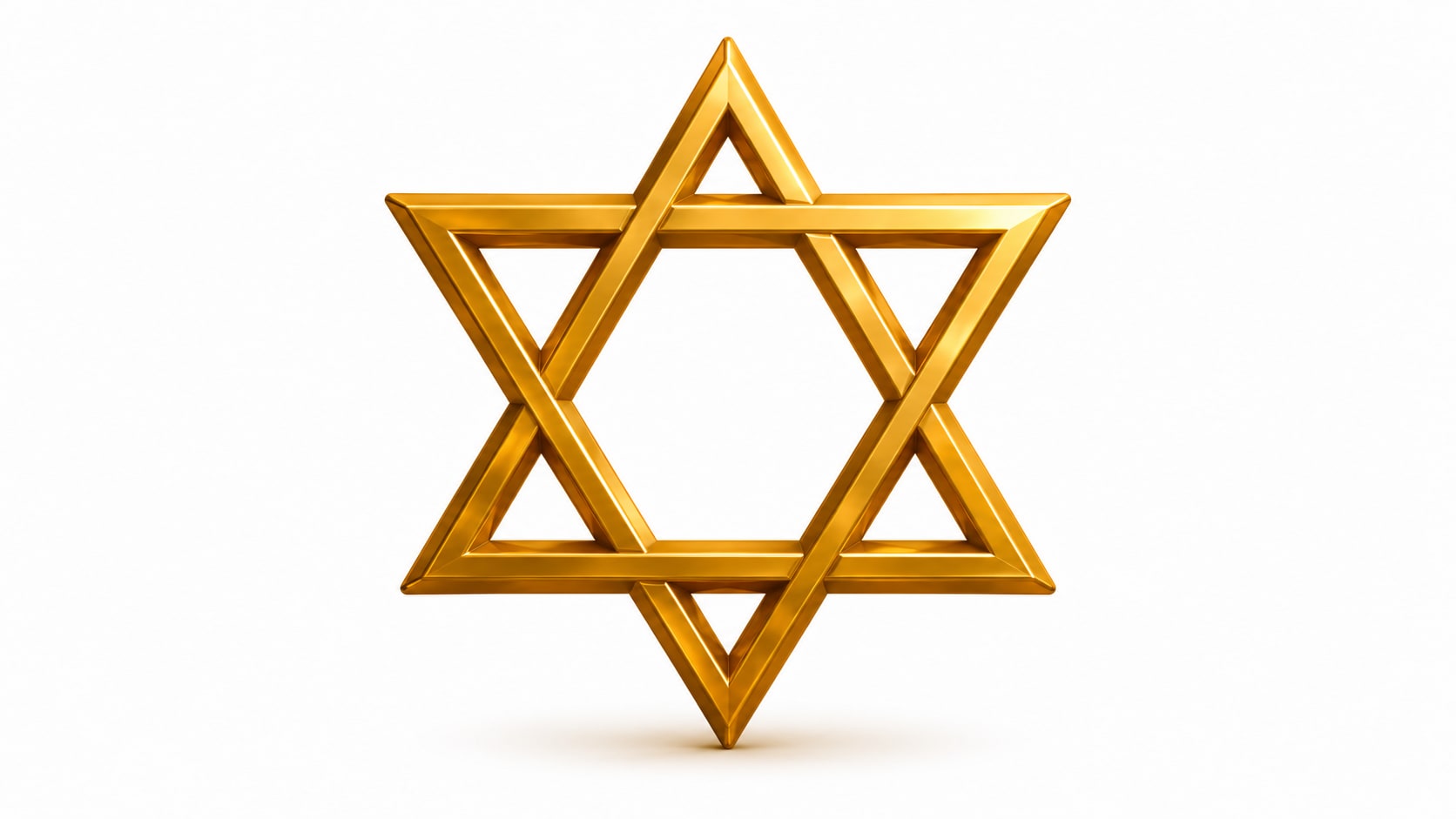
The 6 is something different. It is the hexagram - two interlocking triangles, heaven and earth finding each other at a center point.
In the tarot it is The Lovers, which is not mainly about romance but about the choice to bind oneself to another in a way that will require adjustment, responsibility, and care.
On the Tree of Life, 6 sits at Tiphareth, the sphere of Beauty - the quiet heart of the whole system, the balancing center that holds the structure together.
The 6 is the number of the lily with its six petals. Of divine desire. Of the impulse to tend something, to stay close to it, to let your life become organized around what you love.
Now place these two beside each other. The one who has freed themselves. And the one who has bound themselves. The pentagram and the hexagram. The one who has learned to stand alone, and the one who has learned to stand with another.
They are, in most lives, different people.
In the number 56, they are the same person.

A Person With Two Natures
This is where 56 begins to distinguish itself. The number does not describe someone who is torn between freedom and love the way a restless partner is torn between staying and leaving. That is a much simpler condition.
It usually means one of the two forces is not yet fully formed - that the love is not real enough, or the freedom is not real enough, and the solution will eventually be to let go of the weaker one.
56 describes a different situation. It describes someone in whom both forces are fully real. The freedom is not a fantasy of escape. It is the hard-won autonomy of a person who has, over years, learned to be a sovereign self.
And the love is not attachment dressed up. It is the real thing - the kind of care that would stay through almost anything, because staying is what love does.
Two real things. Neither one false. Both laying claim to the same life.
You can feel, already, why this is an unusual composition. Most people who call themselves free have never truly loved. Most people who have truly loved have had to give up some measure of their freedom. Holding both at full strength is rare enough that the traditions noticed and marked it.
The mark they made on it is the number 11.

Why the Arithmetic Lands Where It Does
Five plus six is eleven.
Eleven keeps its doubled form. When the same digit appears twice, the tradition holds it sacred - the repetition carries a signal that reduction would destroy. Eleven is one of three master numbers (alongside 22 and 33) that the system preserves intact.
This matters because master numbers are not merely "higher octaves" of their reduced forms. They sit outside the normal architecture. They indicate a weight the system cannot simplify away.
Eleven is the Justice card in the tarot. This isn't Strength. Not the High Priestess. Justice - a seated figure holding a sword and a set of scales. The sword is for discernment.
The scales are for weighing. The whole apparatus is for the patient, unhurried work of measuring one thing against another until the truth of their relative weight reveals itself.
Eleven is the number of cause and effect observed without protest. Of discernment practiced as an art. Of the capacity to hold two things on the scale and let the weight tell you which one, in this moment, matters more.
It is not, despite a great deal of recent writing to the contrary, the number of anxiety or nervous intuition. That is a misreading that substituted fragility for complexity.
The eleven is not sharp. It is weighty. And the people who carry it tend not to be nervous but unusually calm in moments that would overwhelm others - because they are not frozen. They are weighing.
The modern misreading of 11 as "spiritual anxiety" or "twin flame nervousness" has no foundation in the older literature.
Balliett described the master numbers as carrying weight the single digits cannot hold - 11 specifically as the number of those who "hold power in their hands which must be used." Agrippa treated 11 as the number that exceeds the perfection of 10, introducing discernment as a necessity rather than a gift.
The weighing in 56 is not a symptom. It is a capacity - one the older tradition treated with considerably more respect than the Instagram posts suggest.
Now return to the composition of 56.
A person in whom liberation and love are both fully real will, sooner or later, be handed the scales. They didn't choose to be a judge. Because there is no other way to hold both forces at once. Someone has to weigh, and they are the one standing at the fulcrum.
Whether 56’s shadow side applies to you — and how strongly — depends on your core numbers. Your birthday reveals the first one.
Enter your birthday below:

Why Freedom and Love Together Produce Discernment
Here is the quiet logic the arithmetic is pointing at.
When a person holds only one of these forces, the decisions are simple. The free person leaves. The loving person stays. Neither has to weigh anything, because the answer is already decided by their nature. They have, in a sense, traded the question for an identity.
When a person holds both, the decisions stop being automatic.
Every day the 56 person wakes up into a set of small and large negotiations. Which love is worth staying for. Which freedom is worth leaving for. When to honor the pull outward and when to honor the pull inward.
When to go and when to remain. When to close a door because closing it is the only way to honor what is inside, and when to open one because opening it is the only way to honor what is outside.
These decisions cannot be made from principle alone. A principle would push one direction or the other, and the 56 person, if they are being honest with their nature, refuses to let either direction win permanently. They have to actually weigh. Each situation. Each time.
That is the only way to hold both forces without betraying one of them.
This is the training that produces discernment. Something more grounded than philosophical theorizing about what matters. The bodily, lived experience of placing one thing on one side of the scale and another on the other and waiting, patiently, until the instrument settles.
The 11 inside 56 is not an add-on. It is the inevitable result of trying to carry liberation and love at full weight through an entire life. Discernment becomes a survival skill. The scales become second nature.

The Tender Version of Justice
There is something worth noticing here about the specific quality of the 11 that emerges from this particular composite.
An 11 arrived at through other routes can feel austere. The builder who becomes the judge often carries a kind of stern authority - the knowledge accumulated from long labor, translated into the right to pronounce. That is one face of the eleven. It is not a soft face.
The 11 that rises out of 56 is different. It is not stern. It is tender.
Because the weighing, in this case, is not being done between good and bad, right and wrong, true and false. It is being done between two goods. Between two things the person loves. Between a life they could freely live and a life they would lovingly stay inside. Both real. Both worthy.
That kind of discernment cannot afford harshness. It requires a softness that most judicial temperaments never develop. The 56 person learns to hold both sides with something close to reverence, because they know, from the inside, that each side has a claim.
They are not arbitrating between a villain and a saint. They are arbitrating between two parts of themselves, or two parts of a life they love, and neither one deserves contempt.
The scales here are held in hands that have been gentle for a long time. This is Justice with the texture of care. Precise - because imprecision would dishonor what is being weighed. Patient - because patience is the only way not to force a false answer.
And above all, refusing to pick a winner and treat the loser as a problem to be solved.
56 is the number of the person who has learned that some of life's most important choices are not about choosing between right and wrong, but about honoring two things that are both right, and finding a way to carry both.

What This Looks Like in a Life
The person moving through 56 is often someone who has, quietly and without fanfare, become the keeper of balances in their own life.
They tend to have both - a genuine love they will not abandon, and a genuine freedom they will not surrender.
The particular shape varies. Sometimes the love is a marriage and the freedom is a calling. Sometimes the love is a child and the freedom is a long friendship with solitude. Sometimes the love is a community and the freedom is the inner life that keeps them sane inside that community.
Whatever the forms, the person learns something others do not. They learn that holding both is not a matter of splitting the days neatly in half. It is a matter of constant, small discernment.
Not "how much time for love, how much time for freedom", that is arithmetic of the wrong kind. But rather: "what does this particular moment ask of me? Which weight, right now, deserves to be honored? And which will still be there tomorrow if I let it wait?"
These are not easy questions. They do not get easier. But the person moving through 56 becomes, over time, unusually skilled at asking them. Others notice.
They come for advice, for counsel, for the strange kind of clarity that only a practiced weigher can offer. The 56 person rarely takes pride in this. It is simply what their life required them to become.
There is also, often, a quiet sorrow running through this kind of life. Because the weighing is real. Things are chosen. Things are, therefore, not chosen.
The 56 person knows the particular grief of a good that was laid on the scale and, in this moment, outweighed. That grief does not vanish. It sits alongside the life they actually built, keeping it honest.
This is different from regret. Regret is the voice of someone who wishes they had chosen differently. The 56 grief is the voice of someone who knows they chose rightly and still mourns what was not chosen. Both things are true. The scales do not lie, but they do not console either.

The Closing Image
Picture, at the end of it, a person who loves and is free.
They are sitting somewhere ordinary. A kitchen, perhaps, in the first light before anyone else is awake. Or on a bench outside a building that holds someone they would not leave. Or on a path that leads both toward home and away from it, depending on which direction they choose to walk.
They are not agitated. Whatever turbulence this life has cost them has settled, over the years, into something quieter. What remains is the scales.
They know, by now, how the instrument works. They know how to place a desire on one side and a devotion on the other.
They know that the weights will never be equal, that one side will always dip lower, and that the dipping is the answer. They know, too, that tomorrow the weights will be arranged differently and the answer will have to be found again.
This is not an anxious life. It is a patient one. The person who has lived here long enough stops wishing they could hand the scales to someone else. They have become the scales. The weighing is how they love. It is also how they stay free.
The number 56 is given, quietly, to people whose lives cannot be built any other way. Who cannot have freedom without love, or love without freedom, and who have therefore had to become the one who carries both.
The instrument they hold is not decorative. It is what their days have asked them to grow into. And the reverence with which they learn to hold it - the tenderness of a Justice that refuses to be harsh toward either side - is perhaps the deepest form the master number 11 ever takes.
They love. They are free. They weigh. Every day, they weigh.
And somewhere in the quiet of the weighing, the two forces that began as enemies discover they were, all along, a single life.

Curious which numbers are active in your chart right now? Your birthday is the starting point.
Enter your birthday below:
Explore Angel Numbers
| Digit meanings | Angel Number 5, Angel Number 6 |
| Reduces to | Angel Number 11 |
Behind Your Angel Number
numerology chart calculator·life path number calculator·numerology guide