Bookends giving meaning to the volumes between them, and volumes giving purpose to the bookends. 4994 is a palindrome where two completed works live inside two foundations - a shelf built for finished things, holding everything you’ve completed standing and accessible.
Angel Number 4994: The Structure That Learned to Breathe
By Blair Andrews · Published April 18, 2026 · Updated May 21, 2026

The numbers inside 4994

4Stability, foundation, building something solid

9Completion, letting go, a bigger purpose
4 + 9 + 9 + 4 = 26 → 8
8: Results, strength, things paying off
What 4994 means for you specifically depends on which of the 11 Life Paths you’re on. Your birthday determines that.
Enter your birthday below:

Picture a shelf of books. Two heavy, identical bookends made of dark wood - the kind your grandfather owned, the kind that weigh enough to hold their ground. Between them, pressed side by side, two thick volumes. The complete works. Everything written, revised, finished, and bound.
Without the bookends, the volumes topple. Without the volumes, the bookends are just blocks of wood sitting on an empty shelf, holding nothing, meaning nothing.
But together - the weight of the finished work held upright by the structure on either side - you have something that functions. Something you can walk past every day and reach for when you need it. A library that stands on its own.
4994 is that shelf. Two identical structures bookending two complete works. And the mastery it produces is the shelf itself - the thing that lets everything you have finished remain visible, accessible, and standing.

The Architecture of the Palindrome
Read the digits forward: 4-9-9-4. Read them backward: 4-9-9-4. The same sentence in both directions.
4 is the builder. In Balliett's system, 4 works entirely upon the intellectual plane, the rank and file of the world, the one who builds the buildings of which 1 is the architect.
In tarot, 4 is the Emperor: cornerstones, load-bearing walls, the cube that is "perfect on all sides." Agrippa called the number four the Tetractis, the perpetual fountain of nature, the root and foundation of all other numbers. YHVH, the four-letter name of God. Four elements, four seasons, four cardinal directions. Structure is not decoration.
Structure is the scaffolding that holds reality together.
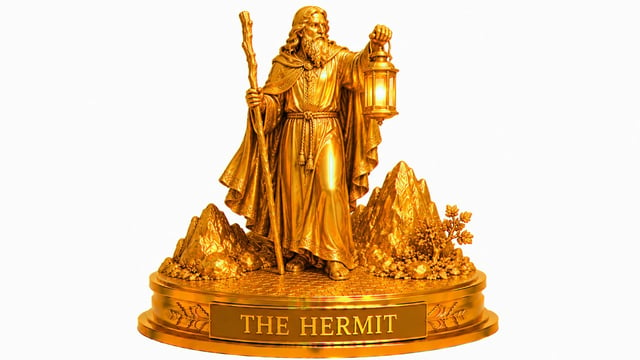
And 9 is the completed cycle. The Hermit on the mountaintop with his lantern, looking back at the path he already walked.
Balliett called 9 "free expression on all planes," the number where "the paths of life, according to Pythagoras, end." Agrippa connected 9 to the nine Muses, the nine celestial spheres, the nine orders of angels. Nine is what remains after the entire single-digit journey from 1 through 8 has been traveled.
Everything experienced, everything digested, everything understood.
So 4994 gives you this: a wall on the left. Two complete journeys standing side by side. A wall on the right. The structure does not contain the completion the way a prison contains a prisoner.
It contains it the way a bookend contains a book - with just enough pressure to keep the finished work standing upright where you can see it and use it.

The Complete Works, Twice Over
Two 9s at the center means you did not finish something once and walk away. You finished it, took a breath, and then finished something else.
That distinction matters more than it sounds. One completion teaches you about endings. Two completions, held together, teach you about the pattern underneath endings.
You start to notice what is consistent across different kinds of finishing - the way the energy shifts in the final stretch regardless of whether you are completing a relationship, a career chapter, a creative project, or a long process of healing.
The shape of an ending turns out to be recognizable, the way someone who has read a hundred novels starts to feel the third act arriving before the author announces it.
The doubled Hermit at the center of 4994 is a reader who knows the shape of a story. Two complete works sitting on that shelf, and the person who wrote them both has developed a fluency with completion that most people never get. Most people learn to start things. Some people learn to finish one.
Very few learn to finish two and recognize the architecture that both finishings share.
Balliett described 9 as the number that "attracts more love than any other" and whose people "have honored gifts from all over the world." Double that, and you are looking at someone whose finished work draws others to it - whose completions produce something that people want to stand near.

The Shelf That Holds Everything
Add the digits: 4 + 9 + 9 + 4 = 26. Then 2 + 6 = 8.
The number resolves to 8. And the path to 8 passes through 26, which carries its own weight.
In the kabbalistic tradition, 26 is the gematria value of YHVH, the four-letter name of God, the Tetragrammaton. Agrippa placed YHVH at the top of the Scale of Four, in the "original world" - the exemplary plane from which all other realities descend.
So the intermediate sum of 4994 passes through the divine name itself before arriving at its final reduction. Whatever mastery 8 represents, it has been consecrated by passing through that particular doorway.
And 8, in Balliett's system, is the beginning of the higher cycle. She called it the number of resurrection, of free forms, of someone who "has reached self-consciousness" and "can look out from the strength within." The Pythagoreans called 8 the number of justice and fullness.
Agrippa connected it to the eight visible spheres of the heavens, the eight Beatitudes, the covenant that marks belonging to something larger than yourself.
In tarot, Strength. The figure holding the lion gently. Roses draped around both of them like garlands. No chains, no violence, no visible struggle. Governance through presence.
So here is what 4994 actually builds, when you let the metaphor complete itself. The two bookends (4, 4) hold the complete works (9, 9) upright. And the shelf - the thing that makes the whole arrangement functional, is the 8. The mastery. The structure that lets the finished work be seen, reached for, used.
Without the shelf, the books and bookends are just objects on the floor. With it, they become a library.
The 8 is what transforms accumulation into something usable.
Whether 4994’s shadow side applies to you — and how strongly — depends on your core numbers. Your birthday reveals the first one.
Enter your birthday below:

The Palindrome Reads True in Both Directions
You can enter 4994 from either end and the story holds.
Coming from the left: you built something solid (4), then poured yourself into completing it fully (9), then completed something else (9), and the completion itself generated new structure (4). The builder who finished and found that finishing produced its own kind of foundation.
Coming from the right: you had a structure in place (4), then something ended inside it (9), then something else ended (9), and the original structure on the other side was still there waiting to receive you (4).
The person who went through two major completions and discovered that the scaffolding of their life held through both of them.
Both readings arrive at the same center. Both produce the same sum. The palindrome is telling you that the relationship between building and completing runs in both directions, and neither direction is the wrong one. Some people build first and then learn how to finish.
Others finish something major and only then discover that the finishing taught them how to build. 4994 does not care which direction you came from. It only asks that you notice you have arrived.

What the Shadow Looks Like
But there is a darker reading of this pattern, and it hides in the joints between the 4s and the 9s.
The shadow of 4994 is the person who builds the shelf but never lets anyone read the books. The one who finishes things beautifully, binds them in leather, sets them between solid bookends - and then guards the whole arrangement like a museum curator rather than a librarian. Look but do not touch.
Admire the collection, but do not actually open anything.
Balliett wrote that when 4 goes wrong, its people lose the power to enjoy what they have achieved. And when 9 goes wrong, it "drops ideals" and becomes "dissatisfied and restless." In 4994's shadow, these failures combine: the structure becomes rigidity, and the completion becomes an ending that refuses to become a beginning.
The bookends clamp down. The volumes seal themselves shut. The shelf becomes a monument to what you did rather than a resource for what comes next.
The correction is in the 8. Balliett described 8 as someone who "takes other men's work and remodels it" - whose particular genius is not building from scratch but taking what already exists and making it available, usable, alive. The shelf is supposed to be functional. People are supposed to reach for those books.
If you find yourself polishing the bookends instead of opening the volumes, the number is asking you to step back and remember what a library is for.

What the Mastery Feels Like
If 4994 is showing up, you are probably not in the building phase anymore. You are probably not even in the finishing phase. The building happened. The finishing happened, twice.
What you are in now is the phase where the relationship between structure and completion has started to produce its own rhythm - a cadence to your life that you did not plan and cannot quite explain but can definitely feel.
You know how to start things. You know how to end them. And somewhere in the practice of doing both, repeatedly, inside frameworks that held, you developed a pulse. A sustainable way of moving through effort and rest, output and recovery, creation and release.
The kind of rhythm that the woman on the Strength card embodies - not grinding, not pushing, not white-knuckling through another project and collapsing at the end. Breathing. Working the way a healthy body works: systole, diastole, systole, diastole.
The Pythagoreans took their most sacred oath by the number four. Agrippa described nine as the number "dedicated to the Muses." Put those together, bookend-style, and you get something that is both sworn and inspired - both solid and complete. The oath and the song. The foundation and the finished poem.
The bookend and the book.
4994 is the shelf that holds everything you have finished in plain sight. The mastery is not in the building or the completing.
It is in the standing - the quiet structural fact that your work is upright, visible, and available, and that the life you built can bear the weight of everything you have learned.

Regarding Angel Number 4994
What does angel number 4994 mean?
4994 means you have built something solid, completed the work inside it - twice - and the combination of structure and completion has produced mastery. It reduces to 8 through the intermediate sum of 26, which connects it to the kabbalistic divine name.
The palindrome shape (4-9-9-4) means the pattern holds regardless of which direction you read it from: whether you built first and then learned to finish, or finished something major and then discovered the structure it needed.
Why is 4994 a palindrome?
Because the relationship between building and completing is not a one-way street.
The builder who learns to finish things and the finisher who learns to build a life around what they completed are taking the same journey from opposite ends. 4994 reads identically forward and backward to tell you that both paths arrive at the same center - the 8, the mastery, the shelf that makes the whole arrangement functional.
What does the 26 mean in 4994's reduction?
4 + 9 + 9 + 4 = 26 before reducing to 8. In the kabbalistic tradition, 26 is the numerical value of YHVH, the Tetragrammaton, the four-letter name of God.
The fact that 4994's path to mastery passes through this number suggests that whatever the 8 represents in your life, it carries more weight than ordinary competence. The mastery has a sacred dimension, whether you experience it religiously or simply as the feeling that your work is connected to something larger than yourself.
What is the shadow side of 4994?
Building the shelf but never letting anyone read the books. The person who finishes things beautifully and then guards the collection rather than making it available. When the structure becomes rigidity and the completion becomes a sealed monument rather than a living resource, 4994 has gone wrong.
The correction is in the 8, which Balliett described as someone whose genius is taking what already exists and making it usable. The library is supposed to be open.
Curious which numbers are active in your chart right now? Your birthday is the starting point.
Enter your birthday below:
Explore Angel Numbers
| Digit meanings | Angel Number 4, Angel Number 9 |
| Reduces to | Angel Number 8 |
| Similar patterns | 5005, 4884, 5115, 4774, 5225, 4664, 5335, 4554 |
Behind Your Angel Number
numerology chart calculator·life path number calculator·numerology guide