The second song carries everything the first one could not. 3663 is an ABBA palindrome with doubled stewardship at center - the songwriter who cared through a prolonged transformative immersion and then wrote the song that puts broken hearts back together.
Angel Number 3663 Meaning: The Two Doors Inside the Studio
By Blair Andrews · Published April 18, 2026 · Updated May 21, 2026
The numbers inside 3663

3Creativity, expression, communication

6Home, responsibility, the people closest to you
3 + 6 + 6 + 3 = 18 → 9
9: Completion, letting go, a bigger purpose
What 3663 means for you specifically depends on which of the 11 Life Paths you’re on. Your birthday determines that.
Enter your birthday below:

A songwriter I knew spent her twenties writing the kind of songs that make strangers cry in coffee shops. She had a voice like a cracked bell - imperfect in a way that felt more honest than perfection.
She wrote about loneliness and desire and the peculiar longing that hits you at gas stations at two in the morning, and people heard themselves in those songs and felt less alone.
Then her mother got sick, and the songwriter stopped performing. For six years she did the invisible labor of caregiving - the pharmacy runs, the insurance calls, the middle-of-the-night adjustments to a hospital bed in the living room. She learned how to bathe someone who used to bathe you.
She became fluent in a kind of love that has nothing to do with applause and everything to do with showing up.
Her mother died on a Tuesday. The songwriter sat in the quiet house for three weeks. And then she picked up the guitar and wrote a song - a different kind of song. The melody was simpler. The words carried a weight that her earlier work could never have held.
She sang about grief the way only someone who has spooned broth into a dying woman's mouth can sing about grief - without flinching, without prettying it up.
The first song could break your heart. The second song could put it back together.
That is 3663. You wrote a song. You spent years caring. You wrote another song. And the second song carries everything the first one could not.

Expression Bookending the Work of the Hands
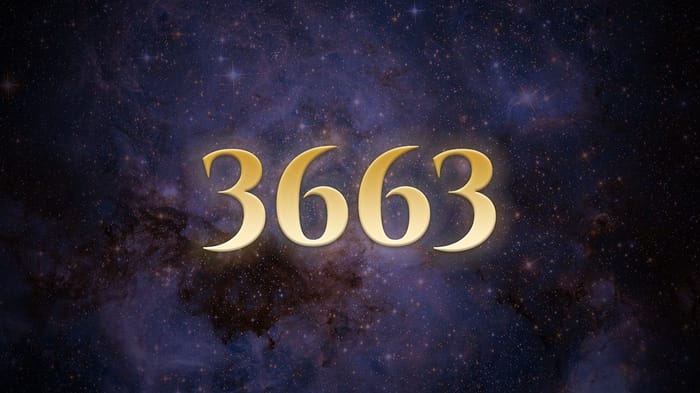
Read the digits: 3, 6, 6, 3. A palindrome - same forward and backward. The outer walls are expression. The inner chamber is doubled stewardship.
Balliett called 3 "the outward expression of the Christ principle of Trinity" - the number whose mission is to heal the sick and bless the world. "Theirs is a borrowed life lent for a purpose." Most musicians, artists, and actors vibrate to 3.
Agrippa described it as an incompounded number, a holy number, a number of perfection, a most powerful number.
In the tarot, 3 is the Empress. The creative force that takes raw material and gives it living shape - the triangle, first enclosed form in geometry, the synthesis that happens when two things meet and produce a third.
The inner digits are both 6s. Balliett called 6 the Cosmic Mother, the Finisher - "arranging the temple for others to use." Agrippa described 6 as the most perfect number in nature: the only number whose parts (1 + 2 + 3) add up exactly to itself.
"Neither wanting, nor abounding." The Pythagoreans called it the Scale of the World.
In the tarot, 6 is the Lovers - and in the deeper readings, the Lovers is about stewardship. The choice to orient your whole self toward tending something larger than your own comfort.
So the architecture reads: expression, then stewardship, then stewardship again, then expression. The creative voice bracketing years of hands-on devotion.

Why the Caring Is Doubled
A single 6 at the center - like 363 - places one act of tending inside a creative frame. You make something, you care for someone, you make something new from the caring. Clean arc, tidy resolution.
3663 doubles the caring.
Two 6s pressed together at the heart of the palindrome. Two seasons of stewardship before expression returns. The caring was not a brief interlude. It was a prolonged, transformative immersion in the needs of other people. The kind that changes the shape of your hands.
The first season of it teaches you the mechanics - how to show up reliably, how to subordinate your preferences to someone else's needs. The second season teaches you something deeper: that the caring itself has its own kind of beauty that has nothing to do with the beauty you used to make on stage.
Your creative voice is not in danger. The outer 3s guarantee that. The expression comes back. But it comes back reshaped by a long passage through devotion, and the person singing the second song is not the same person who sang the first.

What the Moon Teaches About Grief
Add the digits. 3 + 6 + 6 + 3 = 18.
Eighteen is the Moon in the tarot. A narrow path between two towers, a dog and a wolf howling at a light that is borrowed, reflected, showing you shapes without sharp edges. The Moon illuminates with the logic of dreams - the deep hum of something your body knows before your mind catches up.
The Moon governs the passage between the first song and the second. It is the light you have during the years of caregiving, and it is deliberately insufficient. You cannot see clearly by moonlight. You stumble.
You question whether you are doing this right, whether you are enough, whether the creative life you left behind will ever come back to you.
The caring years feel like moonlit years. You cannot make a spreadsheet of what they taught you. But when you sit down to write the second song, you discover that your hands know things they did not know before. The melody arrives from a deeper place.
The words carry weight they could never have carried when you were twenty-five and heartbroken in a coffee shop.
The Moon's light was enough. You just could not see that while you were living in it.
Whether 3663’s shadow side applies to you — and how strongly — depends on your core numbers. Your birthday reveals the first one.
Enter your birthday below:

The Shadow: Caring That Devours the Song
The warning that comes with 3663: the person who enters the doubled caregiving and never comes back out.
Maybe you are this person. The one who was creative once, who had a voice - and then life demanded that you tend, and you tended so thoroughly that you forgot you were also a maker. The outer 3s faded. The palindrome collapsed into just 66 - doubled devotion with no expression to bracket it.
The shadow is not about caring too much. It is about losing the thread back to yourself. The songwriter who sold the guitar because she decided she was "not that person anymore." After enough years without beauty, you start to believe you do not need it.
You do. The second 3 is not optional. It is the structural promise the number makes: the expression comes back. But it comes back only if you let it - only if you pick up the instrument again and let whatever the caring taught you pour through it.

Completion Through the Hermit's Lantern
Reduce further. 1 + 8 = 9.
Nine. The Hermit. Balliett called 9 free expression on all planes, the soul of things, the master of law - the number whose gifts are 3 multiplied threefold. Agrippa dedicated 9 to the Muses and the nine celestial spheres.
It is the end of the single-digit cycle, the number that contains every number that came before.
The Hermit is what 3663 becomes after the Moon has done its quiet, painful, beautiful work. The borrowed light of the caring years eventually resolves into the Hermit's lantern - steady, carried, held high to light the way for whoever follows.
The songwriter's second song is a Hermit's lantern. It does not perform grief. It holds grief up so that other people walking through their own dark passages can see the path a little better.
The Hermit has walked far enough to understand that the caring was never a detour from the creative life. The caring was the creative life, experienced from the inside, where nobody could see it. And the second song is the proof.

Frequently Asked Questions About Angel Number 3663
What does angel number 3663 mean?
3663 is a palindrome built from expression (3) on the outside and doubled stewardship (6-6) at the center, reducing through 18 (the Moon) to 9 (the Hermit).
The core message is about creative work that brackets a long season of caring - and the discovery that the caring transforms the creative work into something richer and deeper than what came before. The second song carries everything the first one could not.
What is the relationship between 3663 and its reverse, 6336?
6336 reverses the architecture - stewardship on the outside, doubled expression at the center. Where 3663 is the artist who becomes a caretaker and returns to art, 6336 is the caretaker who discovers a creative voice buried inside the tending. Both reduce to 9 through 18. Both pass through the Moon.
They are mirror experiences of the same transformation, approached from opposite starting points.
Why does 3663 pass through the Moon (18) on its way to 9?
Because the transition between the first creative act and the second one is not a clean, well-lit corridor. The years of caregiving are moonlit years - you cannot see clearly, you stumble, you question whether your creative identity will survive the passage.
The Moon's borrowed light is deliberately insufficient, and that insufficiency is part of the teaching. You learn to navigate by intuition and body-knowledge rather than certainty.
When the Hermit's lantern finally steadies at the end, its light is different from the Moon's - but it could only exist because you spent years learning to see in the dark.
What is the shadow side of 3663?
The shadow is the person who enters the doubled caregiving and never picks up the instrument again. Someone who was creative once, who had a real voice, but who tended so long and so thoroughly that she forgot she was also a maker.
The outer 3s faded and the palindrome collapsed into just 66 - endless devotion with no expression to bracket it. The number's architecture insists that the second song is structurally necessary, but the shadow is the refusal to believe that.
How is 3663 different from 363?
363 has a single 6 at its center - one act of tending inside a creative frame. The caring is briefer, the transformation more immediate. 3663 doubles the stewardship, which means the passage through caring is longer, harder, and more transformative. The single 6 teaches you what your art is for.
The doubled 6 teaches you a new language that your art did not previously speak. The second song in 3663 is not just better-aimed than the first - it is written in a different vocabulary entirely.

The Second Song
Come back to the songwriter.
She is sitting in the same house where her mother died. The hospital bed is gone. The house smells like itself again - wood and coffee and the faint sweetness of old books.
She has the guitar across her lap, and her fingers are finding a progression she has never played before, something in a minor key that keeps resolving into major in unexpected places.
The song is about a woman bathing her mother. About the weight of a body that used to carry you. About the strange tenderness of reversing the oldest relationship you know.
She sings about the last Tuesday, and the three weeks of silence, and the moment she picked up the guitar and discovered that her hands remembered how to play even though the rest of her had forgotten.
The second song has the Moon in it - all those borrowed-light years of tending. And it has the Hermit in it - the steady lantern of someone who has walked the whole path and come out carrying everything she learned.
3663. Song, then caring, then caring still, then song again. A palindrome that reads the same in both directions because the wisdom does not depend on which direction you read it. It depends on the fact that the caring happened in between, and the second song was brave enough to hold it.
Curious which numbers are active in your chart right now? Your birthday is the starting point.
Enter your birthday below:
Explore Angel Numbers
| Digit meanings | Angel Number 3, Angel Number 6 |
| Reduces to | Angel Number 9 |
| Similar patterns | 3553, 3773, 3443, 3883, 3993, 4004, 3223, 4114 |
Behind Your Angel Number
calculate your full numerology chart·find your life path number·numerology, explained