Angel Number 335: The Justice of the Freed Artist's Choices
By Blair Andrews · Published July 7, 2023 · Updated May 21, 2026
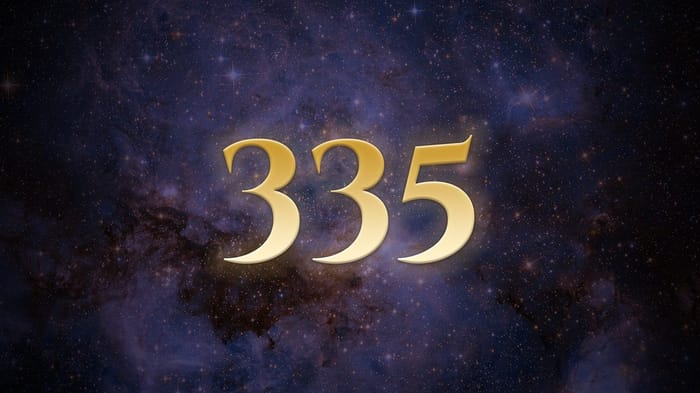
The numbers inside 335


3 + 3 + 5 = 11
11: Heightened awareness, sensing what others miss
Doubled creative voice plus governance lands on the scales of Justice - and the scales hold. 335 halts at master number 11: the creative life under discernment, every choice weighed, nothing made carelessly from this point forward.
What 335 means for you specifically depends on which of the 11 Life Paths you’re on. Your birthday determines that.
Enter your birthday below:

Every artist who has truly freed their voice eventually faces a specific kind of Justice - not about what they should make, but about what they will choose not to make with the freedom they fought so long to earn.
This is not the Justice of the beginner, who is weighing whether they are allowed to create at all. That weighing is long past.
The person inside 335 has already made, and made again, and then - at real cost - freed themselves from the constraints that once kept the making small. The permission question is closed. They can make what they want. They can make how they want. They can make for whom they want.
That is the condition 335 describes. And that condition, despite being the one every younger version of the artist dreamed of reaching, is not the end of the work. It is the beginning of a harder work that no one warned them about.
Because the freedom is now large enough to matter, and the days are now finite enough to notice, and somewhere between the freed voice and the ticking hours a set of scales has quietly been placed on the table.
The scales do not ask whether the artist may create. They ask a different question, with the patience of an instrument that is not going anywhere until it is picked up. Which of these freedoms deserves to be used? Which of these works deserves the freed voice?

The shape of the number
Look at 335. A three. Another three. And then a five.
In the older symbolic reading, the order of the digits is not decorative. The sequence is telling a story. The earlier digits describe what has been produced - the later digit describes the condition the producer now stands in. And the reduction at the end tells the reader what kind of instrument the sequence has placed in their hand.
Here the story is unusually specific. Two layers of creative making, and then the liberation. The artist who has made, and made again, and then walked out of the studio they had been pacing inside for years. Not to stop making. To make differently. To make from a place their earlier selves could not have reached.
Each of those digits is worth sitting with before the scales come into view.

The first three
The 3 is the number of creative expression in its first, warmest form. In the tarot it is the Empress, seated in a garden that is already overflowing, surrounded by things that have decided, without being forced, to come into being.
In the older geometric systems it is the triangle - the first shape that encloses space, the strongest structure in nature, the architecture of synthesis.
Three is the number that moves through a person when they first discover they can make. The voice arrives. Something inside them that had been folded in on itself begins to unfold. The notebook fills. The canvas fills. The song fills. For the first time, an interior state has found a way to become an exterior form.
Three is warm and outward and fertile. It is the number of everyone whose life has been organized, at some level, around getting what is inside them to the outside.
The first three in 335 is the early creative life. The discovery that making is possible. The pouring of the initial voice into whatever forms were available. The years in which every act of making was, regardless of its product, a kind of proof to the self that the inner world was real and could be spoken.
This is not a small thing. Most people never have the first three. They carry the interior forever and never find the form that would let it out.

The second three
The second three is the one people often miss, and it is not the same as the first.
The first three was the discovery. The second three is what happens when the discovery is repeated. The voice that arrived once arrives again.
The making, which might have been a single lucky expression, reveals itself to be a capacity. There is another piece. And another. And another. The well did not run dry. In fact, the well turns out to be deeper than the first drawing suggested.
The second three is where the artist learns, slowly, that they are not a single flash. They are a continuous source. The creativity is not a windfall. It is the ground they walk on.
This doubling also produces something the first three could not produce alone: a body of work. Unfinished, uncurated, but a real accumulation. The studio has begun to fill. Drafts stack. Sketches pile. Ideas, once rare and precious, begin to arrive in numbers that exceed the hours available to render them.
And here the first real strain begins to show. The doubled three, left to itself, scatters. It generates openings at a rate no single life can close. This is not a flaw of the three - it is simply what three does. Three makes. It does not, by itself, discriminate.
The person carrying the doubled three has proved, beyond any reasonable doubt, that they can make. What has not yet been proved is what kind of maker they will become.

The five, finally
Then the five arrives.
The 5 is the most misread number in the popular literature. The popular literature calls it "the wild child" - the thrill seeker, the impulsive wanderer, the one who cannot sit still. But the older tradition understood something far more interesting about the five.
In the esoteric tradition, five is the pentagram. Four points for the elements - earth, water, air, fire - and a fifth point, the head, ruling over them. The five is not unruled freedom.
It is the freedom that comes from the self finally presiding over the forces that were previously presiding over it. The tarot figure associated with five is the Hierophant - the inner teacher, the voice that has learned how to listen to itself.
Five is mastery of desire, not surrender to it. It is constructive freedom.
It is the person who has worked out, at real cost, which of their impulses belong to the deepest part of them and which were only borrowed from outside. Having worked that out, they now live inside a particular kind of liberation: the ability to say yes from their own center and no from the same place.
In 335, the five arrives after the two layers of making. This order matters. The artist has spent years producing - the first three, the second three - often inside frameworks that were not their own. The forms they used were inherited.
The audiences they addressed were assumed. The shape of the career, if they have one, was copied from other careers that looked legible from the outside. The making was real, but the terms of the making were rarely chosen.
The five is the step that changes that. The artist, at some point, liberates themselves from the inherited frame. This can look like many different things. A resignation. A departure.
A rejection of a style that was winning but not true. A refusal, finally, to keep making the thing other people wanted the voice to make. Whatever form it takes, the five is the act by which the freed voice becomes actually free.
And now, for the first time, the artist stands in a condition their earlier selves could not have imagined: they can make what they want, they can make how they want, and no outside structure is holding the frame in place for them.
This condition, which sounds from a distance like an arrival, turns out to be a doorway.

What the arithmetic is pointing at
Add the digits of 335. Three plus three plus five.
Three plus three is six. Six plus five is eleven.
Three plus three plus five rings to eleven. In numerology, certain numbers resonate at a harmonic that single digits cannot produce - 11 is one of those overtones.
The weight the composite has been carrying stays. The person is not given the relief of a single-digit answer.
The arithmetic has arrived at a specific place. After the doubled creative capacity and the hard-won liberation, the number settles on the scales of the eleven.
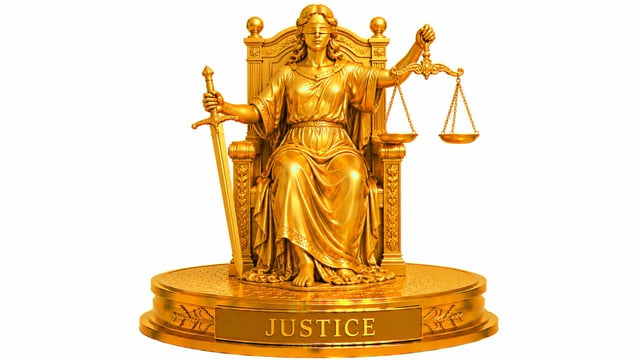
In the older tradition, eleven is the Justice card of the tarot. A seated figure with a sword in one hand and a set of scales in the other.
The sword is for discernment - the clean cut between what matters and what does not. The scales are for weighing - the patient measuring of one thing against another until the truth of their relative weight becomes visible.
The eleven of the tradition carries a quiet weight that has nothing to do with nervous sensitivity. Justice is steady. The eleven is the capacity to hold two weighted things, one in each pan, and feel - without rushing, without flinching - which one is heavier.
The question, always, with an eleven, is what is being weighed. And in 335, the answer has a particular shape that is worth naming plainly.
Whether 335’s shadow side applies to you — and how strongly — depends on your core numbers. Your birthday reveals the first one.
Enter your birthday below:

The scales of the freed voice
The scales of 335 are not asking the artist whether they are allowed to create. That question is long answered.
A note from the practitioner: If you found 335, you are probably not a beginner wondering whether you are allowed to create. That question closed a long time ago. The question you are carrying is harder: of all the things your freed voice could make, which ones actually deserve it? That is the right question. The fact that you are asking it means the scales have already arrived.
They are not asking, either, whether the artist has the capacity to create. The doubled three settled that. The person has made, and made, and made again. The capacity is not a question anymore. It is a given.
They are not even, in the way the 83 scales ask, about which existing pieces to finish. The craftsman's weighing was about works already on the bench. The 335 weighing comes earlier than that. It comes before the piece is started.
And they are not, in the way the 155 scales ask, about which doors to close. The 155 person is weighing which of the many available freedoms to stop using, which invitations to decline, which rooms to walk out of. The 155 weighing is a management of an already-constructed freedom. It is about maintenance.
The 335 weighing is different, and more interior. It arrives at the moment the artist realizes that the freedom they fought for is not a resource they can spend on everything. It is a currency. And like any currency, it buys some things and is squandered on others.
The scales of 335 ask: Of the works that are possible for this freed voice to make, which ones deserve the voice?
This is a quieter question than it sounds. It is not about external worth. It is not about market. It is not about what will sell or what will be understood. Those questions have their own weights, but they are not the weights the master number is asking about.
The 335 scales are asking whether the freed voice is about to be spent on a piece that would, honestly, sit better in someone else's mouth - or on a piece that requires exactly this artist, at exactly this point in their life, with exactly this history of making and remaking and finally breaking free.

The particular failure the scales guard against
There is a specific failure the scales of 335 are built to prevent, and it is worth naming because it is subtle enough to hide easily.
The artist who has just liberated themselves is, for a period, intoxicated. The intoxication is not cynical. It is simply the condition of someone who has been in a room for a long time and has finally stepped outside. The first breath of the new air is extraordinary. The second breath is also extraordinary. The third breath begins to be a breath.
In that first period of liberation, the artist tends to make in every direction at once. The freedoms accumulate. They say yes to things they would never have said yes to before, not because those things are right for them, but because saying yes itself feels like proof of the freedom.
The permission to make is so freshly won that using the permission becomes the thing, and the question of whether any given use of the permission actually deserves the voice gets deferred.
This is the moment the scales arrive. The joy is real, and the tradition does not mind the joy. But the scales are placed on the table, patiently, because the artist is about to begin spending the thing they most recently won - and they are about to begin spending it on works that do not, in the long arithmetic of a life, deserve it.
Some pieces would be better made by someone else. Some pieces were interesting to imagine and are already spoken for by other makers. Some pieces are left over from the unfreed version of the artist and are simply the last gravity of an earlier orbit.
The freed voice, if given to those pieces, is not destroyed - nothing is so easily destroyed. But it is spent. And what is spent on one thing is no longer available for the other.
The scales of 335 are asking the artist to notice this before it becomes a pattern.

How the weighing actually happens
In practice, the weighing of 335 is a quiet act, and easily skipped.
It begins with an honest inventory. The artist lists, in whatever form suits them, the works that are currently calling. The ones that are asking to be started. The new projects that have arrived since the liberation. The invitations that have come. The ideas that have surfaced. The offers. The collaborations. The impulses.
Most of these, on first inspection, look like they deserve the voice. They are all, in some sense, possible. None of them are stupid. The freed artist is now attractive to a wider range of possibilities than the unfreed artist was, and the range is real.
The first weighing sets each of those possible works, one at a time, on the scale. And the scale has a specific counterweight. On the other pan, always, is the reality that the freed voice can only make a finite number of things in the remaining years. Finite. Smaller, usually, than the freed artist wants to acknowledge.
With that counterweight in place, the weighings begin to sort themselves.
Some possible works, held in the light of the finite counterweight, are clearly overweight - they do, in fact, deserve the voice, and the scales tip toward them immediately. Others, held in the same light, are clearly underweight.
Worthy of being made by someone, certainly. Just not worthy of this particular voice, which was earned at this particular cost, and which has this particular amount of remaining time.
The second weighing is subtler. Among the possible works that passed the first weighing, the scales begin to ask which ones require the specific liberation the artist has earned.
Some of the shortlisted pieces could, if pressed, be made by an earlier version of the artist - the version that existed before the five, before the break, before the full freeing of the voice. Those pieces are real, but they are not the pieces only this version of the artist can produce.
The scales of 335, in their deepest weighing, point at the works that require exactly this person, at exactly this stage of their liberation. Because those works will not happen if this voice does not make them.

Why the tradition places the scales here
It would be easy to miss why the eleven lands precisely at this point in a creative life. The placement is not accidental. The older tradition placed the scales here because of a pattern the tradition had observed across many lives.
A note on sources: The older tradition places the scales - the Justice card, the 11 - at precisely this juncture because of a pattern observed across many creative lives. Before liberation, the inherited framework does the weighing for the artist, crudely but automatically. After liberation, the weighing becomes entirely the artist's own. Balliett called 11 the number that cannot be reduced without losing its purpose. The doubled 1 inside it carries the weight of a responsibility that single digits cannot hold.
Before the liberation, the artist does not need the scales. The inherited frame was doing the weighing for them, poorly but automatically. The questions of what to make and how to make it were being answered, in crude form, by the constraints of the frame. The constraint was stifling, but it was also, quietly, a kind of help.
After the liberation, the frame is gone. And when the frame is gone, the weighing becomes the artist's own. No one else can do it for them. No editor, no gallery, no teacher, no audience, no market. The voice is genuinely free, which means the voice is also genuinely responsible for where it chooses to go.
The scales of 335 are the instrument the tradition hands to the artist at precisely the moment the external framework has been removed. They are not a constraint. They are the thing that allows the freedom to be used well rather than spent carelessly.
This is why the eleven lands here. Not as decoration. As necessity. A freedom this large, without the scales, is not freedom at all. It is a fast and well-meaning dispersal of a voice that was hard-won and will not be won again in this lifetime.

The closing image
Picture a studio.
It is not the studio the artist started in. That one is long behind them. It is not even the studio they were working in at the moment of the liberation - they have moved since then, or the studio has moved around them. The light in this room is different. The walls carry none of the earlier constraints.
On a table near the window is a set of scales. They were not there before. They appeared, quietly, in the weeks after the freeing of the voice. The artist noticed them one morning and understood, without needing to be told, what they were for.
In front of the scales, laid out, are the possible works. Some are sketches. Some are letters of invitation. Some are the first paragraphs of things that could become books, or the first measures of things that could become songs, or the first frames of things that could become films. None are started. All are possible.
The artist is not rushed. The freed voice has no deadline except the one the finite years impose, and that deadline is not today.
One by one, they place the possible works on the scale. Against each one, on the other pan, sits the honest counterweight - the fact that only so many pieces will be made, and that each one that is made will consume the particular freedom that was won at real cost and cannot be won again.
Some of the works lift off the scale and are gently set aside. They were possible, but they were not this voice's. Someone else may make them. Perhaps someone else already is.
Others settle low on the scale, heavy with the specific weight of being what only this artist, now, can make. Those are the ones the freed voice will carry forward. The ones that outweigh.
The artist is not triumphant. They are not even, in the usual sense, satisfied. They are simply clear.
Three gave them the voice. Three, again, gave them the proof that the voice was a source, not an accident. Five gave them the liberation that set the voice actually free. And eleven has placed the scales in the room where the freed voice will now do its weighing - so that the freedom, once spent, is spent on the works that deserved it.
This is the Justice of 335. The patient weighing, by the artist alone, of which of their many available freedoms the freed voice will choose to use - and which, with no resentment and no regret, it will choose to let go.
The scales are not philosophical. They are what the freed voice does next.
Curious which numbers are active in your chart right now? Your birthday is the starting point.
Enter your birthday below:
Explore Angel Numbers
| Digit meanings | Angel Number 3, Angel Number 5 |
| Reduces to | Angel Number 11 |
| Mirror | Angel Number 533 |
Behind Your Angel Number
free numerology calculator·life path calculator·what is numerology