Angel Number 272: The Victory Framed on Both Sides
By Blair Andrews · Published June 29, 2023 · Updated May 21, 2026
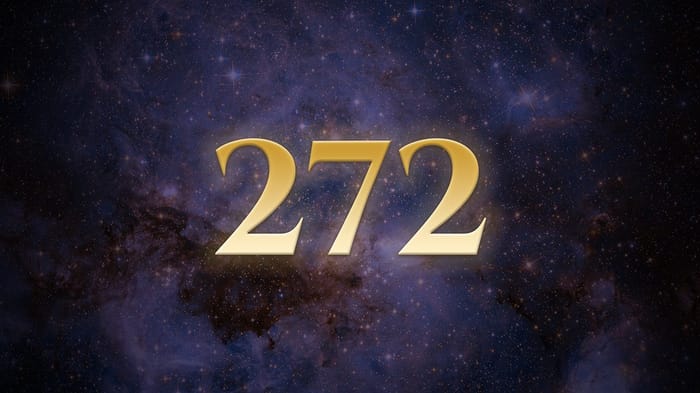
The numbers inside 272

2 + 7 + 2 = 11
11: Heightened awareness, sensing what others miss
Rare hidden master number - the scales ask whether you were faithful to the relational shape that framed the victory. 272 is a palindrome of partnership-victory-partnership that holds Justice at 11, and the accountability question here is the one victory on its own never asks.
What 272 means for you specifically depends on which of the 11 Life Paths you’re on. Your birthday determines that.
Enter your birthday below:

Before anything else, look at the architecture of the number.
272 is the rare master-11 that is also a palindrome. Two partnerships framing one victory, summed to Justice. A reader encountering the number for the first time might think its three digits are simply a sequence. They are not a sequence. They are a shape.
And the shape has a meaning the sequence would not.
In the older symbolic traditions, a palindrome is almost never idle.
When a number reads the same forward and backward, the tradition treats that symmetry as a structural statement - not about arithmetic, but about the architecture of the moment it is naming. Something is being held. Something is at the center. Something is framing it on both sides.
272 says that the victory at its center did not stand alone. It was held, at its left hand and its right, by partnership. And the whole thing, when summed, lands on the scales.

The left-hand two
The two is the High Priestess of the tarot. She sits between two pillars, a half-hidden scroll in her lap, the moon above her. She does not speak first. She receives.
In the older tradition she is the geometry of receptivity, the second point that, appearing after the first, creates the line. Before two, there is only a lone dot. After two, there is direction. Distance. Somewhere to go.
The two is the number of partnership in its most structural sense. Not decoration, not sentimentality. The architectural fact that a single point, on its own, cannot indicate anything. It requires a second point before motion becomes possible at all.
In the lives of people who achieve anything of real weight, the left-hand two is usually the partnership that made the whole thing conceivable in the first place. The early believer.
The person who saw the possibility before the possibility had proven itself. The one who stood at the far end of the line when there was still only one point, and who said, by their mere willingness to be there, there is a there, now.
This partnership is often quiet. It does not always survive intact to the moment of victory. Sometimes the left-hand two is a parent, a teacher, a first collaborator who believed when belief was scarce. Sometimes it is a partnership the reader has long since outgrown, or mourned, or lost touch with.
But the fact of its being there, when it was needed, is what allowed the shape to begin forming.

The seven at the center
The seven is the Chariot of the tarot. The charioteer standing in the vehicle, two beasts below pulling in opposing directions, reins held steady in hands that have learned how to hold them both at once.
The seven is victory, not luck, despite the modern translation. The ancient word rendered as "lucky" meant, more precisely, victorious. Seven is the number of something that was driven to its destination.
The alignment that made the pulling together of opposing forces possible. The inner discipline that finally overtook the outer circumstances and arrived somewhere.
In the older framework, seven is also a meeting place. Three plus four - the divine triangle meeting the earthly square. Heaven reaching down, earth reaching up, and something catching fire at the point where they touch. The seven is therefore never a solo achievement. It is structurally composite.
At the center of 272, the seven is not merely an accomplishment. It is a bridge, the thing that was arrived at because something above met something below. And, importantly, the place it has been reached is the center of a three-digit shape, with a two on either side.
That centrality is doing work. A seven in isolation would belong to the person who drove. A seven at the end of a line of digits would belong to the person whose partnerships produced them.
But a seven in the middle of two partnerships is a seven that was framed. Held. Surrounded on both sides by presences whose job was not to drive the chariot, but to make the driving possible.
The reader who carries 272 has to sit with this. The victory in this number was never owned alone. It was held on both sides while it was happening.

The right-hand two
Then another two. The same High Priestess, the same geometry of receptivity, now on the far side of the victory.
This is the subtle part of 272's architecture. Most numerical readings focus on what precedes an accomplishment. They ask what produced it, what cleared the way for it, what gave rise to it. 272 asks something different. It asks what was present afterward.
The right-hand two is the partnership that caught the victory once it had been driven home.
Think of the people who gather around someone who has just done a thing. Not the early believers - those are accounted for on the left side of the number. The ones who caught the person on the other side of the completion. The friend who was there the night after the book was finished, when the strange emptiness of having done it arrived.
The partner who lived with the person in the slow quiet that followed the public recognition, when the rest of the world had moved on. The collaborator who was not there for the climb but who helped carry what the climb produced into its next form.
This is a different partnership from the first one. It is not originary. It is receptive in a different sense, receiving what has already happened and helping it land.
A victory without this right-hand two tends to evaporate. The person who won, if no one was there to receive what they had done, finds themselves oddly unanchored by it. The accomplishment does not quite become part of a life, because there was no second partnership shaped to hold what the first partnership had helped produce.
272 names, with its palindromic insistence, that this was also a two. That the shape was not lopsided. That the victory was framed on both sides.

Why the palindrome matters
Few master-elevens are also palindromes. Most three-digit composites that land on eleven are linear - a procession of digits telling a one-directional story, left to right, ending in the arithmetic weight of the master.
272 does not tell a one-directional story. It tells a framed one.
The victory at the center did not belong only to what came before it, nor only to what came after. It was held, simultaneously, by partnerships on both sides. The left-hand two and the right-hand two are mirror images of each other. The Chariot between them is mirrored by neither, but it is contained by both.
In the older symbolic traditions, this kind of mirrored framing indicates the architecture of what is shared in the highest sense. Not shared in the weak sense of distributed credit. Shared in the structural sense: the thing's existence required the framing presences, and the framing presences were themselves transformed by what they framed.
272 is given to victories of this particular shape. The shape in which the partnership at the front and the partnership at the back are not merely witnesses to the accomplishment at the center. They are the walls that made the accomplishment possible to stand up inside of.
Whether 272’s shadow side applies to you — and how strongly — depends on your core numbers. Your birthday reveals the first one.
Enter your birthday below:

The arithmetic, when it comes
Only now is it worth following the arithmetic.
Two plus seven plus two. Two plus seven is nine. Nine plus two is eleven.
Two plus seven plus two builds to eleven, and eleven stands. You cannot dismantle a master number without losing the thing that makes it a master number - the tension between two digits held in permanent dialogue.
The weight does not lighten. Whatever the composite has been carrying, it keeps carrying, and the carrier does not get the relief of a simpler answer.
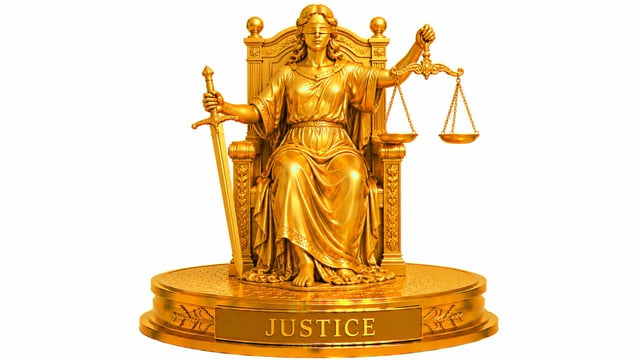
The eleven is the Justice card in the tarot. A seated figure holding a sword in one hand and a set of scales in the other. The sword is for discernment, the clean cut between what matters and what does not.
The scales are for weighing - the patient, unhurried work of measuring one thing against another until the truth of their relative weight reveals itself.
The question, always, with an eleven, is what is being weighed. Each composite that sums to eleven hands the scales to a different kind of weigher and asks a different kind of weighing.
272 asks its own.

What the scales of 272 are weighing
The reader who carries 272 has lived the full architecture of the number. They have had the partnership that preceded the victory. They have driven the chariot home. And they have had the partnership that received what they drove. The shape has been completed. The scales are now being placed in their hands.
The scales of 272 are not asking whether the reader won. The victory sits, plainly, at the center of the number; that arithmetic is done. They are asking something subtler.
The scales of 272 are asking whether the reader was faithful to the shape.
The shape of the number is a victory framed on both sides by partnership. The question, therefore, is whether the reader held that architecture during the course of their accomplishment.
Whether they remained aware, while the chariot was moving through the middle of the number, that they were being framed. Contained. Held by presences on either side of what they were doing.
Because it is possible to win without holding the shape. It is possible to drive the Chariot through the middle of a life and pretend, while driving, that no hands are on either side of you. You can arrive at the victory having forgotten the left-hand two.
You can collect the victory having failed to make room for the right-hand two. In both cases, you have not been unsuccessful, the seven still sits at the center; the prize still exists. But the framing has been neglected.
The scales of 272 notice this. They do not ask whether you won. They ask whether you stayed aware, all the way through, of the partnerships that flanked your victory.
Whether you honored the left-hand two by remembering who made the driving possible, and whether you honored the right-hand two by leaving space, after the prize was collected, for the partnership that would catch it.
This is what faithfulness to the shape looks like. It is not credit distribution. It is something quieter - a continuous attentiveness, through the whole arc of the accomplishment, to the structural fact that you were held on both sides.

The weighing in practice
For many people who encounter this number, the honest answer to its question is partly.
During the early struggle, the left-hand two is usually vivid. The early believers are necessary, and therefore remembered. During the middle of the drive, things often get blurrier. The work narrows. The focus tightens.
The framing presences recede - not because they have left, but because the driver's attention contracts to what is directly in front of them. By the time the victory is arriving, the right-hand two is often not yet in view.
The partnership that will catch the accomplishment has not quite formed, or has formed but has been overlooked in the intensity of crossing the line.
None of this is failure. The scales are not weighing success. They are weighing whether the reader, looking back now, can see what they did not fully see at the time - and whether, in seeing it, they are willing to hold the shape retroactively.
Retroactive holding of the shape is the quiet work 272 asks for. The left-hand two gets honored by remembering it - returning to it in thought, and sometimes in contact, and letting the partnership that preceded the victory be acknowledged as what it was.
The right-hand two gets honored by making room for it - not treating the post-victory partnership as scaffolding to be dismantled once the accomplishment is secure, but letting it be what the shape requires: the receiving frame that catches what the driver drove.
When both are held, the scales settle. The eleven has done its work.

The closing image
Picture, at the end, a driver of a chariot who has just reached the destination.
The prize is at the driver's feet. The beasts that pulled the chariot are resting. The drive is over. In the modern version of this scene, the driver would turn and raise their arms and take the applause of the crowd, and the story would end there.
In the older version, something different happens.
The driver steps down from the chariot and looks to their left. There, at a distance, is the figure who believed in the journey when belief was scarce. The figure is older now, further away, perhaps no longer close - but unmistakably the one who made the first step possible.
The driver acknowledges that figure. The acknowledgment happens quietly, a private nod between driver and witness. The acknowledgment is an act of the interior, a returning of the attention to the partnership that had always framed the left side of the shape.
Then the driver turns to the right. There, closer, sometimes only newly arrived, is the figure who has come to receive what was driven. The friend who was waiting. The partner who will help the accomplishment become part of a life.
The collaborator who will carry what the drive produced into its next form. The driver acknowledges this figure as well. Not ceremonially. Simply - by leaving room. By allowing the victory to be held, now, in a partnership that was always going to be waiting on the other side.
And only then, with both framing presences acknowledged, does the driver pick up the prize.
The scales of eleven, which have been watching the whole arc, settle. Justice has been done - not because anyone has been judged, but because the shape has been honored. The palindrome has been held.
That is the Justice of 272. The scales handed to someone whose win was framed on both sides by partnership, asking whether they were faithful to the shape of what they shared. The Chariot in the middle may be theirs to drive, but the reins pass through hands on both sides of them. The number is asking only whether they drove with that awareness.
Whatever part they missed can be held now, in the quiet evening after the prize has been collected, while the scales rest in their hands and the shape of what they shared becomes, finally, fully theirs to see.
Curious which numbers are active in your chart right now? Your birthday is the starting point.
Enter your birthday below:
Explore Angel Numbers
| Digit meanings | Angel Number 2, Angel Number 7 |
| Reduces to | Angel Number 11 |
Behind Your Angel Number
free numerology calculator·life path calculator·what is numerology