A deeply built domestic life meets a crisis that illuminates every joint and seam. 2266 says the Tower is diagnostic here, not punitive - it finds the seam between genuine bond and performative bond, and what’s structurally real survives.
Angel Number 2266: Two Rounds of Listening, Then Two Defining Choices
By Blair Andrews · Published April 18, 2026 · Updated May 21, 2026
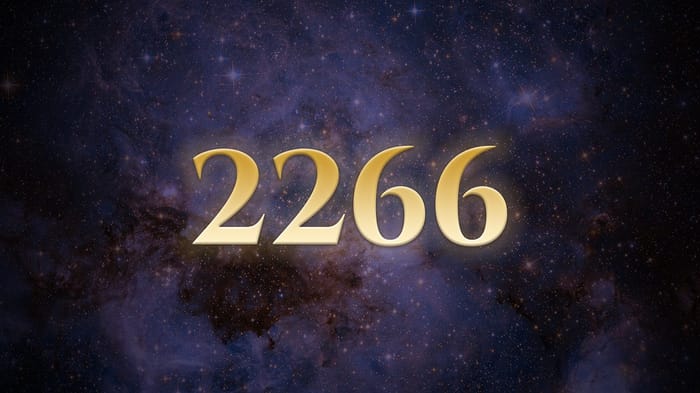
The numbers inside 2266

2Partnership, patience, trust
6Home, responsibility, the people closest to you
2 + 2 + 6 + 6 = 16 → 7
7: Understanding, depth, seeing what others miss
What 2266 means for you specifically depends on which of the 11 Life Paths you’re on. Your birthday determines that.
Enter your birthday below:

There is a family photograph you have probably seen in someone else's house, or maybe your own. Everyone is smiling. The kitchen behind them is clean. The dog sits where the dog was told to sit. Everything in that frame says: we are fine. We are together. We are holding.
Now imagine a storm comes through. The kind that takes the roof off the garage and drops a tree across the driveway. The power is out for three days. The basement floods. Nobody is smiling for photographs anymore.
What happens next is the part that matters.
Some families discover, in the flashlight dark, that the people they built a life with are the same people they would choose again. The teenager who never talks suddenly organizes the food. The spouse who seemed distant is the one holding everything steady at two in the morning.
Other families discover the opposite. The togetherness was decorative. The bonds were contractual, maintained by routine, and the moment the routine broke, there was nothing underneath.
Both discoveries are what 2266 is about.

A Home Built by Four Hands
The first two digits are both 2s. In Balliett's system, 2 is the mother nature, the collector, the peacemaker who draws others close and nourishes what they plant. In the tarot, 2 is the High Priestess - the one who receives, who listens, who sits between two pillars and absorbs what the conscious mind has not yet processed.
Two of them. Two receivers. Two listeners. Two people turning toward each other with the specific patience that partnership requires - the willingness to hear your own uncertainty once, let it settle, and then hear it again when a deeper layer surfaces.
The old Pythagorean tradition called 2 the number of charity, mutual love, and marriage. Agrippa wrote that it carries the weight of "two shall be one flesh." When you double that energy, you get something rare: two people who have each chosen, separately, to stay receptive. Two listeners in the same room, neither one forcing the conversation forward.
Balliett described 2 as the one who waters and nourishes the seed others plant, and often reaps the harvest. A doubled 2 is two people watering each other's seeds. The intimacy of that arrangement is enormous, and so is the risk. Because when two people have invested that deeply in receiving each other, the thing they have built together becomes their whole weather system.

The Weight of Doubled Care
Then come two 6s. And 6 changes the texture entirely.
6 is the Cosmic Mother in Balliett's framework - the finisher, the one who arranges the temple for others to use. In the tarot, 6 is the Lovers, and that card is about something much heavier than romance. The Lovers is the moment of defining choice, the crossroads where you decide what you are actually committed to with full knowledge of what it will cost.
Agrippa called 6 "the number of perfection, because it is the most perfect in nature" - the only number whose parts (1, 2, and 3) sum to equal itself. The Pythagoreans named it the Scale of the World and applied it to generation and marriage. The world was finished on the sixth day. The work of 6 is completion, stewardship, the tending of what has been brought into being.
Two 6s, then. Doubled stewardship. Two rounds of defining commitment. You chose a life of care, and then you chose it again when the first choice was tested. You kept the household running. You showed up to the school meetings. You held the finances together through the lean year and the leaner one after it. You did the work of 6 - the finishing, the arranging, the quiet labor of making a life function - and you did it twice over because that is what the life required.
The 2-2-6-6 pattern is the architecture of a deeply built domestic life. Two partnerships (2, 2) maintaining two layers of care (6, 6). It is the couple who has been together long enough that the love and the logistics have become almost indistinguishable.

Then Lightning Finds the Seam
Add the digits. 2 + 2 + 6 + 6 = 16.
Sixteen is the Tower.
The Tower is the storm. The diagnosis. The affair discovered. The child who leaves and does not come back for Thanksgiving. The bankruptcy, the fire, the phone call at midnight. Whatever it is, it hits the structure you built together and it does not ask permission.
Agrippa's tradition called 16 "the number of felicity" - which sounds perverse next to a lightning-struck tower until you understand what the old philosophers meant by felicity. They did not mean comfort. They meant the state that follows the removal of everything false. Felicity, in the Renaissance sense, was what you discovered about yourself when the decorative layers had been stripped away.
The Tower does not hit random structures. It finds the seam - the place where the load-bearing wall meets the facade. The place where what you were actually feeling diverged from what you were performing. If the partnership was genuine all the way down, the Tower cracks the surface but the foundation holds. If the partnership was maintained by routine and willpower and the quiet daily habit of not looking too closely, the Tower goes deeper.
This is the crisis point of 2266. Two rounds of listening and two rounds of care, tested by a single bolt that illuminates every joint and seam. You find out which bonds were real.
Whether 2266’s shadow side applies to you — and how strongly — depends on your core numbers. Your birthday reveals the first one.
Enter your birthday below:

The Sacred Knowing
16 reduces to 7.
Balliett called 7 the finished number and "the sacred." A closed number, like a person carrying a pack on their back. A complete temple standing alone. 7 carries a refined atmosphere, she wrote, and remains partially a mystery even to those who love it. The Earth itself vibrates to 7, and a person who lands there understands the secrets of the earth as no other can.
In Agrippa's system, 7 is the number of Virginity, "because the first is that which is neither generated, or generates" - and it was dedicated to Pallas Athena, the goddess of wisdom who was born fully formed. Seven is knowledge that does not need to be taught because it has been lived.
After the Tower hits a life built on doubled partnership and doubled care, what remains is a kind of knowing that cannot be faked or borrowed. You know which of your relationships survived because they were real and which ones survived because you were too tired to end them. You know which acts of care were genuine expressions of love and which were performances you maintained because you did not know who you would be without the role.
The 7 at the end of 2266 is earned knowledge. The kind that arrives only after the storm has passed through and you are standing in the yard looking at what is still standing.

The Shadow in the Ruins
The warning that comes with 2266 is worth naming plainly.
The shadow is this: you kept the beautiful life running so long that you forgot to check whether it was still alive.
Two 2s receiving, two 6s tending, and somewhere in all that devoted maintenance, nobody stopped to ask whether the thing being maintained still had a pulse. The dinners happened. The holidays happened. The mortgage got paid and the lawn got mowed. From the outside it looked like a family, like a partnership, like a home. And maybe it was. Or maybe it had become a museum exhibit of what those things looked like, carefully preserved and completely airless.
The shadow of 2266 is care that has become performance. Love that has become logistics. The partner who says "we're fine" so reflexively that neither of you notices it has been years since anyone checked whether that was true.
When the Tower finds that particular seam, it is not punishing you for building wrong. It is showing you where the living tissue ended and the scaffolding began.

What Survives the Storm
2266 does not end at the Tower. 16 reduces to 7, and 7 is wisdom. The sacred. The finished thing.
When you walk through the wreckage and take inventory, some of what you built was genuine. The bond with the person who stayed - not because they had to, but because when the lights went out they reached for your hand and meant it. The soup made at midnight. The bill paid without mentioning it. The quiet act of showing up on the worst day without being asked. Those survive. The Tower cannot touch them because they were never propped up by anything external. They were structural.
Balliett wrote that 7 has the power of internal sight, hearing, and the knowledge of the Presence. After the Tower of 2266, you have exactly that. The sight that knows which bonds are real. The hearing that can tell the difference between a partner's genuine voice and the performance voice they use when company comes over. The knowledge of who was actually there, and who was only nearby.

Frequently Asked Questions About Angel Number 2266
What does angel number 2266 mean?
2266 is the number of a deeply built life - doubled partnership (2, 2) and doubled care (6, 6) - that gets struck by a Tower moment (the digits sum to 16) and arrives at sacred knowing (16 reduces to 7). It describes the experience of having your most carefully maintained bonds tested by crisis, and discovering through that test which of them were real and which were held together by habit.
Is 2266 a bad sign because it contains the Tower?
The Tower is not punishment. The old Renaissance traditions called 16 a number of felicity - meaning the state you reach after the false layers have been removed. The Tower in 2266 strips the performance from your relationships, and what it reveals can be deeply reassuring if the bonds underneath were genuine. The "bad" part is only what was already hollow.
What does 2266 mean for relationships?
2266 is one of the most relationship-specific angel numbers because every digit deals with partnership and care. The doubled 2 is two people who chose to listen to each other, and the doubled 6 is two rounds of committed stewardship. When this number surfaces, your relationships are being asked a direct question: is the closeness real, or is it maintained by routine? The answer the Tower reveals is the answer you already know in your body but may not have said out loud.
What should I do when I keep seeing 2266?
Look at the bonds you are maintaining and ask yourself one honest question: which of these would I choose again today, from scratch, knowing everything I now know? The ones you would choose again are the real ones. The ones you are maintaining out of obligation, fear of disruption, or the sheer momentum of having maintained them this long - those are the seams where the Tower is going to find its opening. You do not have to burn anything down. You just have to stop pretending the seam is not there.
Why does 2266 reduce to 7 instead of staying at 16?
Because the Tower is a passage, not a destination. 16 is the lightning strike, but 7 is what you know after the flash fades. Balliett called 7 "a complete temple standing alone," and that is exactly what 2266 is building toward - the self that remains when the performed bonds have fallen and the real bonds have held. The wisdom of 7 is the wisdom of someone who has been through the storm and can now tell the difference between shelter and a cage.

Curious which numbers are active in your chart right now? Your birthday is the starting point.
Enter your birthday below:
Explore Angel Numbers
| Digit meanings | Angel Number 2, Angel Number 6 |
| Reduces to | Angel Number 7 |
| Mirror | Angel Number 6622 |
| Similar patterns | 2255, 2277, 2244, 2288, 2233, 2299, 2211, 2200 |
Behind Your Angel Number
free numerology calculator·life path calculator·what is numerology