Angel Number 191: The Weighing at the Hinge
By Blair Andrews · Published March 15, 2023 · Updated May 21, 2026
The numbers inside 191


1 + 9 + 1 = 11
11: Heightened awareness, sensing what others miss
Completion sits at the hinge between two beginnings, and what carries forward is being weighed. 191 is a palindrome where the Hermit’s wisdom occupies the pivot point - Justice’s scales ask which insights deserve to travel into the next chapter.
What 191 means for you specifically depends on which of the 11 Life Paths you’re on. Your birthday determines that.
Enter your birthday below:

Near the end of a thing, there comes an evening, when the person finishing it finally lets themselves sit down.
The chapter is closing. They have done whatever was theirs to do. The long project is laid to rest, or the marriage has arrived at its last honest conversation, or the job that carried them through a decade is packing itself into a box. Whatever the shape, the cycle has completed.
They can feel it in the body before they can name it in words. Something is over.
And something else, as they well know, is about to begin. The next chapter is not yet in view - it is out there the way weather is out there the night before a storm arrives.
They cannot see its shape, but they can feel the air shifting. Tomorrow, or next month, or sometime in this new season that has not yet been named, a beginning will ask for their hand.
Before that beginning arrives, there is an evening like this one. The old chapter is closed on the table in front of them, the new one has not yet opened, and the person sitting between the two is being asked - quietly, without ceremony - a question they have rarely been asked before.
Of everything you learned in the chapter you just finished, what deserves to carry forward?
The number that belongs to this evening, and to the particular weighing it requires, is 191.

The shape of the number itself
Look at 191 and notice what it is doing.
A 1 on the left. A 9 in the middle. A 1 on the right.
This is a palindrome, the same read forward as backward, and in the older symbolic traditions that kind of structure is never idle. It is telling you something about the architecture of the moment it describes.
The one is the monad. The concentrated point of consciousness that precedes every act. The Magician of the tarot standing at his table with the four elements arrayed in front of him, one hand raised toward heaven, one lowered toward earth.
The moment before the first motion. The seed still in the palm. One means beginning, in the deepest sense the word carries - the breath before the step.
So the 191 person has a beginning on the left, and another beginning on the right. Two moments of about to begin. Two Magicians, facing inward, with something seated between them.
What is seated between them is the nine. Nine is the Hermit of the tarot, the old figure on the mountaintop holding up a lantern. Not for himself, he already knows the path.
The lantern is lit because he has arrived at the completion of the cycle. Nine is the last of the single digits. It is the harvest. It is the finished chapter, laid down on the table with the candle still burning beside it.
A palindrome with the Hermit at the center, framed by two Magicians.
That is the architecture of 191. Not two beginnings with a middle, but two beginnings with a completion at their hinge. The end of the old is the still center of the number. The new chapter, on the far side of the 9, has not yet begun. The old, on the near side, has just closed.
The person carrying this number is standing at a very specific threshold. They have finished something. They are about to begin something. And the number itself, by its shape, is holding out both the closed page and the blank one at once.
I have sat with a lot of people at this kind of hinge. The person has finished something, the next thing has not yet arrived, and the gap between the two is not empty. It is full of a particular kind of question.
The question what should I do next? is, in this moment, genuinely unanswerable. The new chapter has not yet announced itself. Pretending you already know what it will ask is how people rush into the wrong beginning.
And was the old chapter worth it? is already behind you. Whether it was worth it or not, you lived it. The arithmetic is done.
The question 191 is actually asking lives in a narrower territory, and it is one most people never sit with for long enough.
Of what you just learned, what deserves to carry forward into whatever comes next? And what, having done its work, deserves to stay on the closed page?
A chapter of life teaches many things. Some of what it taught will be structural - lessons about who you are, what you can endure, how you love, what you will and will not trade for a sense of ease.
Those belong to you now, the way your own name is yours. Other lessons were specific to the chapter. They were shaped by that marriage, that job, that town, that version of yourself. They were the right lessons there. They may not be the right lessons here, in the new chapter that is about to begin.
Carrying them forward unexamined is how people start the next cycle already dragging the last one.
See also: Browse our complete angel numbers guide

One plus nine plus one
Here is where the arithmetic of 191 meets the work the arithmetic was made for.
Add the digits. One plus nine plus one.
The expected outcome of a three-digit composite is a single digit, a simple settling into an assigned meaning. 191 does not cooperate with that expectation.
One plus nine is ten. Ten plus one is eleven.
The result is eleven - two ones facing each other like mirrors. The tradition keeps this number intact because the reflection between the digits generates something no single number can.
The weight does not lighten. Whatever the composite has been carrying, it keeps carrying.
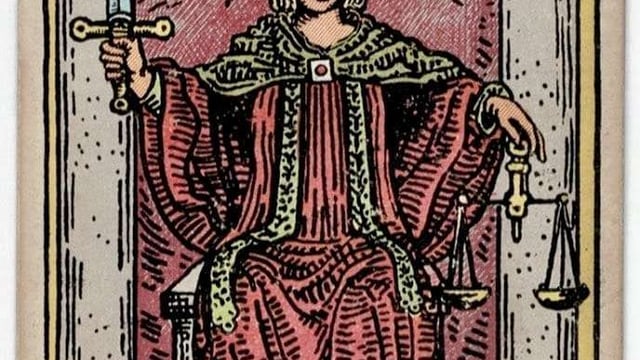
Eleven is the Justice card in the tarot. A seated figure holding a sword in one hand and a set of scales in the other. The sword is for discernment - the clean cut between what matters and what does not.
The scales are for weighing, the patient, unhurried work of measuring one thing against another until the truth of their relative weight reveals itself.
The older meaning is unambiguous: eleven is the apparatus of weighing, placed in the hands of a person now qualified to use it. The question, always, is what is being weighed.
In 191, the scales are used for something very particular. They are not weighing one person's word against another's, or one option against a competing option. The composite has named a different weighing.
The scales of 191 are weighing memory.
What you learned in the chapter you just finished is on one side of the instrument. Your hand rests on the scale. The question the instrument is asking is which of those learnings deserve to travel forward into the new chapter, and which, having done their work, deserve to remain exactly where they were taught.
That is the Justice of personal continuity. It is the specific, almost intimate gift 191 hands the person standing at the threshold.

What stays, and what gets set down
Let me describe, from experience, what this looks like when it happens honestly.
A person finishes a long chapter - say, a marriage of twenty years that ended without animosity but also without rescue. A real completion. A real nine. That chapter taught them a great deal. It taught them how to love steadily through boredom.
It taught them their own patterns of withdrawal, and how long the quiet could last before it became harder to come back from. It taught them what their own needs sounded like when they were being honest, and what they sounded like when they had been rehearsed so long they no longer recognized the voice.
All of this is genuine learning. All of it was earned.
And now, in the hinge evening, the person has to weigh.
Some of what they learned is theirs now, in a way that does not belong to the marriage specifically. The capacity for steady love. The recognition of their own withdrawal patterns. The honest voice of their own needs. These are structural. They travel with the person. They belong in the new chapter because they belong, now, to the self.
But other things were specific to the chapter. The particular way they learned to manage conflict with this partner, who flinched at a certain tone.
The stories they told themselves about why the marriage was worth one more year, then another. The identity they wore as the spouse of that person, which became, by the end, a costume they had forgotten they were wearing.
Those lessons do not carry forward cleanly. Carried forward unexamined, they distort the new chapter before it has had a chance to ask for its own lessons.
The person in the new relationship finds themselves managing a tone no one is using, telling themselves stories that belong to a marriage they are no longer in, wearing a costume whose original occasion has ended.
This is where the scales of 191 do their quiet, essential work.
The question, at this hinge, is simple. Which of these belongs to you now, and which of these belonged to that chapter? The weighing does not shame either pile. The lessons that stay on the closed page were not wasted. They did what they were meant to do, in the cycle they were meant to do it in. They simply are not travel luggage.
Worth exploring: Calculate your Life Path Number
Whether 191’s shadow side applies to you — and how strongly — depends on your core numbers. Your birthday reveals the first one.
Enter your birthday below:

Rushing, emptying, and the patient third way
Few people sit at this hinge long enough to let the instrument settle. They rush it in one of two directions, and both are worth naming.
The first is to begin the new chapter immediately.
The blank page is unsettling, a kind of vertigo arrives when an old arc has closed and a new one has not yet announced itself. Silence feels, to most people, like failure. Something wants to begin now, to prove the ending did not leave them stranded, to fill the quiet with motion before the motion has been weighed.
What happens when a person rushes across the threshold is almost always the same. They begin the new chapter carrying memories that were never sorted. The old marriage's wariness arrives, intact, in the new relationship.
The old job's grievances arrive in the first week of the new one. The old version of the self puts on its coat and walks into the next chapter as though it still belongs there. The new chapter begins its life already doing the work of an older cycle.
The second way is the opposite. In an effort to begin cleanly, the person tries to set down all of the old learning. They declare the closed chapter a mistake, a waste, a detour they will not repeat. They refuse to carry anything forward, because they think travel is best done empty.
But a person who empties themselves of all the learning of the previous chapter is not beginning cleanly. They are beginning amnesiac.
The new chapter will ask them, sooner than expected, for wisdom they already earned and have just refused to bring. They will have to learn it again, this time without the benefit of the teacher who was not, actually, a mistake.
Neither rushing nor emptying is the work 191 asks for. What it asks for is the patient weighing, the scales in the hands, the steady gaze at each piece of learning in turn, the honest question asked of each one. You. Do you belong to me, or to the chapter I am closing?
The scales of eleven cannot be rushed. You place the weights. You remove your hands. You let the instrument find its own rest. Trying to tip the scales faster than they are willing to move is how false answers get produced.
In the hinge evening of 191, what this looks like in practice is a cup of something hot, an old notebook or just the person's own attention, and the learnings of the closed chapter taken out one at a time. Gradually. One at a time.
Each learning is held long enough to feel what it is made of. Is this knowledge of the self - structural, durable, traveling? Or is it knowledge of the specific situation, relational, contextual, belonging to a configuration of people and circumstances that has now dispersed?
Some learnings reveal themselves quickly. The hand knows, almost without deliberation, that this one is going forward. It belongs to the self now. It goes in the bag.
Others reveal themselves more slowly. A pattern the person had thought was structural turns out, when looked at carefully, to be shaped entirely by the person they learned it with.
A wariness that had felt like wisdom reveals itself as a wariness appropriate to a specific set of conversations that will not be repeated. That piece stays on the closed page. Changed, but still here. Honored, where it belongs.
Still others are harder - pieces that contain both structural truth and situational distortion wrapped around each other. These take the longest weighing.
The person has to sit with the piece and separate, with patient honesty, the durable part from the specific part. The durable part goes forward. The specific part stays behind. The separation is not a betrayal of the chapter. It is the completion of its gift.

The practitioner's closing counsel
If 191 has been following you, in the mail, in the times on the clock, in the small numbers that catch your attention when you are not looking for them - there is a good chance you are standing at this kind of hinge.
Something has completed, or is about to. Something else is being prepared, in the invisible work of your own circumstances, to begin.
You are in the evening between them, whether or not you have named it as such.
The counsel the number carries is quiet and practical.
Do not rush the new beginning. The blank page is not your enemy, it is the space in which the weighing happens. Fill the silence too quickly and you will fill it with luggage that was never sorted, and the new chapter will find itself writing, already, the end of the old one.
Do not empty yourself of the closed chapter either. You are not starting from nothing. You are starting from exactly where you have arrived, which includes the structural learnings that the finished cycle earned for you. Those are yours. They are the equipment of whoever you are now.
What 191 asks is the middle path. Sit at the hinge. Take up the scales. Let the weighing happen one piece of learning at a time. Does this belong to me, or to the chapter I am closing? Does this travel, or does it stay on the page with the other memories that served their season?
Some things will go forward with you. Carry those without shame - they are what the closed chapter was, finally, for. Other things will stay behind. Leave those without guilt. They did their work in the time and place they were meant for, and their staying is their last gift to the chapter that produced them.
The new beginning, when it arrives, will be cleaner for the weighing. Cleaner, lighter, with more space to breathe. The new 1 at the end of the number opens with your hands held correctly, not overfull, not empty, but carrying exactly what this next chapter will need from the life that preceded it.
This is the quiet gift of 191. The weighing that happens at the hinge, when a person willing to sit with the scales decides, with care, which part of what they learned deserves to be the foundation now, and which part stays gently, honorably, on the closed page.
The scales settle. The weigher rises. The next chapter opens to its first line - and the pen in the hand, this time, is carrying only what was worth carrying forward.

Between Two Suns
What does angel number 191 mean?
191 means you are standing at the hinge between a chapter that just closed and one that is about to open. The palindrome holds a completion (9) at its center, framed by two beginnings (1, 1), and it reduces to 11 - Justice, the scales.
You are being asked to weigh your memories and learnings one at a time: what travels forward with you, and what stays on the closed page?
What should I carry forward from the old chapter?
The structural things - lessons about who you are, what you can endure, how you love, what your honest voice sounds like. These belong to you now, like your own name.
What stays behind are the situational habits: the way you managed conflict with that specific person, the stories you told yourself about why you stayed, the identity you wore that was shaped by circumstances that no longer exist.
What does 191 mean for relationships?
If a relationship chapter has recently closed, 191 is asking you to sort before you start the next one. The capacity for steady love? That travels. The specific patterns you developed with that particular person? Those stay. Carrying them forward unexamined is how people start new relationships already finishing old ones. Take the time to weigh.
Why is 191 a master number?
Because 1+9+1 = 11 - two ones facing each other like mirrors, generating a reflection the tradition keeps intact. Master numbers carry extra weight and hold their doubled form. In 191, the master number is Justice - the figure with the scales and the sword. The scales weigh your learnings with patience. The sword cuts cleanly between what is structural and what is situational. Both are needed at this hinge.
How do I know when the weighing is done?
When you can hold each major learning from the closed chapter and know, without forcing it, whether it belongs to you or to the chapter.
Some pieces reveal themselves quickly. Others take the longest weighing - they contain both structural truth and situational habit wrapped around each other and need patient separating. The scales settle on their own. Do not tip them.
Curious which numbers are active in your chart right now? Your birthday is the starting point.
Enter your birthday below:
Explore Angel Numbers
| Digit meanings | Angel Number 1, Angel Number 9 |
| Reduces to | Angel Number 11 |
| Numbers that share your vibration | 398, 686, 713, and 767 all reduce to Life Path 2. |
Behind Your Angel Number
free numerology calculator·life path calculator·what is numerology