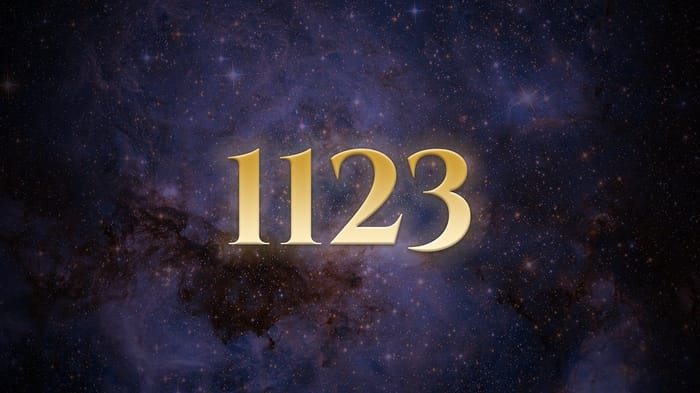
What comes after 1, 1, 2, 3? You already know - it’s 5. 1123 follows the Fibonacci pattern: each stage needs the ones before it to fully form, and the whole sequence points toward sacred knowing.
Angel Number 1123: Two Starts, a Meeting, and a Voice That Finally Arrived
By Blair Andrews · Published May 11, 2026
The numbers inside 1123

1New beginnings, independence, going first

2Partnership, patience, trust
3Creativity, expression, communication
1 + 1 + 2 + 3 = 7
7: Understanding, depth, seeing what others miss
What 1123 means for you specifically depends on which of the 11 Life Paths you’re on. Your birthday determines that.
Enter your birthday below:

Count the seeds in a sunflower head sometime. Start at the center and follow one of the spirals outward. You will lose count around forty, which is fine - the point is what you notice along the way. The seeds are packed in a pattern so efficient that no human engineer has improved on it. Each seed sits at the angle that wastes the least space. And the number of spirals curving clockwise and the number curving counterclockwise are always two consecutive Fibonacci numbers.
1, 1, 2, 3, 5, 8, 13, 21, 34, 55...
Each number is the sum of the two before it. The rule is so simple a seven-year-old can recite it. The forms it produces - nautilus chambers, hurricane arms, the branching of bronchi in your lungs, the way galaxies wind themselves into being - are so complex that mathematicians are still finding new applications for them five centuries after Fibonacci wrote the sequence down.
Look at the first four numbers. 1, 1, 2, 3. That is 1123.
Your angel number is the opening phrase of the pattern nature reaches for every time it needs to grow something.

The Spiral's First Four Notes
Every Fibonacci sequence starts the same way, and the start is unglamorous. Two ones. A two. A three. Nothing impressive on the surface. The drama comes later - the 89s, the 144s, the enormous numbers that build cathedrals out of a kindergarten rule. But none of those later numbers exist without this quiet opening.
The first 1 is a beginning. Balliett called it the Creator - the number that "makes all the other vibrations active rather than acting as an individual principle." It does not build the house. It lights the match. In the tarot, it is the Magician standing at his table with all four tools laid out, ready to begin.
The second 1 looks identical. And if you have lived the energy of 1123, you know how that feels from the inside - like starting over, like going back to square one, like the first attempt somehow evaporated and here you are again with the same tools on the same table. But in the Fibonacci sequence, the second 1 is not a do-over. The sequence literally cannot advance without it. Growth requires the impulse twice before anything new can emerge from it.
The 2 is what the two beginnings produce when they combine. 1 + 1 = 2. The High Priestess, the one who sits between two pillars and holds a scroll she does not unroll for just anyone. Balliett called 2 "the mother nature" - the collector, the one who waters and nourishes seeds that others plant. In the Fibonacci sequence, 2 is the first number that proves the rule is working. Something new has appeared that was not there before. The two identical starts have produced a relationship.
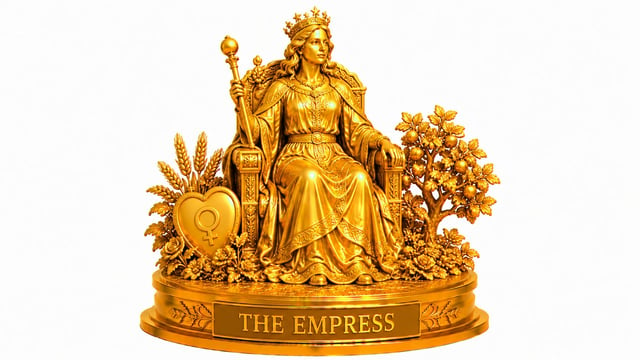
The 3 is the first number that contains the whole pattern's memory. 3 = 1 + 2 - it carries its immediate past within it. Balliett placed 3 as the expression of the trinity: "No. 1 creates, No. 2 collects and No. 3 expresses, making a chain strong and beautiful." The Empress in her garden. The number of artists and musicians. The first shape that encloses space - three points make a triangle, the first surface. And 3 is the proof that the spiral has started turning, because now the sequence knows how to keep going. 5 = 2 + 3. Then 8 = 3 + 5. Then 13. Then 21. The spiral accelerates from here.
You are standing at the moment just before the acceleration.

The Rule Underneath
Add the digits. 1 + 1 + 2 + 3 = 7.
Agrippa wrote that 7 is "of various, and manifold power" - the Vehiculum of mans life, "the number of an oath." The Pythagoreans dedicated it to Pallas, the goddess of wisdom. Seven "neither generated, nor generates" within the first ten numbers. It stands alone. It observes.
In the tarot, 7 is the Chariot. A figure standing upright in a vehicle pulled by two sphinxes who move in unison without reins. The driver does not steer. The sphinxes respond to an alignment happening inside the driver, something deeper than willpower.
The 7 beneath 1123 is the still point inside the spiral. The growth pattern has its own momentum, and the 7 says you do not need to manufacture it. You need the sacred knowing that comes from watching something unfold according to a rule you did not invent but have been following all along.

What It Feels Like from the Inside
If 1123 has been showing up for you, you probably recognize the sequence in retrospect better than you recognized it while living through it.
There was a beginning. A real one - you started something that mattered, you meant it. And then it stalled, or dissolved, or simply did not gain traction. So you started again. Same intention, same tools, but with some quiet adjustment you may not have been able to name at the time. From outside, the two starts looked identical. From inside, you knew the second one carried something the first one didn't.
Then a partnership formed. Maybe with another person. Maybe with a part of yourself you had been circling for a long time before finally sitting down with it. The 2 showed up, and suddenly the two beginnings had somewhere to go.
And then something started being made. The 3. A creative output that began generating its own next steps without you having to force each one. The triangle closed, and inside it was a space that had not existed before.
Whether 1123’s shadow side applies to you — and how strongly — depends on your core numbers. Your birthday reveals the first one.
Enter your birthday below:

The Shadow of the Spiral
Every growth pattern has a way of going wrong, and the Fibonacci spiral is no exception.
The shadow of 1123 is trying to skip ahead. Trying to jump from 3 to 8 without passing through 5. Trying to force the spiral to widen faster than the rule allows, because you can see where it is going and you want to be there already.
You have watched the two beginnings produce a partnership and the partnership produce an expression, and now you know the pattern. You can feel the acceleration coming. The temptation is to grab for it - to treat the spiral like a staircase you can take two steps at a time.
The Fibonacci sequence does not work that way. Each number must be fully present before the next one can compute. 5 is not just "the number after 3." It is 2 + 3. It contains the partnership and the expression within it. Rush past 3 before the expression has finished forming, and the 5 you arrive at will be hollow. Every number after it will inherit that hollowness.
The shadow shows up as impatience with the current stage. Restlessness that looks like ambition but is actually a refusal to be where you are. The voice that says I already know what comes next, why do I have to wait for it.
Because the spiral builds each new chamber from the dimensions of the two before it. Skip a chamber and the proportions fail. The nautilus with a missing chamber does not grow into a bigger nautilus. It collapses.
Stay with the 3. Let it express what it needs to express. The 5 knows when to arrive.

The Spiral in Relationship
In love, 1123 often describes a relationship that needed two approaches before it found the version of itself that could actually grow.
You tried once. It was genuine but incomplete - maybe the timing was wrong, maybe one of you was still carrying the isolation of the first 1, the Creator who has not yet overcome self. Then you tried again, and the second try carried a correction the first could not have known it needed. The partnership that formed from the second beginning had something the first attempt was missing: the willingness to be changed by the other person.
The 3 at the end means the relationship is producing something. The Empress energy - creative, fertile, abundant. Maybe a shared project. Maybe a home. Maybe just the particular quality of conversation that only this pairing generates, the way certain chemical compounds produce colors that neither element carries alone.
The 7 underneath says the relationship has its own understanding now. Its own internal compass. The Chariot's sphinxes are pulling together, and the driver - which is the relationship itself, not either person individually - is standing upright.

The Spiral at Work
Professionally, 1123 is the career that needed a false start to find its real beginning. The word "false" is wrong, actually - the Fibonacci sequence has no false starts. Both 1s are true. But the first one often looks, in retrospect, like a rough draft of the second.
The project you attempted and shelved. The business you started, learned from, closed, and started again with the lessons packed into the new foundation. The skill you picked up casually the first time and seriously the second time, not realizing that the casual exposure was laying neural pathways the serious study would need.
The financial dimension follows the spiral's own logic. Growth in a 1123 career does not arrive through force or clever strategy. It arrives as the natural widening of a spiral that has been following its rule. Revenue is a consequence of the pattern, the way the sunflower's seed-packing efficiency is a consequence of the Fibonacci angle. You did not engineer it. You grew it.

Frequently Asked Questions
What does angel number 1123 mean?
1123 is the first four numbers of the Fibonacci sequence - 1, 1, 2, 3 - the growth pattern that shows up in sunflower heads, nautilus shells, and galaxy arms. Two beginnings produce a partnership, the partnership produces a creative expression, and the whole thing reduces to 7, the number of sacred knowing. If you are seeing 1123, a growth process in your life has been following this pattern, and the spiral is about to accelerate.
Why does 1123 start with two 1s?
The Fibonacci sequence requires two identical impulses before anything new can emerge. The first 1 starts something. The second 1 starts it again with a quiet correction. Both are necessary - the sequence cannot advance without them. If you started the same thing twice, the repetition was structural, not failure. It was the first two terms of a growth pattern that needed both of them.
What does 1123 mean for love?
In relationships, 1123 usually describes a partnership that needed two attempts before it found the version of itself that could grow. The first try was genuine but incomplete. The second carried a correction the first could not have known it needed. The 3 at the end means the relationship is creating something now - a shared life, a project, a quality of conversation that only this specific pairing produces.
What is the shadow side of 1123?
The shadow is trying to skip ahead in the sequence - jumping from 3 to 8 without living through 5, because you can see where the spiral is going and you want to be there already. Each Fibonacci number must be fully formed before the next one can compute. Rushing past the current stage produces a hollow version of the next one. Stay where you are until the current number has finished expressing itself.
Why do I keep seeing 1123 everywhere?
Because the growth pattern has reached the stage where you can feel its momentum. The two beginnings, the partnership, and the expression are all in place, and the spiral is about to widen into its next term. The 7 at the root - the Chariot - says you do not need to push. The sequence knows its own rule. Your job is to stand in the vehicle and let it carry you.
Curious which numbers are active in your chart right now? Your birthday is the starting point.
Enter your birthday below:
Explore Angel Numbers
| Digit meanings | Angel Number 1, Angel Number 2, Angel Number 3 |
| Reduces to | Angel Number 7 |
| Numbers that share your vibration | 1213, 1231, 43, and 52 all reduce to Life Path 7. |
Behind Your Angel Number
free numerology calculator·life path calculator·what is numerology