Seven of Pentacles Tarot Card Meaning: The Harvest Isn't Ready Yet
By Blair Andrews · Published July 14, 2017 · Updated May 10, 2026
You’ve been putting money into the same investment for two years and the returns are flat. Or you’ve been working on a degree that’s supposed to open doors, but you’re only halfway through and the finish line feels imaginary.
Or you planted a garden in April - actual vegetables, in actual dirt - and you keep going out to the backyard every morning to see if anything has broken the surface yet. Nothing has. You’re starting to wonder if you buried the seeds too deep.
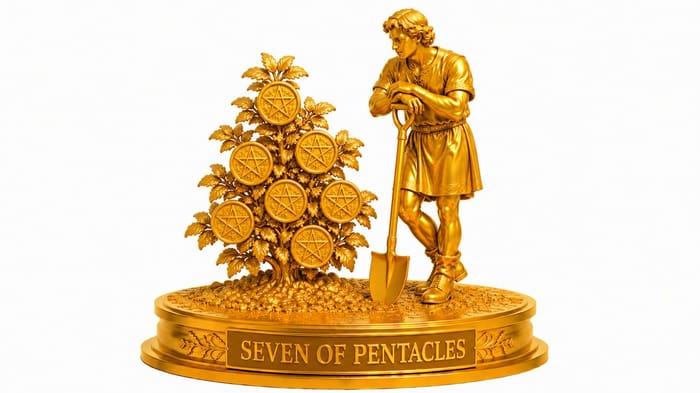
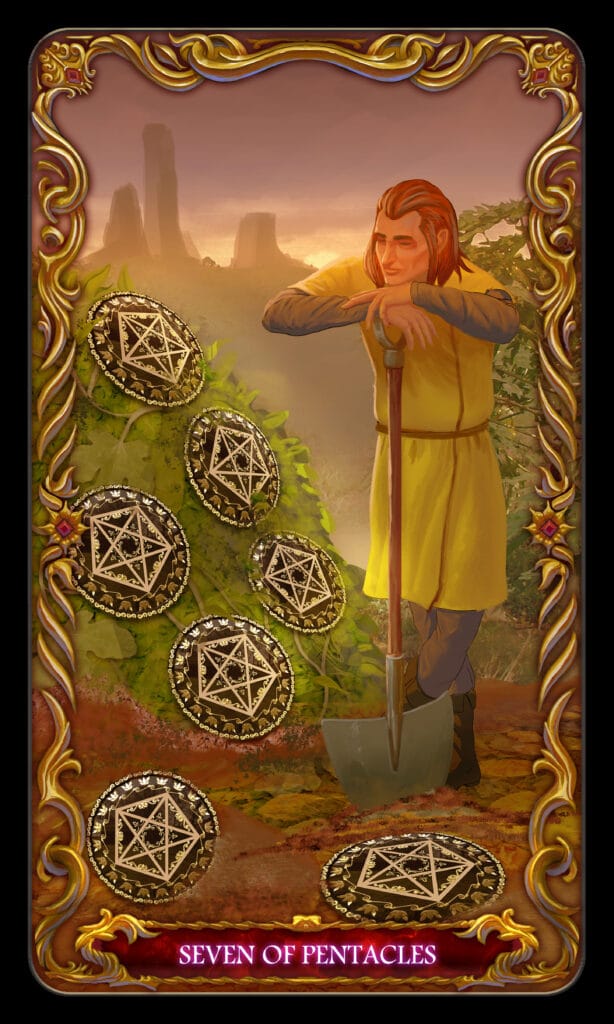
That’s the Seven of Pentacles. A farmer leaning on his hoe, staring at a bush heavy with coins, wearing an expression that might be patience and might be doubt. He’s done the work. All of it. The planting, the watering, the weeding. Now the only thing left is the part he can’t control: the growing.
If you pulled this card, you’re in the waiting room. The results aren’t in yet. The card doesn’t promise they’ll arrive. But it says the work isn’t wasted - and it asks you to look honestly at what’s actually growing before you decide what comes next.

The Card’s Essence
Seven is a singular number. The classical tradition called it "virgin" - it neither divides evenly into anything below ten nor doubles to produce anything within ten. It stands alone. It answers to nobody. In the number sequence, seven is where the established pattern (1 through 6) gets tested by something that doesn’t fit the framework.
When seven expresses through Earth - the suit of money, the body, practical results - that testing shows up as the question every long-term investment eventually asks: is this working? The Ace gave you the seed.
The numbers that followed grew it, structured it, disrupted it, and restored it. Now the Seven pauses the whole sequence and says: before you go any further, take a look at what’s actually in front of you.
The Seven of Pentacles is unique among the sevens because its struggle isn’t violent. The Seven of Wands is defending a position. The Seven of Swords is sneaking away. The Seven of Cups is lost in fantasy. The Seven of Pentacles just leans on a garden tool and evaluates. That quiet assessment is the whole card.

Patience, Stubbornness, or Something Else
The deeper symbolism of this card turns on a distinction that matters more than it seems. In the esoteric tradition, seven’s energy in the Major Arcana is associated with victory and successful completion.
But in the minor cards, that same energy arrives as a struggle to balance opposing forces. The victory is available, but it requires active direction. The Seven of Pentacles asks whether the effort you’ve invested is actually moving toward that victory - or just moving.
There’s a real difference between patience and stubbornness. Patience says: this needs more time, and the signs justify waiting. Stubbornness says: I refuse to stop even though nothing suggests this is working. The card invites you to figure out which one you’re practicing.
The farmer’s posture matters here. He’s leaning, not working. There’s a specific kind of courage in stopping mid-effort to evaluate whether the effort is pointed in the right direction. Most people never do it. They just keep planting in the same soil because starting over somewhere new feels too expensive.

Upright Meaning
Upright, the Seven of Pentacles is a card of assessment during a long game. You’ve put in real effort and the results aren’t visible yet. In career readings, it appears when the promotion hasn’t arrived, the business hasn’t taken off, or the project hasn’t landed - despite consistent, genuine work.
The Seven doesn’t promise the payoff is coming. But it says the work has produced something. Look at the bush - there are pentacles on it. Growth has happened. The question is whether it’s the kind of growth that justifies another season, or whether your effort belongs in different soil.
In financial readings, this is the compound interest card. The investment that won’t mature for years. The savings plan that feels painfully slow. The retirement account you won’t touch for decades. It’s boring in the moment and powerful over time, if the investment is sound.
In health readings, it’s the body healing on its own schedule. The new routine that hasn’t shown visible results yet - but something is shifting underneath, in the places you can’t see.

Reversed Meaning
Reversed, the assessment comes back negative. Or it never happens at all.
The first version: wasted effort. You planted in bad soil. You invested in the wrong thing. You spent years on a path that was never going to produce the harvest you wanted. The reversed Seven is the painful moment of clear sight: this isn’t going to work, and staying here won’t change that.
That sounds harsh. But the reversed Seven is actually one of the more useful cards in the deck - because the alternative is another year leaning on the hoe, staring at a bush that will never bear fruit. The reversed Seven gives you permission to walk away. To take your effort somewhere the soil can actually support what you’re planting.
The second version: impatience. Pulling the plant up by the roots because it’s not growing fast enough. Abandoning a solid plan because you wanted returns last month. The reversed Seven can mean you’re quitting too early - that the harvest was genuinely on its way, and you just couldn’t tolerate the wait.
The third: autopilot. Never pausing to evaluate because the question "is this working?" feels too threatening. The reversed Seven warns against the kind of persistence that’s really just avoidance wearing a work ethic costume.
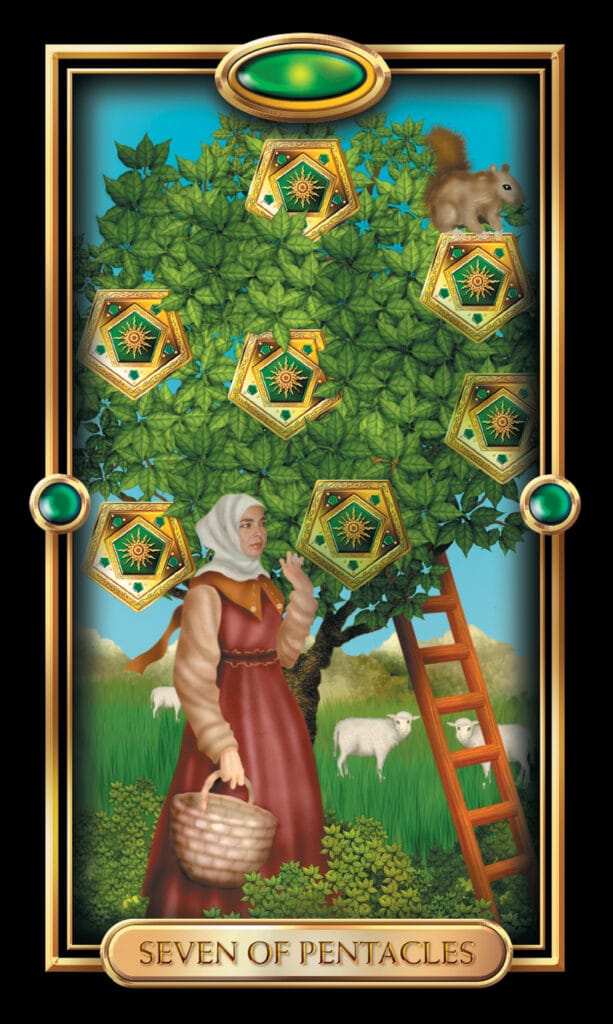
The Gilded Tarot Deck by Ciro Marchetti © 2004 Llewellyn Worldwide, Ltd. All rights reserved, used by permission.

In Love and Relationships
In love, the Seven of Pentacles usually shows up during the slow middle of a relationship - past the initial excitement, before the deep roots.
You’ve been investing time and attention, and you’re starting to wonder whether the investment will pay off. Is this relationship growing into something lasting, or have you been watering a plant that peaked months ago?
If you’re in a relationship, this card asks for honest assessment without premature conclusions. Not every slow patch means the relationship is failing. Sometimes things just need more time. But the Seven also refuses to let you avoid the question entirely.
Look at what’s actually growing between you - not what you hoped would grow. If the signs of life are there, stay. If the soil has been dry for a long time, the card gives you permission to notice that too.
If you’re single, the Seven of Pentacles can mean you’re evaluating a pattern. All this time you’ve been investing in meeting people, going on dates, being available - and nothing has stuck. The card doesn’t say stop trying. It says check the approach. Maybe the garden is fine. Maybe it’s the seeds.

In Career and Finances
This is the Seven of Pentacles at its most practical. In career readings, it’s the mid-point review. You’ve been building something - a business, a reputation, a body of work - and you need to assess whether the trajectory justifies continued effort. The card encourages patience, but intelligent patience. Waiting is not the same as hoping.
In financial readings, this is the long-term investment card. Savings accounts growing slowly. Retirement funds you won’t touch for decades. Property that appreciates year by year.
If you’re looking for quick returns, the Seven of Pentacles shakes its head. This card is about wealth built across time - and the discipline to let that time pass without interference.
The key question in career and finance readings: are you watering something that will actually bear fruit, or have you been pouring resources into soil that was never going to produce? The Seven gives you space to ask this without demanding an immediate answer. Sometimes the assessment itself takes time.

The Numerology Connection
In numerology, the number 7 is the seeker, the analyst, the one who needs solitude and quiet to find the truth. Seven is introspective by nature - the classical sources called it the number of rest, wisdom, and the completion of a phase within a larger cycle.
It sits between the harmony of six and the rhythm of eight, and its job is to evaluate what has been built before the next phase begins.
If you carry 7 energy in your chart - a Life Path 7, or a 7 in your Expression or Soul Urge - you probably know this pause well. The need to step back and understand before committing further. The preference for quality over speed. The willingness to wait for the right answer rather than grabbing the first one available.
The Seven of Pentacles brings that inner-searching quality into the material world. Same instinct, different domain. Instead of asking "what is true?" it asks "is this working?" Both questions require the same thing: the courage to stop and look honestly at what’s in front of you.

Frequently Asked Questions
What does the Seven of Pentacles mean in a reading?
It means you’re in the waiting phase of a long-term investment - career, financial, or personal. The effort is real. The results aren’t fully visible yet. The card asks you to assess what’s growing honestly, without either quitting too early or stubbornly refusing to see that something isn’t working.
Is the Seven of Pentacles a good card?
It’s a necessary card. It confirms that your effort has created something real. The frustration comes from not being able to see the full harvest yet. In career, money, and health readings, it’s actually encouraging - it says the work matters. The growth just needs more time than your impatience wants to give it.
What does the Seven of Pentacles reversed mean?
Reversed, it means one of three things. First: you’ve invested in the wrong thing and need to redirect your effort. Second: you’re quitting too early, before the harvest has a chance to arrive.
Third: you’re on autopilot, never pausing to ask the hard question about whether the path is working. The reversed Seven gives you permission to honestly reassess.
What does the Seven of Pentacles mean for money?
It’s the long-game card. Investments that mature over years. Savings plans that build slowly. Financial strategies that reward patience and penalize impatience. If you’re looking for fast returns, this isn’t your card. If you’re looking for confirmation that slow, steady effort will eventually produce results, it probably is.