Life Path 7 and The Chariot: Your Tarot Birth Card Explained
By Blair Andrews · Published December 2, 2014 · Updated May 10, 2026
The Number Everyone Gets Wrong
If you've spent any time reading about Life Path 7, you've probably been told it means "luck." Maybe you've seen it called "the lucky number" a dozen times over.
Here's the problem with that. The word we translate as "lucky" actually means something closer to "victorious." It's a translation error that's been repeated so many times it became gospel. And the difference matters, because luck is something that happens to you, while victory is something you earn through every fiber of your being.
That distinction sits at the heart of what it means to carry Life Path 7 and its Tarot birth card, The Chariot.
Not sure what your Life Path number is? Calculate it here, then come back.

Why 7 Is the Number of Perfection
The keyword for 7 is perfection. Its planetary ruler is Neptune, its element is water, and its color is purple, the shade historically reserved for royalty, for those who had proven themselves worthy of something higher.
But the real key to understanding 7 lies in how it's built. Seven is the sum of 3 and 4. In the old systems, 3 represented heaven: spirit, divinity, the triangle pointing upward.
And 4 was earth (the four directions, the square, the material plane beneath your feet). When you add them together, you get the point where heaven meets earth. Where the spiritual descends into form. Where meaning takes on a body.
There's another piece of this that most people overlook entirely. In classical geometry, you can construct a triangle with a compass and straightedge. You can construct a square. You can construct a pentagon, a hexagon.
But the heptagon - the seven-sided figure - cannot be constructed with those tools. It is mathematically impossible to draw a perfect seven-sided polygon using only the instruments that build every other basic shape.
To work with seven, you need something beyond mechanical precision. You need trained intuition. You need the kind of knowing that doesn't come from following established rules but from developing a feel for the space between them.
That's the essence of Life Path 7. That's why it's the number of perfection, not because everything comes easily, but because the perfection it seeks can only be approached through a kind of mastery that rules alone can't teach.

Cheth: The Field You Cultivate
The Hebrew letter assigned to The Chariot is Cheth, meaning "fence" or "field"; specifically, an enclosed space that can be cultivated. A field. Personality is a field that can be worked.
This is a more precise statement than it first appears. You are not your body. You are not your emotions. You are not your intellect. If you were, you could not apply the possessive case to them - you wouldn't say "my body," "my feelings," "my thoughts." The fact that you can claim ownership over these things means you are something other than them. The charioteer is not the chariot. The farmer is not the field.
The chariot itself is a "movable fence" that provides containment and forward motion simultaneously. It holds you together while carrying you somewhere. For LP7, this is the fundamental insight: your personality is not a fixed identity. It's a vehicle you're learning to steer. And like any field, it responds to cultivation. What you plant in it - habits of thought, patterns of attention, qualities of character - is what grows.
The faculty Cheth represents is Speech. Not casual conversation, but the disciplined use of language as an expression of will. Your habits of speech are the indices of your will development. The words you use continually are the patterns of your life expression. LP7 people tend toward precision of language, often unusually deliberate in how they speak. You choose words carefully not because you're cautious but because you intuitively understand that speech is action. What you say repeatedly, you become.

Reading The Chariot Card
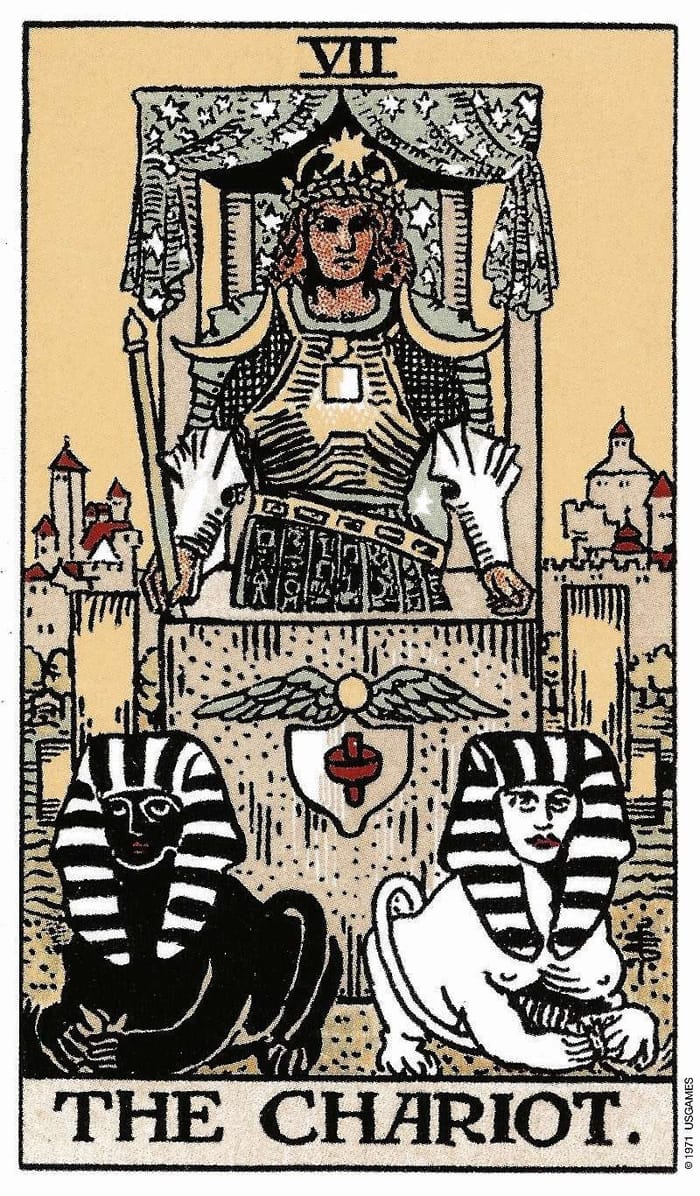
Look at The Chariot closely. A figure sits beneath a canopy of stars, armored and upright, riding forward out of the city behind him. Two sphinxes (one black, one white) are yoked to his vehicle. And those sphinxes are pulling in opposite directions.
This is the detail most readings gloss over too quickly. The charioteer doesn't choose one sphinx over the other. He doesn't pick the light and abandon the dark, or vice versa.
He drives both. The entire point of his mastery is that he can hold two opposing forces in tension and move forward anyway - not by resolving the contradiction but by commanding it.
The crescent moons on his shoulders connect him to the emotional tides, the shifting inner landscape that most people either get swept up in or try to shut down completely.
The stars above him represent the celestial guidance he's tuned into. And the city behind him? That's the world of easy answers and ready-made identities. He's left it behind. Whatever road he's on now, he chose it himself.
The earliest Chariot cards - in the Visconti-Sforza deck - showed something quite different: a beautiful woman as the driver, with winged horses pulling the vehicle. This was a direct rendering of Plato's image from the Phaedrus - the soul as a chariot, with female reason as driver and two horses representing dark appetite and white will. The original Chariot was explicitly about rational soul governing appetite and will. Waite replaced the female driver with a male figure, added the Kabbalistic symbols, and swapped the winged horses for sphinxes. But the Platonic structure survived: the dark and white pair, the question of who is steering, the forward motion that depends on commanding both forces at once.
When this card appears as your birth card, it's telling you something specific about your nature. You are someone built to hold complexity. Other people see contradictions and pick a side. You see contradictions and find a way to harness them.

The Chariot as Synthesis
Here's the question The Chariot puts to every Life Path 7 person: if you are a driven person, who is doing the driving?
The Chariot synthesizes everything that came before it in the Major Arcana. Attention (Magician) plus Memory (High Priestess) plus Imagination (Empress) plus Reason (Emperor) plus Intuition (Hierophant) plus Discrimination (Lovers) equals Victory - which is Will. The Chariot IS the product of mastering all six prior faculties. It's not a new faculty added to the list. It's the integration of all of them into a single directed force.
It's a question worth sitting with, because the answer isn't always what you expect. Most people who carry this energy feel intensely driven. They feel compelled toward something: understanding, truth, some version of completeness they can sense but haven't fully reached. The drive is real. It may be the strongest thing about you.
But the charioteer isn't the chariot. The driver isn't the vehicle.
And the question this card asks is whether the real you - the one connected to Neptune's depths, the one who can feel the pull of both sphinxes without breaking - is actually holding the reins. Or whether some assembled personality, some version of yourself that you've built to meet the world's expectations, has taken over the steering.
Life Path 7 people are natural seekers. You analyze, question, probe beneath surfaces. But that very intelligence can become a trap if it starts driving you rather than the other way around. The mind is a brilliant servant and a terrible master. The Chariot is a powerful vehicle and a coffin if nobody's steering it.

The Number Most Full of All Efficacy
The ancients devoted more attention to 7 than to any other number. They called it "most full of all efficacy" and gave it a unique structural position: because it consists of three and four, it joins the soul to the body. Seven is "the Vehicle of man's life" and "the number of Virginity" - it neither generates nor is generated. It cannot be divided into equal parts within ten, and it cannot be doubled to produce another number within ten. It stands alone.
The heptagon's geometric impossibility is embedded in this observation. Seven resists the tools that construct every other number. It requires something beyond mechanical precision. The seven stages of human life in the ancient system - climacteric years at 7, 14, 21, 28, 35, 49, 70 - are the Chariot's forward motion through time. Not randomness but structured progression. Every seven years, a complete cycle completes and a new phase begins.
The ancients assigned 7 to both Saturn (rest, limitation) and the Moon (motion, change) - two very different planetary energies coexisting. Saturn wants to stop. The Moon wants to move. And the Chariot is the vehicle that holds both: the stillness of the seated driver and the motion of the road beneath him. This dual planetary assignment maps directly to the sphinxes' opposing pulls. You carry both rest and motion, gravity and flow, the need to be still and the need to keep going.

Steel, Purple, and the Closed Number
The standard color for LP7 is purple - the shade of royalty and spiritual accomplishment. But the older vibrational system assigns a wider palette: steel, brick, purple, and magenta. Steel is the primary - specifically because STEEL (1+2+5+5+3) reduces to 16, and then to 7.
Steel is the color of armor. The charioteer in the Rider-Waite card is armored; he carries his history with him, encased in the protection he's built around himself. The tradition describes 7 as "a closed number - like a person carrying a pack on their back." LP7 people carry their past with them in a way that's hard to set down. The experiences that made you who you are are not behind you. They're on your back, informing every step, providing both weight and wisdom.
The tradition also says 7 "remains partially a mystery even to those who love them" and is "like a reservoir filled with water without an outlet." The Chariot's sealed, self-contained forward motion is exactly this. You hold more than you express. You know more than you show. The inner reservoir is vast, and the outlet is narrow - which is why LP7 people can seem so private, so contained, so much more than what appears on the surface.
The concept the older tradition called "Telethusia" - inner knowing that bypasses ordinary sense evidence - is the trained intuition the page describes. You don't arrive at your conclusions through logic alone. Something else operates alongside the analytical mind, and it's reliable in ways that logic sometimes isn't. The trick is learning to trust it without abandoning reason entirely.

What Life Path 7 Looks Like in the World
When this energy is flowing well, Life Path 7 people are some of the most compelling individuals you'll ever encounter. They have a quality of depth that's immediately apparent. You get the sense, talking to them, that there are entire continents of thought and feeling operating beneath whatever they're saying out loud.
They tend to be exceptional at anything requiring analysis paired with intuition. Research, investigation, spiritual practice, any field where you need to go deeper than the obvious explanation and trust your read on what you find there.
They often gravitate toward philosophy, psychology, technology, or healing work - anything that lets them bridge the gap between what's visible and what's hidden.
In relationships, Life Path 7s bring a rare combination of emotional depth and intellectual honesty. They won't settle for surface-level connection, which can sometimes make the early stages of relationships feel intense.
But once they've decided someone is worth knowing, they offer a quality of attention and understanding that few other Life Path numbers can match.
They work well with Life Path 9s (The Hermit), who share their love of depth but approach it from a different angle. A Life Path 1 (The Magician) can be a dynamic match, since both are driven, though the 1 channels energy outward while the 7 channels it inward.
LP7 is notably rare in the general population. Even zero or one 7 in a numerology chart is considered average. Two 7s is already an intensity point. LP7 as a Life Path is therefore inherently unusual. And if you've always felt genuinely rare, a little different from the people around you in ways that are hard to articulate, you're not imagining it. The number itself is structurally uncommon.

The Shadow Side of The Chariot
Every Tarot birth card has its shadow, and The Chariot's shadow is particular. It's not aggression or recklessness, the way you might expect from such a forceful card. It's something colder than that.
The first shadow of Life Path 7 is the charioteer who lets go of the reins. Who decides that other people are too slow, too shallow, too messy to bother with. The brilliant mind that uses its analytical power to justify withdrawal, building an intellectual fortress and calling it independence. Reclusive, completely self-contained, inflexible, deliberately putting others off, appearing eccentric, perfectionist to the point of paralysis.
When 7 energy goes dark, it doesn't explode. It freezes. The depth that should connect you to others becomes a moat. The discernment that should help you understand people becomes a weapon you use to dismiss them. You're still moving forward - the chariot is still rolling - but there's no warmth left in the ride, and nobody sitting alongside you.
But there's a second shadow: the charioteer who stops driving and just rides. This is the LP7 who has abandoned the inner resources - the analysis, the intuition, the depth - in favor of material comfort and surface pleasures. Ignoring the spiritual and analytical gifts, concentrating on material gratifications, coasting on momentum without steering. The chariot uses its own momentum to roll forward, but nobody is choosing the direction. This LP7 may look successful from the outside - the vehicle is impressive, the armor is shiny - but the seat is empty.
If you recognize any of this in yourself, the correction isn't to become someone you're not. You don't need to suddenly become the life of the party. You just need to remember that the sphinxes pull in two directions for a reason.
The inner world and the outer world both need your attention. Perfection isn't found in isolation but in the marriage of heaven and earth, spirit and matter, solitude and connection.

The Chariot as Completion
The first seven cards of the Major Arcana - Magician through Chariot - form what the old philosophers called the "soul of appetite": worldly power, desire, love, material engagement. The Chariot stands at the end of this sequence. It is the culmination of the entire first arc - the point where all six preceding faculties are integrated into a single, directed will.
This means LP7 is not just one faculty among many. It is the product of all the others. And its position at the boundary between the soul of appetite and what follows (the soul of will, beginning with Strength/Justice) gives it the quality of a turning point. The Chariot has mastered worldly engagement. What comes next is a different kind of work entirely, the inner alchemy that begins at card 8.
The most powerful thing about The Chariot as a birth card is that it never lets you coast. Other cards might offer a comfortable resting place, a plateau where you can settle. The Chariot doesn't do that. It's always moving, always asking: are you driving, or are you being driven?
For Life Path 7 people, this is both the gift and the challenge. You will always feel the pull toward something more, something deeper, some level of understanding you haven't quite reached yet.
That restlessness isn't a flaw. It's the engine of the chariot itself. The question is simply whether you're directing it with consciousness and purpose, or whether it's dragging you somewhere you didn't choose to go.
Keep the reins in your hands. Stay connected to both the light and the dark, the spiritual and the practical, the inner world and the people who need what you've found there. The number 7 isn't lucky. It's victorious. And victory, unlike luck, is something you earn.

Frequently Asked Questions
What does Cheth (fence/field) mean practically for LP7?
It means your personality is a field you cultivate, not a fixed identity you're stuck with. The charioteer is not the chariot - and neither are you your habits, your moods, or your history. You are the one tending the field. What you plant (through disciplined speech, consistent practice, chosen patterns of thought) is what grows. If you don't like what's growing, you can change what you plant. The fence doesn't trap you. It gives your cultivation a boundary so things can actually take root.
Is Life Path 7 really the "lucky" number?
The association of 7 with luck comes from a mistranslation that has been repeated across centuries.
The original meaning is closer to "victorious" - a crucial difference. Luck implies passivity, something that falls into your lap. Victory implies agency and earned achievement. Life Path 7 people don't coast on fortune. They work, seek, analyze, and ultimately earn the understanding and success they achieve.
Why is The Chariot sometimes seen as an aggressive card?
The Chariot carries forward momentum and forceful energy, which some interpretations frame as aggression. But look at the card more carefully: the charioteer isn't wielding a weapon.
He isn't charging into battle. He's directing energy, holding the reins with skill and intention. The original card showed a beautiful woman driving winged horses - explicitly about rational governance, not force. As a birth card for Life Path 7, it speaks less to aggression and more to the kind of inner discipline needed to move through the world with purpose while honoring your own complexity.
What careers suit someone with Life Path 7 and The Chariot birth card?
Life Path 7 people thrive where deep analysis meets intuitive understanding. Fields like research, psychology, philosophy, data science, investigative work, and spiritual practice all tend to resonate.
The Chariot element adds a dimension of leadership and forward drive, so unlike some seekers who prefer to stay in the background, LP7 Chariot people often end up directing projects, leading teams, or pioneering new approaches within their chosen field. The faculty of Speech (Cheth) means LP7 people also excel in any role where precise, deliberate communication determines outcomes - law, negotiation, writing, teaching.