The Hierophant as Tarot Birth Card: Life Path 5
By Blair Andrews · Published November 19, 2014 · Updated May 10, 2026
Let's start by clearing something up, because almost every numerology article on the internet gets this wrong.
Life Path 5 is not the "wild child" of numerology. It's not the party number, the commitment-phobic drifter, the person who just can't settle down. That description is lazy, and it misses the entire point of what the number 5 actually represents.
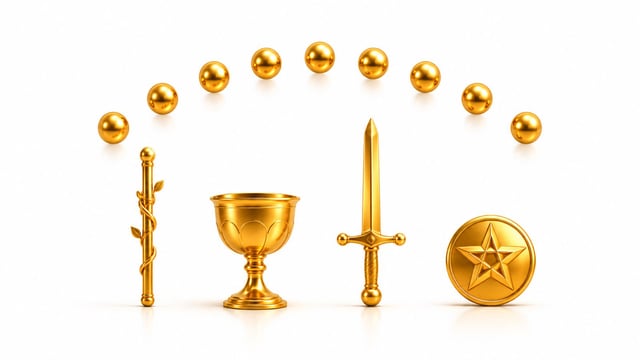
Five is the number of the pentagram, five points, one for each classical element, with spirit sitting at the top. The arrangement isn't random. It's a diagram of mastery: mind over matter. Spirit governing earth, air, fire, and water. The person who has learned enough about the physical world to rise above being ruled by it.
That's your Tarot birth card energy. The energy here is sovereignty.

Why the Hierophant Makes Perfect Sense
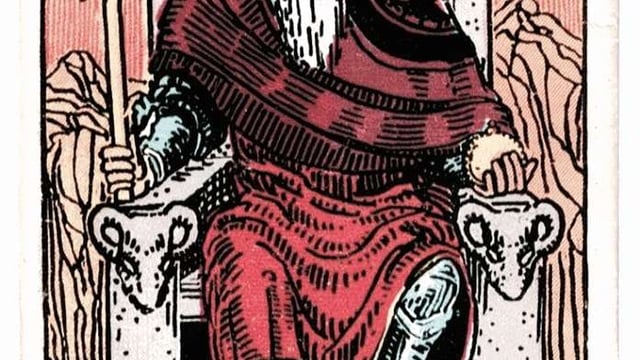
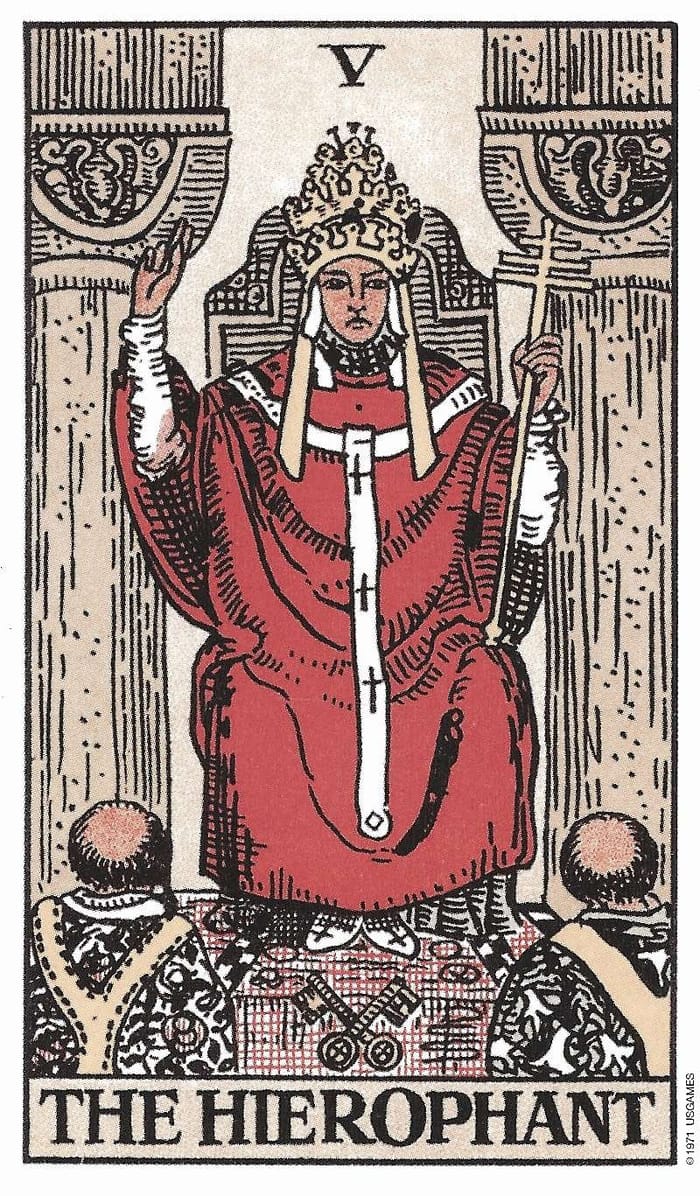
People are often surprised by this pairing. The Hierophant sits in what looks like a church. He wears papal vestments. Two acolytes kneel before him, ready to be initiated. Everything about the image suggests tradition, institution, established order. Hardly what you'd expect for a number associated with freedom and adventure.
But that reaction reveals a misunderstanding of both the card and the number.
The Hierophant is not a figure of blind obedience. He's the inner teacher, someone who has traveled widely enough, studied deeply enough, and lived thoroughly enough to distill all that experience into genuine wisdom.
He doesn't stand above the world because he avoided it. He stands above it because he mastered it. He went through every element (fire, water, air, earth) and came out the other side understanding how they all connect.
The card was originally called "Il Papa," literally the Pope. The two kneeling acolytes, the papal vestments, the institutional setting - all of it was explicitly ecclesiastical. The name "Hierophant" came later, a deliberate renaming that replaced institutional authority with inner authority. The Pope became the inner teacher. The one who instructs from personal experience rather than from a book of rules.
This is exactly the Life Path 5 arc. Your keyword is freedom, but freedom doesn't mean chaos. Real freedom is the pentagram with spirit at the top - the capacity to move through experience without being enslaved by it.

Vav: The Nail That Joins
The Hebrew letter assigned to the Hierophant is Vav, meaning "nail" or "hook." Its primitive form was a pictograph of a yoke. The Sanskrit root of "yoke" is "yoga," which means union. This means the Hierophant is fundamentally a card of union, not instruction.
Vav joins things together. It connects the above to the below, the inner to the outer, the wisdom gained through experience to the person who needs to hear it. If you're an LP5 who has ever felt like your real purpose is translating between worlds (making the complicated simple, making the ancient feel immediate, making the esoteric accessible) Vav is why.
The faculty Vav represents is Hearing, specifically interior hearing. The Inner Voice. Not the voice of other people's opinions, not the voice of your own desire dressed up as intuition, but a specific, recognizable signal that has certain qualities: it never flatters. It is always concise. It is never contrary to reason. And it always gives counsel that can be acted on right now.
That's a working diagnostic test. When LP5 people are trying to distinguish genuine inner guidance from self-justifying desire, those four criteria separate the real thing from the impostor every time.
Look at the Hierophant's ornaments. The golden keys at his feet have "ball and clapper" ward designs - the mysteries are unlocked through vibration, through hearing rather than sight. The ornament hanging from his triple crown falls directly behind his ears, pointing to the organs of hearing. Even the card's visual design is telling you: this path opens through listening, not through looking.

The Roses Have Five Petals
There's a detail in the Hierophant card that most people walk right past. Look at the vestments, the decorative elements, the symbolic flourishes woven throughout the image. Roses appear repeatedly in traditional Major Arcana imagery, and roses have five petals.
In the symbolic tradition, the five-petaled rose represents human desire - all the wanting and craving and longing that drives us through our lives. The pull of good food, physical pleasure, beautiful things, exciting experiences, approval, and comfort. Five categories of desire mapped onto five petals.
The Hierophant doesn't pretend these desires don't exist. He doesn't suppress them or preach against them. Instead, he governs them through understanding. He's felt every one of those desires, explored them fully, and learned how they work.
This knowledge (not willpower, not denial, but genuine comprehension) is what allows him to keep spirit at the top of the pentagram.
Life Path 5 people who are living their number well have exactly this quality. They're not monks. They enjoy life thoroughly, sometimes more thoroughly than anyone around them. But there's an awareness behind the enjoyment, a consciousness that's observing, learning, and integrating, even in the middle of a good time.

The Just Middle
The ancients called 5 "the just middle of the universal number" (ten) - meaning 5 stands at the exact center of the first complete cycle. It is also "the seal of the Holy Ghost, a bond that binds all things, and the number of the cross." Five is sacred to Mercury, which matches the Hierophant's role as translator and messenger.
The ancient scale maps the five wandering planets to the five senses and the five powers of the soul: Vegetative, Sensitive, Concupiscible, Irascible, and Rational. The Hierophant who has mastered all five has genuinely achieved mind over matter - not as a metaphor, but as a description of which faculties have been cultivated. This is the pentagram realized: each faculty developed, integrated, and governed by the spirit at the top.
Five is also called the number of divine grace expressing through embodied human form. Which is exactly what the Hierophant represents: higher truth made accessible to anyone willing to listen. Not abstract, not theoretical, but translated into language that a person standing in the middle of a complicated life can actually use.

Mercury, Air, and Two Colors
The planetary ruler of 5 is Mercury: the messenger, the traveler, the quick mind that makes connections between disparate things. Mercury doesn't settle. He moves. But he moves with purpose: carrying information from one place to another, translating between languages, bridging gaps in understanding.
The element is Air, reinforcing that quality of mental agility and movement. And the color association in the standard system is tan, which might seem surprisingly muted for such a dynamic number.
But tan is the color of well-traveled roads, of parchment that's been written on and read a thousand times, of desert sand smoothed by wind. It's the color of experience made visible.
The vibrational color for 5 in the older system is pink, love without passion, seeking love without passion. This maps to the Hierophant's rose symbolism in a specific way. The red roses elsewhere in the tarot represent raw desire. Pink is desire seeking elevation; not suppressed, but refined. The tradition calls 5 "a Sage, which means a limited master," someone who has genuine authority within a specific domain, earned through experience rather than claimed through position.
Together, these associations paint a picture of someone whose freedom isn't about escaping responsibility but about accumulating enough breadth of experience to see the whole pattern. The Hierophant in his church is someone who has been everywhere and brought all of it back home.

What People Get Wrong About the Five's Love Life
Here's something you won't read in most numerology profiles: Life Path 5, once committed, is one of the most faithful partners in numerology.
Yes, really.
The reputation for restlessness is real, but it's a pre-commitment quality, not a permanent one. Fives take a long time to commit because they take it seriously. They've seen enough of the world to know what they want, and they won't settle for a relationship that doesn't meet that standard.
But when they find the person who genuinely matches them - someone who can keep up intellectually, who doesn't try to cage them, who understands that loving a 5 means giving them room to breathe - they become deeply devoted.
The Hierophant is associated with Taurus, after all. And Taurus, for all its reputation for stubbornness, is one of the most loyal and sensual signs in the zodiac. Once a bull chooses its pasture, it stays.
Compatible matches for a Life Path 5 tend to include Life Path 4 (The Emperor), whose appreciation for tradition and proper form resonates with the Hierophant energy.
Life Path 2 (The High Priestess) offers a spiritual depth that draws the 5 in and holds them. Life Path 9 (The Hermit) makes for long, rich conversations about the nature of being human.
And Life Path 6 (The Lovers) appreciates your counsel and your breadth of perspective.
A Life Path 1 (The Magician) can excite you with their practical energy and push you to turn your accumulated wisdom into action - just be mindful that their directness doesn't tip into bossiness.

The Shadow: An Inverted Pentagram
If the upright pentagram represents spirit governing the elements, the inverted pentagram represents the opposite: the elements ruling spirit. Desire on top. Consciousness underneath. The body driving the mind instead of the other way around.
This is the Life Path 5 shadow, and it's worth being unflinching about. The older tradition issued a blunt warning about this: when desire for material gain becomes prominent in the undeveloped 5, the result has been called "black magicians and hypnotists" - people who use the power of the five senses to manipulate rather than to serve.
When a 5 loses the thread - when experience becomes consumption rather than education - the freedom that defines this path curdles into something aimless. Restlessness without direction. Indulgence without awareness. Chasing the next sensation not because it teaches you something but because sitting still has become unbearable.
You see this in fives who travel constantly but never arrive anywhere. Who start projects with brilliant energy and abandon them when the novelty fades. Who cycle through relationships not because they're searching for the right person but because they're running from themselves.
But there's a second shadow that's harder to spot: the Hierophant who has stopped learning, the one who uses tradition as a wall against further experience. Fearful of freedom, retreating into safe and stable situations, unable to handle change, rigidly avoiding the new. This is the LP5 who has completed one cycle and refuses to begin another - who sits in the institutional chair repeating old teachings rather than going back out into the world to gather new ones.
The lesson of 5 is a complete cycle: to begin, nurture, experience, and detach. The Hierophant who can't complete the cycle - who keeps revisiting the same experiences compulsively - is stuck in a loop, not living a path.
The question to ask yourself, whenever you feel that restless pull, is the pentagram question: which point is at the top right now? Am I moving toward this experience because my spirit is genuinely calling me there? Or am I being dragged by an appetite I haven't examined?
The difference between a Life Path 5 living their highest expression and a Life Path 5 caught in their shadow isn't the amount of experience. It's the quality of attention they bring to it.

The Hierophant in the Larger Arc
The first seven cards of the Major Arcana - Magician through Chariot - form what the old philosophers called the "soul of appetite": worldly power, desire, love, material engagement. The Hierophant stands fifth in this sequence, at the exact midpoint, which is precisely where the ancients placed the number 5 - "the just middle."
He follows Concentration (Magician), Memory (High Priestess), Imagination (Empress), and Reason (Emperor). His faculty is Intuition - specifically interior hearing. This means the first four faculties are all directed outward or inward through effort. The Hierophant is where something new enters: guidance that arrives without being sought. The inner voice that speaks because you've done enough preparatory work to hear it.
This is why LP5 people often feel that their deepest insights come unbidden - in the shower, on a walk, in the middle of the night. You've earned the right to hear things other people can't, not through mystical talent but through the accumulated experience that makes the signal intelligible.

The Bridge
Life Path 5 people move through experience not from distraction but as research. Every new city, every new skill, every new relationship, every new challenge is data. The Hierophant collects it all, processes it, and offers it back to the rest of us.
This is why so many 5s end up as teachers, counselors, writers, or storytellers - even when their career path seems to have nothing to do with education.
Whether they're running a business, raising a family, or working a trade, there's always this quality of accumulated wisdom that people pick up on. Friends come to them for advice.
Colleagues seek their perspective. Even strangers seem to sense that a five has been places, not just geographically but experientially, and has brought back something worth hearing.
Your work, career-wise, thrives wherever you can translate lived experience into guidance. Teaching, youth work, writing, counseling, consulting - any role where breadth of knowledge is an asset rather than a liability.
You'd also excel at storytelling in any form, from spoken word to memoir to copywriting, because you naturally find the beating heart of a narrative and know how to convey it.
The Hierophant's deeper gift, the one that takes a lifetime to fully develop, is this: the ability to make the old new. To find in ancient patterns and timeless truths something that speaks directly to the present moment. Life Path 5 doesn't just collect experience. It translates it.

Frequently Asked Questions
Why is Life Path 5 paired with The Hierophant instead of a more "adventurous" card?
Because the Hierophant represents what adventure produces when it's done with awareness: wisdom, depth, and the ability to guide others. The 5 moves through experience; the Hierophant is what the 5 becomes after integrating all of it. The pairing captures the full arc of this Life Path, not just its early, restless phase.
How do I know if my inner guidance is real or just what I want to hear?
The esoteric tradition gives four specific tests for genuine intuition. True inner guidance never flatters you. It is always concise - not long-winded justifications. It is never contrary to reason - it may go beyond logic, but it doesn't contradict it. And it always gives counsel you can act on right now, not vague future promises. If the "guidance" you're receiving makes you feel special, goes on at length, defies common sense, or tells you to wait indefinitely - that's not intuition. That's desire wearing intuition's clothes.
Is Life Path 5 really compatible with long-term relationships?
Very much so - once the right partnership forms.
The key is that a 5 needs a partner who offers genuine intellectual and experiential companionship, not someone who tries to pin them down. Fives who find this match tend to be deeply loyal, bringing the same passionate attention to their relationship that they bring to everything else they care about.
What's the difference between The Hierophant as a birth card versus when it appears in a tarot reading?
As a birth card, The Hierophant describes a lifelong energy pattern - the overall arc and character of your path.
In a tarot reading, the same card speaks to a specific moment or question, often suggesting you seek guidance from a mentor, honor a tradition, or look to established wisdom for answers. The birth card is the ocean; the reading card is a particular wave.