Second Challenge Number 7: Maintaining Faith While Pursuing Depth
By Blair Andrews · Published April 24, 2025 · Updated May 10, 2026
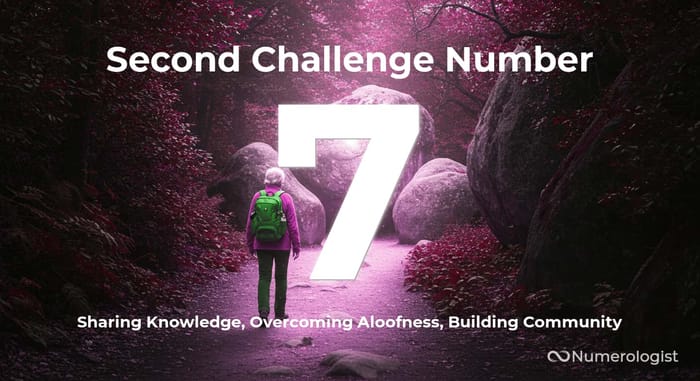
A Second Challenge of 7 brings the questions of faith, inner trust, and authentic depth into the arena of your productive middle years, roughly your mid-thirties through your late forties or early fifties.
These are the years when most people are most deeply embedded in the external world: building careers, raising families, accumulating responsibilities.
Having a 7 Challenge during this phase creates a distinctive and often uncomfortable pull between the demands of outer life and the urgent call of inner life.
The Chariot, 7's Tarot correspondence, depicts a figure moving through the world with inner mastery - the Self driving the personality vehicle. The seven-pointed star, the most difficult regular polygon to construct, represents the art of genuine human mastery.
As a Second Challenge, the 7 asks: In the midst of your busiest, most outwardly focused years, can you maintain a relationship with your own depth?
Can you keep faith - not blindly, but authentically - while the world demands your constant attention?

The Midlife Context for the 7 Challenge
The productive middle years are not typically associated with contemplation. They are associated with action, achievement, and the accumulation of experience and resources.
When the 7 appears as a Second Challenge, it creates a tension that the culture does not provide much support for: the need to go inward during the very years when everything pushes you outward.
This tension often manifests as a vague but persistent sense of meaninglessness despite apparent success. You have the career, the family, the house, the social circle - and something still feels missing.
Or it manifests as a growing hunger for depth in a life that has become relentlessly surface-level: the conversations that never go beyond pleasantries, the work that is competent but soulless, the relationships that function smoothly but lack genuine intimacy.
This is the 7 Challenge speaking. It is not depression (though it can feel like it). It is the Chariot insisting that whoever is driving your life needs to be someone who knows where they are going - and that "where they are going" cannot be answered by salary figures, social status, or a full calendar.

How This Challenge Shows Up
The crisis of meaning. Midlife is when many people confront the question "Is this all there is?" For someone with a Second Challenge of 7, this question is not a passing mood but a central theme of the entire phase.
The answer is not "no" - it is that there is much more, but you have not yet developed the capacity or the willingness to access it. The 7 Challenge is the invitation to develop that capacity.
Isolation that masquerades as independence. The 7's tendency toward withdrawal can become problematic during the years when connection is most needed.
You may pull away from your partner, your friends, your colleagues - not because you do not value them but because superficial interaction has become intolerable and you do not know how to ask for the depth you crave.
The result is increasing loneliness in the middle of a full life.
Intellectual substitution for spiritual engagement. The 7 Challenge at midlife sometimes manifests as a voracious consumption of books, courses, podcasts, and ideas about spirituality, philosophy, and meaning - without the willingness to actually practice any of it.
Knowledge becomes a defense against the vulnerability of genuine spiritual experience.
You can explain twelve different meditation traditions but have not sat in silence for ten minutes.
Cynicism and loss of faith. Life at midlife has provided enough evidence of disappointment, betrayal, and suffering to make cynicism feel like wisdom.
The 7 Challenge during this period often involves a genuine temptation to abandon faith entirely - to conclude that the world is purely material, that ideals are naive, and that the deeper questions do not have answers worth seeking.
This cynicism feels protective, but it leaves you cut off from the very source of meaning the 7 is trying to connect you with.

The Question the 7 Asks at Midlife
Seven is composed of 3 (the divine) and 4 (the earthly). It is where heaven meets earth. The question it asks during your productive years is not "Should you abandon the earthly for the heavenly?" That would be the isolation trap.
The question is: "Can you bring heaven into your earthly life? Can you do your work, raise your family, and engage with the world while remaining connected to something deeper?"
The Chariot does not stop moving. The figure achieves mastery while in motion, while engaged with the world. The victory of the 7 is not retreat - it is alignment: the experience of doing exactly what your outer life requires while being fed by your inner life at the same time.

Working With the Second Challenge of 7
Create non-negotiable space for depth. This is the most practical and most important step. In the midst of a demanding adult life, carve out time that is sacred - for meditation, reflection, study, prayer, nature, silence, or whatever practice connects you to your own depth. Not when it is convenient. Regularly and without exception.
Let the questions live alongside the responsibilities. You do not need to resolve the meaning of life before driving the carpool. The 7 Challenge asks you to hold the existential questions and the practical demands simultaneously, without letting either cancel the other. This is the true art of the seven-pointed star: complexity held in balance.
Risk emotional depth in one relationship. The isolation pattern of the 7 Challenge responds to the deliberate practice of vulnerability. Choose someone you trust and go deeper than you are comfortable going.
Say what you actually believe about life, death, purpose, and meaning. The relief of being truly known - even by one person - can crack the shell of isolation open.
Trust your inner knowing even when you cannot explain it. The 7 develops intuition, perception, and a way of knowing that is not rational.
During the Second Challenge years, you may find that your gut feelings, your spiritual intuitions, and your sense of what is true grow stronger and more accurate - but only if you begin trusting them. Track your inner perceptions.
Notice when they prove correct. Build a relationship with your own wisdom.
Distinguish between solitude and avoidance. Genuine solitude nourishes and connects. Avoidant isolation depletes and disconnects. During the Second Challenge years, you need both time alone and time in meaningful connection. If all your time is alone, you are avoiding. If none of it is, you are avoiding differently.

The Victory at Midlife
People who work through the Second Challenge of 7 during their productive years develop a quality that is rare and deeply attractive: the integration of depth and engagement. They are in the world but not entirely of it.
They do their work with competence and care while remaining connected to something larger. They bring to their relationships a quality of presence that comes from genuine inner life rather than surface-level attention.
The word "lucky," remember, comes from "victorious." The victory of the Second Challenge of 7 is not luck and not escape.
It is the achievement of alignment between your inner knowing and your outer living - the Charioteer fully in command, moving through the world with purpose, depth, and the quiet confidence that comes from having found what you were looking for not by leaving your life but by going deeper into it.

Explore Further
- First Challenge Number 7
- Third Challenge Number 7
- Second Pinnacle Number 7
- Challenge Numbers Calculator
- Challenge Numbers: Complete Guide
- Number 7 Meaning

What the Tradition Says About Challenge Number 7 at Midlife
Goodwin describes the 7 energy as analysis and understanding - the inward path that seeks meaning beneath appearances and demands spiritual awareness alongside intellectual engagement. As a Second Challenge, it brings the faith question into the heart of the productive middle years, often arriving as a deepening dissatisfaction with answers that once seemed sufficient. Goodwin's growth direction - from the pain of isolation to the peace of chosen solitude - describes a transition that is more likely to happen during the Second Challenge years than in youth, when the conditions for genuine inquiry are usually more available.
Drayer identifies the specific demands of the 7 Challenge with precision: "Faith and trust in yourself, others, and God. Make a firmer connection with Spirit. Start meditating. Delve into spiritual and metaphysical literature." She adds the key framing: "Your aloneness is part of the challenge; the peace of mind, once found, will be forever." At midlife, the aloneness the 7 Challenge requires may feel more like a threat - to marriage, to social standing, to the professional identity built over two decades. The Second Challenge of 7 asks for the willingness to enter that solitude anyway, trusting that what is found there is more durable than what is being temporarily set aside.
Drayer's Pinnacle/Challenge distinction is especially relevant here: while a 7 Pinnacle creates an internal state of withdrawal and questioning, the 7 Challenge produces outer circumstances that require introspection. At midlife, these circumstances often take the form of loss, professional disruption, or the kind of sustained questioning that follows a significant life transition. The Second Challenge of 7 uses these circumstances as the curriculum.

Frequently Asked Questions
- What does Challenge Number 7 mean in the second position?
- In the second position, Challenge Number 7 means that the development of genuine inner trust, authentic faith, and a workable relationship with solitude becomes central during your productive midlife years. This challenge often arrives through circumstances that force a reckoning with meaning - loss, transition, or a growing inability to avoid the deeper questions that earlier years allowed you to defer.
- How do I calculate my Challenge Numbers?
- Subtract reduced birth components: First = |month digit − day digit|, Second = |day digit − year digit|, Third = |First − Second|. Use the absolute value of each difference.
- Why does the Second Challenge of 7 sometimes look like depression from the outside?
- Because the 7 Challenge requires extended periods of withdrawal from the noise and activity of ordinary life - and in a culture that treats productivity as a proxy for health, any sustained inward turn tends to be misread as dysfunction. Drayer notes that 7 energy stands with one foot in the higher world and one in the lower, genuinely unsure where it belongs; the Second Challenge uses this uncertainty as the instrument of genuine spiritual growth.