Two Ways to Care: Life Path 6 and 22 Compatibility
By Blair Andrews · Published May 8, 2026 · Updated July 20, 2026
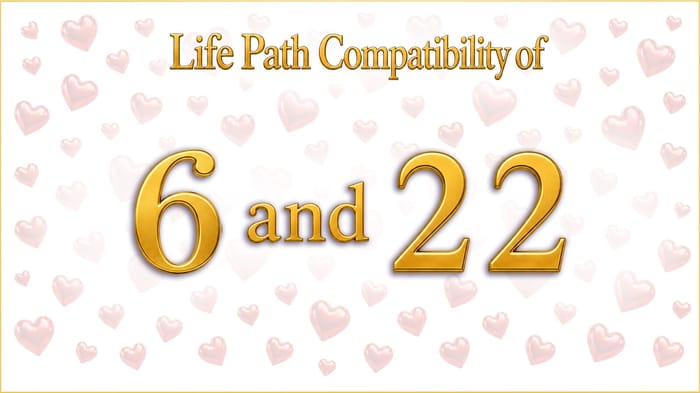
Both the 6 and the 22 build things meant to shelter people. The difference is scope. The 6 builds a home, warm, personal, specific to the people inside it. The 22 builds an institution, designed to shelter people they may never meet, across timelines they won't personally see through.
Put the two of you side by side
Two birth dates are all it takes.
When these two find each other, there's often an immediate quality of mutual recognition: we're both doing the same thing. We both show love through building, through responsibility, through taking care of what needs taking care of. The recognition is real.
And it can take years before both people realize that the same impulse pointed at different scales creates a tension that won't resolve itself through goodwill alone.
This is a pairing that often works beautifully in the first years. Both people are building, both are caring, both are contributing. The friction emerges later, when the 22's scale of care begins to compete with the 6's need for personal attention - and when the 6's domestic orientation begins to feel, to the 22, like a smaller version of something they're trying to do at larger scope.

The Home and the Institution
The Life Path 22 brings the capacity to build structures that serve at community or institutional scale. Their love isn't less personal than the 6's - it's differently aimed. The 22 experiences building for humanity as an expression of genuine care. They're not absent from the relationship because they don't love their partner. They're working at a scale that requires their attention to extend beyond the household.
When the 22 is operating at master expression, they carry a quality of purposeful intensity that can be both impressive and somewhat hard to live alongside.
When the 22 oscillates to their 4 root, the dynamic shifts considerably. The 4 is domestic, practical, present to the immediate environment. The 22 in 4-mode is often more available to the 6's needs - more interested in the home, more focused on the practical matters of shared life.
The 6 may actually prefer this version of their partner in some ways, which creates its own complexity.
The Life Path 6 brings love made tangible. The 6 doesn't just feel love; they cook it into dinner, fold it into laundry, build it into the routines that make a home function. Their form of care is immediate, sensory, and deeply personal.
In a relationship, the 6 creates an environment where their partner is genuinely nourished - not just emotionally but practically, physically, in all the ways a body needs to be cared for in order to do its work in the world.
The 6 also brings a quality of moral seriousness that the 22 can respect. The 6 has convictions about how people should treat each other, about responsibility, about what love owes. These aren't abstract principles for the 6 but lived commitments that show up in how the 6 actually behaves, daily.
The 22, who also operates from conviction about serving others, finds this familiar and reassuring.

Both Building Something That Shelters People
Both of you understand that love is expressed through what you do, not just what you say. Neither has much patience for a partner who is all words and no follow-through. The 6 demonstrates love through domestic attention; the 22 demonstrates it through building something meaningful.
Finding someone else who shares this "love is action" orientation creates a specific kind of trust: you know your partner is invested because you can see the investment in physical form.
The domestic life between these two tends to work. Both value a well-functioning home. Both understand the importance of creating an environment that supports the people in it. The 6 naturally tends to the warmth and beauty of the home; the 22 contributes structural stability. Between you, the life you build tends to feel both comfortable and substantial.
When the 22 oscillates to 4, this pairing enters one of the system's naturally harmonious zones. The 4+6 dynamic - sometimes called "the homestead" in classical compatibility - is characterized by shared values, practical ease, and a mutual understanding of what a life together requires.
During the 22's root-level phases, both people are operating in even-number, earth-oriented space. Things flow.
The 6 also provides something the 22 genuinely needs: consistent attention to the human scale. The 22 can become so focused on building for many people that they lose track of the one person standing closest to them. The 6 won't let that happen indefinitely. They'll name the absence. They'll insist on presence.
And the 22 who responds to this - who allows themselves to be called back to the intimate - discovers something the master-number frequency can obscure: the close-in matters as much as the far-away.

Put the two of you side by side
Two birth dates are all it takes.
When Scope Becomes Competition
The 22's absorption in their larger work is the most predictable source of friction. The 6 needs consistent, personal attention - not grand gestures on holidays, but the daily texture of being noticed, cared for, chosen. The 22's attention is genuinely divided between the relationship and whatever they're building in the world.
This is structural, not personal. But to the 6 who is running the household, maintaining the emotional atmosphere, and waiting for their partner to be fully present, the distinction between structural and personal may not feel meaningful.
The 6 can also tip into martyrdom in this dynamic - providing all the domestic and emotional care without receiving proportionate attention in return, and then carrying the resentment silently because the 6's shadow includes a tendency to suffer nobly rather than confront.
The 22 may not notice this happening until the resentment has built to a critical level, because the 6 is still functioning, still caring, still maintaining the home. The 6 who doesn't speak their needs early creates a crisis that arrives without warning.
There's also a tension around what counts as meaningful contribution. The 6's work - the care, the home, the emotional atmosphere - is culturally undervalued compared to the 22's world-facing achievements. Both may unconsciously absorb this hierarchy, with the 22 treating their work as the significant contribution and the 6's care as the supporting infrastructure.
This isn't usually conscious or malicious. But it's corrosive over time.
When the 22 is at full master expression, they can become genuinely hard to reach. The altitude of their thinking, the scope of their concern, the intensity of their focus on the larger project - all of this can make the 6 feel like they're trying to get the attention of someone who is perpetually looking past them at something on the horizon.

Valuing the Other Scale
For the Life Path 22: Come home. Not just physically (though physical presence matters) but attentionally. When you are with your 6 partner, actually be with them. Put the project down. Make eye contact. Ask about their day with genuine interest.
The 6 doesn't need you to stop building at cosmic scale. They need you to remember that the cosmic and the domestic are not competing values but different scales of the same love, and neither is more important than the other.
Specifically: notice the 6's work. Name it. Thank them for it with specificity rather than general appreciation. "I notice you reorganized the study" lands differently than a vague "thanks for everything you do."
The 6 who feels their specific contributions are seen will sustain this partnership indefinitely. The one who doesn't will eventually stop offering them.
For the Life Path 6: Your work is speaking your needs before resentment builds - and then not framing those needs as accusations. "I need more of your attention this week" is a request. "You're never here" is an attack.
The 22 responds to clear requests far better than to accumulated grievance. Practice asking for what you need in the moment you need it, rather than waiting until the need has become a wound.
Also: develop genuine interest in what the 22 is building, even when it operates at a scale beyond your household. The 22 whose partner understands and cares about their larger work feels less divided between home and mission.
You don't need to participate directly. But genuine curiosity and respect for the work will change how present your partner can be when they return from it.

Where Personal Meets Generational
Establish daily rituals of connection that don't depend on the 22's work schedule or energy level. Morning coffee together. A ten-minute conversation before sleep. Something that happens regardless of what else is going on, that belongs exclusively to the relationship.
Small, consistent touchpoints do more for this pairing than occasional large gestures.
The 22 should periodically invite the 6 into their larger work - not as labor, but as witness. Share what you're thinking about. Explain a problem you're solving. Let the 6 see what occupies you when you're away. This reduces the 6's sense of being shut out and helps them understand why the work matters so much to you.
When the 6 notices resentment building, they should treat it as an alarm rather than something to endure. Speak it the first time you notice it, not the fortieth.
And when the 22 receives this feedback, take it seriously the first time. The 6 who brings a concern and is dismissed or deferred will stop bringing concerns - and start accumulating them.

Two Ways to Care
What the 6 learns in this relationship is that care can operate at larger scale than the household without losing its warmth. The 22 shows the 6 that building for strangers is still an act of love - that the same impulse that makes a good home can also make a good world.
What the 22 learns is that the grandest cathedral is only as meaningful as the people who find shelter in it. The 6 is a constant reminder that the human beings closest to you are the first measure of whether your building is actually serving anyone. If the people in your own home don't feel cared for, the scale of your external work is beside the point.
Together, these two hold a question that matters: can you build at large scale and still be warm at close range? Can you care deeply about one person and also about many? The answer this pairing arrives at, when both people are doing their work, is yes. Both. At the same time. Without one diminishing the other.
Discover your Life Path with our Life Path Calculator and see your full compatibility profile.

Frequently Asked Questions
Does the Life Path 6's domestic focus limit the Life Path 22?
Only if the 22 treats the 6's contribution as something to transcend rather than something to build on. The 6's domestic work is not a limitation on the 22's vision. It's the foundation that makes the vision possible. The 22 who is well-fed, in a clean home, with a partner who maintains the emotional infrastructure of daily life is free to build at full scale precisely because someone is holding the ground. This is partnership, not limitation. The 22 who understands this genuinely - not as a polite acknowledgment but as a real assessment of what makes their work possible - treats the 6 as essential rather than domestic.
How does the 22's oscillation to 4 affect the Life Path 6?
Often positively. When the 22 drops to 4 expression, they become more present to domestic life, more interested in practical matters, more available to the 6's world. The 4+6 combination is one of the system's naturally comfortable pairings. Some 6 partners actually prefer the 22's root-level expression because it brings the partner closer to home. The risk is only if the 6 becomes attached to the 4 mode and resents the return of the master-number expression - the stretching-away that happens when the 22 re-engages their larger vision.
What does the 6 do when the 22 is absorbed in a major project for months?
Maintain their own life. The 6 who makes the 22 their entire emotional world will suffer terribly during the 22's intensive work phases. Having friends, creative outlets, and their own sense of purpose gives the 6 ground to stand on when the 22's attention is elsewhere. It's also healthy to name what you need clearly: "I support this project and I also need you to be present for dinner three nights a week." The 22 who receives specific, concrete requests can usually meet them. The 22 who receives only generalized disappointment doesn't know what to do differently.
Is this pairing better with traditional or non-traditional role division?
It works either way - what matters is that both people's contributions are valued equally regardless of what form they take. The 6 who manages the home and the 22 who works externally is one version. The 6 who works in community care while the 22 builds at institutional scale is another. What doesn't work is any arrangement where one person's contribution is systematically treated as more important than the other's. Name the value of what each person does. Make it explicit. Don't let cultural defaults determine whose work counts.