First Period Cycle 6: Growing Up in Service and Responsibility
By Blair Andrews · Published April 25, 2025 · Updated May 10, 2026
A Childhood Woven in Responsibility
June births carry the 6 as their First Period Cycle, and it colors everything about the world you grew up in. The 6 in Pythagorean numerology is the hexagram - two interlocking triangles, the symbol of harmony between opposing forces.
Its Tarot card is the Lovers, and its planet is Venus. On the Tree of Life, the 6 sits at Tiphareth - Beauty - the central point where all paths converge.
But do not mistake this for a soft or easy vibration. The Lovers card shows a figure standing between two paths (virtue and vice) with the Spirit of Justice hovering above, arrow drawn. Choice and consequence are built into this number from the beginning.
Your First Period Cycle describes the background atmosphere of your formative years. For the 6, that atmosphere revolves around family, service, and the complex dance of loving obligation.
If you grew up feeling needed - like there was always someone to take care of, a problem to solve, a household to help hold together - you were living inside the natural current of this cycle.

Family as the Defining Force
More than any other First Period Cycle, the 6 places family at the absolute center of childhood experience. Your earliest understanding of the world was filtered through family dynamics - who was responsible for what, who needed help, who held things together, and what happened when someone did not carry their weight.
In the esoteric tradition, the 6 represents divine desire - the lily with its six petals, in contrast to the rose's five petals of human desire. There is something almost sacred about the way a 6 First Period child approaches family. You did not just live in your family.
You felt responsible for it. Maybe you were the peacemaker between arguing parents. Maybe you took care of younger siblings. Maybe you were the one everyone came to with their problems, even when you were far too young for that weight.
The family environment itself tends to be warm but demanding. There is love, often a great deal of it, but it comes with strings - expectations, obligations, the unspoken understanding that love means showing up and doing your part.
Venus provides financial protection and material comfort, so 6 First Period childhoods often have a certain stability to them. But the emotional labor can be intense.
Avery called the 6 "the number of adjustment," and in a 6 First Period, childhood is one long lesson in adjusting - to other people's moods, other people's needs, other people's expectations. You became flexible not because you were carefree, but because you were constantly recalibrating to keep the peace.

Beauty and the Aesthetic Sense
There is a dimension to the 6 First Period that is easy to overlook amid all the talk of responsibility. This is also the number of beauty. Venus rules here, and children in this cycle often develop a refined aesthetic sense early. Your childhood home may have been beautifully kept, or you may have been the one trying to make it so.
You might have been drawn to art, music, or design - not in the explosive, expressive way of the 3, but in a more harmonious way, seeking to create environments that feel balanced and pleasing. The hexagram represents the meeting of opposites in perfect equilibrium.
Children under a 6 First Period often have an innate sense of proportion. They can feel when something is off-balance, whether it is a room arrangement, a color scheme, or a relationship dynamic. That sensitivity to harmony is one of the 6's most elegant gifts.

What This Atmosphere Cultivates
The 6 First Period builds people who understand, at a level deeper than words, that life is about relationships and the responsibilities they entail. You do not have to be taught to show up for people. It is your default. You do not need a lecture about commitment. You have been practicing it since you were old enough to help set the table.
Children under this cycle are unusually reliable. Teachers trust them. Relatives praise them. Friends depend on them.
And while that feels good - being needed feels good - it can also set up a pattern where your sense of self-worth becomes entangled with how much you do for others. When the 6 First Period child stops being useful, they can feel genuinely lost.
There is also a capacity for healing that the 6 develops early. Not necessarily in any formal sense, but in the everyday sense of knowing how to make someone feel better, how to soothe a conflict, how to create an environment where people relax and open up.
Prophets, mystics, and healers have long been associated with this number. That resonance often begins in childhood.

Where This Atmosphere Gets Heavy
Honesty matters here. A 6 First Period can be heavy. The child who carries responsibility for family harmony is carrying something that should probably be distributed among the adults.
If you grew up feeling like it was your job to keep everyone happy, to smooth over conflicts, to sacrifice your own needs for the good of the household, that is a pattern that can follow you for decades if you do not examine it.
The shadow of the 6 is depletion. Giving endlessly without replenishment is self-destruction dressed up as service. If your childhood trained you to put everyone else first, the most important thing you can learn as an adult is that you count too.
That your needs are not selfish. That the best service you can offer others starts with a full cup, not an empty one.
Interference can surface too. The 6 cares so much that it can become controlling - not from malice, but from genuine anxiety about the people it loves.
If you catch yourself managing other people's lives, organizing their decisions, offering help that was not requested, that pattern likely started in your 6 First Period, when managing family dynamics was how you survived.

What You Carry Forward
What you need most, as you move into your Second and Third Period Cycles, is permission to receive. The 6 gives beautifully. Learning to accept help, to let someone else carry the weight, to admit that you are struggling - that is the growth edge this childhood sets up.
The Lovers card is not just about choosing between virtue and vice. It is about choosing yourself as someone worth loving too. The beauty of Tiphareth is not decorative. It is structural - the beauty of a life arranged around love that includes the self.
Your First Period gave you the instinct for service. The rest of your numerological chart gives you the opportunity to refine it - to learn the difference between a server and a servant, and to offer the kind of care that sustains both the giver and the one who receives.

Explore Further
- Period Cycles Calculator
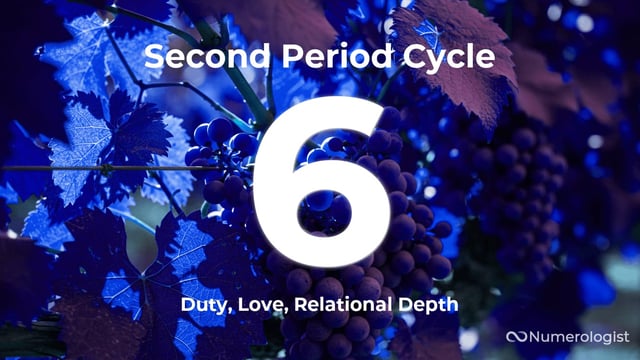
- Second Period Cycle 6
- Third Period Cycle 6
- Period Cycles Overview
- All First Period Cycles
- Number 6 in Numerology
- Life Path Number 6

Frequently Asked Questions
What does a 6 First Period Cycle mean?
A 6 First Period Cycle means your birth month is June, immersing your formative years in the energy of love, responsibility, beauty, and the nurturing force of the Lovers archetype. The 6 is the number of home and family in the Pythagorean tradition, and the atmosphere of your childhood carried an unusual emphasis on care, relationships, and the understanding that love comes with duties.
When does the First Period Cycle begin and end?
The First Period Cycle begins at birth and runs through your late twenties - generally ending around age 28 to 36, depending on your Life Path number. It is derived from your birth month and colors the foundational decades before active adult life begins.
How does a 6 First Period Cycle shape a person's sense of responsibility to others?
The 6 environment teaches early that you are part of a web of relationships, each one carrying weight and obligation. Children growing up in this cycle often assume caretaking roles naturally - the one who notices when someone is hurting, who smooths over conflicts, who takes pride in the family unit. That orientation toward service and harmony runs deep and continues to express itself long after childhood ends.