Your Complete Guide to Astrology: Signs, Planets & Charts
By Blair Andrews · Published April 19, 2026 · Updated July 19, 2026
The short version: Astrology is a psychological map built from the sky at the moment you were born. It describes your core drives, emotional needs, and recurring life patterns - not your future. You read it through three parts: planets (what), signs (how), and houses (where). Your Sun sign is one placement among many.
There's More to This Than Your Sun Sign
 | You already know your zodiac sign. You've probably read a few horoscopes, maybe rolled your eyes at the vague ones, maybe been startled by the ones that landed uncomfortably close to home. And at some point you likely asked the question that brings most thoughtful people to a page like this one: is there actually something here, or is this just entertainment dressed up in ancient language? |
There's something here. Quite a lot, actually.
When I first started studying astrology alongside numerology, the overlap surprised me. The same person whose Life Path number describes them perfectly will find that their birth chart tells the same story in a completely different language.
After 10 million numerology readings, adding astrology felt less like learning a new system and more like hearing a familiar conversation in a second language - the meaning was the same, but the texture was different in ways that deepened everything.
But what's here isn't what most astrology content promises. It's not a system that predicts your future, tells you who to date, or explains your personality in a paragraph. It's something more useful than any of that.
Astrology, taken seriously and studied with care, is a psychological map of remarkable depth. It describes the particular pattern of drives, needs, tensions, and gifts you brought into this life.
It shows you where you're likely to grow, where you tend to get stuck, and what keeps showing up in your experience whether you're looking for it or not.
This guide is your starting point for the entire astrology section on Numerologist.com. Whether you're brand new or you've been reading charts for years, everything you need branches out from here.

What Astrology Actually Is
 | Let's clear something up right away. Planets do not cause things to happen in your life. Mars doesn't make you angry. Venus doesn't make you fall in love. Mercury retrograde doesn't personally sabotage your text messages. |
Astrology works through correspondence, not causation.
The patterns in the sky at the moment you were born mirror patterns in your psyche - not because one produces the other, but because both reflect the same underlying reality. Think of it as a meaningful coincidence woven into the structure of time itself.
Different moments carry different qualities, and your birth chart captures the specific character of the moment you arrived.
This is why astrology, at its best, feels less like fortune-telling and more like looking into an unusually honest mirror. The chart doesn't tell you what will happen. It shows you who you are - the full picture, including the parts you haven't met yet.

Where This Tradition Comes From
The Western astrology tradition (the one described on this page and practiced by most astrologers in the English-speaking world) has its roots in Hellenistic Alexandria, roughly 200 BCE to 400 CE.
The astrologers working in that era built the system most people practice today: the twelve-sign zodiac, the twelve houses, the five visible planets plus Sun and Moon, and the geometric aspect relationships between them.
Their starting assumption was that the cosmos is alive and communicative. The planets weren't dead rocks following mechanical orbits. They were understood as living presences whose movements expressed meaning, not randomly, but in a language that could be read.
The question astrology was built to answer wasn't "what will happen next?" It was "what is this moment trying to say?"
That question still sits at the heart of serious astrological practice. And knowing that this tradition has a specific intellectual lineage - two thousand years of careful observation, debate, and refinement - makes a difference. This isn't vague ancient mysticism. It's a disciplined system with deep roots and a clear history.
In readings I do, the clearest agreement between the two systems shows up at the planetary level. Saturn in a chart and the number 8 in a numerology reading are having the same conversation in different vocabularies.
Numerology and astrology share that root. Both emerged from the same ancient intellectual environment - the same thinkers who said "all things are number" were the ones developing mathematical astronomy.
The number tradition that underlies this site and the astrological tradition that underlies this page grew from the same intellectual soil, not separate systems with a coincidental resemblance. They share roots.

Not a Cage. A Starting Point.
 | One of the most important things to understand before you go any further: your birth chart is not a sentence. It describes your inherent pattern, the psychological landscape you were born with, but it says nothing about what you'll do with it. Two people with nearly identical charts can live completely different lives depending on how consciously they engage with their own tendencies. |
What often feels like fate is really just an unconscious pattern running on autopilot. The same situations keep finding you. The same dynamics keep playing out in relationships. The same internal conflicts keep surfacing.
The chart maps those patterns with startling precision. And once you can see a pattern clearly, you're no longer at its mercy.
That shift, from being driven by your chart to consciously working with it, is the whole point.

The Building Blocks
Astrology has a vocabulary, and it's simpler than it looks. Three core pieces make up every birth chart, and once you understand how they interact, the rest of the system opens up naturally.
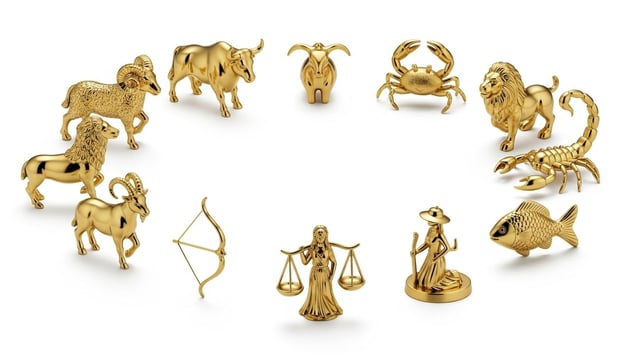
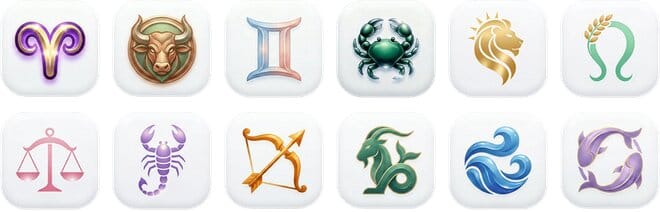
Signs are the twelve phases of a single cycle - not personality types stamped on you at birth but twelve distinct qualities of expression that color everything they touch.
When someone says "I'm a Gemini," they're naming the sign their Sun occupies. But every planet in your chart sits in a sign too, and each one tells a different part of the story. The twelve zodiac signs are the language your chart speaks in.
Planets are the actors, the psychological drives at work inside you. Your Sun represents your core sense of identity. Your Moon holds your emotional instincts and deepest needs. Mercury shapes how you think and communicate. Venus describes what you love and how you connect.
Mars fuels your ambition and your capacity to act. Jupiter searches for meaning. Saturn confronts you with limitation and demands you grow through it. The outer planets (Uranus, Neptune, Pluto) carry the weight of generational forces moving through your life whether you notice them or not. The ten planets are the characters in your chart's story.
Houses are the stage, though they're more than that. Each house is a field of psychological experience, a domain of life in which the planets placed there express their energy.
The common shorthand ("the 7th house is marriage, the 10th house is career") is misleading. The 7th house is not "your spouse." It's the field in which you encounter the other, the not-self, the mirror. Business partners, significant friendships, and open rivals all live here, alongside romantic partnership.
The 10th house is not "your job." It's your relationship to authority, public identity, and the legacy you're building, which might express through career or through something else entirely.
A planet tells you what psychological force is at work. A sign tells you how it expresses. A house tells you where in your life it shows up. The twelve houses are often more revealing than sign placement alone.

Day and Night: The Sect Distinction
Here's something most modern astrology introductions leave out entirely. Traditional astrology organized the planets into two teams: the day team and the night team.
The Sun, Jupiter, and Saturn belong to the day sect. The Moon, Venus, and Mars belong to the night sect. Mercury swings either way, joining whichever team is in power at the moment of birth.
If you were born during the day - Sun above the horizon - the day-team planets perform more reliably in your chart. Jupiter's generosity flows more easily. Saturn's discipline feels more purposeful.
If you were born at night, the night-team planets are more comfortable. Venus and Mars operate with greater ease, and the Moon's instincts carry extra weight.
This concept, called Sect, comes from the Greek word hairesis, meaning choosing sides. It's one of the most useful traditional tools for understanding why two people with the same planetary placements can have such different experiences.
Your birth time (day or night) changes which planets are working with you and which ones are working against the grain.
Sect is one of the first things I check in a chart. The same prominent Mars reads as friction in a day-birth chart and as fuel in a night-birth one. The same placement lands differently depending on the hour of birth.

Beyond "What's Your Sign?"
 | The biggest misconception in popular astrology is that your Sun sign is your whole chart. Knowing only your Sun sign is like reading the title of a book and assuming you know the plot. It matters - but it's one thread in a much larger weave. |
The Sun describes not who you are, but who you are becoming. Your Sun sign is less a trait than a direction, a quality of consciousness you are spending your life learning to express.
A Sun in Aries doesn't mean you arrived as a confident, pioneering person. It means your life's work involves learning to initiate, to assert, to lead. You might spend your first decades feeling the gap between the Aries archetype and your actual lived experience. That gap is not a failure. It's the developmental arc the Sun is describing.
This is why plenty of people don't fully resonate with their Sun sign until their thirties or forties. The Sun isn't a snapshot of who you already are. It's a picture of what you're growing toward.
Your rising sign (also called the Ascendant) is the zodiac sign that was crossing the eastern horizon at the exact moment of your birth.
It shapes how you instinctively engage the world and how other people first experience you. Many people identify more with their rising sign than their Sun sign, and understanding it often makes the rest of the chart click into place.
In readings I do, the rising sign is the placement people recognize fastest. A Capricorn rising with a Pisces Sun will usually tell me she has felt too serious on the outside and too soft on the inside. The chart names that split in one line.
Your Moon sign holds your emotional nature: how you respond when your guard is down, what you need to feel safe, and the patterns you absorbed long before you had words for them.
The Moon tends to operate below conscious awareness, which is exactly why it can be so startling to read about. It describes the you that only the people closest to you ever get to see.
Your Venus sign reveals your relational style: what you find beautiful, how you express affection, and what you genuinely value in love and partnership. Understanding your Venus often illuminates relationship patterns that no amount of compatibility quizzes can explain.
And your Mars sign shows how you pursue what you want: your drive, your ambition, your style of assertion, and your relationship to conflict. Mars is probably the most misread planet in popular astrology. It's not about aggression. It's the force that protects your right to be yourself.

What the Chart Doesn't Show
 | It's worth being honest about limitations. Your birth chart cannot tell you who to marry, which job to take, or whether next Tuesday will be a good day. It cannot tell you who is "compatible" with whom in any simple sense - real compatibility between people involves dynamics far more complex than matching signs. And it absolutely cannot tell you whether your life will turn out well or badly. That part is up to you. |
The chart also says nothing about the quality of your choices. Difficult placements aren't punishments; easy ones aren't rewards.
Some of the most interesting people have charts full of tension, squares and oppositions that created the friction necessary for real depth. The challenging configurations are often where the most important growth happens.
A chart with nothing but ease can produce a life that never develops beyond the surface.

Aspects: The Conversations Between Planets
If you've heard terms like "square" or "trine" and wondered what they mean, here's the short version. Aspects are the angular relationships between planets in your chart. They describe how different parts of your psychology interact with each other.
A conjunction merges two planetary energies so completely that they operate as one. A trine (120 degrees) creates natural flow and ease, gifts that come so smoothly they can be taken for granted. A sextile (60 degrees) is gentle cooperation, opportunity that responds to a little effort.
A square (90 degrees) is friction, genuine internal tension between two parts of yourself that want different things. Squares are uncomfortable, but they're often where the most growth happens, precisely because they won't let you coast. An opposition (180 degrees) places two needs directly across from each other, asking you to find balance rather than choose sides.
Without aspects, a chart reading is incomplete. You have the characters, but not the dialogue between them. A detailed look at all five major aspects lives in our birth chart guide, and our transits and aspects page goes deeper still.

Where to Start
The fastest way in is to get your own placements. Our free rising sign calculator and moon sign calculator turn your birth date and time into the two placements that matter most beyond your Sun. Then the birth chart guide shows you how to read the full map.
| Astrology 101 |
| How to Read Your Birth Chart |
| The 12 Zodiac Signs |
| The 10 Planets |
| The 12 Houses |
 | Moon in the Signs |
 | Venus in the Signs |
 | Mars in the Signs |

Astrology and Numerology: Two Maps, One Territory
You're on a numerology site reading about astrology, so let's talk about why both belong here.
Astrology and numerology are two of the oldest symbolic systems for understanding the self. Both start from the same premise: the specific moment and circumstances of your birth carry meaning, and that meaning can be read if you know the language. Both work symbolically rather than mechanically.
Both describe core psychological drives, recurring life themes, and patterns of development. And both treat numbers as carriers of significance - the twelve signs, the ten planets, the twelve houses, the cycles and aspects - all rooted in the same mathematical relationships that numerology works with directly.
Where they differ is in texture. Numerology distills your name and birth date into core numbers that describe your life path, your expression, your soul's deepest urge. It works at the level of essence: clean, direct, archetypal.
Astrology takes the position of specific celestial bodies at a specific moment and produces a far more detailed and situationally nuanced picture. Numerology gives you the bones. Astrology gives you the musculature and the facial expressions.
Your Life Path number and your Sun sign may describe different facets of the same truth, or they may create a productive tension that reveals something neither system shows on its own.
If you already work with your numbers, adding the astrological layer will deepen what you see. If you're starting with astrology, your numerology chart will give you a grounding point that the complexity of a birth chart sometimes obscures. Our astrology-numerology combination guide explores the overlap in detail.

What We're Building Here
The astrology section on this site is built on a simple conviction: you deserve better than horoscope columns and compatibility quizzes. You deserve content that takes you - and the tradition - seriously enough to go beneath the surface.
Every page in this section treats astrology as what it is at its best: a sophisticated psychological framework for self-understanding. The writing is warm, not clinical. The insights are grounded, not vague. And the goal isn't to impress you with complexity but to hand you a set of tools for seeing yourself more clearly.
Start wherever you're drawn. Follow whatever thread pulls you. The chart is patient. It'll be the same map whenever you come back to it - but you won't be the same reader. That's the quietly extraordinary thing about this work. The more you understand, the more there is to see.
Astrology is one part of a larger pattern. See how it connects to numerology, tarot, and palmistry