Angel Number 636 Meaning: The Grip the Maker Has on Their Own Work
By Blair Andrews · Published July 10, 2023 · Updated May 21, 2026
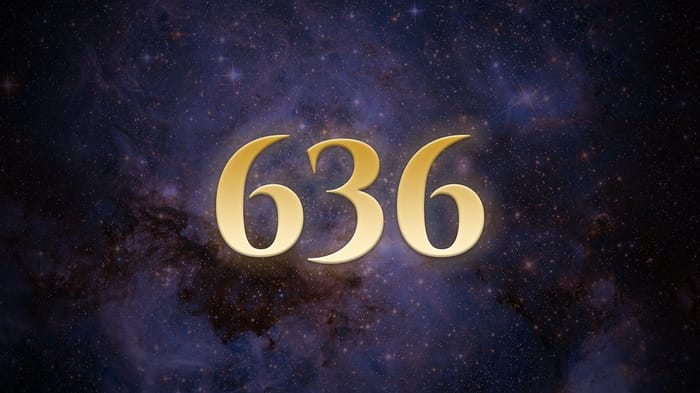
The numbers inside 636

6 + 3 + 6 = 15 → 6
6: Home, responsibility, the people closest to you
A creative voice growing between two loves - and the grip that develops is the maker feeding on the love rather than from it. 636 passes through the Devil and returns to love: the chain is the creative success, and releasing it restores both relationships.
What 636 means for you specifically depends on which of the 11 Life Paths you’re on. Your birthday determines that.
Enter your birthday below:

636 is the third number in the 6-X-6 palindrome series. A creative voice sits at the center. Two loves stand on either side.
The whole figure passes through the Devil on its way to reduction - and the Devil here is not what most readers expect. It is the grip the maker has on their own work. The way love itself can become possessive of what it made.
Start there. The rest is an unfolding.

A Different Frame Than the Others
The 6-X-6 series began with 616, which placed a single, concentrated beginning between two devotions. It continued into 626, where a partnership was protected on both sides by loves standing just outside it. Each of those arrangements put something quiet at the center. A seed. A pairing.
636 is the first in the series that puts a voice at the center. A creative signature. A maker.
If you landed here because you keep seeing 636, there is a good chance you are someone who makes things. You might not call yourself a creative, but you have a voice, a way of doing something that is distinctly yours, and lately that voice has felt caught between the people it grew out of and the people it reaches.
The two 6s have not changed. They are still love in its older sense. Care, responsibility, the long tending of something alive. But the 3 between them is not a seed or a partnership. It is a making. A specific creative output that the two loves frame on either side.
And because the center term has shifted from passive to active, the story the palindrome tells shifts with it. The previous numbers asked how love holds what is being born. 636 asks what love does with what has already been made.

The Two Loves Are Not the Same Love
Before the palindrome can be read clearly, the two 6s need their own shape.
The first 6 is the love that started the work. Not the work itself but the love that was alive before any making happened. The quiet devotion that turned into a practice. The person, the calling, the community, the place the maker's creative voice grew up inside of. The soil. The older devotion that preceded the making and made the making possible.
The second 6 is the love that receives the work. Not the audience in the shallow sense. The specific humans whose lives the work has entered. The reader who memorized a sentence. The listener who played a song at a particular funeral. The child who watched a parent make something and decided their own life could have making in it.
Two loves. The one that started the making. The one that receives it. And between them, the voice that made.

The Voice at the Center
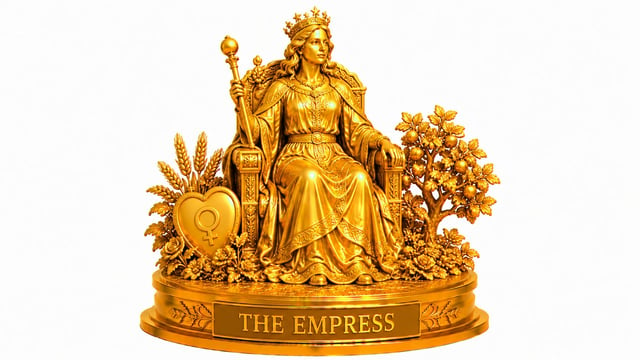
The 3 in 636 is the creative voice. Warm, specific, unmistakable. The Empress in the tarot. The number that generates rather than reflects.
Put it inside the palindrome. A love that started the work. A voice that makes. A love that receives what the voice makes. Read left to right, the shape describes an entire creative life. Soil, flowering, harvest. Nothing in that picture is wrong.
But palindromes have a specific feature. The shape reads the same forward and backward. Right to left, the same three terms: harvest, flower, soil. And at some point in any long creative life, the direction of reading begins to reverse.
The maker stops seeing the work as something coming out of them and starts, without meaning to, seeing it as something coming back at them. The received love becomes the thing the voice orients toward.
The mirror slowly turns the creative voice around. Until it is no longer making toward the soil it grew out of, but making toward the shape the audience has learned to love.
That turning is where the Devil comes in.

The Specific Chain of 636
6 plus 3 plus 6 is fifteen. And fifteen is the Devil in the old deck.
The usual warning applies. The card is not about evil, and the chains are loose enough to lift off at any moment. The 15 page treats this in full. But every Devil transit has its own specific chain, and the chain of 636 is the grip.
Not the grip of appetite. Not the grip of the celebrated work insisting on its own continuation. The grip, specifically, that the maker has on the work itself. The way the two loves on either side can tilt the voice into possessiveness of what it has made.
The maker begins to speak about the work the way a person speaks about a child they have not let grow up. My piece. My line. My particular way. The thing only I make this way. The possessives multiply until the work itself can no longer breathe outside the maker's hands.
It is a tender chain. That is what makes it easy to miss. It does not announce itself as possession. It announces itself as love. As care. As the maker's responsibility to the work, to the legacy, to the reputation of having made the thing this way and not some other way. The grip tightens in the name of devotion.
Whether 636’s shadow side applies to you — and how strongly — depends on your core numbers. Your birthday reveals the first one.
Enter your birthday below:

How the Grip Forms
Watch how the two 6s make the grip possible.
The soil, meaning the older devotion the making grew inside of, gives the voice its particular shape. Over time, the maker begins to confuse that shape with something that must be protected.
Any departure feels, to the maker, like a betrayal of the love that grew the voice. I cannot work in a different medium. The teachers who gave me this technique gave it to me for a reason.
The audience does the same thing from the other direction. Any departure feels like a betrayal of the people who received the work. The ones who loved this loved it in a particular form. Changing the form breaks the agreement.
The two loves, in themselves, are not doing anything wrong. They are only being loves. But together, they can slowly press the creative voice into a fixed shape - until the maker no longer owns the voice but has become a caretaker of a specific version that both loves have agreed to love.
That is the grip. The creative voice held tightly by the hands it is trying to serve.

The Transmutation
Fifteen reduces further. One plus five is six.
Another 6. This is where the palindrome does its quietest work. The maker enters the transit as a creative voice between two loves. The reduction produces a third love - not a new one, and not a replacement for either of the other two. A different form of love altogether.
The 6 at the bottom of 636 is not the soil, and it is not the audience. It is love for the making itself, held by a maker who has finally released the work from their grip.
The 6 that emerges is the version of love that no longer requires the work to be a specific shape. The maker can let the work change. Let the medium shift. Let the sentence go in a direction that breaks the earlier contract with both loves on either side.
The new love is not less committed - it is wider. It makes because making is what the voice does. Not because the soil needs to be honored in this exact way. Not because the audience needs to be given this exact shape again.
The grip dissolves. The work is returned to itself.
Here is what I want you to hear: the tightness you feel around your work is not selfishness. It is love that forgot how to let go. The number is not telling you to care less. It is showing you that your creative voice was never yours to own. It was yours to use. You still choose what happens next with it.

Where the Maker Stands Afterward
Before the transit: 6, 3, 6. Love, voice, love. A creative voice flanked by two devotions that, without meaning to, tightened around it.
After the reduction: a single 6. Love for making. The two outer loves have not disappeared. The soil is still soil. The audience is still the audience. What has changed is the maker's relationship to the voice at the center.
The grip has opened. The hand that was holding the work tightly has turned palm upward. The work is no longer something the maker owns, defends, preserves, and delivers on schedule. It is something the maker makes, releases, and makes again - in whatever shape the voice is ready to make next.
The two 6s on either side look, to the maker standing there afterward, slightly different than they did before. The soil is no longer a cage. The audience is no longer an obligation.
Each has become what each always was underneath - a love that was never asking the work to be a particular shape. Only the maker was asking that. The loves were only loving.

The Closing Shape
The soil did not ask to be repaid in kind. The audience did not ask for duplicates of what they already received. The maker was the one who mistook both loves for a contract.
The transit dissolves the contract by revealing there was never a contract to begin with - only two loves on either side of a voice, watching the voice tighten around what it had made, waiting patiently for the grip to open.
When it opens, the palindrome holds its shape but loses its possessiveness. Two loves still frame a creative voice.
But the work has been released from the maker's grip - and what stands between the loves, finally, is not a caretaker of a fixed object but a voice making again, for its own sake, watched gently from both sides by the devotions that have been waiting for this all along.
The first 6 is the love that started the work. The second 6 is the love that received it. And the 6 at the bottom - the one the whole palindrome reduces to - is the love that no longer needs the making to be any particular shape.
The grip lets go. The work returns to itself. The voice keeps making.

Curious which numbers are active in your chart right now? Your birthday is the starting point.
Enter your birthday below:
Explore Angel Numbers
| Digit meanings | Angel Number 3, Angel Number 6 |
| Reduces to | Angel Number 6 |
Behind Your Angel Number
numerology chart calculator·life path number calculator·numerology guide