The Seam Between Two Earned Wins
By Blair Andrews · Published June 18, 2023 · Updated May 21, 2026
The numbers inside 1771


1 + 7 + 7 + 1 = 16 → 7
7: Understanding, depth, seeing what others miss
The Tower’s strike landed on the seam between two wins, not on the wins themselves. 1771 is a palindrome where adjacent victories formed a single identity - the lightning separates them back into what each one actually was.
What 1771 means for you specifically depends on which of the 11 Life Paths you’re on. Your birthday determines that.
Enter your birthday below:

Write out 1771 and look at it as a shape before reading it as a number.
One, seven, seven, one.
The two outer digits are identical. The two inner digits are identical. It reads the same forward and backward. This is a palindrome - one of the cleaner four-digit ones, structurally speaking, because the symmetry is perfect on both axes at once.
Palindromes in numerology tend to matter for a reason that is easy to overlook. A palindrome doesn't travel. It folds back on itself. Whatever is at the middle is held by matching presences on either side, and whatever is at the edges is answered by the same thing at the other edge. The reader passes through it rather than along it.
What makes 1771 distinctive is what sits in the middle. Not a single digit. Two identical digits, pressed directly against each other.
Two 7s, adjacent. And on either side of them, two 1s.
That arrangement - doubled core with single bookends - is what this whole piece is about.

The seven, briefly, and why it being doubled matters
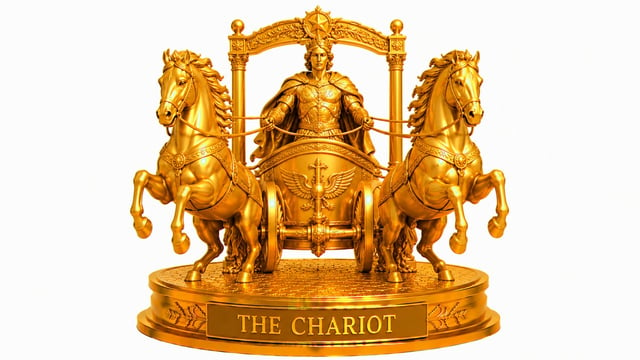
The 7 in this tradition is the Chariot. Not luck, not spiritual awakening, not a fear of failing. The Chariot. A disciplined self taking the reins of a vehicle and driving it forward with intention.
A victory earned through alignment rather than accident. The "lucky" sense some people attach to 7 is a translation drift from an older word that meant victorious.
One 7 is a driver. One completed run. One disciplined stretch of forward motion that arrived where it meant to arrive.
Two 7s beside each other, not separated, not alternating, but directly adjacent - is something else. It is two disciplined chapters that touched. Two completed runs with no reset in between.
The second Chariot did not start from scratch. It inherited the momentum, the skill, and the muscle of the first, and it moved directly into the next stretch of road while the first was still warm.
This is different from alternating Chariots (like 1717, where a new beginning sits between them). In 1771, the two Chariots share a wall. Whatever was built in the first one fed straight into the second one without being interrupted by a return to the starting line.
That adjacency is the quiet event the number is marking.
If you have been carrying the weight of two back-to-back achievements and something in you is nervous about what holds them together, that nervousness is the number arriving. You are not imagining the tension. The seam between the two chapters is real, and acknowledging it is the first step toward being free of it.

The 1s on either side
Outside the doubled core, on both edges of the number, is the monad. The 1. The Magician. The point of initiation, the focused will, the single stroke that has not yet become anything.
1s bookend this number. One at the beginning and one at the end. That structure describes a life where a beginning leads into the doubled disciplined chapter, and then another beginning waits at the far side, ready to open once the double-chapter is complete.
The first 1 is the person before the disciplined work began. The Magician with the tools on the table but the work not yet started. Quiet. Potential. Pre-formation.
The second 1, the one on the far side - is something different. It is the same Magician archetype, but it stands on the other side of two completed Chariot stretches. It knows more. It is not green. Whatever it begins next will be begun by a person who has already driven the disciplined work through two full phases.
So the bookends are not identical in content even though they are identical in digit. They are the same archetype catching the same person at two different distances from the doubled middle.

The arithmetic, and the card it lands on
One plus seven plus seven plus one equals sixteen. Sixteen reduces to seven.
Hold the sixteen for a moment before collapsing it. Sixteen in the older tarot sequence is the Tower. The card shows a structure being struck by lightning, figures falling from a height, crown of the tower blown off by the strike.
The cultural fear around this card distorts what it actually teaches. The Tower does not arrive for buildings that were honestly constructed. It arrives for structures built out of something other than what they were presenting themselves as. The strike is a separation, the person from the inauthentic construction they had come to stand on.
1771 sums to 16 because somewhere in the doubled-Chariot arrangement, a tower has quietly been built. Agrippa associated the number 16 with what he called "spiritual ascensions," and the paradox is real: the ascent requires noticing what your hands are still gripping so you can release it. By design - though it didn't feel designed at the time. Two consecutive disciplined victories, with no reset between them, tend to accumulate into a particular kind of self-story - I am the person who drives these things through.
That story, when it hardens, becomes a structure that was never supposed to be permanent.
The Tower strikes the structure. What sits between the Chariots. What lives between the disciplined phases. What connects the two phases. The structure that got built out of their adjacency.
Whether 1771’s shadow side applies to you — and how strongly — depends on your core numbers. Your birthday reveals the first one.
Enter your birthday below:

Where the Tower strikes, exactly
This is the part of 1771 that deserves careful attention, because the palindrome tells you where the lightning lands.
In 1717 - the alternating cousin - the two Chariots are stacked vertically into a kind of pedestal, and the Tower strike hits the stack from above. That is one geometry of the 16.
In 1771, the two 7s are not stacked. They are adjacent. They touch along a seam, shoulder to shoulder, two bodies of disciplined work pressed against each other with no space between.
The Tower does not strike the Chariots themselves. It strikes the seam.
That is a specific kind of event. It is the collapse of the illusion that the two chapters were one continuous thing. For a while, to the person living it, they looked like a single long stretch of competence.
The first rolled into the second. The second was credited to the same self, the same method, the same story. The seam was invisible because the momentum did not pause.
The 16 strike makes the seam visible. Suddenly it is obvious that the first Chariot and the second Chariot were two different vehicles driven by two different phases of the same person, and that the continuity between them was - at least in part - a construction.
The work was real. The victories were real. The unified identity draped across both was the Tower.
That construction comes down. The two Chariots remain standing. They always did.

The reduction to 7, read honestly
After the 16 collapses, the number reduces to 7.
This is not the 7 that preceded the Tower. It is not one of the two adjacent Chariots caught mid-run. It is the 7 that exists after the strike - the disciplined self after the seam has been opened and acknowledged.
That driver is different. They have done two full stretches of disciplined work. They know they can. They no longer need two stacked victories to prove it, because the proof has been revealed as a structure anyway, and the structure has been taken.
What is left is the underlying fact: this person drives. This person can take the reins, read the road, and move the vehicle forward.
But the driving is no longer weighted with the job of making the two chapters mean something larger than they were. The first chariot was a chariot. The second chariot was a chariot. They were each their own small complete thing. The person is free to begin a third disciplined stretch without the earlier two having to hold it up from below.
That is the quiet gift of 1771. A Chariot unencumbered by needing to stack.

The second 1, now legible
Return to the far bookend. The 1 on the right-hand side of the number.
After the reduction-through-16, that 1 can be read for what it is. It is the next beginning - not the one that will launch a third victory-in-the-series, but the one that will launch something the person is now free to begin without the two earlier wins having to justify it.
The Tower has taken the pressure off. The beginning that waits on the far side of the doubled Chariot is not a performance of continued momentum. It can be modest. It can be slower.
It can be something the old stacked-identity would not have recognized as worthy, because the old stacked-identity needed every new thing to extend the streak. The post-strike beginning has no such need.
This is why 1771 so often appears for people near the quiet end of a long run of disciplined accomplishment - two phases of career, two mastered crafts, two seasons of proven competence.
The number arrives around the time they begin to feel the seam. And it arrives with the structural announcement that the seam was always real, and that the self standing on the far side does not have to perform unity across the two chapters any longer.

What the palindrome is actually saying
Read 1771 one more time, slowly. The first 1 was a beginning. Two disciplined phases followed, touching along their shared edge. A second 1 waits. Between them, held in the middle digits, is the whole arithmetic of 16 - the doubled Chariot and the structure quietly built out of its doubling.
The symmetry is not decorative. It is a description.
The person who started something and drove it through, then kept driving directly into a second stretch without pausing, is being met by a Tower strike that separates the two runs from the identity draped across them.
And a new beginning is being offered on the other side - offered to the same Magician who started the whole thing, but wiser, and no longer needing to accumulate.
The doubled-7 middle is also why this number belongs to the 16th Tower piece in the sequence. Some collapses are precise rather than catastrophic. Some collapses are corrective.
The one 1771 describes is a correction in favor of lightness - the lifting of a weight the person did not fully know they were carrying, a weight made entirely of the felt pressure to keep the two chapters continuous.
When the strike has finished and the arithmetic has settled to 7, what stands is a driver who has done the work, knows they can do the work, and no longer needs the work to prove anything beyond itself. The Chariot, finally, without the tower.
Curious which numbers are active in your chart right now? Your birthday is the starting point.
Enter your birthday below:
Explore Angel Numbers
| Digit meanings | Angel Number 1, Angel Number 7 |
| Reduces to | Angel Number 7 |
| Similar patterns | 1661, 1881, 1551, 1991, 2002, 1441, 2112, 1331 |
Behind Your Angel Number
free numerology calculator·life path calculator·what is numerology